Table of Contents
- Alexandria on the Edge: A City Before the Storm
- A Child of Alexandria: The Early Life of Hypatia
- The Philosopher’s Chair: Hypatia as Teacher and Public Intellectual
- Between Temple and Church: Religious Tensions in Late Antique Alexandria
- Orestes and Cyril: Rival Powers in a Fractured City
- A Pagan in a Christian World: Hypatia’s Position in the New Order
- Rumors, Sermons, and Street Whispers: The Road to Hatred
- March 415: The Trap Closes Around Hypatia
- The Day of Blood: Inside the Murder of Hypatia
- In the Shadow of the Caesareum: Aftermath in the Streets
- Voices of the Past: How Ancient Authors Remembered Her Death
- Philosophy Silenced: The Impact on Learning and Science
- Power, Gender, and Fear: Why Hypatia Was Targeted
- From Forgotten Crime to Enlightenment Icon
- The Murder of Hypatia in Modern Imagination and Debate
- Myths, Misreadings, and the Difficult Truth
- Lessons from a Broken City: Tolerance, Fanaticism, and Memory
- Conclusion
- FAQs
- External Resource
- Internal Link
Article Summary: In the early fifth century, Alexandria stood at a crossroads between the fading classical world and a rapidly ascendant Christianity, and in this charged atmosphere the murder of Hypatia became a turning point laden with symbolism. This article traces Hypatia’s life as a philosopher, teacher, and public figure, and follows step by step how religious rivalry, political intrigue, and social tension converged in a single brutal act. Moving from the streets and lecture halls of Alexandria to the imperial court in Constantinople, it reconstructs the events that led to the murder of Hypatia and the shockwaves that followed her death. Along the way, it explores how ancient sources shaped the narrative, how later centuries reimagined her as a martyr for reason, and how modern historians have re-examined the evidence. Throughout, the story reveals how fear of knowledge, mistrust of women in power, and the instrumentalization of faith can ignite violence. It is a cinematic, historically grounded journey into a city at war with itself, where a philosopher’s blood was spilled in a church. Finally, the article reflects on why the murder of Hypatia still resonates in today’s debates over science, religion, and tolerance, reminding us how fragile intellectual freedom can be when tied to the storms of politics and belief.
Alexandria on the Edge: A City Before the Storm
The story of the murder of Hypatia begins not with a knife or a stone, but with a city vibrating at the limits of its own contradictions. In the early fifth century, Alexandria was a place of dazzling brilliance and lurking violence. Its harbor received ships from every corner of the Mediterranean; its streets echoed with Greek, Coptic, Latin, Hebrew, and the murmured prayers of countless other tongues. The famous Great Library had long since suffered calamities, but Alexandria’s reputation as an intellectual powerhouse persisted through her museums, lecture halls, and schools of philosophy. Yet beneath this veneer of wisdom, the city was tense—religiously, socially, and politically.
Rome’s empire was Christian now—or at least, officially so. Emperors in Constantinople enforced Christian orthodoxy as state policy, closing or converting temples, turning once-sacred precincts into churches, and issuing laws that increasingly marginalized those who clung to older gods. Alexandria, with its tradition of pagan scholarship and towering temples, did not shift quietly. Here, Christianity did not arrive as a gentle persuasion; it was entangled with the ambitions of bishops, the fears of governors, and the raw energy of urban crowds.
Jews, Christians, and pagans lived side by side, but the arrangement was uneasy. Jewish communities had deep roots in the city, contributing to its commerce and intellectual life. Christian communities, once persecuted, now felt the wind of imperial favor at their backs. Pagans—philosophers, city elites, temple priests, artisans—found themselves watching their ancestral world recede into the past. Public statues of ancient gods still loomed over plazas; processions still wound through the streets on certain festivals. But the legal tide was running against them.
In this Alexandria, Christianity was not monolithic. Competing theological factions struggled over doctrine and authority; bishops were not only spiritual leaders, but power brokers. Crowds loyal to different preachers occasionally turned the streets into battlegrounds. The city’s prestige meant that what happened here echoed across the empire. Whoever controlled Alexandria’s pulpits controlled a significant part of Christian discourse—and whoever commanded its loyalist mobs wielded a terrifying, if unofficial, weapons.
Into this restless world walked Hypatia: philosopher, mathematician, and teacher. Her life would intersect with imperial politics, ecclesiastical rivalry, and the raw force of religious zeal. The murder of Hypatia would one day be remembered as a moment when Alexandria devoured one of its brightest minds, but to understand how it happened we must first see how the city itself was primed for such a horror. This was not just a crime of passion; it was the terminal symptom of a deeper sickness gnawing at a cosmopolitan society in transition.
A Child of Alexandria: The Early Life of Hypatia
Hypatia’s story begins in a household steeped in numbers, stars, and questions. Born around 355–370 CE, she was the daughter of Theon of Alexandria, a mathematician and astronomer associated with the famed Mouseion and the scholarly tradition that lingered in the city. Theon edited and commented on classical works like Euclid’s “Elements” and Ptolemy’s “Almagest,” trying to preserve and clarify the scientific heritage of the Hellenistic age in a world that was quickly changing.
We know frustratingly little about Hypatia’s childhood, but the outlines are suggestive. Theon, unlike most fathers of his age, did not confine his daughter to domestic skills or arrange an early marriage as a primary goal. Instead, he opened to her the subtle world of mathematics and the vast map of the heavens. In a time when educated women were still rare and public female intellectuals almost nonexistent, Hypatia was trained to stand at the intersection of calculation and contemplation.
Later anecdotes—some embellished, some plausible—describe how Theon nurtured both her mind and her character. He is said to have encouraged her to surpass him, to become “a complete human being,” combining intellectual discipline with physical exercise and moral rigor. Whether these stories are perfectly accurate is less important than what they reveal: by the time Hypatia emerges clearly in our sources, she is no mere curiosity but a fully formed philosopher, acknowledged by contemporaries as a leader of Alexandria’s Neoplatonic school.
It is possible that Hypatia traveled beyond Alexandria in her youth, perhaps studying in Athens, the traditional heartland of philosophy, or at least corresponding with philosophers abroad. By the early 400s, however, we find her firmly planted back in her native city, presiding over a circle of students that included some of the empire’s upcoming civil servants, churchmen, and thinkers. In a society where many pagans had learned to keep their heads down, Hypatia—openly philosophical, non-Christian, and publicly engaged—was an astonishing figure.
Her choice to remain unmarried, to wear simple philosopher’s robes, and to walk the city streets in the company of students marked her as someone who had stepped outside conventional gender roles. She was not cloistered; she was visible. People of influence came to her home and listened. Her letters (preserved through her students) suggest not only a mind capable of handling complex geometry and astronomy, but a presence capable of guiding anxious officials through ethical and political dilemmas. From this unusual upbringing would grow a woman whose very existence seemed like a defiant reminder of Alexandria’s pagan intellectual glory—an image that would one day paint a target on her back.
The Philosopher’s Chair: Hypatia as Teacher and Public Intellectual
By the first decades of the fifth century, Hypatia had become a living institution. We are told that she occupied “the chair of philosophy” at Alexandria, a metaphorical but powerful phrase that meant she led one of the city’s premier schools of Neoplatonism. In an age when philosophy, theology, and science fused into a single, wide-ranging conversation about the nature of reality, Hypatia’s classroom was not a narrow academic enclave. It was a training ground for those who would rule, judge, preach, and administer.
Students traveled from across the empire to sit at her feet. Among them was Synesius of Cyrene, a young man from North Africa who would later become a Christian bishop. His surviving letters are one of our richest windows into Hypatia’s world. He writes of her with reverence, calling her “mother, sister, teacher, and benefactor,” and he sends her technical questions about constructing an astrolabe, requests for advice on philosophical reading, and confessions of his political anxieties. In one letter, he thanks her for the gift of a hydroscope, a kind of calibrated instrument to measure the density of liquids—evidence that Hypatia moved with ease between abstract metaphysics and applied science.
Her teachings likely centered on Neoplatonism, the school founded by Plotinus and later elaborated by philosophers such as Porphyry and Iamblichus. Neoplatonism saw the visible world as a reflection or emanation of a higher, immaterial reality. The goal of the philosopher was to ascend, through intellect and moral purification, toward union with the divine One. For Hypatia, mathematics and astronomy offered a ladder of understanding: the elegant order of the cosmos hinted at the deeper order of mind and being. To contemplate geometry was not just to solve puzzles; it was to align the soul with a rational universe.
But Hypatia was not locked away inside her lecture hall. Sources suggest she walked the public spaces of Alexandria, conversed with officials, and gave advice to those holding office. The pagan historian Damascius later wrote that she “used to appear in public… openly” and that the city’s leaders would “first consult her in matters of administration.” Even allowing for rhetorical exaggeration, the picture is striking: a philosopher whose counsel mattered in the rough world of politics.
Her fame spread beyond the Mediterranean’s eastern shores. To some pagan intellectuals, she embodied the last flourishing of Greek philosophy on Egyptian soil. To some Christians—especially those with philosophical inclinations—she was a respected, if religiously ambiguous, beacon of learning. To urban Alexandrians, she was a familiar face in the streets and marketplaces, dressed not as a matron, but in the sober garments of a thinker, an echo of Plato’s Academy transplanted to a city of warehouses and shipyards.
And yet, as her reputation grew, so did the gap between the old intellectual order she represented and the new religious and political order hardening around her. The murder of Hypatia would eventually be framed by some as a clash between science and faith, but in her own lifetime, these lines were more blurred. She counted Christians among her students and correspondents, and her philosophical discourse, though technically pagan, addressed the same questions of the divine and the soul that preoccupied Christian theologians. The tragedy was not that she belonged to a different cosmos, but that she stood, unmistakably, in a space where rival powers felt threatened by every symbol they did not control.
Between Temple and Church: Religious Tensions in Late Antique Alexandria
While Hypatia’s lectures unfolded inside, outside the city pulsed with a rhythm of competing devotions. The old temples still loomed—once the pride of Ptolemaic kings and Roman governors. But many had been damaged or destroyed; others were being repurposed into churches. The monumental Serapeum, a temple complex that once housed part of the famed library, had fallen victim to violence in the late fourth century, when Christian monks and urban crowds clashed with pagan defenders and toppled the cult statue of Serapis. That ruin haunted Alexandrian memory like a visible scar.
Christian bishops did not merely preside over liturgies; they maneuvered for dominance and negotiated (or defied) imperial power. Their authority extended to charitable works, food distribution, and moral policing. They commanded devoted followers who would rally at their words. In Alexandria, where the bishop’s seat ranked among the most prestigious in Christendom, competition for the office could be fierce and, at times, bloody.
Jews, too, had a long history in the city. Their synagogues hosted robust intellectual life, and some members of the community played important roles in commerce and civic administration. Yet as Christian legions of the faithful gained ascendancy, old resentments and new rivalries ignited sporadic violence. Sectarian clashes, boycotts, and retaliations were not merely theological arguments; they were struggles over space, privilege, and identity.
Roman imperial law increasingly favored Christian orthodoxy. Edicts restricted pagan sacrifices, banned certain rites, and, in some cases, threatened penalties for those who persisted in keeping the old ways. But enforcement depended heavily on local authorities—governors, magistrates, and bishops. This created a delicate, often volatile, balance of power. If a governor appeared too lenient toward pagans or Jews, he risked the wrath of local Christians; if a bishop overstepped, he might provoke the intervention of the imperial court.
Alexandria’s streets became a stage for symbolic demonstrations. Public destruction of idols, conversion of temples into churches, or the erection of lavish Christian basilicas in prominent places—each broadcast a message of who truly ruled the city. A sermon denouncing “Hellenic” practices, a procession of monks through a former pagan district, or the forced closure of a synagogue could all carry political overtones.
In such an atmosphere, a highly visible pagan philosopher who enjoyed the respect of civic elites and maintained close ties with the imperial governor was not simply another scholar. She was a potential rallying point for those uneasy with Christian dominance. Whether or not Hypatia actively defended pagan religious practices, her public prominence symbolized a world that some Christians believed must finally be swept away. When resentments boiled over and blame sought a human face, the murder of Hypatia would present itself, to fanatics, as a dark kind of solution.
Orestes and Cyril: Rival Powers in a Fractured City
At the heart of the tragedy lies a conflict between two men: Orestes, the imperial prefect of Alexandria, and Cyril, the city’s bishop. Hypatia stood between them—not as a conspirator, but as an influential friend of power, the kind of figure onto whom suspicious minds project hidden schemes.
Orestes represented the imperial state. As prefect, he was responsible for tax collection, law enforcement, and the overall order of the city. He answered not to local clergy or to Alexandrian crowds, but to the emperor Honorius and his court in Constantinople. Orestes was officially Christian, but he was also a guardian of Roman law and tradition, which required a careful balance between communities. His task was unenviable: govern a city that roiled with theological fervor, class conflict, and communal rivalries, using the limited tools of bureaucracy and troops that might or might not be loyal in a crisis.
Cyril, on the other hand, had risen to the bishopric of Alexandria in 412 after a bitter contest. He inherited not just a religious office, but a kind of local principate. His uncle Theophilus, the previous bishop, had wielded enormous power, clashed with monks and pagans, and presided over the destruction of the Serapeum. Cyril inherited that legacy of militant episcopal authority and, by temperament and conviction, seemed unlikely to retreat from it.
Relations between Orestes and Cyril quickly deteriorated. One flashpoint came when Cyril’s followers clashed with the Jewish community, leading to violence and death. In the aftermath, Cyril reportedly expelled many Jews from the city, taking on a prerogative that rightly belonged to the secular administration. To Orestes, this was a direct encroachment on his authority. To Cyril, it was probably framed as the defense of his flock and the enforcement of Christian morality.
The tension escalated when a group of Nitrian monks—ascetics from the desert, fiercely loyal to Cyril—confronted Orestes in the street. During the confrontation, they hurled accusations of pagan sympathies and, in the chaos, one monk named Ammonius struck the prefect with a stone and injured him. Orestes’ guards seized Ammonius, and he was later tortured and executed as a criminal. When Cyril tried to claim him as a martyr, even some Christians balked at the characterization, and Cyril backed away publicly. But the damage was done: the chasm between bishop and prefect was now visible and widening.
It was into this already poisoned environment that rumors seeped: whispers that Hypatia, the philosopher, was influencing Orestes, that she was somehow preventing reconciliation between bishop and prefect. It is astonishing, isn’t it, how easily complex civic disputes are reduced to a single scapegoat in the public imagination? Several sources suggest that people began to say Hypatia “held Orestes by her spells” or that “she enchanted him with her sorcery,” drawing on old stereotypes of philosophers and educated women as dangerous magicians. In the minds of zealots, the murder of Hypatia could be recast as an act of purification: remove the sorceress, heal the city.
A Pagan in a Christian World: Hypatia’s Position in the New Order
Hypatia did not live in a vacuum. She occupied a delicate, ambiguous position: a pagan philosopher at a time when pagan public life was under legal and social pressure, yet someone whose students and allies included Christians of high rank. Her Neoplatonism resonated with some Christian thinkers, who found in its emphasis on a transcendent One a philosophical grammar for speaking about their God. Others, more suspicious, saw any pagan philosophy as a seductive threat.
We have no evidence that Hypatia engaged in direct anti-Christian agitation. On the contrary, her circle seems to have been religiously mixed. Synesius, eventually a Christian bishop, remained her devoted disciple. Other students may have gone on to hold civilian and ecclesiastical offices. This suggests that Hypatia represented, for some, a bridge between intellectual traditions, not an enemy camp.
Yet she did not convert. In an era when prominent pagans increasingly adopted Christianity—sometimes out of conviction, sometimes for career reasons—her choice to remain philosophically and religiously aligned with the older Hellenic tradition made her stand out. Her identity as a philosophos carried religious dimensions: philosophy, worship, and ethical practice were interwoven. To be a pagan Neoplatonist was not merely to hold different ideas, but to participate in a different spiritual path.
Her gender compounded everything. A woman who spoke publicly, who instructed men, who advised officials, and who walked the streets in philosopher’s garb could easily become, in the imagination of some, a transgressor of natural and divine order. Even sympathetic accounts emphasize how she preserved her chastity and modesty, as if to reassure readers that she did not embody the stereotype of the seductive witch. The need for such assurances tells its own story.
In a more tolerant city, Hypatia’s hybrid relationships might have allowed her to act as a mediator between old and new. But Alexandria was not that kind of city in 415. Here, boundaries were hardening. Christian leaders feared doctrinal deviation; crowds, whipped up by sermons and gossip, sought clear villains. In that tightening atmosphere, someone like Hypatia—non-Christian, authoritative, highly visible, attached to the Roman prefect—could too easily be portrayed as the poison in the civic bloodstream.
The murder of Hypatia, when it came, would blend all these anxieties: fear of pagan wisdom, suspicion of female authority, and resentment of anyone thought to stand between the bishop and full control of the city. She became, in essence, the meeting point where the anxieties of an age converged with the ambitions of men who understood how to weaponize them.
Rumors, Sermons, and Street Whispers: The Road to Hatred
Mass violence rarely erupts out of nowhere. It is prepared in words—repeated, sharpened, personalized words that make another human being seem less than human. In the months leading up to 415’s bloody March, Alexandria’s air thickened with such words, though the precise phrases are lost to us.
We know from later sources that Hypatia was accused of sorcery, of casting spells over Orestes, of obstructing reconciliation between bishop and prefect. These accusations tapped into old prejudices against philosophers and intellectuals, whom ordinary people often imagined dealing in mysterious forces. Mixed with sexist suspicion of educated women and Christian denunciations of “Hellenic” practices, the picture painted for the street was poisonous: a pagan woman manipulating the city’s secular ruler against God’s chosen shepherd.
Some historians, drawing on the Christian chronicler John of Nikiu, suggest that sermons from clerics close to Cyril played a role in kindling hatred. John, writing centuries later but echoing an earlier tradition, describes Hypatia as someone “who devoted herself continually to magic, astrolabes, and instruments of music, and she beguiled many people through her Satanic wiles.” Though biased, his account preserves the flavor of how enemies may have spoken of her. They did not argue with her philosophy; they demonized her very learning.
In such an environment, even simple scenes—a crowd glimpsing Hypatia riding in her carriage, students gathering at her door, messengers carrying letters between her and Orestes—could become raw material for conspiracy theories. As every outburst between Cyril’s followers and imperial officials deepened mutual suspicion, the explanation whispered in some circles became simple and terrifying: “It is that woman. She is to blame.”
We have no record of Hypatia defending herself publicly against such charges. Philosophers did not generally campaign for favor in the streets. She may have been aware of growing hostility; she may have trusted that her respectability and connections would shield her. Perhaps some friends advised her to leave for a time, to travel, to wait out the storm. If so, she stayed. Alexandria was her world, the stage for her life’s work. To abandon it may have felt like a betrayal of her duty to students and to truth itself.
But this was only the beginning. Rumor and hostility, once seeded, began to search for a moment to act. Tensions between bishop and prefect meant that any new flare-up could become the spark. Many of the men who would later seize Hypatia were not policymakers or theologians; they were lower-level clergy and rough men from the streets, the kind who enforce a leader’s will without requiring written orders. All they needed was one dramatic narrative to justify bloodshed—and the murder of Hypatia took form in their imagination as a righteous execution.
March 415: The Trap Closes Around Hypatia
The exact date of Hypatia’s death has been debated, but most scholars place it in March 415 CE, during Lent, when Christian piety, penitence, and, in some circles, zeal reached intense levels. The city’s mood would have been darkly introspective; sermons would have rung with calls to purify the soul and the community. It was a dangerous time for anyone cast as a contaminating influence.
Hypatia continued her routines, traveling between home and the places where she taught and advised. She often rode in a carriage—an emblem of her status and also, ironically, of her vulnerability. The carriage made her movements predictable and her presence unmistakable. On that fateful day, as she made her way through Alexandria’s streets, a group of men lay in wait.
The leader named in our sources is Peter the Reader, a minor church official. He was not a bishop, not part of the formal hierarchy’s highest ranks, but he was situated perfectly to gather a band of zealous Christians, likely including some from the parabalani—a loosely organized brotherhood originally tasked with caring for the sick and burying the dead, but increasingly notorious as a kind of episcopal militia. This was the combustible crowd into which rumors and resentments had been poured.
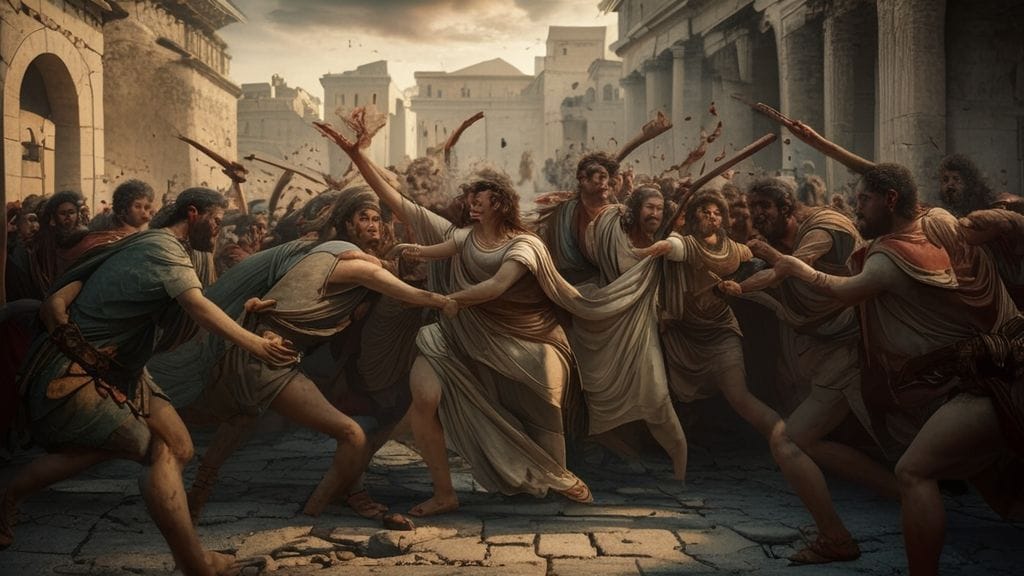
As Hypatia’s carriage approached, the men surged forward. They dragged her from her vehicle into the screaming chaos of the street. Some witnesses may have looked away; others may have cheered; a few may have protested and fled. But the momentum now was with the mob. To them, this was not a kidnapping but a holy cleansing, a seizing of the city’s alleged “sorceress” in God’s name.
They did not kill her on the spot. Instead, they carried her—perhaps half-dragging, half-bearing—through the streets toward a church. The building they chose, the Caesareum, had once been a temple dedicated to the imperial cult, a symbol of Roman power and divine kingship. It had been converted into a Christian church, a striking example of how the city’s religious landscape had been remade. For the men who seized Hypatia, this church would become a theater of both devotion and butchery.
It is here, at this moment of abduction, that one senses the cold machinery of symbolic violence at work. To murder Hypatia in the shadow of the Caesareum—once a shrine of emperors, now a house of Christ—was to stage an execution that said: the old powers are dead, and anyone who clings to them will be dragged to the altar and judged. The trap around Hypatia had closed, not only in physical terms, but in the space of meaning. Her death was designed to send a message that would reverberate far beyond the pain of a single body.
The Day of Blood: Inside the Murder of Hypatia
Ancient accounts of the murder of Hypatia are harrowing. Socrates Scholasticus, a near-contemporary church historian writing in Constantinople, gives the most sober version. He relates that the mob took her into the church, stripped her, and killed her with roofing tiles or oyster shells, tearing her body apart before burning the pieces. John of Nikiu’s later Christian chronicle is more openly hostile, but confirms the essentials: she was dragged, stripped, dismembered, and her remains incinerated outside the city.
Imagine the interior of the Caesareum that day—its stone floor, its vaulted space, its Christian symbols. This was supposed to be a place of prayer, of sacrament, of communion. Instead, it became a slaughterhouse. Hypatia, philosopher and teacher, stood—or perhaps was hurled—before her captors. Stripped of clothes and dignity, she faced the full fury of men who had convinced themselves that her blood would purify their world.
The implements of her murder are chilling in their banality. Roofing tiles or potsherds, some say oyster shells: not imperial swords or ritual daggers, but the broken debris of ordinary construction and everyday life. Her killers did not need special weapons. They used what lay at hand, proof that when hatred ignites, almost anything can become an instrument of atrocity. Piece by piece, they tore at her, transforming a body that had housed so much thought into a torn mass of flesh. The woman who had mapped the heavens was unmade by shards of fired clay.
To modern ears, the setting of her death seems almost impossibly sacrilegious: a murder in a church, by men who believed themselves Christians. Yet this is what gives the murder of Hypatia such tragic power. It exposes how religious spaces and language can be co-opted by fanaticism, how sanctuaries can become stages for collective cruelty when leaders stoke fears and fail to set moral boundaries.
After the killing, the mob carried what remained of her outside the city and burned it. The act was both practical and symbolic: practical, to dispose of the body and erase physical evidence; symbolic, to refuse any possibility of a tomb, of a shrine, of a memorial where future generations might gather to honor her. Fire was supposed to obliterate her, to reduce her to ash carried off by the sea breeze, to make her only a warning, not a memory.
And yet, paradoxically, the opposite happened. Because witnesses survived, because some Christians themselves were appalled, because historians like Socrates Scholasticus recorded the event with dismay, the murder of Hypatia became one of the few vividly preserved episodes of late antique violence against an intellectual. The mob succeeded in killing a woman, but they failed to extinguish her story. They sought to silence a voice and instead amplified it across sixteen centuries.
In the Shadow of the Caesareum: Aftermath in the Streets
The day after such a crime, a city never feels the same. In Alexandria, whispers must have ricocheted through marketplaces and corridors: “They killed the philosopher. They killed Hypatia in the church.” Some rejoiced, no doubt—those who had been primed to see in her death the triumph of the faithful over sorcery. Others were horrified, sensing that something fundamental had been broken.
The immediate political consequences centered on Cyril and Orestes. Socrates Scholasticus lays moral responsibility at Cyril’s door, suggesting that he had “eyes and ears everywhere” and that his supporters, inspired by sermons and rumors, carried out the act. There is no proof that Cyril issued a direct order, but in a world where leaders understood the power of innuendo, such distinctions may offer little comfort. At minimum, his circle had cultivated an atmosphere in which killing Hypatia could be rationalized as a service to God.
Orestes, already locked in conflict with the bishop, now presided over a city where one of his closest advisers had been publicly butchered. His authority, never secure, was dealt a humiliating blow. A mob loosely associated with the church had kidnapped and killed a respected citizen and counselor to the prefect, in a church no less, with no immediate imperial intervention. The message was clear: Orestes commanded laws on paper, but Cyril’s influence commanded men’s fists.
News traveled slowly but surely to Constantinople. At court, where the emperor and his advisers struggled to maintain cohesion in a fraying empire, reports of the murder of Hypatia would have sounded like an ominous warning about Alexandria’s volatility. Some sources hint that an investigation followed and that the parabalani’s power was curbed by imperial decree, reducing Cyril’s ability to deploy them as a private militia. Yet Cyril himself faced no formal condemnation from the emperor. He remained bishop of Alexandria until his death in 444 CE, going on to play a major role in the Christological controversies that shaped Eastern Christianity.
On the human level, Hypatia’s students were left bereft. Those who had gathered around her as the guiding light of their intellectual and spiritual life now confronted a world in which she was suddenly, violently gone. Some, like Synesius, were already dead by then; others had to process their grief in silence or private correspondence. There are no surviving laments from her immediate disciples about the day of her death, but their absence is haunting in itself—a void where we can only imagine the shock and sorrow.
In the streets, the murder left a wound in the city’s self-understanding. Alexandria had prided itself on being the heir of Greek learning, the home of Euclid and Ptolemy, of scholars and scribes. Now, it had also become the place where a philosopher was slain in a church by fanatics. Over time, that reputation would stick, overshadowing many quieter triumphs of learning. The city that once measured the earth now became, for many later writers, the city that murdered one of its own brightest minds.
Voices of the Past: How Ancient Authors Remembered Her Death
Our understanding of the murder of Hypatia comes not from archaeological remains or trial transcripts, but from a handful of texts, each shaped by its own agenda and worldview. To approach the truth, we must listen to these voices, measure their biases, and place them in dialogue.
Foremost among them is Socrates Scholasticus, a Christian church historian writing in Constantinople in the mid-fifth century. In his “Ecclesiastical History,” he recounts Hypatia’s death with unsparing clarity, condemning the actions of those who killed her and linking the crime to Cyril’s supporters. Socrates admired ascetic piety and orthodoxy, yet he believed deeply that Christians must behave with justice and moderation. To him, the murder was a disgrace to the Church, “for nothing can be further from the spirit of Christianity than the allowance of massacres, fights, and transactions of that kind.” His testimony is powerful precisely because it runs against the tendency to shield revered bishops from criticism.
Another important, though more hostile, voice is John of Nikiu, a seventh-century Coptic Christian chronicler. He writes with obvious hatred of Hypatia, describing her as a witch who “beguiled the people of the city” and “devoted herself to magic.” For John, her death is not a crime but a triumph of the Church. His account is valuable not for factual detail—he writes centuries after the event—but as a window into a strand of Christian memory that framed Hypatia as a demonic threat. In this version, the murder of Hypatia becomes almost a hagiographic scene, a purging of evil from the community.
Pagan and philosophically inclined authors also weighed in. Damascius, a sixth-century Neoplatonist, portrays Hypatia as the last great representative of Hellenic philosophy in Alexandria, a tragic figure caught in the crossfire of Christian power politics. His account, preserved in later summaries, emphasizes Cyril’s jealousy and the mob’s brutality. Though colored by nostalgia for the lost pagan past, Damascius’ narrative highlights how deeply the murder of Hypatia had etched itself into the collective memory of the philosophical schools.
Even more than the facts of the murder, it is the moral framing that drew later readers. Was Hypatia a martyr for philosophy? For science? For paganism? Was her death a lamentable excess in an otherwise righteous Christian ascendancy, or a symptom of something fundamentally dangerous in clerical power? Different traditions answered these questions differently. What unites them is a recognition that the event was not trivial. It demanded interpretation.
Modern historians, drawing on these sources, have tried to reconstruct what happened and why. Edward Gibbon, in the eighteenth century, famously cast the murder as emblematic of Christianity’s supposed war against reason, an episode in his sweeping indictment of the “decline and fall” of Rome. More recent scholarship, such as Maria Dzielska’s Hypatia of Alexandria, has sought to strip away romanticized legends and hostile caricatures alike, presenting Hypatia as a complex historical figure caught in specific, local conflicts. As Dzielska and others argue, the murder of Hypatia was less an abstract war of “science vs. religion” and more a deeply personal, politically charged act in a city where religion and politics intertwined fatally.
Philosophy Silenced: The Impact on Learning and Science
Measured against the vast arc of human history, the murder of one philosopher might seem a small event. Yet the murder of Hypatia carried outsized symbolic weight in the history of learning. She was not the last philosopher of Alexandria, but she was among the last to operate with such public prominence and civic influence in that city. Her death signaled a narrowing of the space in which non-Christian intellectuals could work openly in the Eastern Roman Empire.
Alexandria did not suddenly fall silent. Christian scholars continued to study mathematics, astronomy, and philosophy—often integrating them into their theological work. The city remained a center of scriptural exegesis and doctrinal debate. But the public face of learning changed. Philosophers like Hypatia, who embodied continuity with a pagan intellectual lineage stretching back to Plato, found themselves increasingly marginalized or absorbed into Christian frameworks.
On a more subtle level, her murder broadcast a warning: high-profile intellectual independence, especially when combined with political connections and religious nonconformity, could be deadly. In societies where violence lurks close to the surface, one spectacular act of brutality can have a chilling effect far beyond its immediate circle of victims and perpetrators. How many potential Hypatias—men or women, pagan or Christian—chose subsequent caution over public engagement, calculating that it was safer to avoid controversy than to risk becoming a symbol?
In the longer history of science, Hypatia’s name became shorthand for the idea that knowledge is vulnerable, that libraries can burn and thinkers can be stoned or cut down. Enlightenment scholars, looking back across the centuries, saw in her death the silhouette of their own struggles against censorship and dogma. Though historians now caution against equating her murder with some imagined “end” of ancient science—it did not, by itself, extinguish scientific inquiry—it nonetheless marks one of those darkly luminous points where the story of ideas intersects with the story of human cruelty.
Preserved fragments of her work suggest she contributed to commentaries on Diophantus, Apollonius, and Ptolemy. These were not minor tasks; commentaries were the main vehicle by which complex texts were transmitted, corrected, and taught. As a teacher, she multiplied her influence through students who carried her methods and interpretations into other cities and fields. When the mob silenced her, they did not only end a life; they cut short a network of future commentary, correspondence, and collaboration that we can only dimly imagine.
Yet behind the celebrations of some fanatics, there lay an irony: the Church that harbored her killers would, in centuries to come, also become the custodian of much of the classical knowledge she cherished, copying manuscripts and preserving texts in monasteries. History rarely divides cleanly into villains and saviors of learning. The tragedy of Hypatia resides not in a simple narrative of “light vs. darkness,” but in the reminder that any tradition—religious, secular, or otherwise—can be twisted into an instrument of suppression if fear and power are allowed to dominate conscience.
Power, Gender, and Fear: Why Hypatia Was Targeted
To understand why the murder of Hypatia happened, one must look beyond the raw facts and into the deep structures of fear and power at work in Alexandria. Politics, religion, and gender combined to mark her as a uniquely threatening figure to some men in authority.
First, her proximity to the prefect Orestes made her a political lightning rod. In a feud between bishop and governor, any advisor perceived as influencing the secular side could be cast as an enemy of the Church. Rumors that she “bewitched” Orestes or blocked reconciliation gave Cyril’s partisans a simple story: eliminate the advisor, resolve the standoff. In reality, the conflict was far more complex, rooted in jurisdictional rivalries and communal tensions. But mobs prefer faces to structures, and Hypatia’s became the face.
Second, her religious identity as a pagan philosopher mattered. In an age when imperial law increasingly condemned pagan practices, leaders like Cyril saw themselves as champions of a new sacred order. To some, Hypatia embodied the old Hellenic culture that refused to die. She taught Neoplatonism, engaged with astronomy, and represented a continuity with gods and rituals that Christian zealots wanted to eradicate. Killing her in a church inverted and dramatized the conflict: the shrine of the new faith became the site where the “old wisdom” was ritually destroyed.
Third—and crucially—her gender and public authority challenged deeply entrenched expectations. A woman lecturing to men, advising officials, and walking unveiled in philosopher’s garb was always going to stir unease in a patriarchal society. Even sympathetic sources stress her chastity, her modesty, as if to reassure male readers that she did not wield sexual power. Her enemies, however, had no such scruples: they framed her influence as a perverse, unnatural dominance of a woman over a male ruler. To kill her was, in their logic, to reestablish “proper order.”
This intersection of fears—about women, about pagans, about intellectuals—created a lethal alchemy. Had Hypatia been a man, still pagan but less symbolically transgressive in gender terms, would the mob have dared to drag him naked into a church and carve him apart? Perhaps; late antiquity is full of brutalities against male scholars and officials. But the detail of her nudity, the savagery of dismemberment, and the focus on her alleged “sorcery” all point to a gendered dehumanization. She was not simply an opponent; she was a witch, a corrupter, a body that had to be unmade.
In this sense, the murder of Hypatia illuminates a pattern recognizable across epochs: when societies are anxious and leaders seek scapegoats, those who sit at the intersection of multiple fault lines—religious, political, and gendered—are often the first to be sacrificed. Her death warns us how quickly admiration can turn to hatred when circumstances shift and demagogues discover that fear of the “other” is an effective means to consolidate power.
From Forgotten Crime to Enlightenment Icon
For centuries after the fall of the Western Roman Empire, the story of Hypatia circulated in limited circles—among church historians, philosophers, and chroniclers. She was remembered as a talented pagan teacher, a victim of fanatical Christians, a cautionary example. But it was not until the early modern period that the murder of Hypatia began to acquire the status of a symbol in larger cultural battles.
Renaissance humanists, rediscovering classical texts and celebrating Greek and Roman learning, stumbled across her story with a mix of fascination and horror. Here was a woman philosopher, rare enough in ancient records, destroyed by men claiming the mantle of Christ. In an age when scholars were themselves fighting for intellectual freedom against various forms of religious and political censorship, Hypatia’s fate resonated as a bleak precedent.
In the eighteenth century, the Enlightenment’s leading critic of ecclesiastical power, Edward Gibbon, famously drew on her story in “The History of the Decline and Fall of the Roman Empire.” To Gibbon, Hypatia was “a woman of beauty and learning” whose death epitomized what he saw as the intolerance and superstition of the Christian Church at its worst. He linked her murder directly to Bishop Cyril, later canonized as a saint, drawing a searing contrast between Christian ideals and clerical realities. In Gibbon’s narrative, the murder of Hypatia was not a local tragedy, but an emblematic episode in the broader “triumph of barbarism and religion.”
This framing, though rhetorically powerful, simplified the complexities of late antique Christianity and paganism. Yet it proved extraordinarily influential. Hypatia became, in the Enlightenment imagination, a martyr for reason, a symbol of philosophy crushed by fanaticism. Voltaire and other critics of the Church invoked her name. Plays, essays, and poems cast her as a noble victim surrounded by brutal monks and scheming bishops.
In the nineteenth century, Charles Kingsley’s novel “Hypatia” further cemented her romantic image. Kingsley presented her as a brilliant, beautiful, virtuous woman caught between the declining pagan aristocracy and an often crude, triumphalist Christianity. Though steeped in Victorian prejudices, the novel popularized her story among English-speaking audiences and inspired a new wave of artwork and discussion. The real Hypatia—mathematician, commentator, pragmatic advisor—became increasingly overlain with mythic qualities.
By the time the modern age dawned, Hypatia stood as an icon in several overlapping narratives: the struggle of science against dogma, the persecution of religious minorities, the oppression of women, and the tragedy of cultural transition. Her historical specificity—the precise politics of Alexandria, the particular personalities of Cyril and Orestes—often faded behind these larger, sometimes anachronistic themes. Yet the persistence of her story across so many centuries underlines how deeply the murder of Hypatia taps into human anxieties about knowledge, power, and the costs of intolerance.
The Murder of Hypatia in Modern Imagination and Debate
In the twentieth and twenty-first centuries, Hypatia’s story has continued to evolve, reflecting new intellectual and cultural concerns. Feminist historians and writers have reclaimed her as a pioneering woman in mathematics and philosophy, a rare case where ancient records allow us to see a woman at the center of public intellectual life. Her murder becomes, in this reading, part of a long history of violence against women who step beyond prescribed roles.
Secularists and advocates of scientific rationalism often invoke the murder of Hypatia as a cautionary tale about religious extremism. In public debates, her name surfaces alongside Galileo and Giordano Bruno as an example of how authorities claiming divine sanction have sometimes tried to silence inconvenient voices. At times, this framing oversimplifies the rich interplay between religion and science in late antiquity, but it also captures a genuine continuity: the danger that emerges when any belief system, religious or otherwise, is tied to unchecked power.
Popular media have brought Hypatia to new audiences. The 2009 film “Agora,” directed by Alejandro Amenábar and starring Rachel Weisz, dramatizes her life and death, emphasizing her astronomical studies and positioning her as a proto-scientist torn between philosophical curiosity and a rising tide of violence. The film takes liberties with chronology and character, but it visually imprints the murder of Hypatia on millions of viewers, reinforcing her image as an emblem of reason destroyed by fanaticism.
Within Christian circles, her story has prompted introspection and, at times, defensiveness. Some apologists downplay the Church’s responsibility for her murder or argue that it should not be seen as representative of Christian teaching. Others, more candidly, acknowledge the episode as a grievous sin of the Christian community, a failure to live up to its own ideals of compassion, justice, and respect for the image of God in every person. In this sense, Hypatia’s death serves as a mirror in which believers confront the darkest possibilities of religious zeal.
Historiographically, scholars now situate the murder of Hypatia within late antique urban politics, emphasizing the fluid and overlapping identities of Christians and pagans, the role of imperial law, and the dynamics of street violence. They warn against reading the event as a simple “war of science and religion.” Hypatia herself was a deeply spiritual figure; many of her Christian contemporaries were, in their own way, intellectuals. The tragedy lies not in an inherent incompatibility of faith and reason, but in the corrosion of both when deployed as tools of factional power.
This modern plurality of interpretations does not dilute the horror of what happened in 415. If anything, it deepens our appreciation of how one woman’s violent death can echo across fields and centuries, continuing to provoke questions that remain urgently relevant: How do we protect intellectual and spiritual freedom in times of social upheaval? How do we prevent belief, whether secular or sacred, from sliding into fanaticism? And what responsibilities do leaders bear for the actions of those who claim to act in their name?
Myths, Misreadings, and the Difficult Truth
Stories as potent as that of Hypatia rarely escape myth-making. Over time, layers of interpretation, exaggeration, and projection accumulate, sometimes obscuring the underlying reality. To honor her memory truthfully, it is important to peel back some of these layers.
One common myth is that Hypatia was the last librarian of the Great Library of Alexandria, murdered at the moment that library was destroyed by Christian mobs. This image, seductive in its symbolism, has no basis in our sources. The Great Library had suffered multiple earlier catastrophes; by Hypatia’s day, whatever remained of its collections had been dispersed or integrated into other institutions. She taught in a city still rich with books and scholars, but she did not preside over the legendary library in the form imagined in modern fiction.
Another distortion is the notion that her death marked the immediate and absolute end of ancient science and philosophy. While the murder of Hypatia was a devastating blow and an ominous sign, intellectual life continued in the Byzantine Empire, in the Islamic world, and in various Christian and pagan circles. Mathematics, astronomy, and philosophical debate did not vanish overnight. What her death does represent is a conspicuous moment when public, pagan-aligned intellectual authority was violently suppressed in a major city—and a symbol of how fragile such authority can be when entangled with emerging religious hegemonies.
Some modern readings also oversexualize Hypatia, focusing obsessively on her supposed beauty or imagined romances. This tendency, present even in some Enlightenment and Victorian portrayals, says more about later fantasies than about her life. Our sources emphasize her chastity and philosophical seriousness; the lurid details belong mostly to later fiction. Reducing her to an object of erotic fascination risks repeating, in another guise, the same dehumanization that made it easier for a fifth-century mob to strip and kill her.
Finally, there is the temptation to cast her murder solely as a crime of “Christianity” in the abstract, flattening the complex religious landscape of late antiquity into a simple villain. While the killers were Christians and acted in a context shaped by Christian ascendency, many other Christians—Socrates Scholasticus among them—were appalled and condemned the act. The same tradition that harbored fanatics also produced voices of conscience who saw in the murder of Hypatia a betrayal of their own faith. To acknowledge this is not to excuse the crime, but to recognize that human cruelty can infect any community, and that resistance to cruelty can arise from within those communities as well.
Holding on to the difficult truth means accepting both the specificity and the universality of Hypatia’s fate. She was a pagan, a woman, a philosopher, and an Alexandrian; those identities shaped her story in precise ways. But her murder also speaks to broader patterns: the scapegoating of intellectuals, the weaponization of rumor, the vulnerability of women in public life, and the ways in which fear can be dressed up as piety or patriotism. The truth is neither neat nor comforting—but it is, for that very reason, all the more necessary to face.
Lessons from a Broken City: Tolerance, Fanaticism, and Memory
Standing back from the narrow streets of fifth-century Alexandria, one can see the murder of Hypatia as a crossroads—a point where a city’s unresolved tensions exploded in a single, unforgettable act. The lessons it offers are not confined to its time. They speak into any age in which societies grapple with diversity, rapid change, and competing claims to ultimate truth.
First, the story underscores how dangerous it is when civic and religious authorities become locked in a struggle for supremacy with no shared commitment to the rule of law. Orestes and Cyril might have been able to manage their differences had there been strong institutions to mediate between them. Instead, each cultivated his own base of support—Orestes through the machinery of empire, Cyril through fervent believers and quasi-militant followers. In that vacuum, the murder of Hypatia was not a random crime, but an almost predictable eruption.
Second, the narrative highlights the corrosive power of dehumanizing rhetoric. Hypatia was not killed because her geometry was wrong; she was killed because she was painted as a witch, a corrupter, a barrier to divine will. Once such labels stick, ordinary moral inhibitions loosen. The progression from “philosopher” to “sorceress” to “enemy of God” makes the unthinkable suddenly appear necessary. This dynamic is not unique to any one religion or ideology. It is a recurring pattern whenever groups seek purity by excising those cast as “unclean.”
Third, the violence inflicted on her body speaks volumes about gendered hatred. Public stripping, dismemberment, and burning are not just methods of killing; they are acts of symbolic domination. They declare: this body, which dared to move and speak and think freely, now lies utterly at our mercy. In that sense, the murder of Hypatia resonates with countless other acts of gendered violence, past and present, in which the desire to silence women is expressed through the destruction of their bodies.
Yet there is another side to the story: memory. Those who tore Hypatia apart sought to erase her. They denied her a grave, tried to ensure that no place could become a site of pilgrimage or homage. That strategy failed. Writers like Socrates preserved her story. Later thinkers reclaimed it. Today, her name is invoked in classrooms, articles, novels, and films around the world. The very attempt to annihilate her gave her a kind of immortality that no ordinary life, however distinguished, could have guaranteed.
One modern historian has noted, in a quietly powerful line, that “the true victory over fanaticism is not vengeance, but remembrance.” By remembering Hypatia—not as a flawless saint or a convenient symbol, but as a real, complex person—we resist the erasures that fanatics always seek. We acknowledge that cities can break, that communities can turn on their brightest members, and that no tradition is immune from corruption. But we also affirm that such crimes do not have the last word. The murder of Hypatia, meant to silence, continues to speak.
Conclusion
From the quays and alleys of early fifth-century Alexandria to the pages of modern histories and the screens of contemporary cinemas, the story of Hypatia has traveled far. What began as a local act of political and religious violence—the brutal murder of a philosopher in a church—has become a touchstone in debates about knowledge, faith, gender, and power. The murder of Hypatia is not just a dark anecdote in the chronicles of late antiquity; it is a prism through which the tensions of an entire era come into view.
We have followed her from the house of Theon, where she learned to read the stars, to the lecture halls where she guided students in Neoplatonic inquiry, to the fraught corridors of power where she advised the prefect Orestes. We have watched Alexandria’s religious and political conflicts intensify, heard the rumors that painted her as a sorceress, and witnessed, through the testimony of ancient writers, the fury of the mob that dragged her into the Caesareum. In that church, shards of clay and stone became tools of terror, and a city famous for its intellectual heritage betrayed one of its finest minds.
Yet if her death reveals the depths of human cruelty, her long afterlife in memory reveals something else: the stubborn persistence of admiration, empathy, and moral reflection. Christians like Socrates condemned the killing as unchristian; philosophers like Damascius mourned her as the last shining light of a fading world; Enlightenment writers enshrined her as a martyr for reason; modern scholars work carefully to recover her as a real, historical woman. Across these varied responses, a common instinct emerges: to insist that what happened to her was wrong, and that such wrongs matter.
Today, we live again in a world of sharp ideological divisions, instant rumor, and the temptation to demonize those who think differently. The details of Hypatia’s life belong to a distant time, but the mechanisms of hatred that destroyed her are distressingly familiar. Remembering her is not about freezing her into a simple icon of “reason vs. religion,” but about recognizing how fragile intellectual and personal freedom can be when fear and ambition override conscience.
In the end, Hypatia’s legacy lies not only in the mathematical commentaries and philosophical teachings that can be faintly traced through her students, but in the question her death forces us to ask: what kind of city, what kind of community, do we want to be? One that drags its thinkers into the streets and tears them apart, or one that allows space for difference, inquiry, and dissent? The murder of Hypatia shows us the cost of choosing the former. Our responsibility, centuries later, is to choose otherwise—and to remember.
FAQs
- Who was Hypatia of Alexandria?
Hypatia of Alexandria was a late fourth- and early fifth-century philosopher, mathematician, and astronomer who led a Neoplatonic school in Alexandria, Egypt. She was renowned across the Eastern Roman Empire for her teaching, her technical expertise in mathematics and astronomy, and her role as a public intellectual and advisor to political figures such as the prefect Orestes. - What led to the murder of Hypatia?
The murder of Hypatia arose from a volatile mix of religious tension, political rivalry, and gendered prejudice in Alexandria. As a prominent pagan philosopher closely associated with the imperial prefect Orestes, she was accused by some Christians of obstructing reconciliation between Orestes and Bishop Cyril. Rumors that she practiced sorcery and “bewitched” the prefect helped justify, in the eyes of fanatics, the decision to drag her into a church and kill her. - How exactly was Hypatia killed?
According to the church historian Socrates Scholasticus, Hypatia was seized in the street by a Christian mob led by a lector named Peter, taken into the Caesareum church, stripped naked, and killed with roofing tiles or similar sharp fragments. Her body was then dismembered, and the remains were burned outside the city. These details, corroborated in variant form by later sources, underline the public and symbolic nature of the violence. - Was Bishop Cyril directly responsible for her death?
No surviving document proves that Cyril personally ordered Hypatia’s murder, and historians generally avoid definitive claims on this point. However, the killers were part of the broader circle of militant Christians associated with his episcopate, and Socrates Scholasticus explicitly links the crime to Cyril’s supporters, criticizing the bishop for the atmosphere that made such an act possible. Modern scholars tend to see Cyril as politically responsible, even if the murder was carried out without a written command. - Did the murder of Hypatia end the Great Library of Alexandria or ancient science?
No. The Great Library had already suffered major losses long before Hypatia’s time, and there is no evidence she served as its “last librarian,” a popular but fictional image. Intellectual activity in mathematics, astronomy, and philosophy continued after her death in both Christian and non-Christian contexts. Her murder was, however, a significant and symbolic blow to the public prestige and safety of pagan-aligned philosophy in Alexandria. - Why is the murder of Hypatia important today?
The murder of Hypatia is important because it highlights the dangers of fanaticism, the weaponization of rumor, and the vulnerability of intellectuals—especially women—who challenge entrenched power structures. Her story resonates in modern debates about the relationship between science and religion, the treatment of minorities, and the need to protect freedom of thought and expression in politically and religiously charged environments. - How reliable are our sources for Hypatia’s life and death?
Our sources are limited but significant. The most important are Socrates Scholasticus, a near-contemporary Christian historian who condemns the murder; Damascius, a later Neoplatonist who offers a pagan philosophical perspective; and John of Nikiu, a much later Coptic Christian chronicler who vilifies Hypatia. Each has biases—religious, philosophical, chronological—so historians cross-check their accounts and contextualize them to reconstruct the most plausible narrative. - Was Hypatia a martyr for science against religion?
Hypatia was indeed a scientist and philosopher killed by religious zealots, but the historical situation is more complex than a simple “science versus religion” story. Many Christians in her time valued learning, and some of her own students were Christians. Her death resulted from a specific entanglement of local politics, religious rivalry, and misogyny. While she can be seen as a symbol of the vulnerability of knowledge to fanaticism, it is important to recognize the nuanced reality of late antique intellectual and religious life. - Did Hypatia leave behind any writings?
Hypatia is believed to have written or co-written commentaries on mathematical and astronomical works by authors such as Diophantus, Apollonius, and Ptolemy, and she may have contributed to the editing of her father Theon’s texts. None of these works survive under her name alone, and much of what we infer about them comes from later references and the surviving writings of her students, particularly Synesius of Cyrene. - How do modern historians view Bishop Cyril in relation to Hypatia’s death?
Modern historians generally acknowledge Cyril as a major theological figure and influential bishop while also recognizing that Hypatia’s murder casts a long shadow over his legacy. Many see him as politically implicated—his rivalry with Orestes, his use of militant followers, and the rhetoric circulating in his circle helped create conditions for the crime—even if direct authorship of the murder cannot be proven. This duality illustrates how historical figures can be both doctrinal heroes and participants in deeply troubling events.
External Resource
Internal Link
Other Resources
- Encyclopaedia Britannica – general search for the exact subject
- Google Scholar – academic search for the exact subject
- Internet Archive – digital library search for the exact subject