Table of Contents
- Introduction
- What Was NAFTA?
- The Road to the Agreement
- Key Goals and Provisions
- Impact on the United States
- Impact on Canada
- Impact on Mexico
- Economic Growth and Trade Volumes
- Controversies and Criticisms
- Labor and Environmental Concerns
- Legacy and the USMCA
- Conclusion
- External Resource
- Internal Link
1. Introduction
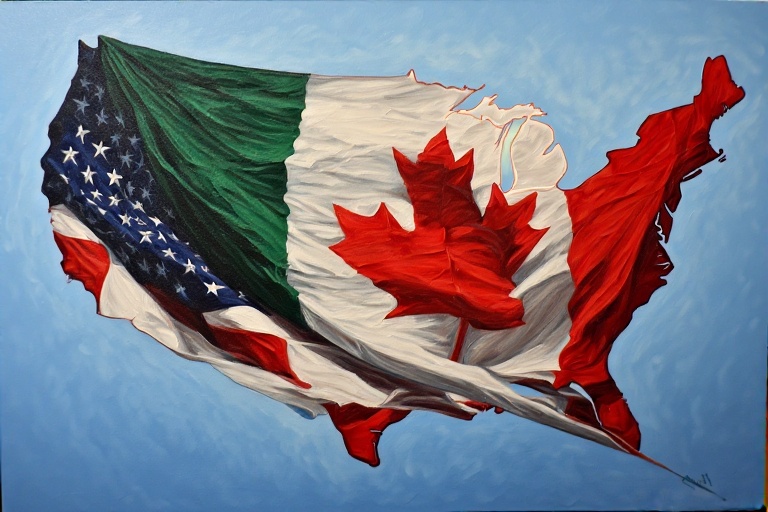
When the North American Free Trade Agreement (NAFTA) officially took effect on January 1, 1994, it wasn’t just a new economic policy—it was a bold reshaping of how Canada, the United States, and Mexico would conduct business. NAFTA became one of the world’s largest free trade zones and a powerful symbol of globalization.
2. What Was NAFTA?
✔️ A trilateral trade agreement between the U.S., Canada, and Mexico
✔️ Aimed to eliminate tariffs and reduce trade barriers
✔️ Covered goods, services, investment, and intellectual property
It fundamentally changed how goods and capital flowed across North America.
3. The Road to the Agreement
✔️ U.S. and Canada had already signed a free trade pact in 1989
✔️ Mexico sought broader access to U.S. and Canadian markets
✔️ Talks began in 1991 and concluded in 1992 under U.S. President George H. W. Bush
It was ratified in 1993 and went into effect the following year under President Bill Clinton.
4. Key Goals and Provisions
✔️ Elimination of tariffs on most goods traded among the three nations
✔️ Protection of intellectual property
✔️ Establishment of dispute resolution mechanisms
✔️ Promotion of fair competition
The agreement was designed to promote growth and reduce trade friction.
5. Impact on the United States
✔️ Boosted exports to Mexico and Canada
✔️ Supported growth in manufacturing, especially automotive
✔️ Critics argued it led to job losses in some sectors due to offshoring
NAFTA became a flashpoint in American political debates.
6. Impact on Canada
✔️ Strengthened Canadian exports, especially energy and agriculture
✔️ Helped solidify trade relationships with the U.S.
✔️ Concerns about loss of sovereignty in environmental and labor standards
Canada saw NAFTA as a mixed but largely positive economic evolution.
7. Impact on Mexico
✔️ Encouraged foreign investment and export manufacturing
✔️ Rapid growth in maquiladora (assembly plants) along the border
✔️ Critics said it worsened rural poverty and dependence on U.S. imports
NAFTA reshaped Mexico’s economy but also deepened inequality.
8. Economic Growth and Trade Volumes
✔️ Trade between the three nations more than tripled by 2016
✔️ $1.2 trillion in annual trade by the late 2010s
✔️ Growth in cross-border supply chains and integrated industries
North America became more economically interconnected than ever.
9. Controversies and Criticisms
✔️ Labor unions in the U.S. blamed NAFTA for manufacturing job losses
✔️ Environmentalists criticized regulatory standards
✔️ Populist politicians used NAFTA as a symbol of flawed globalization
Despite its economic success, NAFTA became politically divisive.
10. Labor and Environmental Concerns
✔️ Side agreements on labor and environment were added but criticized as weak
✔️ Issues like wage disparity, pollution, and safety standards emerged
✔️ Critics demanded stronger, enforceable protections
The agreement highlighted the gap between free trade and fair trade.
11. Legacy and the USMCA
✔️ In 2020, NAFTA was replaced by the United States–Mexico–Canada Agreement (USMCA)
✔️ New rules on digital trade, labor, and auto production
✔️ Reflected growing skepticism of globalization’s promises
Still, NAFTA’s legacy as a pioneering trade framework remains undeniable.
12. Conclusion
The signing of NAFTA in 1994 marked a turning point for North America. Though controversial, it catalyzed an era of economic integration, growth, and redefinition of cross-border relations. While far from perfect, it remains one of the most impactful trade agreements in modern history.