Table of Contents
- The Dawn of a New Era: Namibia on the Brink of Independence
- The Historical Weight of Colonization: From German Rule to South African Mandate
- The Tumultuous Road to Self-Governance: Key Players and Ideological Battles
- International Pressures and Global Context: The Cold War and Apartheid South Africa
- The Role of SWAPO: The Voice and Force of Namibian Liberation
- The Transition Decade: From Guerrilla Warfare to Political Negotiations
- UN Involvement and the Birth of UNTAG: A Unique Peacekeeping Mission
- March 21, 1990: The Day Namibia Woke Up Free
- Sam Nujoma’s Inauguration: A Symbol of Hope and Unity
- The Challenges of Nation-Building: Reconstruction and Reconciliation
- Economic Hurdles and the Legacy of Inequality
- The Social Fabric of a New Namibia: Education, Culture, and Identity
- Namibia on the World Stage: Diplomatic Relations and Membership in the UN
- Reflections on the Role of External Powers: Controversies and Support
- The Memory and Legacy of Struggle: How Namibian Independence is Remembered Today
- Namibia’s Path Forward: Democracy, Development, and Regional Influence
- Conclusion: An Inspiring Triumph Amidst Adversity
- FAQs: Understanding Namibia’s Journey to Independence
- External Resources: Further Reading
- Internal Link: Discover More on History Sphere
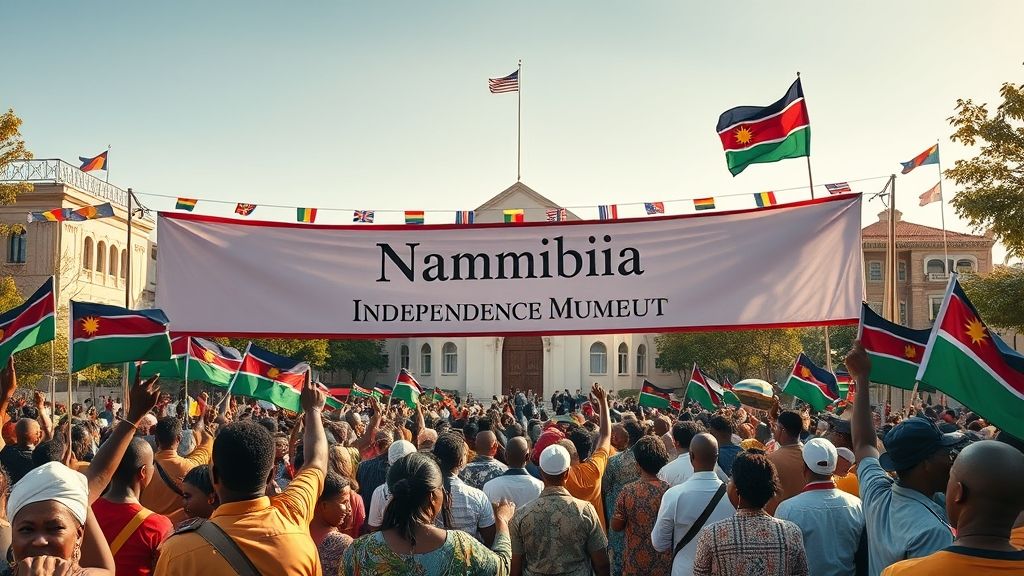
From the crisp morning air of Windhoek, March 21, 1990, carries an atmosphere electric with anticipation. The dusty streets once marred by the boots of colonial soldiers now shimmer under the dawn light as thousands gather in jubilant anticipation. Flags ripple in the wind, faces beam with tears of joy and exhaustion, and the air vibrates with the rhythms of liberation songs. Today is no ordinary day—it is the birth of an independent Namibia, a nation emerging from the shadows of decades-long oppression and armed struggle. The first waves of freedom had begun earlier, but on this very day, Namibia steps boldly onto the stage of sovereign nations, her people finally clutching the reins of their destiny.
The Dawn of a New Era: Namibia on the Brink of Independence
Namibia’s independence story is a tapestry woven from threads of resilience, sacrifice, and unyielding hope. The liberation was not a sudden gift but the climax of decades of struggle against colonizers and apartheid enforcers. To comprehend the magnitude of this victory, one must trace back the long and arduous history that led the Namibian people to this historic threshold in 1990. Behind the joyous crowds and pomp lay wounds healed slowly, scars of conflict, and the persistent dream of freedom.
The Historical Weight of Colonization: From German Rule to South African Mandate
Namibia’s colonization stands apart for its brutality and longevity. Originally known as South West Africa, the territory was colonized by Germany in the late 19th century during the fervent "Scramble for Africa." German control, established firmly by 1884, brought exploitative policies and ruthless suppression of local communities.
One of the darkest chapters is the Herero and Nama genocide between 1904 and 1908. German forces, confronted by uprisings, responded with disproportionate cruelty, resulting in the deaths of tens of thousands—decimating entire ethnic groups. The scars of these massacres linger in Namibian collective memory.
After World War I, Germany lost its African colonies. South West Africa was mandated to South Africa by the League of Nations, setting the stage for a new phase of oppression. South Africa imposed its apartheid system, firmly embedding racial segregation and denying political rights to the majority black population.
The Tumultuous Road to Self-Governance: Key Players and Ideological Battles
Throughout the 20th century, several organizations sprang up demanding justice and self-rule. Among all, the South West Africa People’s Organization (SWAPO) emerged as the leading nationalist movement. Founded in 1960 under Sam Nujoma's charismatic leadership, SWAPO combined political activism and armed resistance, gaining support within Namibia and abroad.
Meanwhile, South Africa’s regime maintained a firm grip over the territory, entrenching apartheid laws, and fiercely suppressing dissent. The ideological clash between apartheid enforcement and liberation movements was stark, with SWAPO embodying both a struggle for political power and a vision for social justice.
International Pressures and Global Context: The Cold War and Apartheid South Africa
Namibia’s fight for independence unfolded against the backdrop of a divided world. The global Cold War rivalry complicated negotiations: Western nations worried about the spread of communism if liberation movements like SWAPO aligned with the Soviet bloc, while the USSR and Cuba supported SWAPO and their allies.
Simultaneously, apartheid South Africa found itself increasingly isolated but remained determined to retain control over South West Africa. The United Nations and the international community incrementally pressured South Africa to relinquish its mandate. The issue became a litmus test for debates on decolonization and human rights worldwide.
The Role of SWAPO: The Voice and Force of Namibian Liberation
SWAPO was much more than a political party: it was a crucible for the liberation narrative and the vessel through which many Namibians channeled their hopes. The movement’s military wing, the People’s Liberation Army of Namibia (PLAN), waged guerilla warfare from neighboring Angola and Zambia. The struggle was brutal, marked by raids, ambushes, and heavy South African retaliation including cross-border attacks.
Yet SWAPO also excelled diplomatically, lobbying the United Nations where in 1973 it was officially recognized as the sole legitimate representative of the Namibian people. This recognition was a watershed moment reinforcing Namibian claims to self-determination.
The Transition Decade: From Guerrilla Warfare to Political Negotiations
The 1980s saw increasing exhaustion from prolonged conflict. The entry into negotiations was catalyzed by several events: the decline of apartheid South Africa’s regional dominance, international sanctions, and the transformative shifts at the end of the Cold War.
The pivotal breakthrough came with the 1988 Tripartite Accord involving South Africa, Angola, Cuba, and facilitated by the UN, which called for the withdrawal of foreign troops, cessation of hostilities, and preparation for free elections under UN supervision.
UN Involvement and the Birth of UNTAG: A Unique Peacekeeping Mission
In a remarkable act of mediation and international compensation, the United Nations established the United Nations Transition Assistance Group (UNTAG) to supervise the ceasefire and organize elections. This was one of the largest and most complex peacekeeping operations ever deployed, involving thousands of personnel tasked with ensuring a fair and transparent transition.
UNTAG’s presence was essential not only to keep peace but also to instill confidence among all factions, demonstrating the principle of impartiality and the legitimacy of the democratic process.
March 21, 1990: The Day Namibia Woke Up Free
The early hours of this day were enveloped in a solemn, almost sacred calm. As the sun rose over Windhoek’s skyline, the Union Jack and South African flags were lowered forever. In their place rose Namibia’s own flag—stripes of blue, red, green, white, gold, and black, each color steeped in symbolism.
At the Independence Ceremony, Sam Nujoma took the oath as Namibia’s first President. His speech—resonant, hopeful, and unifying—called for reconciliation and nation-building. “The shackles of colonialism and apartheid have finally fallen,” he declared, “Today we are truly free.”
Sam Nujoma’s Inauguration: A Symbol of Hope and Unity
Nujoma’s rise from exile to President was emblematic of Namibia’s transformation. He had spent decades as a guerrilla leader and diplomat, embodying the struggle and aspirations of his people. His investment in healing divisions and fostering inclusive governance was critical during this fragile phase.
His inauguration was attended by numerous global dignitaries, signaling international recognition and the beginning of Namibia’s reentry into global society as an equal actor.
The Challenges of Nation-Building: Reconstruction and Reconciliation
Despite jubilant independence celebrations, the new nation faced daunting challenges. Decades of unequal development, economic disparity, and social fragmentation required urgent attention.
The government embarked on programs to promote national unity, including the integration of former combatants into a single national military, the rebuilding of infrastructure, and establishing institutions that respected human rights.
Economic Hurdles and the Legacy of Inequality
South Africa’s apartheid policies had entrenched deep economic disparities: vast land ownership by a minority, limited access to education, and underdevelopment of rural areas.
Namibia inherited an economy heavily dependent on mining—particularly diamonds and uranium—and agriculture, but with high unemployment and poverty rates menacing stability. Structural reforms and foreign investment were sought to stimulate growth, but progress was gradual.
The Social Fabric of a New Namibia: Education, Culture, and Identity
Building a coherent national identity for a country of diverse ethnic groups was a central goal. Efforts were made to recognize indigenous languages, celebrate cultural heritage, and promote education.
The younger generation, born into an independent Namibia, came to be known as “the children of freedom,” embodying potential and hope in stark contrast to their parents' experience.
Namibia on the World Stage: Diplomatic Relations and Membership in the UN
Namibia wasted no time in asserting its presence globally. It became the 160th member of the United Nations just days after its independence and joined the Commonwealth, African Union, and Southern African Development Community—all platforms for forging diplomatic alliances and promoting regional integration.
Its independence inspired other liberation movements and strengthened the continent’s decolonization narrative.
Reflections on the Role of External Powers: Controversies and Support
Namibia’s road to independence was heavily influenced by international actors—some helpful, others obstructive. The Cold War rivalry meant that liberation movements were sometimes viewed through ideological lenses more than human ones.
Countries like Cuba and the Soviet Union provided military aid to SWAPO, while Western powers, wary of communism, were ambivalent or supportive of South Africa’s position for years. Yet growing global anti-apartheid sentiment ultimately tipped the scales.
The Memory and Legacy of Struggle: How Namibian Independence is Remembered Today
Every year March 21 is a public holiday—Human Rights Day—commemorating the long fight for freedom. Museums, monuments, and oral histories ensure that the sacrifices and stories of resistance remain alive.
This memory continues to inspire ongoing efforts toward justice, equality, and sustainable development within Namibia.
Namibia’s Path Forward: Democracy, Development, and Regional Influence
Namibia remains a stable democracy in a sometimes turbulent region. Democratic elections have continued, and peaceful transfers of power have strengthened political institutions.
Development challenges linger, but Namibia’s commitment to environmental protection, particularly of its unique desert ecosystem, has gained global commendation. Its role in regional peace processes remains notable.
Conclusion: An Inspiring Triumph Amidst Adversity
Namibia’s independence is a testament to the power of resilience, unity, and global solidarity. It stands as a beacon for all peoples yearning for freedom from oppression. The triumph of March 21, 1990, was not just a political event but the renewal of human dignity and the realization of dreams deferred for generations.
As Sam Nujoma’s inaugural words echo still, Namibia’s journey reminds us that the pursuit of justice is long and arduous, but victory is possible when courage meets determination.
FAQs
1. What were the main causes leading to Namibia's independence in 1990?
Namibia’s independence stemmed from prolonged colonial oppression under Germany and South Africa, systemic racial discrimination imposed by apartheid, and decades of armed struggle led chiefly by SWAPO. International pressure and shifts in global politics also played key roles.
2. Who was Sam Nujoma, and why was he important?
Sam Nujoma was the founding president of SWAPO and became Namibia’s first President. His leadership, both as a guerrilla commander and diplomat, was pivotal in uniting the liberation movement and steering Namibia towards independence.
3. What role did the United Nations play in Namibia’s independence?
The UN recognized SWAPO as the legitimate representative of the Namibian people, imposed sanctions on South Africa, and arranged for and supervised Namibia’s transition through UNTAG, ensuring peaceful elections and troop withdrawals.
4. How did the Cold War impact Namibia’s liberation movement?
Cold War geopolitics complicated Namibia’s independence. SWAPO received support from the communist bloc, particularly Cuba and the USSR, while Western countries were cautious or supportive of apartheid South Africa. Ultimately, changing global attitudes helped end the conflict.
5. What were the major challenges Namibia faced after independence?
Post-independence challenges included overcoming economic inequalities, nation-building among diverse ethnicities, creating democratic institutions, and addressing infrastructure development and social services.
6. How is Namibia’s independence commemorated today?
Namibia celebrates Human Rights Day every March 21, marking independence. The day honors the struggle for freedom, featuring cultural events, speeches, and reflection on the country’s ongoing journey.
7. What was unique about Namibia’s transition compared to other African nations?
Namibia’s transition was unique for its extensive UN peacekeeping operation (UNTAG), the international consensus around its independence, and the relatively peaceful nature of its electoral process, following a protracted armed struggle and diplomacy.
8. How has Namibia’s independence influenced the Southern African region?
Namibia’s successful liberation contributed to regional stability, inspired other independence movements, and reshaped geopolitical dynamics, particularly contributing to the eventual dismantling of apartheid in South Africa.