Table of Contents
- The Dawn of a New Era: April 18, 1927
- China on the Brink: Fragmentation and Turmoil
- The Northern Expedition’s Final March
- The Kuomintang’s Ascendancy
- The Fall of Wuhan and the Shift of Power
- Nanjing Selected: Geography, History, and Symbolism
- Sun Yat-sen’s Legacy and the Power Vacuum
- Chiang Kai-shek: The Man of Nanjing
- The Ceremony of Establishment: April 18, 1927
- Ideological Battles Within the Kuomintang
- The Leftists and the CCP: Tensions Rising
- Consolidating Authority: Military and Civil Administration
- International Reactions and Diplomatic Challenges
- The White Terror: Purging the Communists
- Economic and Social Policies of the New Government
- The Role of Foreign Powers in Shaping Nanjing’s Fate
- Nanjing’s Transformation into a Capital
- Cultural Renaissance and Propaganda Efforts
- The Unfolding Civil War: Nanjing’s Struggle to Maintain Control
- Lessons from 1927: Unity, Fragmentation, and Nationalism
- Conclusion
- FAQs
- External Resource
- Internal Link
1. The Dawn of a New Era: April 18, 1927
It was a golden spring afternoon when the city of Nanjing witnessed the dawn of a new chapter in China’s tumultuous history. The air was thick with anticipation, the cobbled streets pulsing with a mix of hope and uncertainty. On April 18, 1927, amidst the echoes of cannon fire and the uncertainty of a fractured nation, the nationalist leaders formally convened to establish the National Government of the Republic of China. This was no mere administrative shuffle. It was an audacious claim to the destiny of a nation long divided by warlords, foreign invasion, and ideological strife.
As banners fluttered with the emblem of the Kuomintang, or KMT, and crowds gathered in closeness to hear the words of Chiang Kai-shek and his compatriots, Nanjing stepped out of the shadows of regional conflict to stake its claim as the capital of a reunified China. Yet, beneath the veneer of celebration lay the deep wounds of a civil war in its infancy—a war that would shape the course of Chinese history for decades.
This moment was not simply a political milestone but the tinder of hope for millions who had endured years of suffering and fragmentation. Yet it was also the scene of a dangerous gamble, where revolutionary ideals, military power, and international diplomacy collided in a fragile dance that might yet bring China the unity it desperately sought, or plunge it deeper into chaos.
2. China on the Brink: Fragmentation and Turmoil
To understand why the National Government was founded in Nanjing in 1927, one must first grasp the fractured condition of China in the early 20th century. The fall of the Qing Dynasty in 1911 had ended two millennia of imperial rule but failed to deliver a stable republic. Instead, the Republic of China, proclaimed in 1912, found itself trapped in a web of warlordism, foreign interference, and ideological conflict.
Regional military leaders, each commanding their own armies, carved out spheres of influence, often clashing with each other. Meanwhile, the emerging political ideologies of nationalism, communism, and democracy struggled to capture the future direction of China. The country was a tinderbox—ripe for political upheaval and civil strife.
At the heart of this fragmentation stood the Kuomintang. Originally led by Sun Yat-sen, often hailed as the “Father of Modern China,” the KMT sought to unify the country under a nationalist banner, inspired by a blend of republicanism and modernization. Yet, events following Sun’s death in 1925 left his successors scrambling for legitimacy and control in a landscape crowded with competing interests.
3. The Northern Expedition’s Final March
The establishment of the National Government in Nanjing was the direct outcome of the military campaign known as the Northern Expedition (1926-1928). This ambitious campaign, launched by the KMT with the support of leftist factions and Soviet advisers, aimed to defeat the warlords controlling northern China and reunite the fragmented nation.
Under the command of Chiang Kai-shek, the KMT-led forces pushed relentlessly northward. The campaign was a mixture of military brilliance, political maneuvering, and at times brutal suppression of opposition forces. As the KMT armies marched, they swept away warlords who had ruled independently for years, demonstrating both the possibility and the challenges of central authority in China.
The fall of Wuhan, a key city earlier declared a rival capital by leftist KMT factions and the Chinese Communist Party (CCP), signaled the waning influence of the left within the KMT. This defeat paved the way for Chiang and his conservative nationalist allies to assert dominance and claim a new seat of government.
4. The Kuomintang’s Ascendancy
The KMT’s path had never been straightforward. It was an alliance of revolutionaries, intellectuals, soldiers, and communists—many of whom had fundamentally different visions for China. The leftists within the party wanted a socialist, perhaps even communist, revolution. The right-wing favored a nationalist, anti-communist, and military approach.
Chiang Kai-shek, a military man without Sun Yat-sen’s charismatic aura but with considerable tactical genius, gradually consolidated power by sidelining the leftists and communists. His leadership style was authoritarian but effective—a silver bullet meant to pierce through the chaos.
By the time the National Government was established in Nanjing, Chiang had become the undisputed leader of the nationalist cause. Yet this ascendency came at a grave cost: the impending purge of communists within the KMT and the fracturing of the fragile United Front that had guided the Northern Expedition.
5. The Fall of Wuhan and the Shift of Power
In 1927, Wuhan represented the leftist KMT stronghold—home to communist sympathizers and progressive revolutionaries. However, its fall to forces loyal to Chiang Kai-shek marked a turning point. The ideological balance of the nationalist movement shifted decisively to the right.
With Wuhan’s collapse, Chiang moved swiftly to establish a new government center in Nanjing. This move was both strategic and symbolic. It signified not only military victory but also a new political doctrine—one that prioritized military authority and national unity over cooperation with communists.
The relocation also splintered the nationalist movement and ignited a bitter civil war that would rage for decades, pitting the Kuomintang against the Chinese Communist Party.
6. Nanjing Selected: Geography, History, and Symbolism
Why Nanjing? Known historically as Jinling and for centuries a capital of various Chinese dynasties, Nanjing carried with it centuries of political and cultural symbolism. Positioned on the banks of the Yangtze River, its strategic location offered logistical advantages—proximity to the Yangtze delta’s economic wealth and an accessible base to control much of southern China.
Its historical role as an imperial capital endowed the city with a kind of legitimacy. Choosing Nanjing was a statement: It claimed continuity with China’s grand past, while heralding a modern, republican future under the KMT.
For the nationalist leaders, Nanjing was a symbol of unity, tradition, and aspiration—an anchor for a fractured state.
7. Sun Yat-sen’s Legacy and the Power Vacuum
Although Sun Yat-sen had died two years earlier in 1925, his legacy loomed large over the political landscape in 1927. He had founded the Kuomintang on the “Three Principles of the People” — nationalism, democracy, and the livelihood of the people — and envisioned China as a strong, unified republic.
But Sun’s vision had fractured. His untimely death left no clear successor with his combination of charisma, ideology, and pragmatic leadership. The power vacuum intensified factional struggles within the KMT and opened the door for military figures like Chiang Kai-shek.
Defining Sun’s legacy became a battleground in itself. Chiang positioned himself as the executor of Sun’s dream, while sidelining more radical elements who claimed fidelity to Sun’s revolutionary spirit.
8. Chiang Kai-shek: The Man of Nanjing
Chiang Kai-shek was not born to privilege. Coming from a modest background, he received military training in Japan and was steeped in both traditional Chinese values and modern military doctrine. He was a man of paradoxes: devoted to Sun Yat-sen’s ideals but pragmatic to the point of ruthlessness.
Upon taking command of the National Revolutionary Army, Chiang honed a reputation for discipline and strategic cunning. When the Northern Expedition established momentum, Chiang’s influence grew rapidly, making him the dominant figure in the nationalist movement.
The establishment of the National Government in Nanjing was his crowning moment: the formal start of his rule as the de facto leader of China. His subsequent policies, particularly the exile and suppression of communists, would catapult China into civil war.
9. The Ceremony of Establishment: April 18, 1927
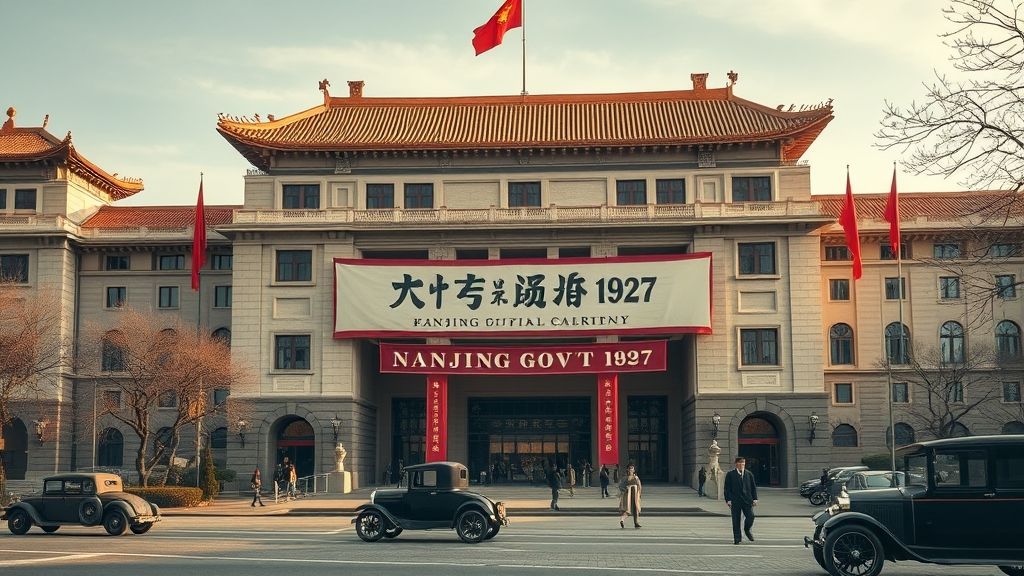
On that historic day, the atmosphere in Nanjing was electric but tense. Representatives from various provinces, military leaders, and political aspirants gathered beneath banners proclaiming unity and renewal. Speeches were delivered with an urgent tone—calls for national unity, modernization, and the restoration of China’s dignity.
Chiang Kai-shek stood at the center, elevated by his military triumphs and political acumen. The National Government was declared the legitimate authority over all of China, though the reality on the ground was far more complex.
Yet for many citizens, this was the first glimmer of hope after years of warlord chaos and foreign encroachments. It marked a new chapter—a fragile but promising step toward national reunification.
10. Ideological Battles Within the Kuomintang
However, beneath the surface of official declarations, fierce ideological battles brewed within the KMT ranks. The left-wing factions, closely allied with the Chinese Communist Party, challenged Chiang’s authoritarian strategies and his purges of leftists.
The KMT’s fragile four-party (“United Front”) alliance splintered. The conflict foreshadowed the brutal purges known as the White Terror, during which thousands of communists and leftist sympathizers were arrested and executed.
These internal divisions would define much of China’s subsequent drama, highlighting the impossibility of a unified, nationalist government without addressing ideological schisms.
11. The Leftists and the CCP: Tensions Rising
The cooperation between the Kuomintang and the CCP had been uneasy from the start, born of necessity rather than trust. The communists hoped to ride the wave of nationalist revolution toward a socialist transformation, while the KMT sought a capitalist modernization and centralized state control.
As Chiang consolidated power in Nanjing, he launched an anti-communist campaign that shattered the alliance. The suppression of trade unions, peasant movements, and communist activists led to widespread violence.
The purges ignited the Chinese Civil War, turning former allies into mortal enemies. The fateful rupture was witnessed by China and the world as a bitter betrayal of revolutionary ideals.
12. Consolidating Authority: Military and Civil Administration
The new National Government had to quickly move from symbolic declaration to effective governance. Chiang relied heavily on his military apparatus to maintain order and enforce authority.
Administrative reforms aimed at unifying tax collection, standardizing laws, and modernizing infrastructure were introduced, though unevenly applied across China’s vast territory. Regional warlords remained stubborn in their independence, while foreign concessions complicated sovereignty.
Despite challenges, the government pushed modernization agendas and public works campaigns, hoping to demonstrate capacity to govern and win hearts.
13. International Reactions and Diplomatic Challenges
Foreign powers watched the establishment of the National Government warily. Imperial powers such as Britain, Japan, and the United States maintained significant economic and political interests in China.
Japan, in particular, viewed Chiang’s regime with suspicion, especially given its firm nationalist stance and increasing control over strategic territories. Western powers were cautious but hopeful that Nanjing might bring stability.
Yet, the government wrestled with limited diplomatic recognition and continued foreign interference—a reflection of China’s semi-colonial status.
14. The White Terror: Purging the Communists
One of the darkest chapters following the government’s formation was the White Terror—an intense, violent crackdown on suspected communists and leftists in Nanjing and throughout China. Thousands were arrested, tortured, and executed.
This purge was orchestrated by Chiang Kai-shek and his allies, aimed at extinguishing communist influence within and outside the party. It fractured social movements and trade unions, sowed fear, and hardened ideological divides.
The White Terror not only defined the brutal nature of Chiang’s rule but also sealed the tragic fate of the fragile United Front.
15. Economic and Social Policies of the New Government
Amidst political turmoil, the National Government sought to revive China’s shattered economy. Efforts were made to stabilize the currency, promote industrialization, develop infrastructure, and reform education.
However, rampant corruption, warlord interference, and limited resources hindered progress. The government’s reach was strongest in urban centers and eastern provinces; rural areas remained largely neglected.
Social policies attempted to modernize traditional structures, emphasizing nationalism and discipline, but often alienated grassroots populations, especially peasants.
16. The Role of Foreign Powers in Shaping Nanjing’s Fate
The semi-colonial nature of China in the 1920s meant that foreign powers played a subtle but relentless role in the new National Government’s trajectory. From commercial interests to military interventions, foreign nations sought to protect concessions, ports, and investments.
The Nanjing government had to balance nationalist rhetoric with pragmatic diplomacy, often blunting its revolutionary zeal to avoid antagonizing powerful neighbors.
Japan’s rising aggression in Manchuria and elsewhere foreshadowed the greater conflicts to come, while Western powers hedged their bets between stability and influence.
17. Nanjing’s Transformation into a Capital
Once a city whose glory had faded since imperial times, Nanjing was reborn as the seat of republican governance. The city was invested with new buildings, government offices, schools, and military barracks.
Urban planning combined symbolism with functionality, as the KMT sought to construct a legacy and imprint authority on the physical landscape.
Public monuments, parades, and propaganda campaigns celebrated Nanjing as China’s heart—the newly unified nation’s glowing capital.
18. Cultural Renaissance and Propaganda Efforts
The early National Government fostered a cultural revival aimed at forging a modern Chinese identity aligned with nationalist ideals. Educational reforms emphasized patriotism, civic duty, and science.
Artists, writers, and intellectuals often aligned with KMT goals, producing works celebrating unity, anti-imperialism, and modernization.
While these efforts had mixed success, they reflected an important dimension of China’s national rebirth—a contest of ideas and symbols that accompanied political upheaval.
19. The Unfolding Civil War: Nanjing’s Struggle to Maintain Control
Despite the establishment of the National Government, China was far from unified. The schism with communists precipitated a full-scale civil war, fragmenting the country again into territories loyal to the KMT or CCP.
Nanjing became the nerve center for Chiang’s war efforts, but the conflict drained resources and hardened divisions.
The government’s survival depended on military successes, foreign support, and the fragile loyalty of warlord factions—a precarious balance that proved elusive in the years ahead.
20. Lessons from 1927: Unity, Fragmentation, and Nationalism
The founding of the National Government in Nanjing offered a lesson in the complexities of nation-building in a fractured land. It was simultaneously a triumph of nationalism and a prelude to protracted conflict.
The vision of unity clashed with deep ideological divides and competing interests. The state had to wrestle with modernization amid lingering feudal structures, foreign domination, and social upheaval.
Yet, the National Government’s establishment marked the beginning of modern Chinese central authority, laying groundwork—ambiguous and contested—that continues to echo in China’s historical memory.
Conclusion
April 18, 1927, stands as a watershed moment. The National Government formed in Nanjing was a beacon of hope and determination—a symbol that amidst chaos, a vision could unite millions towards a shared destiny. Yet, it was also a painful reminder of the challenges of forging a modern nation: ideological rifts, conflicting loyalties, and foreign pressures.
The story of Nanjing as the cradle of republican China is as much about human struggle as it is political triumph. It reveals a people’s yearning for dignity, sovereignty, and peace in a world turned upside down. And though the road ahead was fraught with bloodshed and betrayal, the establishment of this government was a vital step toward the China we know today.
History’s flame was lit that spring afternoon, illuminating both the promise and peril of revolution—and reminding us, across time, of the fragile courage required to rebuild a nation.
FAQs
Q1: What prompted the establishment of the National Government in Nanjing in 1927?
A: The National Government was founded following the success of the Kuomintang’s Northern Expedition to unify China by defeating warlords and sidelining leftist factions. The fall of Wuhan and Chiang Kai-shek's consolidation of power led to Nanjing being chosen as the new capital.
Q2: Who was the key figure behind the National Government’s establishment?
A: Chiang Kai-shek, leader of the Kuomintang military forces, was the central figure who orchestrated the government’s creation and became its leader.
Q3: How did the establishment affect the relationship between the Kuomintang and the Chinese Communist Party?
A: It marked the collapse of their United Front. Chiang initiated violent purges against communists in what became known as the White Terror, sparking the Chinese Civil War.
Q4: Why was Nanjing selected as the capital over other cities like Wuhan or Beijing?
A: Nanjing’s historical significance as an imperial capital, strategic Yangtze River location, and symbolic connection to earlier Chinese dynasties made it ideal for legitimizing the new government.
Q5: What role did foreign powers play in the formation of the National Government?
A: Foreign countries watched cautiously and at times interfere diplomatically and economically, attempting to safeguard their interests amid China’s fragile unity.
Q6: What were some of the social and economic challenges faced by the National Government?
A: The new government struggled with warlord resistance, limited resources, corruption, and the difficulty of extending effective control over rural and war-torn areas.
Q7: How did the establishment of the National Government influence China’s future?
A: It laid the foundation for centralized governance and nationalist ideology but also intensified ideological conflicts that led to decades of civil war.
Q8: Is the 1927 National Government considered the first legitimate Republican government in China?
A: It is regarded as the first significant attempt to create a unified republican government controlling much of China, though legitimacy was often contested.