Table of Contents
- The Dawn of Disaster: Morning Shadows over Japan
- The Geological Context of Nankaido: A Sleeping Giant Awakens
- Japan in 1946: A Nation on the Edge of Reconstruction
- The Tremor that Shook the Soul: December 21, 1946
- The Initial Shockwave: From Land to Sea
- Tsunami on the Horizon: Nature’s Unrelenting Fury
- Human Stories of Survival and Loss
- The Japanese Government’s Immediate Response
- International Reactions and Aid Efforts
- Scientific Investigations and Advances Post-Disaster
- The Aftershocks: The Nation’s Trembling Heart
- Reconstruction Amid Ruins: Lessons Learned
- Cultural Memory and the Nankaido Earthquake in Japanese Society
- The Nankai Trough: A Perpetual Threat in Modern Japan
- Comparing the 1946 Earthquake to Later Seismic Events
- The Role of Tsunami Warning Systems Evolved from 1946
- Environmental Impact: Coastal Changes and Marine Ecosystem
- Personal Accounts: Voices from Survivors and Witnesses
- Myth and Memory: The Earthquake in Folk Tales and Media
- The Nankaido Earthquake Today: Legacy and Preparedness
- The Global Context of the 1946 Quake: Lessons for Earthquake-prone Regions
- Conclusion: Resilience Forged in Tremors
- FAQs: Understanding the Nankaido Earthquake
- External Resources
- Internal Links
The Dawn of Disaster: Morning Shadows over Japan
On a cold winter morning, December 21, 1946, the tranquil pace of daily life along Japan’s southern coast was shattered. Just before dawn, the sleepy towns scattered across the Nankaido region—stretching from Shikoku Island through the Kii Peninsula and partway into Honshu—began to feel an ominous rumble beneath their feet. This was no ordinary tremor; it was a deep, terrifying herald of nature’s caprice. People woke to a world blurred by darkness and trembling walls. Doors rattled with fierce urgency, windows cracked, and the earth itself began to convulse. In the next few minutes, the Nankaido Earthquake, or as it is frequently called, the Nankai Earthquake, delivered one of the most powerful seismic shocks Japan had experienced in centuries.
The afternoon would bring even more terror as monstrous waves rolled relentlessly towards the shores—a tsunami that obliterated entire villages, tore apart the fragile post-war infrastructure, and drowned thousands. But this was not just a catastrophe measured in magnitude or death toll. It left an indelible scar on the Japanese psyche, a poignant reminder of the fragile balance between human endeavor and the raw forces of the Earth beneath them.
The Geological Context of Nankaido: A Sleeping Giant Awakens
Japan, an archipelago perched precariously on the “Ring of Fire,” is no stranger to earthquakes. Situated at the convergence of four major tectonic plates—the Pacific, Philippine Sea, Eurasian, and North American plates—the country lives with a constant, underlying anxiety. The Nankai Trough, a deep underwater trench running parallel to the southern coasts of Honshu and Shikoku, holds particular geological significance. Here, the Philippine Sea Plate slides beneath the Eurasian Plate in a process known as subduction.
This subduction zone is infamous for generating megathrust earthquakes—massive quakes where the locked plates suddenly slip, releasing colossal amounts of energy. These events occur in cycles separated by decades or centuries, often accompanied by devastating tsunamis. Historical records and geological evidence reveal a periodicity to these Nankai megathrust events, with the last significant quake before 1946 dating back to 1923 in the great Kamigoto earthquake sequence.
But beneath this rhythm of destruction lies unpredictable complexity. Scientists now understand that the Nankaido region is vulnerable to multiple simultaneous ruptures along different segments of the fault line, making precise forecasting nearly impossible, and the 1946 earthquake would tragically validate these fears.
Japan in 1946: A Nation on the Edge of Reconstruction
The year 1946 found Japan in a fragile state of transition. The ashes of World War II still smothered its cities; Hiroshima and Nagasaki’s horrors etched deeply into the collective consciousness. Economic ruin, food scarcity, and political upheaval were the order of the day. The Allied occupation, led by American forces under General Douglas MacArthur, was actively reshaping the nation’s political landscape, dismantling militarism, and sowing seeds for democracy.
In many ways, this was a moment of fragile hope. The Japanese people, bruised but unbroken, toiled to rebuild homes and families, industries and traditions from the ruins. Infrastructure was stretched thin, emergency services weakened, and morale was tenuous—a context that would exacerbate the tragedy when the earth suddenly betrayed its restless slumber.
The Tremor that Shook the Soul: December 21, 1946
In the dead of night, at 4:19 a.m. local time, the Nankaido Earthquake struck with a staggering force. The magnitude was later measured at approximately 8.1—a monster unleashed below the surface. The ground did not shake as a mere tremor but roared with a relentless fury that twisted homes, tore roads, and cracked embankments. For hours, aftershocks cascaded, each one a grim echo of the first, keeping residents in a state of terror and exhaustion.
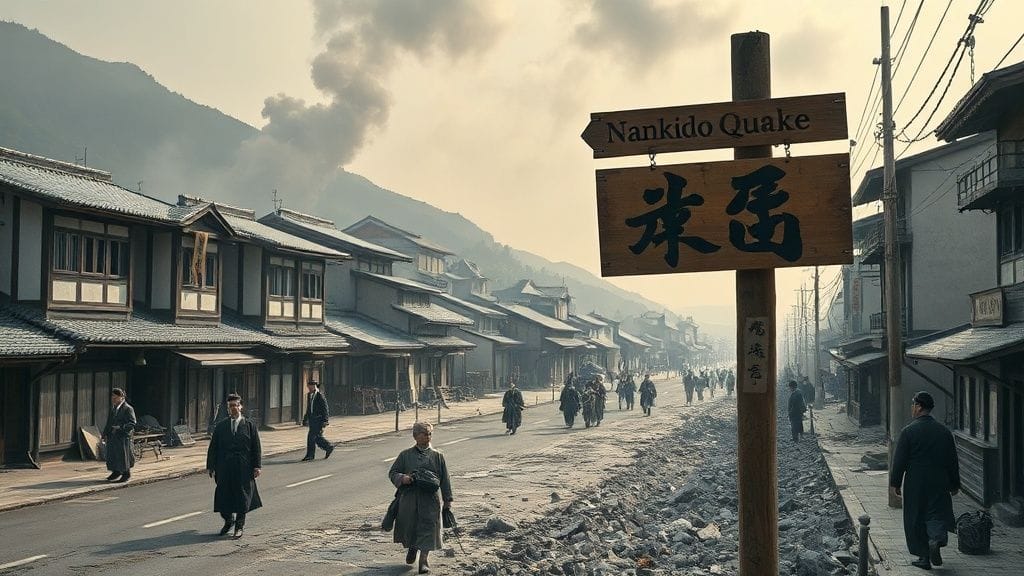
Communities scattered around Shikoku Island and the Kii Peninsula bore the brunt of this colossal quake. Particularly hard-hit were the cities of Wakayama, Tokushima, and Kōchi, where entire neighborhoods were reduced to rubble. The infrastructure, already fragile from war damage, collapsed further. Fires ignited in the chaos, spreading rapidly through narrow wooden lanes.
But the earth’s fury was just beginning to reveal its cruelest face.
The Initial Shockwave: From Land to Sea
The earthquake’s rupture along the Nankai Trough unleashed violent motions beneath the seabed, displacing massive volumes of seawater. The initial inland shock sent ripples through the community, but this tsunami was poised to deliver a far deadlier blow. Emergency warnings were scarce, and the technology for rapid communication was rudimentary compared to today’s standards.
Despite some traditional knowledge—passed through centuries—about signs of an impending tsunami, many coastal residents had little time to react once the first waves appeared. The sea, typically a bearer of life and bounty, became a cataclysmic force drawing inexorably toward dry land.
Tsunami on the Horizon: Nature’s Unrelenting Fury
Minutes after the earthquake’s initial jolt, monstrous waves began to rise on the horizon. These tsunamis—giant walls of water—spread rapidly across the Pacific, racing toward the low-lying coasts of Shikoku and the Kii Peninsula. Eyewitnesses later described the sea retreating suddenly before surging back with monstrous, inexorable power.
The impact was devastating. In some areas, the water rose to over 10 meters (roughly 33 feet), sweeping away homes, fishing boats, and people alike. Entire fishing communities disappeared beneath waves that carved new inlets and altered the coast forever. Tragically, because of the time of day—early morning hours—many families were caught unprepared, asleep, or sheltering indoors, dramatically increasing the death toll.
The scale of the tsunami brought a grim sense of déjà vu to scholars and survivors alike, recalling earlier waves in centuries past that had shaped the region’s legendary fears and respect for the sea.
Human Stories of Survival and Loss
Behind the cold statistics of death tolls—estimates vary but place casualties between 1,300 to over 1,500—lie countless narratives of trauma, heroism, resilience, and grief. Among them, the story of a small fishing village on the southern coast of Shikoku stands out.
Mrs. Yuki Arai, then a young mother, recalled the harrowing moments when her village was engulfed. “We felt the shaking, and then the sea simply vanished as if it had been pulled by an invisible hand,” she later recounted. “My father ran shouting to higher ground, dragging my brothers and me. Behind us, the ocean roared like a beast, swallowing everything in its path.”
Stories like hers reflect the dilemmas faced by thousands: the split-second decision to flee, the impossibility of saving everyone, the enduring pain of losing loved ones and homes. Yet, within these tragedies, sparks of humanity also heat the cold pages of history—communities banded together to search for survivors, strangers shared what little resources they had, and the will to rebuild never waned.
The Japanese Government’s Immediate Response
In an era before Japan had fully developed a national disaster response system, the government’s reaction was swift but overwhelmed. Emergency units were dispatched, but damage to transport and communications hampered coordination. The Allied occupation authorities, although primarily focused on demilitarization and economic reform, activated humanitarian aid channels.
Shelters were established in less affected regions, riverside embankments were inspected, and rescue teams worked tirelessly despite limited resources in the harsh winter cold. Maps of the damage were sketched hastily, often relying on eyewitness reports and military reconnaissance planes.
The 1946 quake revealed deep vulnerabilities in civil defense and preparedness, serving as a harsh teacher for a country about to enter a new era of technological progress and disaster resilience.
International Reactions and Aid Efforts
Though Japan was emerging from the isolation and devastation of war, international communities recognized the scale of suffering wrought by the Nankaido Earthquake. Neighboring countries expressed sympathy, and allied nations, particularly the United States, provided material assistance.
Humanitarian aid included food supplies, medical equipment, and reconstruction materials. Relief workers documented the destruction to prepare for future emergencies worldwide. The global attention cast a spotlight on Japan’s ongoing need for recovery and the interconnectedness of humanity’s vulnerability to natural disasters.
Scientific Investigations and Advances Post-Disaster
The 1946 earthquake became a cornerstone event in seismology. Japanese geologists, working alongside American experts, undertook detailed studies to understand the mechanisms behind the quake and the devastating tsunamis. The analyses deepened understanding of the Nankai Trough’s behavior and led to innovations in measuring seismic activity.
This earthquake’s data informed early models of earthquake prediction and tsunami generation, a science still imperfect but dramatically improved since that fateful day. It underscored the urgent need for early warning systems, a need Japan has since embraced with world-leading technology.
The Aftershocks: The Nation’s Trembling Heart
The initial 8.1 magnitude quake was followed by a succession of aftershocks, some of significant intensity. These tremors kept panic alive and complicated rescue operations. For residents, the fear of returning to damaged homes conflicted with the dangers of exposure to harsh winter conditions.
Physically and psychologically, Japan was rattled far beyond the single date of December 21. The aftershock sequence became a reminder that the earth’s unrest is often a prolonged torment, a slow uncoiling of pent-up forces that refuse to be silenced.
Reconstruction Amid Ruins: Lessons Learned
Japan’s rebuilding after the Nankaido Earthquake joined its larger post-war reconstruction effort. Buildings were redesigned with seismic resistance as a priority; new construction codes emerged, influencing architecture and urban planning.
Investment in communication infrastructure, emergency services, and public education about earthquakes and tsunamis accelerated. The disaster was a painful catalyst for modernization, ensuring future generations would carry the tools to mitigate similar horrors.
Cultural Memory and the Nankaido Earthquake in Japanese Society
Although overshadowed by the war’s end and subsequent economic miracle, the Nankaido Earthquake remains embedded in local memory and national consciousness. Annual commemorations in affected prefectures mark the disaster, blending solemn remembrance with educational outreach.
In literature and film, the event has inspired reflections on human frailty and endurance, with survivors’ testimonies passed down to younger generations. This cultural memory helps maintain vigilance in a land where the earth’s whispers can erupt without warning.
The Nankai Trough: A Perpetual Threat in Modern Japan
Today, the Nankai Trough is recognized as one of the greatest seismic threats facing Japan. Scientists warn that future Nankai megathrust earthquakes are inevitable, potentially devastating similar or greater regions than in 1946.
The government’s disaster preparedness plans now include large-scale evacuation drills, sophisticated seismic monitoring, and international cooperation on earthquake resilience. The memory of 1946 drives a collective commitment to be ready.
Comparing the 1946 Earthquake to Later Seismic Events
The 1946 Nankaido Earthquake was followed by significant quakes in the region, notably the 1944 Tonankai Earthquake and the more recent 2011 Tōhoku earthquake and tsunami. While different in specifics, these events share common themes: massive ruptures of subduction zones, consequential tsunamis, and profound human costs.
Comparisons offer insights into evolving preparedness and continuing gaps in the world’s fight against natural disasters.
The Role of Tsunami Warning Systems Evolved from 1946
A direct legacy of the 1946 calamity was the recognition that effective tsunami warnings could save thousands. By the late 20th century, Japan developed the world’s most advanced system, involving rapid seismic detection, ocean buoys, and automated alerts.
These systems have been proven invaluable, although challenges remain, especially in reaching all communities quickly. The spirit of innovation born from the tragedy persists.
Environmental Impact: Coastal Changes and Marine Ecosystem
Beyond human lives, the earthquake and tsunami reshaped coastlines. Some bays widened, new inlets formed, and entire ecosystems faced upheaval. Saltwater inundation damaged agricultural land, fisheries suffered losses in both infrastructure and stock.
In the long term, some regions saw renewal and ecological shifts, as nature adapted to these catastrophic forces.
Personal Accounts: Voices from Survivors and Witnesses
Firsthand testimonies breathe life into history’s cold facts. Shuichi Tanaka, a fisherman, described “the eerie silence after the wave passed, broken only by cries and the creaking of wreckage.” Elderly residents have passed down stories of instinctive escapes, miraculous survivals, and grim losses.
These voices preserve lessons and honor the resilience that defines human responses to disaster.
Myth and Memory: The Earthquake in Folk Tales and Media
Japanese culture has long intertwined natural disasters with mythology. The 1946 quake reinvigorated stories of dragons and sea gods disturbing the earth and sky, a symbolic framing that helps people process trauma.
Post-disaster literature and films reflect a layering of ancient fears with modern realities, creating a rich narrative tapestry.
The Nankaido Earthquake Today: Legacy and Preparedness
Currently, December 21 is observed with memorials and drills, reinforcing awareness. Technology has transformed detection and response, but the memories of 1946 continue to caution humility before nature’s power.
Japan’s resilience, shaped in part by such tragedies, remains a beacon of human fortitude.
The Global Context of the 1946 Quake: Lessons for Earthquake-prone Regions
The Nankaido Earthquake provided an invaluable case study for countries around the Pacific Rim and beyond. Concepts such as subduction zone earthquake cycles, tsunami behavior, and disaster preparedness strategies transcend borders.
The tragedy helped galvanize international collaboration in earthquake science and humanitarian response.
Conclusion: Resilience Forged in Tremors
The 1946 Nankaido Earthquake was more than a geological event; it was a profound human tragedy and a crucible for transformation. In the chilling grip of the earth’s rupture and the overwhelming flood of the tsunami, Japan’s people confronted vulnerability in its rawest form.
Yet from the ruins emerged determination—a renewed commitment to understanding the forces beneath their feet and to protecting future generations. The disaster imprinted lessons in brick and blood, in stories told around fires and in classrooms. It belongs not only to history but to the living present, a constant reminder that while humans cannot quell nature’s fury, they can meet it with courage, knowledge, and solidarity.
FAQs: Understanding the Nankaido Earthquake
Q1: What caused the Nankaido Earthquake of 1946?
The earthquake was caused by the sudden rupture along the Nankai Trough subduction zone, where the Philippine Sea Plate is thrusting beneath the Eurasian Plate, releasing a massive amount of seismic energy.
Q2: How strong was the earthquake?
The main shock reached a magnitude of approximately 8.1, classifying it as a ‘megathrust’ earthquake with immense destructive potential.
Q3: What areas were most affected by the earthquake and tsunami?
The southern coasts of Shikoku Island and the Kii Peninsula were hardest hit, including cities such as Wakayama, Tokushima, and Kōchi.
Q4: How many casualties resulted from the disaster?
Estimates suggest between 1,300 and 1,500 deaths, though exact numbers vary due to the scale of destruction.
Q5: How did the earthquake impact Japan’s disaster preparedness?
It exposed weaknesses in emergency response, prompting improvements in building codes, infrastructure resilience, and the eventual development of national tsunami warning systems.
Q6: What is the significance of the Nankai Trough today?
It remains one of the most dangerous seismic zones in Japan, with a high probability of future large earthquakes and tsunamis.
Q7: How has the Nankaido Earthquake been remembered culturally?
Through local memorials, survivor stories, literature, and media, the event remains a poignant part of Japan's collective memory.
Q8: What lessons did the world learn from the 1946 Nankaido Earthquake?
The earthquake helped advance the understanding of subduction zone mechanics and tsunami behavior and underscored the importance of preparedness globally.