Table of Contents
- The Final Chapter of an Emperor: May 5, 1821
- The Exile on St Helena: From Power to Isolation
- The Long Road to St Helena: Defeat and Capture
- The Atlantic Crossing: A Journey into Obscurity
- Life on the Remote Island: Conditions and Companions
- The Physical Decline of a Legend: Napoleon’s Last Days
- The Mystery of His Death: Poison or Natural Causes?
- The British Custodianship: Guardians or Prisoners?
- The Will of an Emperor: Final Words and Testament
- Reactions Across Europe: Mourning and Myth-Making
- The Return of the Remains: From St Helena to Paris
- Legacy in Death: How Napoleon Shaped History Posthumously
- Memory and Myth: The Emperor’s Indelible Shadow
- Scientific and Historical Investigations: Revisiting the Death
- The Island Today: St Helena as a Monument of Exile
- Conclusion: The Emperor’s Last Breath and Enduring Echo
- FAQs: Unraveling the Mysteries of Napoleon’s Death
- External Resource: Wikipedia Link to Napoleon’s Death
- Internal Link: Visit History Sphere
1. The Final Chapter of an Emperor: May 5, 1821
The sun rose late over the lonely island of St Helena, casting a pale light on the rugged cliffs and barren hills that seemed to echo the desolation of the man who lay within. On May 5, 1821, the world quietly lost one of its most towering figures—Napoleon Bonaparte, the self-styled Emperor of France, a man who had reshaped the destiny of Europe through fire and steel. His death, far from the battlefields and thrones, occurred in forced exile under British watch, a poignant and somber closure to a life marked by glory and tragedy.
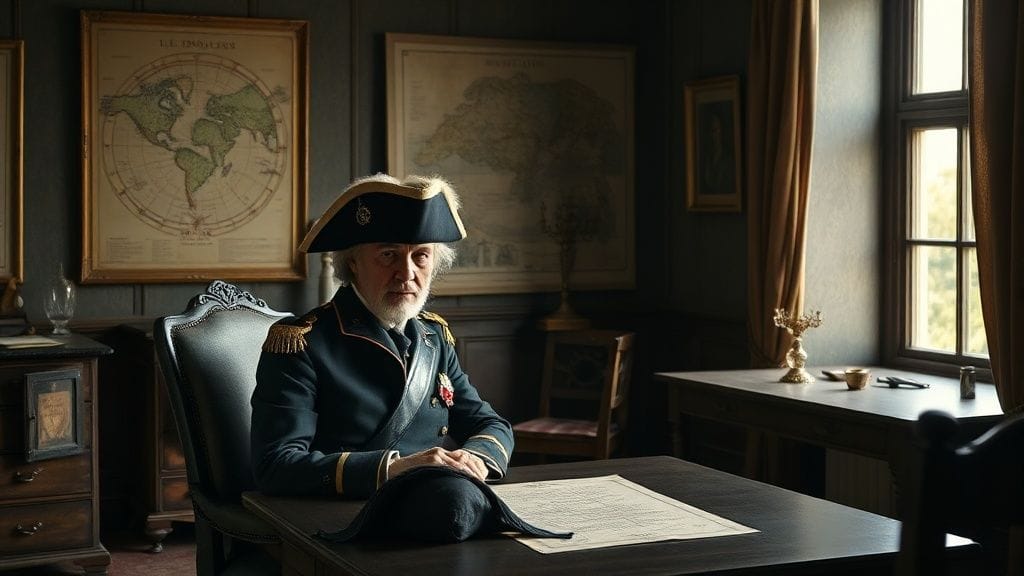
In the small, dimly lit room of Longwood House, Napoleon breathed his last. The room was heavy with an air of finality, nestled in a remote corner of the South Atlantic Ocean. His breathing had become shallow, his once commanding voice reduced to whispers. Those who were closest to him—loyal retainers and devoted followers—watched as the legend of the Corsican emperor slipped quietly from this world. Yet, even in death, the figure of Napoleon would stir fevered debates, whispers of foul play, and profound reflections on a life lived at the zenith of ambition and power.
2. The Exile on St Helena: From Power to Isolation
To understand the poignancy of Napoleon’s death on St Helena, one must retrace the dramatic shift from sovereign splendor to solitary exile. Once the master of Europe, commanding armies that swept across borders with unmatched brilliance, the exile marked a harsh, humiliating reversal. The remote island, some 1,200 miles off the coast of southwestern Africa, was chosen by the British not just for its physical isolation but for its symbolic finality—a place from which Napoleon could never escape again.
His fall was not sudden; it was the result of a series of military defeats culminating in his abdication and exile to Elba, followed by his hero’s return in the brief but spectacular Hundred Days. After Waterloo and his ultimate surrender, Churchill’s government led by the Duke of Wellington was determined to prevent any further attempts at resurgence. St Helena was a prison disguised as a refuge.
3. The Long Road to St Helena: Defeat and Capture
Napoleon’s fortunes had been on the rise for over a decade, his rapid climb from artillery officer to Emperor inspiring awe and dread across the continent. But by 1814, the Allied powers closed in on Paris. Forced abdication, exile to Elba, a stunning return, and then his crushing defeat at Waterloo in June 1815 marked the denouement of the Napoleonic saga.
After surrendering to the British aboard HMS Bellerophon, he was shipped away on a voyage that crushed any final flicker of hope. The journey to St Helena was marked by cold seas, changing winds, and the slow realization that the man who had seized Europe’s crown was now nothing but a captive, a pawn on a global chessboard.
4. The Atlantic Crossing: A Journey into Obscurity
The voyage from Europe to the remote South Atlantic was a fraught odyssey of several weeks. Napoleon’s entourage—his loyal marshals, servants, and a few companions—accompanied him under tight British security. Each wave that slapped the hull seemed to wash away the remnants of his past grandeur.
The cold, damp air contrasted sharply with the courtly pomp and military parades that had once surrounded him. The extensive correspondence between Napoleon and his captors during the crossing reveals a man grappling with his new reality, alternating between defiant pride and deep introspection.
5. Life on the Remote Island: Conditions and Companions
Longwood House was scarcely more than a damp, drafty lodging—far from the grand palaces and battle-hardened camps Napoleon once commanded. The island’s climate was harsh and unforgiving, with sudden squalls and oppressive humidity.
Napoleon’s inner circle dwindled over the years; the isolation was absolute. Companions such as General Bertrand, the faithful physician Dr. Francesco Antommarchi, and a handful of attendants provided what comfort they could. Despite this, the Emperor remained a figure of great dignity, occupying his time with writings, reflections on history and leadership, and dictation of his memoirs.
6. The Physical Decline of a Legend: Napoleon’s Last Days
By early 1821, signs of Napoleon’s failing health could no longer be ignored. He suffered severe abdominal pain, weakness, and difficulty breathing. His doctors diagnosed cancer of the stomach—a disease perhaps made worse by the harsh conditions and psychological torment of exile.
Eyewitnesses recounted the decrepitude of the former ruler, noting how even his stature seemed to shrink with his strength. Yet his will to command, his sharp intelligence, and his burning spirit endured even as his body became frail.
7. The Mystery of His Death: Poison or Natural Causes?
The exact cause of Napoleon’s death has fueled speculation and intrigue for two centuries. While Dr. Antommarchi’s reports pointed to stomach cancer, later theories suggested slow arsenic poisoning—potentially inflicted by his British captors aiming to hasten his end.
Forensic studies conducted on samples of his hair discovered elevated arsenic levels, though many historians argue that these could be due to environmental factors or medicinal treatments of the time. The mystery of Napoleon’s demise encapsulates the enduring fascination the world holds for the Emperor—even in death.
8. The British Custodianship: Guardians or Prisoners?
Britain, the nation that had defeated and banished Napoleon, played a complex role in his final years. Governor Sir Hudson Lowe, appointed to oversee the prisoner’s confinement, represented both protector and warden. Relations between Lowe and Napoleon were strained—marked by mutual suspicion and political antagonism.
The British were determined to prevent escape or rescue, imposing strict surveillance measures. Yet their treatment, while stringent, was arguably humane in the context of 19th-century imprisonment standards. The nature of this custodianship shapes much of the narrative surrounding Napoleon’s final years.
9. The Will of an Emperor: Final Words and Testament
In the twilight of his life, Napoleon dictated his will and a final testament that revealed a man mindful of legacy and justice. He requested that his remains return to France, instructed generosity towards his family and loyal followers, and expressed reflections on power, fate, and destiny.
Among his last words was the famous phrase, “France, the army, the head of the army, Joséphine,” a litany of what the Emperor held closest to his heart. These parting words offer profound insight into his identity and enduring attachments.
10. Reactions Across Europe: Mourning and Myth-Making
The news of Napoleon’s death was met with a complex tapestry of emotions across the continent. For many, it was relief—an end to turmoil and war. For others, particularly in France, it sparked waves of mourning and the beginning of mythologizing.
Royalists sought to erase his legacy; Bonapartists celebrated his memory as a symbol of national pride and military genius. Writers, poets, and artists of the 19th century immortalized his image, blending fact and legend in a growing cult of personality.
11. The Return of the Remains: From St Helena to Paris
It would take nearly two decades before Napoleon’s remains were repatriated to France. In 1840, during the reign of King Louis-Philippe, the young nation demanded the return of its fallen hero in what became known as the “Retour des cendres” (Return of the Ashes).
His body was exhumed and transported with great ceremony, ultimately placed in a grand tomb at Les Invalides, Paris—a fitting resting place for a man whose life had so profoundly shaped the nation.
12. Legacy in Death: How Napoleon Shaped History Posthumously
Napoleon’s death did not mark the end of his influence. On the contrary, it sparked intense historical, political, and cultural discourses. His reforms in law (the Napoleonic Code), administrative organization, and military strategy continued to shape Europe long after his demise.
Moreover, his life became a template for debates on leadership, ambition, and national identity. For some, he was a visionary who modernized France; for others, a tyrant whose wars devastated a continent.
13. Memory and Myth: The Emperor’s Indelible Shadow
The memory of Napoleon is a landscape as vast and varied as the lands he once ruled. In France, he remains simultaneously a hero and a cautionary figure. Across Europe and the world, his image symbolizes the heights of human ambition and the depths of political exile.
From statues and literature to films and academic studies, Napoleon’s myth endures, shaped as much by the stories told about him as by reality. His death, wrapped in mystery and marked by isolation, only amplifies the tragic grandeur of his figure.
14. Scientific and Historical Investigations: Revisiting the Death
Modern science has revisited the circumstances of Napoleon’s death with renewed curiosity. Techniques such as toxicology analyses of hair samples, exhumations, and documentary scrutiny have sought to disentangle myth from fact.
While the cancer diagnosis remains the consensus, the suggestion of slow poisoning has not been definitively disproven, keeping the debate alive. This ongoing investigation reflects humanity’s hunger to understand not just the man but the end of an era he embodied.
15. The Island Today: St Helena as a Monument of Exile
Today, St Helena stands as a silent witness to one of history’s most extraordinary exiles. The island has become a site of pilgrimage for history enthusiasts and scholars alike. Longwood House is preserved as a museum, offering a glimpse into Napoleon’s final years.
The landscape, steeped in history and legend, continues to captivate visitors drawn by the story of the fallen emperor and his solitary death far from the glories of Europe.
16. Conclusion: The Emperor’s Last Breath and Enduring Echo
Napoleon Bonaparte’s death on that misty morning of May 5, 1821, was both an end and a beginning. The physical life of the man who had commanded armies and kingdoms ended in a remote prison, yet his spirit was immortalized in history’s vast pages.
Exile, illness, suspicion, and reflection marked his final days, but the story did not end there. Through the lens of memory, myth, and modern inquiry, the Emperor continues to challenge, inspire, and provoke. Even death could not silence his indelible roar across the centuries.
FAQs
Q1: What caused Napoleon’s death on St Helena?
A1: The official cause was stomach cancer, confirmed by his physician. However, theories of arsenic poisoning have persisted based on hair analyses, though no conclusive evidence supports foul play.
Q2: Why was Napoleon exiled to St Helena specifically?
A2: The British chose St Helena for its extreme isolation, minimizing the risk of escape or rescue, ensuring Napoleon remained a permanent prisoner far from Europe.
Q3: Who was responsible for guarding Napoleon during his exile?
A3: Governor Sir Hudson Lowe oversaw Napoleon’s captivity and enforced strict security measures, though tensions between the two men were frequent.
Q4: How did Europe react to Napoleon’s death?
A4: Reactions were mixed—relief among monarchies, mourning and mythologizing in France and Bonapartist circles, and scholarly reflection across the continent.
Q5: When and how were Napoleon’s remains returned to France?
A5: In 1840, his remains were exhumed and brought back to France with great ceremony for reburial at Les Invalides in Paris.
Q6: Did Napoleon write or dictate memoirs during his exile?
A6: Yes, he spent much of his time dictating memoirs and reflections, shaping the narrative of his reign and life in exile.
Q7: How is St Helena preserved in relation to Napoleon’s legacy?
A7: Longwood House is a museum, and the island attracts visitors interested in the story of Napoleon’s exile and death.
Q8: What is the lasting significance of Napoleon’s death?
A8: It marked the definitive end of his political power but kickstarted a rich legacy of historical study, cultural myth, and national memory.

