Table of Contents
- A Spring Morning in Milan: Setting the Stage for a Coronation
- From Corsican Outsider to European Master: The Road to Italy
- The Italian Peninsula Before Napoleon: Fragmented Lands, Restless Peoples
- The Cisalpine Republic and the Birth of a New Italian Order
- Victory at Marengo and the Making of an Italian Crown
- Negotiations, Calculations, and a Crown of Iron
- Milan on the Eve of 26 May 1805: Soldiers, Silks, and Suspicion
- Inside the Duomo: Ritual, Symbolism, and Stagecraft
- “God Has Given It to Me”: The Moment Napoleon Crowned King of Italy
- The People’s View: Cheers, Silence, and Murmurs in the Piazza
- Crowning a Dynasty: Josephine, the French Court, and Italian Nobility
- Law, Administration, and the Napoleonic Recasting of Italy
- Church and Crown: Concordats, Clergy, and a Nervous Papacy
- The European Reaction: Vienna’s Fury and London’s Alarm
- Italian Voices: Patriots, Opportunists, and Early Nationalists
- War Returns: The Kingdom of Italy on the Battlefield
- Fall of an Empire: From Milan’s Glory to Waterloo’s Ashes
- From Kingdom to Memory: How 1805 Shaped the Risorgimento
- The Duomo Remembered: Myths, Symbols, and Historical Debates
- Conclusion
- FAQs
- External Resource
- Internal Link
Article Summary: On 26 May 1805, beneath the soaring Gothic vaults of Milan Cathedral, napoleon crowned king of italy transformed a patchwork of republics and satellite states into the Kingdom of Italy, placing an ancient iron crown upon his own head. This article traces how a young Corsican artillery officer became the arbiter of Italian destiny, using victories like Marengo to justify a royal title south of the Alps. It follows the choreography of the day itself—the banners, uniforms, incense, and the telling gesture with which Napoleon seized the crown and proclaimed his sovereignty. Yet behind the spectacle of napoleon crowned king of italy lay deep political calculations, the anxieties of Austria and Britain, and the wary hopes of Italian elites and commoners. We explore how new legal codes, administrative reforms, and conscription reshaped everyday life across northern Italy. The narrative then follows the kingdom through war, defeat, and the post-Napoleonic settlement, showing how the memory of napoleon crowned king of italy outlived the empire that created it. Italian patriots later reimagined the 1805 coronation as a flawed but significant step toward national unity. Ultimately, the story of napoleon crowned king of italy becomes a lens through which to understand power, ambition, and the long, uneven road to modern Italy.
A Spring Morning in Milan: Setting the Stage for a Coronation
Morning light broke over Milan on 26 May 1805 with an almost theatrical clarity, as if the city itself understood that history had chosen this day. The streets around the grand, jagged silhouette of the Duomo were already alive before dawn—boot heels on cobblestones, the neighing of horses, muffled orders barked in French and Italian. Draperies of green, white, and red—colors that were not yet a national flag but already a political promise—hung from windows and balconies. Church bells rang in overlapping peals, answered by trumpet calls from French and Italian regiments forming up in the square. On that Sunday, napoleon crowned king of italy would turn a military occupation and a fragile republic into a monarchy, and the entire city felt stretched between curiosity and unease.
The Duomo of Milan, gothic and unfinished, seemed to rise from the very stones of Lombardy, its spires reaching toward the pale sky. Inside, the air was heavy with incense. Candles, hundreds upon hundreds, threw flickering light across statues of saints and marble columns. Workmen had been busy for days, erecting a temporary throne platform, arranging rich textiles brought from Paris, and situating the treasure of the day: the ancient Iron Crown of Lombardy. Revered, contested, and shrouded in legend, that small circlet—golden on the outside, but containing within it a band of iron said to be forged from a nail of the True Cross—was more than jewelry. It was a symbol that reached back to the kings of the Lombards, to Charlemagne, and to the medieval Holy Roman Emperors. By claiming it, Napoleon intended to inscribe himself into a story far older than the French Revolution.
Outside, crowds clustered wherever they could find a vantage point. Peasants in coarse wool stood shoulder to shoulder with Milanese merchants in dark coats and powdered hair. Children attempted to climb lampposts or scramble onto barrels for a better view, only to be shooed down by gendarmes. Some faces shone with admiration for the small, intense man who had swept the Austrians from northern Italy and filled the city with business and bustle. Others were watchful, tight-lipped—resentful of taxes, of conscription, of the arrogant swagger of certain French officers. But all understood one thing: this day would fix their city forever in the chronicles of Europe.
Within the cathedral’s side chapels, bishops and priests fussed over vestments and liturgical books, exchanging murmured comments. Many of them had already witnessed another extraordinary ceremony less than a year before, when Napoleon had crowned himself Emperor of the French in Notre-Dame de Paris. That moment had resounded across Christendom, the Pope himself summoned to bless a revolution’s new monarch. Now, in Milan, there would be no pope present—only a carefully arranged Catholic ritual surrounding an act of unmistakably personal theater. The line between sacrament and spectacle had never been thinner.
As the city’s clocks approached the hour, a distant drumroll traveled through the narrow streets, growing louder. Windows filled with faces. Somewhere, an old woman crossed herself and whispered a prayer, not for the mighty man who would soon sit beneath the Duomo’s vaults, but for her son serving in the Italian regiments that fought under his banner. In that fragile human gesture lay the real meaning of the day: the convergence of grand ambition and everyday fate.
From Corsican Outsider to European Master: The Road to Italy
To understand why Milan awoke in such tension and splendor that morning, one must follow the arc of a life that began far from the marble and gilt of Italian cathedrals. Napoleon Bonaparte was born in 1769 on Corsica, a rocky island newly acquired by France. He grew up not as a favored son of Parisian salons but as an awkward provincial youth who spoke French with an accent and dreamed of honor in uniform. The Revolution that exploded in 1789 shattered the old aristocratic order and opened a path for men like him—educated, ambitious, ruthlessly self-assured.
Italy first became his stage in 1796, when the French Directory, desperate for victories and money, handed command of the Army of Italy to the 26-year-old general. The soldiers who first saw him—thin, pale, with lank hair and an oversized uniform—were not impressed. They were half-starved and poorly equipped, used to being a sideshow to the “real” war on the Rhine. Napoleon changed that within weeks. He moved swiftly, improvising daring maneuvers, striking at the Austrian and Piedmontese forces with a rhythm that stunned both friend and foe. In a whirlwind campaign, he drove the Austrian Habsburgs out of Lombardy, stormed across the Po, and sent dispatches back to Paris dripping with triumph—and loot.
These first Italian campaigns were more than a prelude to future crowns. They formed Napoleon’s political imagination. He saw, in the cities of northern Italy, a land of wealth and culture that had long been shackled by foreign dynasties and local oligarchies. Here was a laboratory for revolutionary ideas: “liberty” carried on French bayonets, new constitutions drafted in candlelit rooms, old aristocratic titles dissolved with a stroke of a pen. Yet he also learned something else—that people do not abandon their loyalties overnight. While some Italian patriots cheered the fall of ancient tyrannies, many others looked upon the French as simply a new breed of conqueror.
As the victories piled up, so did Napoleon’s sense of destiny. He staged grand entries into cities like Milan and Venice, surrounding himself with artists, scientists, and notables. He wrote proclamations addressed to “the Italian people,” as if conjuring into being a nation that had not yet come to political life. In these gestures, one sees the early shadows of what would happen when napoleon crowned king of italy: the fusion of republican rhetoric with monarchical ambition, the attempt to marry the new cult of the nation with the old prestige of crowns and ceremonies.
By the time he seized power in the coup of 18 Brumaire (November 1799), becoming First Consul of France, Italy was already woven tightly into his plans. To secure his authority at home, he had to control the Alpine passes and the rich plains beyond. To project himself as a European lawgiver and modernizer, he needed visible proof that his rule could bring order out of post-revolutionary chaos. Italy, with its ancient cities and tangled politics, offered exactly such a stage.
The Italian Peninsula Before Napoleon: Fragmented Lands, Restless Peoples
Before the thunder of Republican artillery echoed across its valleys, the Italian peninsula resembled a mosaic shattered into too many pieces. In the north, the wealthy region of Lombardy and parts of Venetia were under Habsburg Austrian control. The Duchy of Milan had long been a jewel in the imperial crown, a strategic gateway into the peninsula. Venice, though nominally independent, was a fading maritime power whose glory days on the Adriatic were already a memory. To the west lay the Kingdom of Sardinia-Piedmont, ruled by the House of Savoy, a small but proud realm that straddled the Alps.
Central Italy was dominated by the Papal States, where the Pope ruled not only souls but territories. The city of Rome, with its layered classical and Christian heritage, remained a magnet for pilgrims and intellectuals alike, but its government was hardly a model of modern administration. To the south sprawled the Kingdom of Naples (and Sicily), ruled by the Bourbon dynasty—a land of both immense resources and deep poverty, fertile soils and entrenched feudal structures. In between were small duchies like Parma, Modena, and Tuscany, each with its own court etiquette and petty diplomatic intrigues.
For centuries, foreign powers had used this fragmented map as a chessboard. Spain, Austria, and France had alternated in influence, making and unmaking alliances with local rulers. Italian intellectuals lamented this condition. The poet Vittorio Alfieri spoke bitterly of “servitude” and foreign tutelage. Thinkers in the late eighteenth century, imbued with Enlightenment ideals, started to dream aloud of “Italy” as something more than a geographical expression. They imagined a shared culture, a common heritage anchored in Roman law, Renaissance art, and the Italian language itself. Yet these ideas had not yet found a political vessel.
Economically, the peninsula was uneven. Lombardy was among the most prosperous agricultural regions in Europe; its cities bustled with silk production, banking, and trade. By contrast, vast tracts of the south remained dominated by large estates, rural poverty, and banditry. Social tensions ran deep: between nobles and bourgeois, between urban elites and peasant masses, between the reformist currents of the Enlightenment and the conservative reflexes of the Church. When the French Revolution erupted across the Alps, it sent tremors through every chancery and palace in Italy. Some saw in it a chance to modernize; others, a terrifying omen of chaos.
Into this fractured, uneasy landscape marched the armies of revolutionary France and, later, their most brilliant commander. Italy would serve as a laboratory for institutional and social change—but also as a proving ground for Napoleon’s appetite for glory. By the time we arrive at that moment when napoleon crowned king of italy in Milan Cathedral, the peninsula had already been subjected to a decade of upheaval that loosened old bonds and prepared, often unwillingly, the ground for something new.
The Cisalpine Republic and the Birth of a New Italian Order
Napoleon’s first conquests in Lombardy did not immediately translate into a crown. Instead, they produced a new kind of political creature: the “sister republic.” In 1797, after humiliating Austria and overawing local rulers, he oversaw the creation of the Cisalpine Republic, centered on Milan. Its very name—“Cisalpine,” meaning “on this side of the Alps” from a French perspective—betrayed its derivative nature. It was at once an Italian experiment in self-government and a French satellite, living under the protective shadow of French bayonets.
The Cisalpine Republic adopted a constitution inspired by the French model, with representative institutions, a Directorial government, and a tricolor flag. Liberty trees were planted in main squares; old feudal privileges were formally abolished; new administrative divisions—departments—replaced antique patchworks of jurisdictions. French officials and advisers flooded in, sometimes condescending, often energetic, helping to draft laws, reorganize finances, and secularize public life. Churches lost properties, monastic orders were suppressed, and long-standing guilds were disbanded.
Reactions among Italians were mixed. Enlightened elites and younger lawyers or bureaucrats were attracted to the promise of merit and rational administration. They staffed the new ministries, wrote in patriotic newspapers, and began to speak earnestly about “citizens” rather than “subjects.” For them, the Cisalpine Republic was a fragile but exhilarating beginning. Others experienced the new order as a burden: increased taxation to support the French army, requisitions of grain and horses, sudden changes in legal code that few fully understood.
Napoleon himself never entirely trusted the republicans he had helped install. He viewed them as useful auxiliaries, but he believed that without France’s stern guidance their political experiments would collapse into factionalism. “You are children,” he is reported to have told some Milanese patriots, “and you need a tutor.” The comment was cutting, but it reflected a basic truth of his policy: Italy was to be modernized, yes, but always within the orbit of French strategic needs.
In 1799, when a coalition of European powers drove the French temporarily out of much of Italy, the Cisalpine Republic crumbled. Old regimes returned in haste, attempting to reverse the reforms. It was a violent interlude: reprisals, score-settling, and civil unrest. The episode left scars but also hardened identities. Those who had tasted republican government and Napoleonic reform were often unwilling to return entirely to the world before 1796. When Napoleon, now First Consul, swept back over the Alps and triumphed at Marengo in 1800, he restored the Cisalpine Republic—but under tighter French control. The stage was being set, step by careful step, for the transformation of this republic into a kingdom under his own hand.
Victory at Marengo and the Making of an Italian Crown
The road to the coronation in Milan leads inexorably through the vineyards and fields near the small Piedmontese village of Marengo. On 14 June 1800, Napoleon’s Army of the Reserve faced Austrian forces in a battle that nearly ended in disaster. For much of the day, the French were pushed back, their lines bending under the pressure of disciplined imperial troops. Reports would later describe Napoleon standing amid the smoke, seemingly calm but fully aware that a defeat here could unravel both his regime in France and his hold over Italy.
Late in the afternoon, reinforcements under General Desaix arrived, and fortune, so often courted by Napoleon, finally smiled. A counterattack was launched, the Austrians were thrown back, and what had looked like a rout became a celebrated victory. Desaix himself was killed in the moment of triumph, prompting one of Napoleon’s most quoted laments: “Why is it not permitted for me to weep?” Marengo quickly became a legend, burnished by propaganda, paintings, and pamphlets. But beyond its mythic aura, it had concrete consequences: Austria was forced to acknowledge French dominance in northern Italy, and Napoleon’s political authority in Paris was bolstered.
In the wake of Marengo, Napoleon began to think more systematically about Italian governance. The Cisalpine Republic was reestablished in an expanded form, and in 1802 it was renamed the Italian Republic, with none other than Napoleon himself as its president. Here, in embryo, lay the idea that would later culminate when napoleon crowned king of italy in 1805. A republic whose president resided in Paris and wielded near-monarchical powers could easily, at a chosen moment, be transformed into a kingdom whose king happened to be the same person.
The Italian Republic adopted the Napoleonic Civil Code, reformed the judiciary, and continued the secular policies of the revolutionary era. A new Italian political class emerged—prefects, judges, mayors, officers—many of whom owed their position to the new regime and were personally loyal to Napoleon. At the same time, the presence of French troops and the subordination of Italian finances to French military needs fostered resentment. The peninsula was learning, in daily practice, what it meant to be both partner and subordinate in Napoleon’s Europe.
From Paris, Napoleon watched and calculated. He understood that to secure his empire, he needed not just client republics but durable dynastic entities: kingdoms that could be handed to relatives and loyal marshals, creating a web of thrones around France. Italy, with its symbolic weight and economic value, was too important to remain a mere republic. When he crowned himself Emperor of the French in December 1804, the transformation of the Italian Republic into a kingdom became, in his mind, almost inevitable. The only real questions were timing and form—and, crucially, which crown he would wear.
Negotiations, Calculations, and a Crown of Iron
In the months between Napoleon’s imperial coronation in Paris and his journey to Milan, a flurry of diplomatic and administrative maneuvers unfolded, mostly behind closed doors. The transformation of the Italian Republic into the Kingdom of Italy was announced in March 1805, with Napoleon as king and his stepson, Eugène de Beauharnais, named viceroy. To many observers, this was simply the logical extension of what already existed. Yet the decision had profound implications.
Austria saw it as a direct threat. The Habsburgs had long claimed a special role in northern Italy, and the ancient title of “King of the Romans,” later Holy Roman Emperor, was closely tied to the old Lombard crown. For Napoleon to style himself “King of Italy” was more than vanity; it was a challenge to Habsburg prestige and to the traditional balance of power south of the Alps. In Vienna’s council chambers, officials worried that this new kingdom would become a permanent French outpost menacing their borders.
Within Italy, reactions varied. Some elites in Lombardy and Venetia hoped that a kingdom would bring greater stability and clearer lines of authority than the shifting republican experiments. If Napoleon would, in effect, be their monarch, perhaps he would invest more heavily in local infrastructure and governance. Others feared the symbolic break with republican ideals. Had they not, only a few years earlier, toasted liberty and the end of crowns? The irony did not escape contemporaries. A Milanese pamphleteer dryly observed that “republics, like comets, have a brief and brilliant course.”
Central to Napoleon’s imagined royal role was the Iron Crown of Lombardy. This relic, guarded in the treasury of Monza near Milan, had long been used in coronation ceremonies for kings of Italy within the Holy Roman Empire. Its outer band of gold and jewels concealed a narrow interior circlet of iron, traditionally said to have been fashioned from a nail used in Christ’s crucifixion—a claim that blended piety and politics. By seeking this particular crown, Napoleon was not merely inventing a new kingdom; he was appropriating a line of legitimacy that reached back over a millennium.
There were negotiations about the precise form of the ceremony, the presence of clergy, and the role of the Italian political class. Napoleon insisted that he would, as in Paris, crown himself. No prelate, however venerable, would place the Iron Crown upon his head. The Church could bless the occasion, but it could not claim to confer authority. As one French official noted in a memorandum, the coronation in Milan had to “combine the solemnities of religion with the unambiguous assertion that sovereignty rests in the person of His Majesty.” It was a delicate balancing act: respecting Italian traditions while making clear who authored this new order.
By the time Napoleon set out for Milan in the spring of 1805, the script was largely written. He traveled through northern Italy as an emperor on progress, receiving honors, inspecting troops, and listening—when it suited him—to local petitions. Ahead of him, artisans and decorators raced to ready the Duomo for an event that would condense centuries of Italian history into a few choreographed hours.
Milan on the Eve of 26 May 1805: Soldiers, Silks, and Suspicion
As May advanced, Milan became a city in a state of heightened performance. Tailors worked late into the night stitching uniforms and gowns; printers rolled off programs and proclamations detailing the new royal style: “Napoleon, by the grace of God and the constitutions of the Republic, Emperor of the French and King of Italy.” The phrase itself was an ideological hybrid—combining divine sanction with the language of written constitutions, monarchy with republican residue.
The city’s narrow streets filled with visitors. Provincial notables arrived from Lombardy’s towns, wearing their best clothes, anxious not to be absent from an event that might shape their careers. Foreign envoys—British, Austrian, Russian—observed everything with keen, sometimes hostile eyes, sending back coded reports to their capitals. Merchants rubbed their hands at the prospect of increased trade, inns overflowed, and prices of basic goods spiked, as they always did when armies and courts descended.
The military presence was impossible to ignore. French grenadiers in blue coats and tall bearskins drilled near the Porta Romana; Italian troops in green uniforms, bearing their new royal standards, marched with deliberate pride. Cannons were polished until they gleamed. In the piazza before the Duomo, workers erected platforms for musicians and reserved seating for dignitaries, while soldiers rehearsed their formations. Rumors circulated freely: that Austria was about to declare war, that the Pope had secretly cursed the coronation, that Napoleon intended to abolish all remaining local privileges. None of this was entirely true, but each story contained a grain of plausible fear.
In private salons, Milanese aristocrats weighed their options. Many had already made their accommodation with French rule, serving in administrative posts or offering daughters in marriage to French officers. Others remained aloof, clinging to memories of Austrian elegance. Some saw in the coming coronation an opportunity to reposition themselves, to be seen on the right side of history when napoleon crowned king of italy and sealed the new order with pomp and ceremony. To be absent could be interpreted as disloyalty; to be present too enthusiastically might offend Vienna, should fortunes reverse.
Among the urban poor and artisans, conversation took a more practical turn. Would the new king lower taxes? Would there be more work on roads, canals, and public buildings? Would the hated conscription lists be lengthened or shortened? For many, the difference between “republic” and “kingdom” was less important than the question of how many sons would be taken to fight in distant campaigns and how much bread would be left on the family table.
As dusk fell on 25 May, illuminations lit up the façades of key buildings. The Duomo’s jagged edge glowed in the last light, while nearby palaces flickered with candlelit windows. Inside the cathedral, final rehearsals took place: clergy walked through their processions, choirboys practiced responses, and officers checked the seating chart with an almost obsessive concern for precedence. The Iron Crown rested in its reliquary, silent witness to the last time it had been used and to the centuries of kings who had worn it. Tomorrow, it would encircle the head of a man who had risen from Corsican minor nobility to imperial supremacy in less than two decades.
Inside the Duomo: Ritual, Symbolism, and Stagecraft
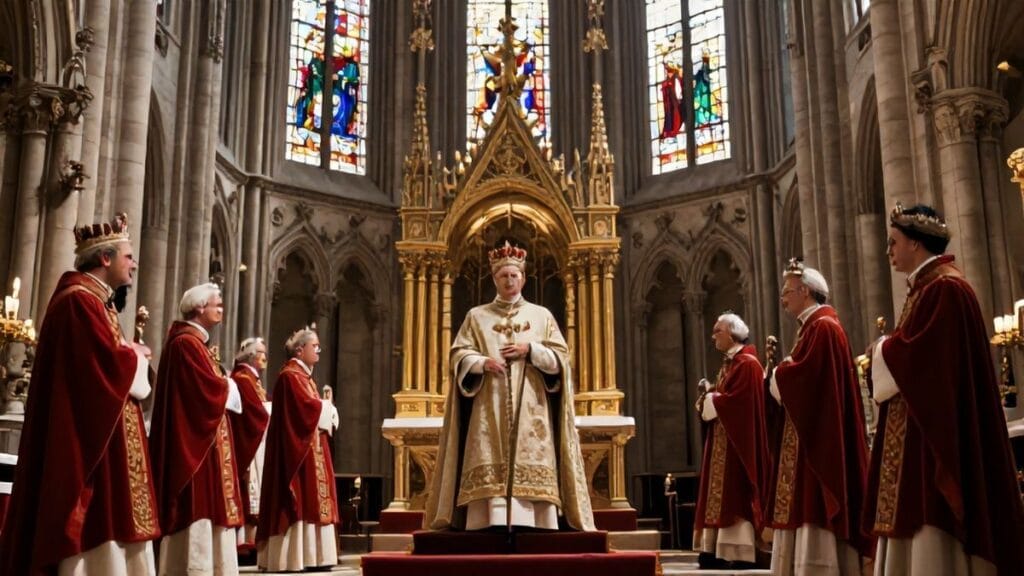
On the morning of 26 May, the Duomo of Milan became a carefully orchestrated theater of power. Long before Napoleon arrived, the vast interior was filled with the rustle of silk, the scrape of chairs, the murmur of voices hushed by the awareness of sacred space. Sunlight filtered through stained glass, painting colored bands across the stone floor and the faces of those assembled—Italian senators in ceremonial robes, French generals with glittering epaulettes, bishops in miters, envoys in embroidered coats heavy with gold thread.
The nave was lined with troops standing rigidly at attention, their polished muskets and gleaming bayonets both a tribute and a reminder of the force that underpinned all this magnificence. Beyond them, rows of seats accommodated dignitaries according to a strict hierarchy: French marshals closer to the altar, Italian officials arrayed carefully according to rank and favor, foreign diplomats granted visible but not overly honored positions. Women in exquisite dresses, their hair arranged in the latest Parisian fashion, whispered to one another about who had been given which place—a social map overlaid upon a political one.
At the heart of the scene stood a raised platform before the high altar, upon which sat a richly carved throne draped in green and gold. Nearby rested the cushion bearing the Iron Crown. A canopy overhead framed the spot where Napoleon would soon sit, placing him visually between heaven and earth, under the gaze of painted saints and stone angels. The cathedral’s organ rumbled softly during pauses, as if to remind everyone that this was, at least officially, a church ceremony.
The liturgy had been adapted to suit the moment. There would be Mass, blessings, and prayers for the new king, but crucially, the act of crowning would not be performed by ecclesiastical hands. Instead, the clergy’s role was to sanctify what Napoleon himself would do. It was a choreography born of both pride and calculation: pride that he owed his elevation to no one but himself and the French people, calculation that he still needed the aura of religious legitimacy in a continent where such symbols remained potent.
As the appointed hour approached, a hush spread through the cathedral. Outside, in the piazza, military bands prepared to play. The tension was almost physical. Those who later wrote about the scene described a feeling of holding one’s breath, as if the city’s entire recent history—the upheaval of revolution, the back-and-forth of armies, the rise and fall of republics—were gathering into a single, suspenseful instant. Then, at last, the distant thunder of drums and trumpets signaled that the emperor-turned-king was on his way.
“God Has Given It to Me”: The Moment Napoleon Crowned King of Italy
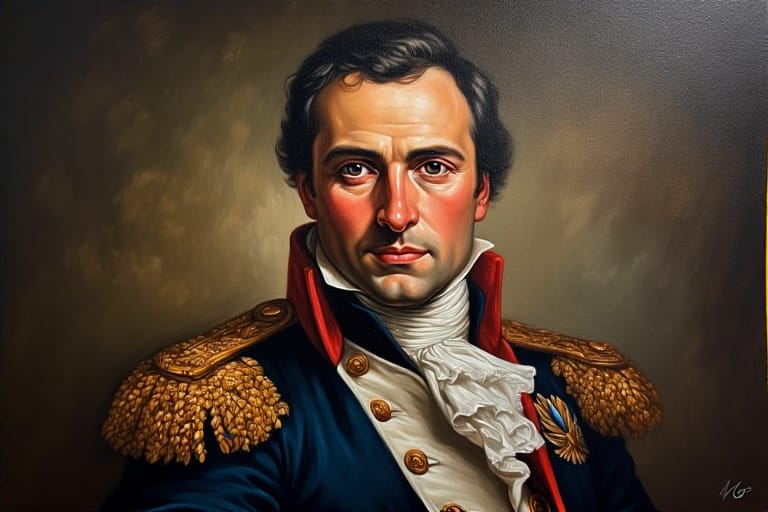
When Napoleon entered the Duomo, the atmosphere shifted at once from anticipation to electrified presence. Dressed in a richly embroidered coronation mantle of green velvet—chosen to resonate with the colors of his new Italian kingdom—he moved with deliberate slowness along the central aisle, flanked by marshals and high dignitaries. Those close enough to see him noted the familiar intense gaze, the slightly sallow complexion, the aura of command that seemed to bend the space around him.
The choir launched into a solemn hymn; incense thickened the air. He reached the raised platform and turned to face the assembly, then the altar. The Mass proceeded: readings, chants, prayers for divine guidance. But all eyes, in truth, were drawn to the small, gleaming object resting on its cushion—the Iron Crown. It appeared almost modest compared to the opulent regalia of modern courts, but its history conferred a weight far beyond its physical size.
At the crucial moment, an officiating prelate presented the Iron Crown to Napoleon. Here, the choreography differed starkly from the coronations of old. No bishop lifted the circlet to place it upon royal temples. Instead, Napoleon took the crown in his own hands. According to a widely repeated account—recorded by contemporaries and later polished by historians—he raised it above his head and pronounced words that would echo through the decades: “Dieu me l’a donnée, gare à qui y touchera!”—“God has given it to me; woe to him who touches it.”
Then he placed the crown upon his own head. In that gesture, the essence of his political doctrine became visible: sovereignty as a personal attribute, affirmed before God but conferred by no human intermediary. The crowd inside the Duomo, bound by protocol, erupted in acclamations: “Vive le Roi d’Italie! Viva il Re d’Italia!” Trumpets sounded; cannons outside boomed. The moment when napoleon crowned king of italy was, therefore, as much a performance for those beyond the cathedral walls as for the assembled elite. The sound rolled through the city, startling pigeons from rooftops and confirming, in noise and vibration, that the map of Europe had been redrawn once more.
Witnesses later debated the exact phrasing and tone of Napoleon’s pronouncement. Some claimed he spoke the words quietly, others that he almost shouted them, challenging any present or future foe. But nearly all agreed on one point: he seemed utterly certain. There was no tremor in his hand, no hesitation as he placed the Iron Crown upon his head. The man who had, months earlier, taken the imperial crown in Paris from the Pope’s hands to place it on his own now repeated the gesture with an object steeped in Italian and imperial lore. A contemporary Italian observer wrote, with a mix of fascination and unease, that “in that instant, I saw centuries of our history change masters.”
After the coronation moment, a formal oath sealed the act. Napoleon swore to maintain the integrity of the Kingdom of Italy, to respect its laws, and to defend the Catholic religion. It was a pledge heavy with implications—some of which he would later strain or break under the pressures of war and empire. But for the time being, it completed the ritual circle: the ancient crown had a new bearer, and that bearer had promised, at least in words, to be more than a conqueror.
The People’s View: Cheers, Silence, and Murmurs in the Piazza
While the elite watched from inside the Duomo, thousands of ordinary Milanese experienced the coronation as a spectacle of sound and motion in the open air. When the cannons fired and church bells rang in unison, cheering broke out in the piazza. Military bands struck up marches; regiments presented arms. From balconies draped in tricolor fabrics, women waved handkerchiefs. For many, this was less a political statement than a rare moment of communal excitement, a break from the weariness of daily toil and the anxieties of wartime Europe.
Yet behind the celebration lay complexities. Some onlookers were genuinely enthusiastic. They credited Napoleon with driving out Austrian rule, reopening trade routes, and bringing a sense of order to public life. Merchants spoke admiringly of his efficiency; younger professionals saw in the new institutions opportunities for advancement denied to them under the old regimes. When they shouted “Viva il Re!” they did so with a sense that a powerful, modern state might finally be taking root in the north of the peninsula.
Others were more cautious. The memory of heavy requisitions, lost sons in distant battles, and abrupt policy shifts was fresh. The fact that napoleon crowned king of italy did not erase the deeper reality that Italy remained under French dominance. Some whispered that the new kingdom would simply mean more taxes, more conscription, more interference from Paris. An elderly man in the crowd reportedly muttered that crowns were like new landlords: “At first they paint the door; later they raise the rent.” Such sardonic skepticism, though seldom public, was widespread.
Still others saw the day in more symbolic, even hopeful terms. Among the younger generation of Italian patriots, the creation of a Kingdom of Italy—however dependent on France—was not a betrayal but a step. They chose to interpret the coronation as a historical milestone: for the first time in centuries, a political entity named “Italy” existed with a clear territorial definition and central institutions. The fact that its king was a foreigner did not erase the potential. As one such patriot later recalled, “We cheered Napoleon, but in our hearts we cheered Italy.”
In the days that followed, taverns and workshops buzzed with debate. Some cursed the arrogance of the new monarch; others praised his vigor. An Italian chronicler, writing years later, summed up the mood with a deft turn of phrase: “We were not united, but we were no longer entirely strangers to one another.” The coronation had not created a nation, but it had provided a shared point of reference—an image of Italy under a single crown that would linger in collective memory long after the empire that produced it had fallen.
Crowning a Dynasty: Josephine, the French Court, and Italian Nobility
Although the ceremony in Milan focused on Napoleon alone, its meaning was inseparable from the broader question of dynasty. His wife, Empress Josephine, did not receive a matching Italian coronation, and this omission was conspicuous. Their marriage, already strained by concerns over her inability to produce an heir, cast a shadow over plans for a durable imperial family. Nonetheless, key members of the Bonaparte circle gathered in Milan, projecting an image of a cohesive ruling house.
At receptions and balls held in palaces around the city, French courtiers mixed uneasily with Italian aristocrats. Language barriers and cultural differences sometimes produced awkward scenes. French officers mocked what they saw as the stiff formality of certain Italian nobles; Italians, in turn, rolled their eyes at the brashness of men who had risen from obscure origins in the chaos of revolution. Yet pragmatic considerations prevailed. Many houses that had once favored Austria now courted French favor, offering daughters in marriage and sons in government or military service.
Central to Napoleon’s Italian plans was Eugène de Beauharnais, Josephine’s son from her first marriage. Appointed viceroy of Italy, Eugène was to act as the king’s representative, governing in his name from Milan. Young, courteous, and less intimidating than his stepfather, he quickly earned a measure of affection among Italian elites. His presence gave the kingdom a quasi-dynastic texture: should Napoleon’s direct line fail, perhaps a Beauharnais branch could continue the work in Italy. In this sense, the day when napoleon crowned king of italy also marked the elevation of Eugène as a quasi-princely figure in the peninsula.
Italian nobility, for their part, adapted with characteristic flexibility. Titles were confirmed, sometimes modified; new honors, such as the Order of the Iron Crown, were created to bind local elites more closely to the Napoleonic system. To be invited to join such an order, to wear its insignia at court, was both a social triumph and a political statement. Old coats of arms were subtly adjusted to include Napoleonic symbols; palaces long accustomed to Habsburg portraits now displayed likenesses of the Emperor-King.
But beneath the glitter, certain tensions remained unresolved. Was this new Italian nobility a continuation of traditional aristocracy, or something altered by the meritocratic ethos of the Revolution and the empire? Could a family made powerful by proximity to Napoleon’s armies claim the same legitimacy as one that traced its line to medieval lords? These questions would not be settled in 1805, but they haunted the subsequent decades. When the empire collapsed, many of those who had attached their fortunes to the Napoleonic star would find themselves in a precarious position, negotiating with restored dynasties wary of their past allegiances.
Law, Administration, and the Napoleonic Recasting of Italy
The coronation was spectacle; its deeper significance unfolded in offices, courts, and village halls. Once napoleon crowned king of italy, the Kingdom of Italy became a laboratory for the extension of Napoleonic institutions beyond France. The Civil Code—often called the Code Napoléon—formed the backbone of the new legal order. It brought a measure of clarity and uniformity where previously a patchwork of local laws, feudal privileges, and ecclesiastical regulations had prevailed.
Under the Code, all male citizens were, in principle, equal before the law. Feudal dues were abolished, property rights were clarified, and new procedures for contracts and inheritance were imposed. For peasants and townspeople alike, this could be both liberating and disorienting. Old customary understandings were swept aside; litigation increased as neighbors tested the contours of the new rules. Lawyers, trained in the old systems, had to adapt quickly or give way to a younger generation more at ease with Napoleonic jurisprudence.
Administratively, the kingdom was divided into departments, each headed by a prefect appointed from above. This system, modeled on France, aimed at efficiency and uniform control. Prefects reported directly to the central government in Milan and, ultimately, to Paris. They oversaw tax collection, public works, policing, and the implementation of laws. Local self-government, where it had existed, was curbed or reshaped. To critics, this was a form of enlightened despotism; to supporters, it was modern statecraft at last.
Education also became a tool of transformation. New lycées and schools, often under state or semi-state control, propagated not only literacy and numeracy but also a certain civic ethos. Portraits of Napoleon hung in classrooms; maps emphasized the unity of the kingdom; textbooks lauded the benefits of rational laws and centralized administration. A generation of Italian youths grew up under this system, learning to see themselves as subjects of a modern state—even if that state ultimately served French imperial interests.
Economic policy aimed to integrate northern Italy more tightly into the continental system that Napoleon was building. Roads and bridges were improved; work began or continued on canals; customs barriers within the kingdom were reduced. Yet these measures came at a cost. Taxes were heavy, and conscription siphoned off robust young men who might otherwise have worked the fields or staffed workshops. The burden of empire weighed most heavily on those least able to bear it, even as its reforms opened new avenues for some.
Historians have long debated the ultimate impact of these reforms. Some, like the nineteenth-century historian Guglielmo Ferrero, saw in them the “foundations of the modern Italian state.” Others emphasized the coercive character of Napoleonic rule. The truth lies somewhere in between: through a combination of genuine modernization and relentless exploitation, the Kingdom of Italy became at once a victim and a beneficiary of Napoleonic ambition.
Church and Crown: Concordats, Clergy, and a Nervous Papacy
The coronation in Milan, though saturated with religious imagery, epitomized Napoleon’s ambivalent relationship with the Catholic Church. He understood the power of faith as a social glue, yet he had no intention of allowing Rome to dictate policy. Earlier, his Concordat with Pope Pius VII had restored a measure of peace between France and the Church, recognizing Catholicism as “the religion of the great majority of French citizens” while keeping church lands in lay hands and subordinating the clergy to the state.
In the Kingdom of Italy, a similar pattern emerged. Bishops were often nominated or approved by the state; parish priests were expected to swear loyalty to the king. Religious orders that had been suppressed during the revolutionary years saw only limited restoration. Church property remained largely in secular hands, though some compensation mechanisms were introduced. To many devout Italians, this was a mixed picture: the open hostility of the most radical revolutionary period had passed, but the Church no longer enjoyed the unchallenged authority it once had.
For the Papacy, the creation of the Kingdom of Italy under Napoleon’s crown was deeply unsettling. The Papal States, though not immediately annexed, found themselves hemmed in by a powerful, aggressively secular neighbor whose ruler already held the imperial title in France. Pius VII, who had traveled to Paris to bless Napoleon’s imperial coronation in 1804, now watched from Rome as that same sovereign extended his power over traditionally Catholic lands in the north of the peninsula. The Pope’s role in Milan was reduced to that of a distant, largely symbolic head of Christendom.
At the local level, parish life continued much as before. Children were baptized; couples married; the dead were given Last Rites. Priests often served as intermediaries between rural communities and the new state, translating Napoleonic decrees into terms their flocks could understand. Some clergy cooperated willingly; others grumbled or quietly encouraged resistance, especially when conscription lists arrived. The confessional became, in certain places, a subtle arena of political counseling or dissidence.
Over time, as Napoleon tightened his grip on central Italy—eventually annexing parts of the Papal States and even imprisoning Pius VII—the tension between crown and Church escalated. In this broader conflict, the coronation in Milan came to be viewed in Rome as an omen: the moment when napoleon crowned king of italy, asserting his right to rule Christian lands with minimal papal involvement, foreshadowed the later humiliations inflicted upon the Holy See. Yet among many Italian Catholics, a more nuanced view took hold. They could accept Napoleon as a temporal ruler while reserving spiritual loyalty for the Pope—a duality that would echo through Italian politics well into the nineteenth century.
The European Reaction: Vienna’s Fury and London’s Alarm
News of the coronation rippled quickly across Europe. In Vienna, the reaction was immediate and intense. The Habsburg court, already stung by previous defeats and the loss of influence in Italy, saw Napoleon’s assumption of the Iron Crown as a direct provocation. Emperor Francis II and his ministers perceived the new Kingdom of Italy as a French dagger pointed at their southern flank. The symbolic theft of an ancient title was almost as galling as the strategic loss of territory.
Austrian diplomats had, in fact, expected something of the sort. But expectation did not lessen the insult. Pamphlets and journals in German-speaking lands denounced Napoleon’s “usurpation.” Court poets lamented the passing of the old imperial order. The reverberations were not merely cultural. The coronation became one of several triggers that pushed Austria into forming the Third Coalition with Britain and Russia. Within months of napoleon crowned king of italy in Milan, Europe was again hurtling toward a major war that would culminate at Austerlitz.
In London, the coronation confirmed what many already believed: that Napoleon’s ambitions knew no bounds. British newspapers described the scene in Milan with a mix of disdain and fascination, portraying it as an overblown piece of theater masking naked aggression. The Times referred to Napoleon as “the actor on the Milanese stage who would play at being Charlemagne,” underscoring the belief that he was attempting to resurrect a continental empire in defiance of Britain’s maritime supremacy.
Russia, under Tsar Alexander I, watched events with a more mystical lens. Alexander, torn between admiration for Napoleon’s genius and fear of his expansionism, saw in the crowning of a “King of Italy” a disturbing portent. Italy, though distant from Russian frontiers, was part of a European order that the tsar felt bound to defend. His religious convictions, combined with aristocratic sensibilities, inclined him to view Napoleon’s self-coronations—as emperor in Paris and king in Milan—as hubristic challenges to divine and historical norms.
Thus, the scene in Milan Cathedral was not a purely Italian affair. It resonated in war rooms, chancelleries, and newspapers from London to St. Petersburg. The Iron Crown, once an object of medieval ceremonial, became a symbol in a new kind of ideological struggle: between revolutionary-turned-imperial France and the monarchies that claimed to guard Europe’s old order. The cannons that thundered in Milan on 26 May 1805 were, in this sense, an overture to the much greater artillery barrages that would soon echo across Central Europe.
Italian Voices: Patriots, Opportunists, and Early Nationalists
For Italians attuned to the currents of political thought, the coronation provoked intense reflection. Writers, lawyers, and young officers who had been shaped by Enlightenment ideas and the upheavals of the 1790s now faced a complex paradox. On the one hand, they had rallied to republican slogans, celebrated the fall of feudal structures, and dreamed of a free Italy. On the other, they could not ignore that Napoleon’s regime, however authoritarian, had done more to create a coherent “Italy” in administrative and legal terms than most local rulers had ever contemplated.
Some chose a line of open patriotism tied closely to France. They argued that the Kingdom of Italy was a necessary transitional stage: an apprenticeship in self-government under the tutelage of a powerful neighbor. They joined the royal army, served in the administration, and wrote passionately in favor of Napoleonic reforms as steps toward eventual full autonomy. For them, the day when napoleon crowned king of italy was a cause for genuine, if cautious, celebration.
Others adopted a more critical stance. They feared that Italian energies were being harnessed to serve foreign wars, that the dream of national unity was being diverted into the service of a French emperor’s glory. Secret societies and Masonic lodges buzzed with whispered debates. Some individuals, such as the future nationalist Ugo Foscolo, expressed in poetry and prose the ambivalence of their generation: gratitude for the destruction of old tyrannies mixed with resentment at new forms of domination. In Foscolo’s work, one senses an aching awareness that Italy’s liberation could not be outsourced indefinitely to foreign bayonets.
There were also outright opportunists, both Italian and French, who saw in the new kingdom little more than a field for personal enrichment. They acquired confiscated church lands, secured lucrative contracts, and manipulated bureaucratic posts to favor friends and clients. Their presence added a layer of cynicism to public life, feeding the impression among some ordinary people that high politics, whether republican, monarchical, French, or Italian, ultimately served the same narrow interests.
Yet, despite these tensions, a subtle shift was underway. Italians from different regions—Lombards, Venetians, Emilians—served together in the same regiments, studied under the same educational system, and appealed to the same central authorities. They traveled more extensively within the kingdom, encountering accents and customs once distant from their own. Over time, these experiences made the phrase “Kingdom of Italy” less abstract and more concrete. The coronation thus played its part, perhaps unwittingly, in the slow emergence of an Italian political consciousness that would outlast the Napoleonic era.
War Returns: The Kingdom of Italy on the Battlefield
Even as the ink dried on decrees formalizing the new kingdom, the drumbeat of war sounded again. The Third Coalition, led by Britain, Austria, and Russia, assembled to challenge French supremacy. For the Kingdom of Italy, this meant that the ceremonial splendor of May 1805 would soon be followed by the harsher realities of mobilization and campaigning.
Italian troops, fighting under the green flags of their new monarchy but ultimately for Napoleon’s strategic goals, distinguished themselves in several engagements. They marched into Tyrol, clashed with Austrian forces along rivers and mountain passes, and took part in sieges that tested their discipline as much as their courage. In battle bulletins, Napoleon praised their valor, keenly aware that loyalty must be nourished by recognition as well as fear. Casualty lists, however, told another story: across Lombardy and beyond, families received news that sons, brothers, or fathers had fallen in lands they barely knew by name.
The economic strain intensified. Fields were left untended as conscripts departed; horses were requisitioned; food supplies were diverted to feed armies on campaign. War also brought opportunities for some: arms manufacturers, suppliers, and certain merchants profited from government contracts. Yet even they understood that their fortune rested on a precarious foundation. A major defeat could shatter the structure that sustained their gains.
Napoleon’s great victory at Austerlitz in December 1805 briefly seemed to vindicate all the sacrifices. To supporters of the regime in Italy, it confirmed that they had aligned with a master of war whose star continued to rise. But the European conflict did not end there. Over the next years, as campaigns spread from the Iberian Peninsula to the plains of Poland, the Kingdom of Italy remained a reservoir of men and resources. Its soldiers fought in far-flung theaters, often earning respect for their tenacity but paying a terrible price in blood.
The irony is striking: the kingdom created to embody Italian unity and identity was, in practice, deeply enmeshed in struggles whose core was Franco-British rivalry and the contest between French imperial ambition and continental coalitions. The more Napoleon demanded of his Italian subjects, the more ambiguous their feelings became. The same coronation that had infused them with pride gradually came to be associated, in many minds, with burdens they could no longer willingly embrace.
Fall of an Empire: From Milan’s Glory to Waterloo’s Ashes
History seldom grants permanence to arrangements born of war and personal ambition. By 1812, cracks had begun to spread across Napoleon’s edifice. The disastrous Russian campaign drained French and allied forces, including contingents from the Kingdom of Italy. Survivors returned, if they returned at all, with tales of frozen marches, burned villages, and a retreat that bordered on catastrophe.
As the tide turned against Napoleon, his grip on Italy weakened. In 1813 and 1814, with the Sixth Coalition pushing into central Europe, Austrian forces advanced once more across the Alps. Battles flared in northern Italy; fortresses changed hands; local populations weighed their options with increasing caution. Some Italian officials hedged, maintaining the appearance of loyalty to Napoleon while quietly courting Austrian favor. Others remained steadfast, convinced that betrayal would condemn their country to another century of division.
In April 1814, Napoleon abdicated and went into exile on Elba. For the Kingdom of Italy, this was a moment of existential uncertainty. Eugène de Beauharnais, the viceroy who had governed from Milan with relative moderation and growing affection for his Italian subjects, attempted to secure a future for himself as an independent ruler, perhaps as a constitutional monarch. But the great powers, gathered at Vienna, had other plans. They preferred to restore old dynasties and reassert Austrian predominance in the peninsula.
Milan, which had glittered on the day when napoleon crowned king of italy, now found itself the scene of yet another political reversal. Austrian troops re-entered the city; the green flags of the kingdom were lowered. The Kingdom of Italy was effectively dissolved, its territory largely absorbed into a new Austrian-controlled entity: the Kingdom of Lombardy-Venetia. Some of the reforms introduced under Napoleonic rule survived, especially in law and administration, but the political structure that had bound them together under a single Italian crown was gone.
After Napoleon’s final defeat at Waterloo in 1815 and his subsequent exile to Saint Helena, his name became a matter of bitter contention. To conservatives, he was a tyrant whose fall marked a welcome return to legitimate order. To many Italian veterans and patriots, he remained a complex, even tragic figure: the foreign conqueror who had nonetheless made Italy visible as a single political body, however briefly.
In the years that followed, memories of the coronation in Milan were refracted through the lens of nostalgia, disappointment, and simmering hope. Some remembered only the arrogance and the cost; others cherished the moment when the word “Italy” had stood beside a crown and a throne, promising a unity still yet to be realized. The Duomo itself, impassive and enduring, watched new flags rise and fall.
From Kingdom to Memory: How 1805 Shaped the Risorgimento
Though the Kingdom of Italy created by Napoleon vanished in the Restoration reshuffle, its imprint on the Italian imagination proved indelible. The decades after 1815—known as the Restoration era—saw the reestablished monarchies try to smother the sparks of nationalism. Censorship tightened, secret police monitored dissidents, and Austrian influence loomed large over northern Italy. Yet ideas have a way of surviving where institutions do not.
Former Napoleonic officers, administrators, and students formed an important part of the new opposition. They had experienced a unified Italian state, however imperfect, and internalized many of its habits: centralized administration, national army structures, common legal frameworks. When they later joined secret societies like the Carbonari or, in time, movements led by figures such as Giuseppe Mazzini, they carried with them an understanding of what a unified Italy might look like in practice.
Intellectuals and politicians of the Risorgimento often looked back to the Napoleonic period with a mixture of critique and appreciation. The historian and statesman Cesare Balbo argued that while Napoleon had exploited Italy for his own purposes, he had also “awakened” Italians from their provincial slumber. Others, like Massimo d’Azeglio, emphasized the continuity between the administrative and legal reforms of the early nineteenth century and the structures of the new Italian state emerging in the 1860s. Even when they condemned Napoleon’s despotism, they acknowledged that his reign had accelerated the erosion of feudalism and fragmented sovereignty.
The memory of the day when napoleon crowned king of italy was reinterpreted accordingly. No longer simply a tale of foreign domination, it became, in some narratives, a chapter in a longer national story: a preparatory stage in which Italians glimpsed both the possibilities and the perils of unity under a powerful central authority. Later patriots argued that true independence would require recreating some of the Napoleonic achievements—uniform laws, strong institutions, integrated infrastructure—but placing them under native leadership and constitutional guarantees.
By the mid-nineteenth century, as the Kingdom of Sardinia-Piedmont under the House of Savoy took the lead in unification efforts, the symbolism of crowns and coronation returned in a new guise. When Victor Emmanuel II was proclaimed King of Italy in 1861, some observers could not help but recall the earlier coronation in Milan. The two events differed profoundly in context and content, yet they shared an underlying theme: the use of monarchical imagery to express national aspirations. A crown, once the emblem of foreign control, became—at least in the rhetoric of the Risorgimento—a sign of Italian self-determination.
In this way, Napoleon’s Italian kingdom, though brief, served as both a cautionary tale and a blueprint. It showed how external force could impose unity, and how quickly that unity could dissolve without broad-based legitimacy. It also contributed institutional bricks to the edifice that later nation-builders would construct. Memory, in the Italian nineteenth century, was not merely backward-looking; it was an active tool in the struggle to shape the future.
The Duomo Remembered: Myths, Symbols, and Historical Debates
Today, visitors who step into Milan Cathedral encounter an information plaque noting that, on 26 May 1805, Napoleon was crowned King of Italy within its walls. The casual tourist may read the line and move on, more intrigued by the stained glass or the view from the rooftop terraces. Yet for historians, the Duomo is a living archive of that day: stone, light, and space still infused with the echoes of a singular political performance.
Over two centuries, the image of the coronation has been repeatedly reimagined. Nineteenth-century paintings often present an idealized scene: Napoleon standing in radiant isolation, the Iron Crown gleaming, rows of rapt spectators frozen in awe. These canvases tend to blur the ambivalences, smoothing over the skepticism and fear that also filled the cathedral. In popular French memory, the event sometimes recedes behind the more famous imperial coronation in Paris, yet among Italian nationalists of the later nineteenth century, images of the Milan ceremony were occasionally repurposed to illustrate the “awakening” of Italy—even as they criticized Napoleon himself.
Modern historians have taken a more critical, nuanced approach. They emphasize the coronation as a calculated act of political theater rather than a spontaneous expression of popular will. Some interpret it as part of Napoleon’s broader campaign to appropriate medieval and early modern symbols—Charlemagne, the Iron Crown, Roman law—in order to legitimize a regime born from revolution and coup. Others focus on the local dimension, examining how Milan’s elites negotiated their roles in the ceremony, or how the city’s urban fabric was temporarily transformed for the event. As the historian Stuart Woolf notes in his study of Napoleonic Italy, the coronation was “less the birth of a nation than the sealing of a client kingdom,” even if its long-term consequences were more complex.
Debates also persist about the degree to which Italians, at the time, saw themselves as part of a single nation. Did the scene in the Duomo represent the awakening of Italian national consciousness, or merely the imposition of a foreign crown upon a heterogeneous set of provinces? The answer likely lies somewhere in between. The act of naming the polity the “Kingdom of Italy,” of gathering representatives from across northern regions in one place, of placing upon a single head a crown steeped in Italian history—all these gestures contributed to an emerging sense of shared identity, even if that identity remained embryonic and contested.
In public history—the way events are presented in museums, school curricula, and popular media—the coronation often appears as a milestone along the road to unification. Documentaries linger on the moment when napoleon crowned king of italy, using it as a visual anchor in narratives that leap forward to Garibaldi, Cavour, and Victor Emmanuel II. Critics argue that this can create a teleological story, as if history inevitably flowed from Napoleon’s act to the modern Italian Republic. Yet awareness of such narrative pitfalls has also sharpened scholarship, encouraging closer attention to the contingency of 1805, to the paths not taken, and to the ordinary people whose lives were altered by a decision made in Paris and enacted under the Duomo’s vaults.
Standing in the cathedral today, one might imagine the rustle of 1805’s richly dressed crowd, the gleam of the Iron Crown, the echo of cannons outside. But one might also think of the quieter aftermath: the bureaucrats drafting new decrees, the families reading death notices from distant battles, the young men memorizing their Latin and law under a system that called them “Italian” citizens of a kingdom already destined, though they did not yet know it, to be swept away. History’s grand ceremonies are never the whole story; they are the visible tips of deeper, slower currents that shape the lives below.
Conclusion
The coronation of Napoleon in Milan Cathedral on 26 May 1805 was both a culmination and a beginning. It crowned years of military conquest and political experimentation with a dazzling act of symbolism: a Corsican-born general, turned French emperor, placing upon his own head the Iron Crown of Lombardy and declaring himself King of Italy. In that moment, napoleon crowned king of italy not only asserted personal supremacy but also crystallized a new political entity, the Kingdom of Italy, whose institutions and boundaries would, in altered form, outlast his own regime.
Yet behind the glitter of ceremony lay a field of tensions. Italians experienced the new kingdom unequally: some as an opportunity for reform and advancement, others as a heavy yoke of taxation and conscription. European powers interpreted the coronation as a provocation, a deliberate reshaping of the continent’s symbolic and strategic landscape that demanded response in war. The Church grappled with a ruler who embraced religious ritual while keeping ecclesiastical authority firmly subordinated to the state.
In the long view, the kingdom Napoleon created collapsed within a decade, swept away in the vortex of his fall. But many of its innovations—legal, administrative, educational—endured, woven into the fabric of later Italian states. The very notion that “Italy” could exist as a single political entity, however imposed from above, took firmer root in minds shaped by those Napoleonic years. When later generations struggled for the Risorgimento, they drew consciously and unconsciously upon the precedents and structures left behind by the imperial king who had once stood under the Duomo’s vaults.
The story of that day in Milan, then, is more than a picturesque episode in the life of a famous conqueror. It is a window into the processes by which symbols are mobilized to legitimize power, how legal codes and administrative routines can quietly revolutionize societies, and how memories of even short-lived regimes can influence the aspirations of nations yet to come. The Iron Crown that Napoleon seized for himself returned, after his fall, to its reliquary. But the image of his hand lifting it—the fusion of audacity, calculation, and theatrical genius—remains etched not just in stone and paint, but in the very narrative of modern Italy.
FAQs
- Why did Napoleon choose to become King of Italy as well as Emperor of the French?
Napoleon sought to consolidate his control over northern Italy, a region of great strategic and economic importance, and to integrate it more tightly into his European empire. By taking the title “King of Italy” and wearing the historic Iron Crown of Lombardy, he appropriated centuries of symbolic legitimacy, signaling to both Italians and foreign powers that his rule south of the Alps was not temporary military occupation but a dynastic reality. - What was the significance of the Iron Crown used in the coronation?
The Iron Crown of Lombardy was traditionally associated with medieval kings of Italy and Holy Roman Emperors. Its inner band was believed to be forged from a nail of the True Cross, giving it religious as well as political weight. By using this particular crown in Milan Cathedral, Napoleon presented himself as heir to a long line of Italian and imperial rulers, blending revolutionary origins with ancient monarchical symbolism. - How did the coronation affect ordinary people in northern Italy?
For most ordinary Italians, the immediate impact was less about titles and more about policies. The new Kingdom of Italy brought the Napoleonic Civil Code, centralized administration, improved infrastructure, but also heavy taxation and conscription into distant wars. The coronation itself was a moment of spectacle; its real effects unfolded in courts, tax offices, and draft boards over the following years. - Did Italians support Napoleon’s rule in Italy?
Italian responses were varied. Many elites and younger professionals welcomed his reforms and the creation of a unified political entity named “Italy,” seeing opportunities in the new administration and army. Others resented French dominance, economic burdens, and the loss of traditional autonomy. Among the wider population, support often depended on local conditions, personal experience of war and taxation, and the influence of clergy or notables. - What happened to the Kingdom of Italy after Napoleon’s fall?
After Napoleon’s abdication in 1814 and defeat at Waterloo in 1815, the Kingdom of Italy was dissolved by the powers assembled at the Congress of Vienna. Most of its territory was absorbed into the Austrian-controlled Kingdom of Lombardy-Venetia, while other areas reverted to restored dynasties. However, many of the legal and administrative reforms introduced under Napoleonic rule survived, and the memory of a unified Italian state contributed to later nationalist movements. - How did the coronation influence the later Italian unification (Risorgimento)?
Although the Napoleonic Kingdom of Italy was a client state, it accustomed many Italians to the idea of a single political structure encompassing multiple regions. Its institutions, such as a centralized bureaucracy and unified legal code, provided models for later nation-builders. Veterans, former officials, and intellectuals who had served under Napoleon played important roles in the Risorgimento, and they often invoked the earlier kingdom as both a warning and a precedent. - Was the Pope involved in Napoleon’s coronation as King of Italy?
No, Pope Pius VII did not attend the coronation in Milan. Unlike the imperial coronation in Paris in 1804, where the Pope was present but sidelined when Napoleon crowned himself, the Milan ceremony was conducted without papal participation. Local clergy officiated the Mass and offered blessings, but the act of crowning was performed solely by Napoleon, underscoring his intention to control the terms of his own legitimacy. - Where exactly did the coronation take place, and can visitors see the site today?
The coronation took place inside Milan Cathedral (the Duomo di Milano), on a raised platform before the high altar. While the temporary throne and ceremonial structures are long gone, visitors today can still stand in the same general area and see plaques and references to the event. The cathedral itself, with its vast Gothic interior, remains much as it was in 1805, offering a powerful sense of continuity with that moment in history.
External Resource
Internal Link
Other Resources
- Encyclopaedia Britannica – general search for the exact subject
- Google Scholar – academic search for the exact subject
- Internet Archive – digital library search for the exact subject