Table of Contents
- A New Dawn in Washington: The Birth of NATO
- Shadows of War: Europe’s Devastation After World War II
- Rising Cold Clouds: The Soviet Threat Takes Shape
- Seeds of Alliance: Early Efforts Toward Western Security Cooperation
- The Washington Conference: Setting the Stage for Collective Defense
- Architects of Peace: The Leaders Behind the NATO Treaty
- The Covenant Signed: April 4, 1949, A Pact for Mutual Protection
- Article 5: The Promise of Collective Defense
- Hesitations and Doubts: Challenges in Ratification
- The Soviet Reaction: A World Divided Solidifies
- The Role of the United States: A Commitment Beyond Isolationism
- Integration of Military Structures: From Alliance to Command
- The Marshall Plan and NATO: Twin Pillars of Western Recovery
- Expanding Horizons: Prospects and Early Membership Debates
- The Psychological Impact: From Fear to Security in Western Europe
- NATO’s Impact on the Early Cold War Balance
- Cultural and Social Ripples: How the Alliance Changed Societies
- Lessons Learned: NATO’s Early Years and Collaborative Defense
- Myths and Realities: Common Misconceptions About NATO’s Founding
- The Legacy of 1949: Setting the Stage for Modern Geopolitics
- Conclusion: NATO’s Enduring Promise in a Divided World
- FAQs: Clarifying the Origins and Impact of NATO
- External Resource
- Internal Link
1. A New Dawn in Washington: The Birth of NATO
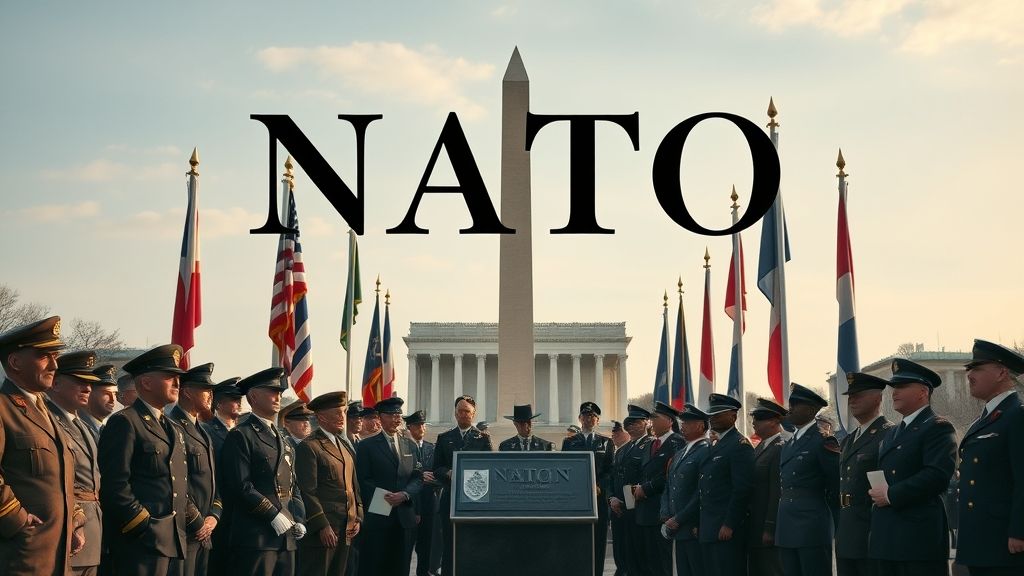
On a crisp spring morning, April 4, 1949, delegates from twelve nations gathered in the stately halls of the Department of State in Washington, D.C. The air was thick with a mix of hope, wariness, and urgent determination. The memories of the Second World War—scorching battles, shattered cities, and devastating loss—still haunted Europe. Yet these nations now looked toward the future, forging an unprecedented pact that sought to transform the fractured continent into a bastion of collective security. This was no mere treaty. It was a bold statement: that peace could—and must—be maintained by unity. The North Atlantic Treaty Organization, better known as NATO, had been born.
2. Shadows of War: Europe’s Devastation After World War II
To comprehend the magnitude of NATO’s founding, one must first grasp the abyss Europe faced at the close of the 1940s. The continent was a landscape of ruin: cities like London, Rotterdam, and Berlin lay scarred by relentless bombings; economies were shattered; millions were displaced. The horrors of two world wars had drilled a deep reluctance to confront armed conflict once again. Yet beneath the surface, anxieties brewed. The Soviet Union, victorious but stern and expansionist, cast an imposing shadow. Stalin’s Red Army occupied vast swathes of Eastern Europe, reshaping borders and regimes with a brutal hand. The West, fractured and fatigued, found itself in a precarious position—hoping to rebuild but fearing further aggression.
3. Rising Cold Clouds: The Soviet Threat Takes Shape
By the late 1940s, the wartime alliance between the Soviet Union and Western powers had splintered almost irreparably. The ideological chasm between democracy and communism widened with chilling speed. The Czech coup of 1948, in which the communists seized control, was a clarion call. The Berlin blockade of 1948-1949 further underscored the Soviet willingness to exert pressure and deprive millions of basic needs. The Western democracies realized that appeasement was no longer an option. A new approach was imperative—one that could deter Soviet ambitions and prevent yet another catastrophic war.
4. Seeds of Alliance: Early Efforts Toward Western Security Cooperation
Long before the formal creation of NATO, Western leaders quietly nurtured the idea of collective defense. The wartime cooperation had planted seeds, but with peace, differing national interests threatened to reassert themselves. The establishment of the Western Union in 1948, uniting Britain, France, Belgium, the Netherlands, and Luxembourg in a defensive compact, was a preliminary step. Yet it lacked the crucial participation of the United States. Recognizing that European security could not be upheld solely by the war-torn continent, the U.S. administration cautiously weighed its involvement. It was clear: only a transatlantic partnership could safeguard the fragile post-war order.
5. The Washington Conference: Setting the Stage for Collective Defense
From March 22 to April 4, 1949, delegates from twelve countries convened in Washington, D.C., to translate ambitions into tangible commitments. This conference ultimately culminated in the signing of the North Atlantic Treaty. Crafting the text required not just political will, but delicate diplomacy—to reassure allies and deter enemies without provoking further tensions. Topics ranged from mutual defense obligations, dispute resolution mechanisms, to military cooperation and the balance between sovereignty and alliance. The conference was a crucible where war memories clashed with hopes for peace, where fears met ideals—out of which emerged a bold framework binding nations as never before.
6. Architects of Peace: The Leaders Behind the NATO Treaty
Behind the legal phrasing and political maneuvering, the treaty was shaped by remarkable individuals whose divergent styles and visions converged on the principle of unity. Dean Acheson, the U.S. Secretary of State, was instrumental in championing American engagement. British Foreign Secretary Ernest Bevin, shaped by wartime experiences and a firm belief in collective security, pushed European nations toward cooperation. The French representative, Georges Bidault, anxious to secure his country’s recovery, brought added urgency. These diplomats grappled with compromises, negotiation battles, and the heavy burden of seeking peace in a precarious world. Their success laid a foundation that would last decades.
7. The Covenant Signed: April 4, 1949, A Pact for Mutual Protection
When the ink dried on the treaty document, it was a moment imbued with solemnity and resolve. The North Atlantic Treaty embodied more than a legal partnership; it pledged mutual aid in the face of aggression, binding signatories to stand as one. Twelve nations—Belgium, Canada, Denmark, France, Iceland, Italy, Luxembourg, the Netherlands, Norway, Portugal, the United Kingdom, and the United States—committed their armed forces, resources, and political will to a collective defense. The treaty begins with words that echo through history: “The Parties undertake, as set forth in the Charter of the United Nations, to settle any international dispute in which they may be involved by peaceful means…” This was the promise of peace, but with an ironclad edge.
8. Article 5: The Promise of Collective Defense
The heart of NATO lies in Article 5, which states that an armed attack against one or more members shall be considered an attack against all. This principle was unprecedented in its scope and ambition. It effectively created a security umbrella that transformed vulnerability into strength, deterring adversaries by signaling unified retaliation. For small European states battered by war and occupation, this pledge was not merely symbolic—it was existential. The weight of this commitment would only be tested decades later, but its existence altered the Cold War’s strategic calculus from that day forward.
9. Hesitations and Doubts: Challenges in Ratification
Despite the optimism in Washington, NATO’s birth was met with skepticism and domestic opposition in some quarters. Many worried about entangling alliances dragging Western democracies into another war. Isolationist sentiments persisted in the United States; some European governments feared losing sovereignty under American dominance. Parliamentary debates across Europe and North America reflected these tensions. Yet, through rigorous campaigning and political persuasion, ratification succeeded in each member country, revealing a shared determination to balance caution with conviction.
10. The Soviet Reaction: A World Divided Solidifies
The Soviet Union viewed NATO’s creation as a direct challenge and threat. Stalin condemned the alliance as a “military bloc,” an aggressive Western intrusion on Eastern Europe’s sphere. In response, the USSR accelerated its own military consolidation and tight control over its satellite states. The early division of Europe into East and West hardened. The foundation of NATO thus crystallized the bipolar geopolitics that would define the Cold War for the next four decades—a world split not just by ideology, but by military alliances.
11. The Role of the United States: A Commitment Beyond Isolationism
NATO marked a dramatic pivot in U.S. foreign policy. After decades of isolationism, American leaders accepted permanent engagement in European affairs. The United States dispatched troops and resources to defend distant shores, recognizing that its security was inextricably linked to Europe’s stability. This commitment was both ideological and pragmatic, anchored in the desire to prevent the spread of communism and to foster economic recovery. It was a gamble that would shape global politics profoundly, establishing America as a cornerstone of international order.
12. Integration of Military Structures: From Alliance to Command
The treaty laid a political foundation, but the challenge of turning words into action required integrated military structures. By 1951, NATO established the Supreme Headquarters Allied Powers Europe (SHAPE), with American General Dwight D. Eisenhower appointed as Supreme Allied Commander. This unified command enabled joint planning, coordination, and rapid response capabilities. It was a revolutionary approach to multinational military cooperation, transcending national military traditions for a shared defense posture that was both flexible and robust.
13. The Marshall Plan and NATO: Twin Pillars of Western Recovery
While NATO focused on security, the Marshall Plan sought economic revival. Together, these initiatives formed twin pillars stabilizing the West. The war-torn economies of Europe received vital aid facilitating reconstruction, job creation, and political stability—conditions essential for lasting peace. The link between economic health and security was clear: prosperity reduced susceptibility to extremist movements and communist appeal. NATO, therefore, was not just about guns and soldiers; it was about creating a framework in which democracy and capitalism could flourish.
14. Expanding Horizons: Prospects and Early Membership Debates
Though NATO began with twelve members, discussions quickly emerged about expansion. Greece and Turkey, both strategically significant in the Mediterranean, joined in 1952. West Germany’s entry in 1955 was particularly contentious yet crucial, demonstrating NATO’s evolving role in European security. These expansions elicited strong reactions from the Soviet bloc, further entrenching divisions. However, they also reflected NATO’s adaptability and its capacity to integrate new members into a coherent defense system.
15. The Psychological Impact: From Fear to Security in Western Europe
For millions of Europeans, NATO’s establishment provided a profound psychological reassurance. After decades of invasion and occupation, the assurance of collective defense eased anxieties. It restored national confidence and fostered a sense of belonging to a broader community. The alliance also served as a symbol of the democratic world’s resilience in the face of totalitarian threats. Yet beneath the surface, the knowledge of living in a divided and tense world lingered, coloring everyday life with both hope and caution.
16. NATO’s Impact on the Early Cold War Balance
NATO’s founding shifted the global balance decisively. It offered the West a platform to coordinate defense and diplomacy, deterring Soviet expansion without open conflict. The alliance institutionalized the Cold War divide but also provided mechanisms for communication and crisis management. It became both a shield and a stage where the geopolitical drama unfolded: from espionage to arms races, from proxy wars to negotiated détente. NATO’s presence made it clear that the Cold War would be a long contest of wills supported by solid alliances.
17. Cultural and Social Ripples: How the Alliance Changed Societies
Beyond strategy and policy, NATO influenced culture and social perceptions. Veterans’ organizations, cultural exchanges, and youth programs emerged to foster transatlantic understanding. NATO became a motif in art, literature, and political discourse—sometimes hailed as a beacon of freedom, sometimes criticized as an instrument of Western dominance. Societies in member states grappled with the dualities of security benefits and the costs of militarization, reflecting the complexity of living under the shadow of a potential global conflict.
18. Lessons Learned: NATO’s Early Years and Collaborative Defense
The early years of NATO offered invaluable lessons in alliance management. Coordinating forces from diverse nations required compromise, trust-building, and respect for national differences. The alliance experimented with joint exercises, intelligence sharing, and command unity. These experiences forged a template for collective defense that could adapt over time. NATO demonstrated that military alliances could be more than mere coalitions; they could become enduring communities with shared identities and common purposes.
19. Myths and Realities: Common Misconceptions About NATO’s Founding
Despite its significance, NATO’s founding is often misunderstood. Some view it simply as an anti-Soviet bloc, ignoring its broader goal of collective security and peace preservation. Others mistakenly believe it was solely an American project, overlooking the crucial role of European states. The notion that NATO guaranteed perpetual peace is also an oversimplification; rather, it created a framework that balanced deterrence with diplomacy. Recognizing these nuances is vital to appreciating its lasting relevance.
20. The Legacy of 1949: Setting the Stage for Modern Geopolitics
The signing of the North Atlantic Treaty was not just a Cold War milestone—it was a seismic event shaping the modern international system. NATO pioneered collective security and transnational military cooperation, models emulated worldwide. It altered notions of sovereignty and defense, embedding security within alliances rather than isolation. The framework established in Washington still echoes today, influencing global diplomacy, crisis management, and peacekeeping missions across continents.
21. Conclusion: NATO’s Enduring Promise in a Divided World
From the smoke and rubble of a war-torn Europe, twelve nations forged a pact whose reverberations endure. NATO’s founding was a courageous answer to fear and division—a leap of faith into collective security and shared responsibility. Today, amid new challenges and shifting alliances, it remains a symbol of unity, a bulwark against aggression, and a testament to the power of cooperation in shaping a safer world. The alliance that began in Washington, D.C., on that April day in 1949, continues to remind us that peace is not given but forged—through trust, commitment, and the unyielding will to stand together.
FAQs
Q1: What were the primary reasons for founding NATO in 1949?
A1: NATO was founded primarily to provide collective security against the rising Soviet threat, deter aggression, and stabilize Western Europe after World War II. The alliance sought to bind members in mutual defense to prevent future conflicts.
Q2: Which countries were the original members of NATO?
A2: The twelve original NATO members were Belgium, Canada, Denmark, France, Iceland, Italy, Luxembourg, the Netherlands, Norway, Portugal, the United Kingdom, and the United States.
Q3: What is the significance of Article 5 in the NATO Treaty?
A3: Article 5 commits members to consider an armed attack against one member as an attack against all, obliging collective defense and mutual assistance—a cornerstone principle of the alliance.
Q4: How did the Soviet Union react to NATO's creation?
A4: The USSR condemned NATO as a hostile military alliance, accelerating its own military alliances in Eastern Europe and deepening Cold War divisions.
Q5: How did NATO change the United States' foreign policy?
A5: NATO marked a decisive shift from U.S. isolationism to active engagement in European security and global affairs, committing troops and resources to collective defense beyond the Americas.
Q6: Were there any challenges to NATO’s ratification?
A6: Yes. Some political factions feared loss of sovereignty or entanglement in future wars; isolationist sentiments, especially in the U.S., posed hurdles. Ratification required significant debate but ultimately succeeded.
Q7: How did NATO influence Western Europe psychologically?
A7: NATO provided assurance against Soviet aggression, fostering confidence and a sense of security among European populations still haunted by recent wars.
Q8: What legacy did NATO’s founding in 1949 leave for future international relations?
A8: NATO established models for collective security, multinational military cooperation, and alliance politics that continue to influence global diplomacy and security frameworks today.