Table of Contents
- A Wedding in the Shadow of Empire
- Rome in 53 CE: A City of Marble and Fear
- The House of Claudius: Bloodlines, Power, and Anxiety
- Claudia Octavia: The Emperor’s Daughter in a Gilded Cage
- The Young Nero: From Lucius Domitius to Imperial Heir
- When nero marries claudia octavia: The Political Architecture of a Union
- The Wedding Day in Rome: Ritual, Spectacle, and Silent Dread
- Voices in the Crowd: How Romans Saw the Imperial Marriage
- Agrippina the Younger: The Architect Behind the Matrimonial Alliance
- Claudius on the Throne: A Father, an Emperor, and a Pawn
- Marriage as Strategy: Dynastic Politics in the Julio-Claudian Age
- Private Lives Behind Marble Walls: Nero and Octavia as Husband and Wife
- From Heir to Emperor: How the Marriage Prepared Rome for Nero’s Rule
- Unraveling Vows: Messalina, Poppaea, and the Undoing of a Dynasty
- The Tragic Fate of Octavia: From Imperial Bride to Political Victim
- Echoes Through Time: How Ancient Writers Remembered the Wedding
- Women, Marriage, and Sacrifice in Imperial Rome
- What This Marriage Reveals About Power in Rome
- Conclusion
- FAQs
- External Resource
- Internal Link
Article Summary: In 53 CE, when nero marries claudia octavia, Rome witnessed not simply a union between two young nobles, but a calculated act of political engineering at the summit of imperial power. This article reconstructs that marriage as a living moment in time: the crowded streets, the carefully staged ceremonies, the silent fears of a girl-empress and the ambitions of those who arranged her fate. We explore how Nero’s marriage to Claudius’ daughter was designed to glue together a fragile dynasty, and how that same bond later became a pretext for betrayal, divorce, and murder. From the perspective of common Romans, senators, slaves, and the imperial family themselves, the narrative traces the emotional and political aftershocks of this carefully choreographed alliance. As the story unfolds, nero marries claudia octavia again and again in the minds of contemporaries and later historians—as symbol, as cautionary tale, as the prologue to a reign of excess. We follow the long arc from the promise of stability to the reality of cruelty, examining the way gender, dynasty, and spectacle intersected in this marriage. In doing so, the article shows how a single wedding, however ornate, could not conceal the fractures inside Rome’s most powerful household.
A Wedding in the Shadow of Empire
On an ordinary Roman morning in 53 CE, the streets of the capital trembled with an oddly ceremonial kind of bustle. Bakers fired their ovens earlier than usual. Perfume sellers dusted amphorae that would never enter the homes of the poor but would instead be carried into marbled atriums. Soldiers polished armor that would gleam in the early light, less for battle than for parade. News had spread through the city’s tangled alleys and colonnaded forums: the emperor’s daughter would marry the emperor’s stepson. Rome would witness a wedding that was meant to quiet anxieties about succession, to wrap the empire’s future in the safe illusion of family harmony.
This was the day nero marries claudia octavia, though few in the crowd, craning their necks for a view of the imperial cortège, could yet guess its long-term consequences. To them, the marriage looked like a familiar Roman story dressed in imperial scale: a political alliance sealed with garlands and incense. Nero, still known as a promising young noble with a poetic streak, would receive more than a wife; he would receive the visible stamp of legitimacy that came with marrying the biological daughter of the reigning emperor, Claudius. Octavia, small and silent in the historical record, would receive something far more ambiguous—an imperial husband whose ambitions were shaped not only by his own desires but by the relentless will of his mother, Agrippina the Younger.
But this was only the beginning of the story. In the shadows of Rome’s monuments, senators whispered about what the wedding meant for their own precarious positions. Old aristocratic families muttered that the Julio-Claudian line was stretching itself thin, binding and rebinding its members in unions that tested even Roman tolerance for dynastic intermarriage. The wedding was both a public holiday and an unmistakable reminder that in this city, a single family claimed ownership of the state. The union of Nero and Octavia was supposed to make that claim unassailable.
Yet behind the celebrations, there was unease. Claudius had already adopted Nero as a son and heir, even though he had a biological son, Britannicus. Was this marriage to Octavia meant to further push the natural heir into the background? Or was it genuinely a gesture of unity, an attempt to knit together rival branches of the imperial household? The answers depended on whom you asked—and whether they dared to speak honestly. To understand why this wedding mattered so deeply, we must first step back into the Rome of 53 CE, a city both triumphant and afraid.
Rome in 53 CE: A City of Marble and Fear
Rome in 53 CE dazzled with surfaces that told a flattering story about its power. Marble façades glowed on temples reshaped by Augustus and his successors. Triumphal arches displayed carved victories won in distant lands most citizens would never see: Britain, Mauretania, Thrace. Aqueducts carried water across miles of countryside so that fountains could murmur in patrician gardens; yet just beyond these estates, tenements of wood and brick listed precariously, packed with the labor that kept the city alive.
It’s astonishing, isn’t it, how a city can look so stable and yet rest on constant anxiety? The Julio-Claudian dynasty had held power since Augustus, but each emperor’s accession had carried the taint of improvisation. Augustus had won power through civil war and careful myth-making. Tiberius had been a reluctant successor, shadowed by suspicion. Caligula, for a brief moment a golden hope, had descended into cruelty and theatrical excess before he was assassinated. Claudius, shuffled aside for much of his life due to physical impairments and perceived oddities, had arrived on the throne almost by accident when the Praetorian Guard pulled him from hiding after Caligula’s murder.
By 53 CE, Claudius had ruled for over a decade, and his governance had brought administrative reforms, legal changes, and new territories under Roman control. But his reign also bore the scars of palace intrigue. His previous wife, Messalina, had been executed after an alleged mock marriage and conspiracy against him. The court was understood to be a dangerous place where proximity to the emperor meant both opportunity and risk. People rose and fell quickly in this environment, leaving a residue of fear that seeped out into the broader elite.
The common people, meanwhile, navigated their own complexities. For many urban Romans, what mattered most were grain supplies, public entertainments, and the sense that the emperor cared, at least performatively, for their welfare. They might cheer a wedding procession not because they adored Nero or Octavia but because such ceremonies meant games, distributions, spectacles, and the reassuring rhythm of imperial ritual. An orderly succession meant fewer chances of civil unrest or purges that might disrupt the fragile systems that kept food and work flowing.
On this stage of precarious stability, the spectacle in which nero marries claudia octavia took on added importance. The empire needed a story about continuity; it needed to believe that one emperor would flow into the next like a well-planned procession. A wedding was a familiar form through which to tell that story, binding personal union to public expectation. But beneath the scripted surface of ritual lay the reality that the imperial house was divided by competing interests and personalities, each with their own reading of what this marriage should achieve.
The House of Claudius: Bloodlines, Power, and Anxiety
The Julio-Claudian dynasty was less a family in the domestic sense and more a living apparatus of power. Relatives were at once kin, assets, and potential threats. Marriages, adoptions, and divorces were tools to shape political outcomes. To understand why it mattered that nero marries claudia octavia, one must first trace the tangle of blood that connected them.
Octavia was the daughter of Emperor Claudius and his notorious third wife, Valeria Messalina. Nero, born Lucius Domitius Ahenobarbus, came from another branch of the same extended clan. His mother, Agrippina the Younger, was the great-granddaughter of Augustus. Through her, Nero was linked directly to the founding figure of the dynasty, a connection Agrippina never forgot and never allowed others to ignore.
The house was haunted by memories of earlier tragedies: Germanicus, the beloved general whose suspicious death under Tiberius had shaken the empire; Agrippina the Elder, exiled and starved; the young heirs Gaius and Lucius, carefully groomed by Augustus, dead before they could inherit. These losses had made succession a treacherous question. It was no longer clear that blood alone could guarantee rule; instead, the dynasty had begun to rely heavily on adoption and strategic marriage to construct workable lines of succession.
Claudius, for all his power, knew this uncertainty well. His own path to the purple had been improbable. Some in the Senate still viewed him as a scholar-emperor, more at home with scrolls than in armor, propped up by the Praetorian Guard. His son Britannicus offered a chance for a less precarious future—native-born, legitimate, easy to frame as the natural next emperor. Yet in 50 CE, due largely to Agrippina’s maneuvers, Claudius had adopted Nero as a son and given him precedence in public honors.
The balance within the household shifted. Britannicus was still very much a child; Nero was a teenager moving quickly into adulthood. Senators and equestrians looked at the two boys and saw not just personalities but possible futures for Rome: different counselors, different patronage networks, different degrees of continuity or change. Marriage to Octavia, Claudius’ daughter, would further privilege Nero, making him both adopted son and son-in-law. It was a doubling-down on a particular version of the dynastic story.
But anxiety lingered. If Nero and Octavia produced heirs, Britannicus’ position would be even more fragile. If they did not, Rome might face another period of uncertainty. Agrippina, whose ambition has become almost legendary in the historical tradition, was keenly aware that the window of opportunity to secure her son’s future might be narrow. The wedding in 53 CE, therefore, emerges not as an idyllic family moment but as one move in a chess game that stretched across the entire imperial structure.
Claudia Octavia: The Emperor’s Daughter in a Gilded Cage
Claudia Octavia enters the historical record almost as a shadow. We know little of her voice, her preferences, her daily emotions. Ancient authors—Tacitus, Suetonius, Cassius Dio—record her primarily in terms of what was done to her rather than what she chose. Yet it is precisely within that silence that we can glimpse the shape of her life, defined by expectations she could neither refuse nor reshape.
Born into the imperial family, Octavia was from the start more symbol than child. As the daughter of Claudius and Messalina, she represented the continuity of the line, the promise that the Julio-Claudians would not simply fade after a few reigns. Even as a girl, her upbringing would have been steeped in etiquette and watchfulness—how to move through crowded banquets without drawing undue attention, how to display modesty without seeming weak, how to listen to conversations laden with political implications without betraying reaction.
One can imagine her education: Greek and Latin literature, music, perhaps some philosophy filtered through a moral lens intended for noblewomen. She would have been taught the virtues Roman moralists endlessly rehearsed for women of rank: pudicitia (chastity), constantia (steadfastness), and obedientia (obedience). Octavia’s body, her fertility, her alliances were never fully hers; they belonged to the narrative needs of the dynasty.
By 53 CE, Octavia was not yet a woman in our modern sense, but in Roman terms she stood at the threshold of marriageable age. Many noble girls were promised in marriage from early childhood; some, like Octavia, grew up already knowing they were pieces in a larger design. That knowledge did not erase whatever personal fears or fragile hopes she might have had, but it did constrict them. The day nero marries claudia octavia, she likely understood that whatever the emotional content of her union with Nero, her fundamental role was to cement his legitimacy and produce heirs with faultless lineage.
Later, when Nero sought to cast her aside, the memory of Octavia’s earlier conduct would become politically important. Ancient sources make much of her perceived innocence and virtue—qualities that, when contrasted with Nero’s extravagance, turned her into a potent symbol of the old, austere Roman ideal. During her lifetime, however, those same virtues might have felt like little more than the bars of an invisible cage, demanding silent endurance. The marriage of 53 CE tightened those bars further, even as its ceremonies celebrated her as the radiant daughter of an emperor.
The Young Nero: From Lucius Domitius to Imperial Heir
Before nero marries claudia octavia, he is still, in some sense, two people at once: Lucius Domitius Ahenobarbus, a scion of a noble but not directly ruling line, and Nero Claudius Caesar, the newly minted imperial heir. Adoption in Rome was not merely a legal fiction; it was a re-scripting of identity. With Claudius’ adoption of Nero, the young man’s very name was rearranged to carry the weight of imperial history.
Nero’s father, Gnaeus Domitius Ahenobarbus, had a reputation for ruthlessness and arrogance—a man who, according to some accounts, once drove his chariot over a child in the road. His mother, Agrippina, combined an impeccable lineage with a tenacity born of trauma. Exiled by her brother Caligula, widowed, and later recalled, she understood deeply how quickly fortune could reverse. For her son, she envisioned not mere survival but domination.
Nero’s upbringing, therefore, was to be a project of refinement and display. He was educated by the philosopher Seneca, who tutored him in rhetoric, literature, and the philosophical traditions that claimed to cultivate virtue. The future emperor learned to recite, to perform, to shape words into persuasive tools. He cultivated a talent for music and poetry, skills that would later scandalize some in the elite who thought such pursuits beneath an emperor.
Yet for all this cultural varnish, the politics of his elevation remained raw. Nero’s status as adopted heir existed alongside the presence of Britannicus, Claudius’ natural son, only a few years younger. The two boys, one can imagine, were constantly compared—not just in their studies, but in public rituals where rank and seating order signified future importance. Every honor given to Nero over Britannicus sent a signal through the Senate and army alike.
In this context, marriage to Octavia was a logical next step. It fused the two lines of Claudius’ household: the adopted heir and the born princess. For Nero, it was a triumph of his mother’s strategy; for Octavia, it was the confirmation of a path chosen for her, not by her. For Claudius, it was a bet that he could hold together a complicated family long enough to deliver a smooth succession. The young man who walked toward that wedding, dressed in ceremonial splendor, was not merely a groom. He was a project in progress, the product of years of positioning that would soon reach a decisive phase.
When nero marries claudia octavia: The Political Architecture of a Union
When historians write that nero marries claudia octavia in 53 CE, the simplicity of the phrase conceals an intricate political architecture. This was not a private decision between two families; it was an operation that involved the emperor, the Senate, the Praetorian Guard, and the wider Roman elite. Every aspect of the union was crafted to send specific messages about power, continuity, and legitimacy.
First, the timing. The marriage came several years after Nero’s adoption by Claudius in 50 CE. Adoption alone had been an enormous step, but it still left open the possibility that Britannicus might eventually assert stronger claims as Claudius’ natural son. By arranging a marriage between Nero and Octavia, Claudius and Agrippina were effectively doubling down on the policy of elevation. Nero would not just be an adopted son; he would be the husband of the emperor’s daughter. His bond to the ruling family would be biological through his bride and legal through adoption. In a society that revered ancestry, such layering of claims mattered.
Second, the legal and ceremonial framing. Roman law placed restrictions on certain degrees of kinship, but imperial families often navigated or reinterpreted these boundaries to maintain dynastic closure. The Julio-Claudians were no strangers to what we might call today “family politics” of a particularly intense kind. By casting the marriage as necessary for the stability of the empire, the regime presented any moral or legal scruples as small compared to the needs of Rome.
Third, the public narrative. In imperial edicts, coins, inscriptions, and orchestrated rumors, the marriage was presented as a blessing for the Roman people. It promised heirs who would carry the dual bloodlines of Claudius and Agrippina, heirs who would embody both the stability of the current reign and the glamour of the Augustan legacy. Tacitus, writing decades later, would observe in his Annals how such public narratives often masked more ruthless calculations beneath them, but for many contemporary Romans, the story carried some plausible comfort.
Finally, the personal stakes. For Agrippina, the marriage signaled her victory over rivals at court, particularly those who might have favored Britannicus or another candidate. For Claudius, it was an assertion that he could guide the future of Rome rather than leave it to chance or posthumous intrigue. For Nero and Octavia, it meant the formal end of childhood; their bodies, their reputations, their potential offspring now belonged to the stage of imperial history. The day nero marries claudia octavia thus crystallized years of maneuvering into a single, shimmering moment of apparent unity that concealed, more than it resolved, the underlying tensions of the regime.
The Wedding Day in Rome: Ritual, Spectacle, and Silent Dread
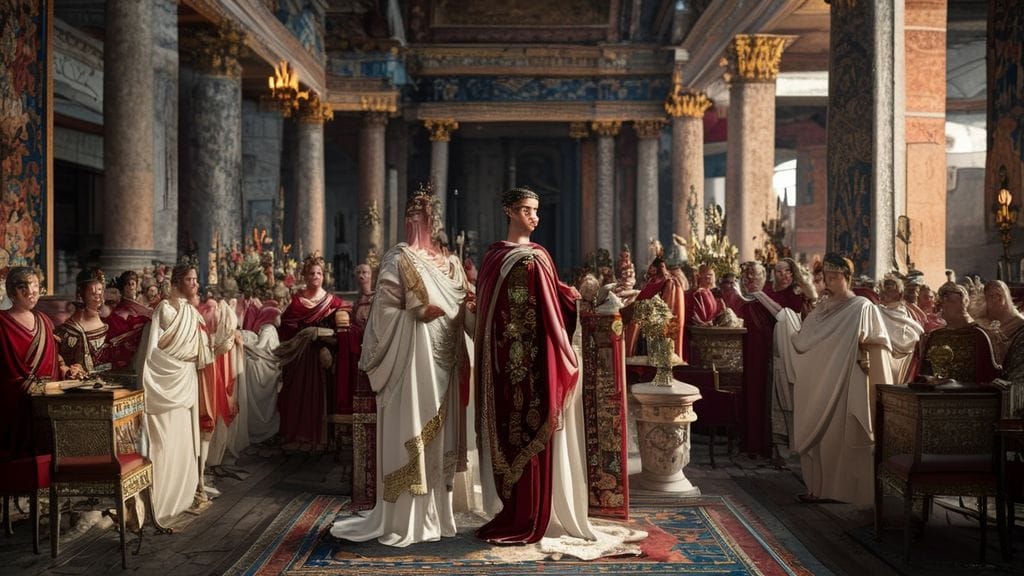
The precise details of the wedding ceremony in which nero marries claudia octavia have not survived, but Roman custom and fragmentary references allow us to reconstruct its likely contours, and from them, its atmosphere. Imperial weddings were not ordinary family affairs; they were state occasions that turned private vows into public theater.
Imagine the streets near the Palatine Hill swept clean and lined with soldiers in gleaming armor. The morning air is thick with incense. Musicians play flutes and horns as crowds press forward, jostling for a view. Vendors sell honey cakes and cheap wine to those willing to wait for hours. Rumors mingle with the smell of sweat and perfume: “They say Britannicus is nowhere to be seen.” “They say Agrippina herself designed the procession.” “They say this will make Nero emperor one day.” The city hums with expectation.
Octavia, veiled in the traditional saffron-colored flammeum, would have been escorted through the streets, flanked by attendants and watched by a populace that knew her face from coins and rumors but had rarely seen her in person. Children might laugh and point; older women might murmur prayers for fertility and safety, recalling their own weddings in far humbler surroundings. For all its imperial gloss, the ritual tapped into something familiar to many Romans: the transfer of a woman from the household of her father to that of her husband.
Nero, dressed in finery that highlighted his status as both heir and groom, would await her, surrounded by the city’s leading men. Senators in white-bordered togas. Priests ready to perform sacrifices. Representatives of powerful families, including those perhaps quietly fearful of the future such a marriage foretold. The words spoken—oaths of fidelity, prayers to Juno, the goddess of marriage—would echo the formulae used across Rome, but here every phrase bore double weight. A promise for personal union was also a promise that the empire would not crumble after Claudius.
Yet behind the celebrations, one can sense a quiet dread. For Octavia, perhaps the dread was more immediate: leaving the familiar palace arrangements for a new role as wife to a young man whose ambitions and appetites she could not fully know. For Nero, it might have been the dread of expectation, of being fixed publicly in a role he would later try to escape when he sought a more passionate, less politically encumbered union. For others at court, the dread came from what this alliance implied for alternative futures—especially for Britannicus and those aligned with him.
As the ceremony concluded and offerings were made to the gods, as guests reclined at lavish banquets where wine flowed and delicacies were piled high, the city basked in the glow of spectacle. Torchlight would have flickered on marble columns long into the night. Poets composed flattering verses. Orators praised the wisdom of Claudius in securing the succession. And somewhere, perhaps unseen in a quieter corner of the palace, Britannicus understood that the marriage of his sister to his rival had further dimmed his own chances.
Voices in the Crowd: How Romans Saw the Imperial Marriage
Most Romans, like most people in any age, did not read senatorial decrees or consult deep genealogical charts. They experienced imperial events through rumor, spectacle, and the tangible effects on their daily lives. When nero marries claudia octavia, the meaning of that union is filtered through dozens of different perspectives at street level.
For a grain merchant at the Tiber docks, the wedding might have been a logistical boon: increased demand from households preparing feasts, a rush of orders from the palace kitchens, a chance to earn a few extra sesterces. His interest in the marriage revolved less around dynastic succession and more around whether the coming emperor, Nero, would maintain the grain subsidies that kept the urban population fed and relatively calm.
A veteran soldier, retired to a modest house on the outskirts of the city, might have watched the procession with more political awareness. He had seen emperors come and go, heard whispers about assassination and plots. To him, the marriage could look like a sober attempt to prevent another crisis like the one that produced Claudius. Stability meant his pension remained secure and his sons less likely to be dragged into civil war.
A senator, seated in a place of prominence at the ceremony, would interpret the event with more calculation. He might have privately favored Britannicus, believing that a biological son of Claudius, raised entirely within the current reign, would be a safer bet than Nero, whose mother’s formidable ambition made many uneasy. Yet he could not openly oppose the marriage; to do so would be to challenge the emperor’s chosen narrative of the future. Instead, he applauded, smiled, and made a mental note of which colleagues seemed most enthusiastic in their praise of Nero.
Women of the elite, watching Octavia’s transformation into wife and—so the hope went—future mother of emperors, might have felt a complex blend of envy, sympathy, and fear. On the one hand, she was stepping into the highest possible form of Roman womanhood. On the other, they knew that “highest” in this case also meant most exposed to danger. A noblewoman’s reputation could be smeared, her alliances turned against her, her body made the object not only of desire but of political strategy. Octavia’s beauty and youth, so praised in official rhetoric, were paradoxically sources of vulnerability.
For slaves and freedmen within the imperial household, the marriage was a shift in the internal balance of power. Some would now be assigned to serve Nero and Octavia, others to Britannicus, others loyally clinging to Agrippina’s orbit. Their fates were tied to which patrons ultimately prevailed. Around the edges of the wedding festivities, small, practical decisions were made: who would sleep in which rooms, who would manage which accounts, who would have the ear of the new couple. In these quiet rearrangements of service and proximity, the contours of future influence were already taking shape.
Agrippina the Younger: The Architect Behind the Matrimonial Alliance
If Nero and Octavia were the public faces of the wedding, Agrippina the Younger was its principal architect. Few figures in Roman history have attracted as much fascination and condemnation as she. Daughter of the admired Germanicus, sister of the notorious Caligula, niece and later wife of Emperor Claudius, and mother of Nero, she moved through the corridors of power with a determination honed by both privilege and trauma.
Agrippina’s motives in engineering the moment when nero marries claudia octavia were layered. On the most immediate level, the marriage cemented Nero’s place as heir, aligning him unmistakably with the ruling branch of the family. But on another level, it reinforced Agrippina’s own centrality. As mother of the groom and wife of the bride’s father, she stood at the crossroads of two imperial lines. In the symbolic grammar of Roman politics, that gave her a claim not merely to influence but to indispensability.
Ancient sources, particularly Tacitus in the Annals, paint Agrippina as ruthless, perhaps even murderous in her pursuit of power. Modern historians, while often skeptical of the most lurid accusations, broadly agree that she was exceptionally skillful in exploiting the limited avenues available to women at court. She could not hold formal office, but she could orchestrate alliances, manage patronage, and stage public gestures that subtly asserted her authority—such as appearing alongside Claudius on coinage or receiving foreign embassies, a role traditionally reserved for the emperor.
The marriage of Nero and Octavia was, in this sense, both a continuation and an escalation of her strategy. By aligning Nero with Octavia, she could marginalize Britannicus and those who backed him. By presenting the union as Claudius’ will, she cloaked her ambitions in the mantle of wifely loyalty and maternal concern. It was a delicate balance: to appear too overtly dominant risked backlash; to remain invisible meant ceding ground to others less sympathetic to Nero’s cause.
Yet Agrippina’s very success sowed seeds of later disaster. Nero, once fully in power, would come to resent the woman who had so carefully constructed his path. Octavia, caught between a commanding mother-in-law and an increasingly unstable husband, would have little room for independent action. The architecture Agrippina built around the marriage was solid in the short term but brittle in the long, incapable of accommodating the shifting moods and desires of those it bound together.
Claudius on the Throne: A Father, an Emperor, and a Pawn
While Agrippina drove much of the policy surrounding the marriage, Claudius was still emperor in 53 CE, and his consent was essential. His role in the story in which nero marries claudia octavia is ambiguous: was he a convinced strategist, a hesitant collaborator, or a manipulated husband? The sources disagree, but all insist that he was no mere bystander.
Claudius had spent much of his life underestimating and being underestimated. Kept from major office under Tiberius, mocked by Caligula, he had turned his energies to scholarship, writing histories of the Etruscans and Carthaginians. When he became emperor, some expected a weak ruler easily controlled by advisers. Instead, he showed a surprising capacity for administrative work, expanding citizenship to provincial elites and reforming aspects of the legal system.
Yet his domestic life remained turbulent. The scandal surrounding his previous wife, Messalina—accused of bigamy and conspiracy—had shaken him profoundly. In choosing Agrippina as a new wife, he had turned to a woman with impeccable lineage but also a reputation for assertiveness. It was under her influence that he adopted Nero and began to shape the succession in favor of this new heir.
In consenting to the marriage between Nero and Octavia, Claudius may have believed he was shoring up his dynasty’s foundations. The union promised a line of heirs who would carry his own blood through Octavia and the Augustan heritage through Nero. To an emperor keenly aware of how fragile power could be, such a combination must have seemed appealing. Some ancient authors claim he later regretted giving too much ground to Agrippina’s plans, but by the time doubt set in—if it truly did—it was likely too late.
As father of the bride, Claudius participated in the rituals of giving Octavia away, though the symbolism was complex. He was not simply transferring her from his guardianship to that of another household; he was handing her to the man he had chosen as political heir over his own son. The gesture must have resonated with those watching: an emperor willing to bend personal paternal instincts, if he had them, to the perceived needs of the state. Whether he fully foresaw the consequences—the marginalization and eventual death of Britannicus, the later tragedy of Octavia—we cannot know. But his role reminds us that even emperors, at the center of vast power structures, could be swept along by currents they only partly controlled.
Marriage as Strategy: Dynastic Politics in the Julio-Claudian Age
In Rome’s imperial system, marriage among the ruling elite was never just about affection. It was currency, policy, and propaganda. The story in which nero marries claudia octavia fits into a broader pattern that stretched back to Augustus, who famously arranged and rearranged marriages within his family to secure loyalty and succession. The Julio-Claudian dynasty was built not only on victories and laws but on calculated unions.
Consider the precedents. Augustus married his daughter Julia to multiple prominent men—first to Marcellus, then to Agrippa, then to Tiberius—each time seeking to bind potential heirs more tightly to his own line. Tiberius, in turn, was compelled to divorce his beloved first wife, Vipsania, to marry Julia, a political union that embittered him. Caligula’s brief reign also featured marriages that raised eyebrows, including a notorious fascination with his sisters that later authors would interpret through a lens of decadence and taboo.
Within this context, nero marries claudia octavia as part of a familiar Roman script with particularly high stakes. The union aimed to consolidate the Julio and Claudian branches, emphasizing a continuity that transcended the individual quirks of each emperor. An heir produced by Nero and Octavia would carry nearly every major strand of the dynasty’s blood, making it even harder for rival claimants to present themselves as legitimate alternatives.
The tools of propaganda reinforced this strategy. Coins might depict the couple together, presenting a visual shorthand for unity. Official pronouncements framed the marriage as a blessing for Rome, invoking the gods’ favor on the young pair. By sacralizing the union, the regime tried to shift it from the realm of human choice to that of divine sanction. To question the marriage’s political implications, therefore, risked appearing impious as well as disloyal.
Yet the very intensity of this strategy carried dangers. When so much rested on one union, its failure—emotional, sexual, or political—could destabilize more than just two lives. Nero’s later dissatisfaction with Octavia, his attraction to Poppaea Sabina, and the ultimate dissolution of the marriage would not simply be family drama; they would be ruptures in the carefully woven fabric of dynastic narrative. In that sense, the glittering day on which they were wed contained, already folded within it, the seeds of its eventual unraveling.
Private Lives Behind Marble Walls: Nero and Octavia as Husband and Wife
The sources tell us far more about the public consequences of the marriage than about the day-to-day reality of Nero and Octavia as a married couple. Yet we can, with careful imagination grounded in evidence, trace the outline of their private world. It was a world of corridors and courtyards, of formal dinners and whispered conversations, where personal feelings had to navigate the dense web of imperial expectations.
After the wedding, Octavia would have moved into spaces designated as part of Nero’s domain within the palace complex. There, she occupied the role of uxor, wife, a term that in Roman culture implied not just companionship but partnership in managing the household. In an ordinary aristocratic home, this might have meant overseeing slaves, managing finances, and participating in social hospitality. In the imperial household, such duties were magnified and complicated by politics. Every invitation, every favor granted, every gesture of kindness or coldness could be interpreted as a signal of future influence.
Nero, for his part, was still not emperor at the time of the marriage. He was heir, endowed with honors and increasingly accustomed to public deference, but still formally under Claudius’ authority. In private, he might have felt a mixture of exhilaration and resentment—exhilaration at his elevated status, resentment at the constraints still imposed on him by older figures: Claudius, Agrippina, senior advisers like Seneca and Burrus. The marriage to Octavia, arranged rather than chosen, was one more structure pressing in on him.
Ancient authors later claim that Nero found Octavia dull or frigid, lauding her chastity as if it were a flaw in the eyes of a husband hungry for excitement. Whether this is fair to her is doubtful; such portrayals seem colored by the need to justify Nero’s behavior. Still, it is likely that the relationship lacked the mutual passion that might have helped it withstand political pressures. Nero’s interests in performance, music, and later more extravagant pleasures may have found little echo in Octavia’s more traditional, perhaps more introverted disposition.
Within this mismatch lay human tragedy. The same ceremony that had enshrined Octavia as the embodiment of Roman matronly virtue also left her little room to adapt or negotiate. To deviate from the script of modesty and loyalty would expose her to accusations of immorality; to adhere to it made her vulnerable to being labeled cold and unappealing by a husband seeking grounds to replace her. In the private quarters of the palace, the emotional gulf between them widened, even as the public myth of their union persisted—for a time—as a cornerstone of dynastic stability.
From Heir to Emperor: How the Marriage Prepared Rome for Nero’s Rule
Two years after the day nero marries claudia octavia, the marriage’s political purpose would be tested dramatically. In 54 CE, Claudius died—suddenly, under circumstances that would be debated for centuries. Ancient historians, never reluctant to see poison where death came at a convenient time, widely suspected Agrippina of orchestrating his end, perhaps via poisoned mushrooms. Whether or not this is true, the result was clear: the throne was vacant, and the carefully staged narrative of succession sprang into action.
Because Nero had already been adopted and publicly married to Octavia, the transition to his rule could be presented as smooth and legitimate. The Praetorian Guard, whose support was critical, had been prepared to see Nero as the natural next ruler. Senators, already accustomed to treating him with quasi-imperial honors, voted him the powers of the principate with little visible resistance. Britannicus, still young and now increasingly isolated, found himself sidelined—his sister’s marriage to Nero having symbolically shifted her allegiance and, by implication, the dynasty’s center of gravity.
In these tense days, the fact that nero marries claudia octavia only two years earlier took on immense significance. The marriage reassured conservative elements that Nero was not an outsider usurping the throne, but the husband of the emperor’s own daughter, a man woven into Claudius’ line. Octavia, silent in the political record, nonetheless served as a living bridge between old and new. Her presence at Nero’s side, her very existence as Claudius’ daughter and Nero’s wife, softened what might otherwise have felt like a more jarring transition.
The early months of Nero’s reign were, by many accounts, relatively moderate. Guided by Seneca and Burrus, he presented himself as a princeps attentive to the Senate and generous to the people. In this phase, the public image of the young imperial couple still aligned with optimistic expectations: he, the cultured and promising ruler; she, the decorous and dignified empress. To many observers, the marriage appeared to be doing exactly what it had been designed to do—embodying continuity and stability at the heart of the empire.
But beneath the calm surface, fault lines were already visible. Agrippina chafed at any attempts by Nero’s advisers to limit her influence. Nero, increasingly aware of his own authority and desires, began to resent the web of obligations—filial, marital, political—wrapped around him. Octavia, raised to be a symbol of unity, would find herself, over the coming years, redefined as an obstacle to her husband’s ambitions. The union that had once smoothed Nero’s path to power would, in time, become a barrier he was determined to break.
Unraveling Vows: Messalina, Poppaea, and the Undoing of a Dynasty
The marriage in which nero marries claudia octavia did not exist in a vacuum of affection alone; it was part of a longer pattern of volatile unions at the top of Roman power. Claudius’ earlier marriage to Messalina had ended in blood, with her execution on charges of adultery and treason. The court had already learned that the emperor’s marital bed could be a political battlefield where alliances were made and unmade with lethal consequences.
During Nero’s reign, that pattern intensified. Enter Poppaea Sabina—a woman of renowned beauty and ambition, married first to Rufrius Crispinus and later to Otho before catching Nero’s eye. Poppaea represented everything Octavia did not: glamour, daring, and a willingness to operate within the ambiguities of imperial desire. To Nero, increasingly bored with the disciplined façade of his early reign and hungry for indulgence, she became not merely a lover but a possible new center of his world.
As Nero’s infatuation with Poppaea grew, his marriage to Octavia came to feel like a constraint rather than a foundation. The same political logic that had once made the union so attractive—its embedding of Nero in Claudius’ line—now made it difficult to dissolve. Divorcing the emperor’s daughter was no trivial matter. It touched not just intimate life but the very story Rome told itself about the continuity of rule.
Yet Nero had precedents to draw upon. Had not his own father-in-law, Claudius, executed one wife and taken another when it suited political needs? Had not earlier emperors and leading men rearranged marriages to better align with shifting strategies? The difference, however, was that Nero’s motives appeared rooted less in statecraft than in personal passion and impatience, and this distinction did not go unnoticed.
Poppaea, according to later accounts, pressed Nero to free himself from Octavia, mocking the empress’ supposed coldness and her failure to produce an heir (for which Nero himself may well have been responsible). Court informers and opportunists sensed which way the wind was blowing and began to frame narratives that cast Octavia in an unflattering light. The very qualities that had once made her an ideal imperial bride were recoded as liabilities.
What had begun as a marriage intended to stabilize the dynasty was now unraveling under the pressure of erotic politics and imperial caprice. The path from nero marries claudia octavia to Nero divorces and condemns Octavia was not a straight line, but at each turn, we see how the fusion of personal desire and absolute power can corrupt the original promise of a political union. The imperial household, meant to embody Roman order, again became a cautionary tale about the danger of concentrating too much in the hands of too few.
The Tragic Fate of Octavia: From Imperial Bride to Political Victim
For Octavia, the girl who had once walked through Rome’s streets to marry the heir with all the city watching, the later years of Nero’s reign brought a descent from ceremonial radiance into fear and isolation. Her tragedy illustrates with painful clarity what it meant to be a woman at the intersection of dynasty and autocracy.
In 62 CE, nearly a decade after nero marries claudia octavia, Nero moved decisively to sever the tie. He accused Octavia of barrenness, that most loaded of charges in a culture that tied female worth so closely to fertility. Soon accusations of adultery followed—a pattern chillingly familiar from the case of Messalina and from earlier scapegoating of imperial women. To label a noblewoman unfaithful was not just to attack her personally; it was to delegitimize any children she might bear and to paint her as morally unfit to stand beside the emperor.
The charges against Octavia were flimsy, and many knew it. Tacitus records that public opinion sympathized with her, viewing her as a victim of Nero’s desire to marry Poppaea rather than as a genuine wrongdoer. Ordinary Romans, who had once cheered the day nero marries claudia octavia, now found in Octavia’s plight a symbol of the cruelty that unrestrained power could visit upon even the most exalted. According to some accounts, protests erupted in Rome when she was first banished, with images of Poppaea toppled and Octavia’s name shouted in the streets.
But popular sympathy was insufficient protection. Nero, enraged by displays of support for his discarded wife and encouraged by those who saw advantage in demonstrating loyalty to his new queen, moved from banishment to execution. Octavia was exiled to the island of Pandateria, a grim echo of earlier exiles within the dynasty. Soon after, in 62 CE, she was killed. Some sources speak of her veins being opened; others of harsher methods. What unites them is the assertion that her end was unjust and pitiable.
In death, Octavia gained what she had been denied in life: a strong voice in the narrative. Roman historians, often conservative in their values, retroactively cast her as the epitome of old-fashioned Roman virtue—chaste, modest, loyal, and grievously wronged. Her marriage to Nero, once hailed as a brilliant dynastic solution, now appeared in hindsight as the beginning of a long martyrdom. The phrase nero marries claudia octavia, which in 53 CE had sounded like a promise of stable continuity, came to be remembered instead as the first act in a tragedy in which the bride was sacrificed to the changing whims of power.
Echoes Through Time: How Ancient Writers Remembered the Wedding
The event in which nero marries claudia octavia did not vanish with the lives of those directly involved. It continued to echo in the pages of historians and biographers who shaped later understanding of the Julio-Claudian age. Their accounts are not neutral; they are charged with moral judgment, political nostalgia, and fascination with the interplay of sex and power at the imperial court.
Tacitus, writing in the early second century, offers perhaps the most influential portrayal in his Annals. He frames the marriage primarily in terms of Agrippina’s ambition and the manipulation of Claudius. For him, the wedding is one more step in a sequence of events that culminates in Nero’s tyrannical excesses. Octavia appears as a tragic figure, her initial elevation followed by undeserved suffering. Tacitus’ Rome is a place where virtue is constantly threatened by corruption—an interpretive lens through which the marriage takes on a dark, foreshadowing quality.
Suetonius, in his Life of Nero, is less concerned with political nuance and more with character sketches and sensational anecdotes. He mentions the marriage but dwells more on Nero’s later conduct—his artistic pretensions, his cruelty, his scandalous relationships. In Suetonius’ telling, the wedding becomes a kind of prelude, an almost perfunctory scene setting up the more lurid episodes of Nero’s reign. The solemnity of the vows taken in 53 CE recedes behind tales of banquets, performances, and murder.
Cassius Dio, writing in Greek in the third century, adds his own interpretive layer, blending earlier sources with rhetorical flourish. By his time, the Julio-Claudian dynasty was long gone, replaced by new lines of emperors, but the fascination with its rise and fall remained. To Dio, the story that begins when nero marries claudia octavia serves as a didactic warning about dynastic excess and the dangers of allowing one family to monopolize state power.
Modern historians, such as Miriam Griffin and Anthony Barrett, approach these ancient accounts with healthy skepticism, teasing apart exaggeration from plausible fact. They note how Octavia’s portrayal may have been idealized as a counterpoint to Nero’s increasingly damning image, and how Agrippina’s ambition might have been amplified to serve male authors’ anxieties about powerful women. Yet even critical scholarship acknowledges that the marriage was a pivotal node in the web of Julio-Claudian politics—an event whose symbolic weight far outstripped the brief span of its apparent harmony.
Women, Marriage, and Sacrifice in Imperial Rome
The story that begins when nero marries claudia octavia illuminates not only the fate of a particular couple but the broader condition of elite women in imperial Rome. For them, marriage was not a private matter of choice or romance; it was the primary avenue by which they were woven into the fabric of political life, often at great personal cost.
Roman law and custom granted women of the upper classes certain forms of influence and autonomy—control over dowries, networks of clients, the ability to host salons and patronize artists or philosophers. Yet these powers were almost always mediated through male relatives: fathers, husbands, brothers, sons. A woman like Octavia could be, in legal terms, transferred from one male guardian to another, her consent assumed or ritualized rather than deeply considered.
In this context, the fact that nero marries claudia octavia was less a unique imposition and more an extreme case of a general pattern. Many aristocratic girls were married in their early teens to men they barely knew, often much older, in arrangements designed to consolidate wealth or influence. If the husband was kind and the political winds gentle, such unions could allow for quietly fulfilling lives within the constraints of the time. If, however, the husband’s fortunes rose or fell dramatically, the wife became collateral damage.
What sets Octavia’s case apart is the scale of the stakes. Her marriage was explicitly tied to the empire’s future, making her conduct and her womb matters of state. When she failed—so it was framed—to produce an heir, and when Nero’s desires turned elsewhere, her removal became a public act with public justifications. Her banishment and death were not framed as the private brutality of a cruel husband but as necessary measures against a supposedly unfaithful and barren empress. The gendered double standard is stark: Nero’s infidelities were tolerated, even celebrated by some, while Octavia’s invented indiscretions justified her destruction.
Through Octavia, we see how Imperial Rome converted women’s bodies into battlegrounds where larger struggles over legitimacy and morality were fought. Her story invites us to listen more carefully to the faint traces of other women at court—Agrippina, Poppaea, Messalina—whose reputations were shaped as much by male anxieties and political needs as by their actual choices. The wedding of 53 CE thus becomes a lens not just on one marriage, but on the entire gendered structure of power in the early empire.
What This Marriage Reveals About Power in Rome
Looking back across the arc that begins when nero marries claudia octavia and ends with her violent death, a pattern emerges that tells us something fundamental about power in Rome. The Julio-Claudian system wrapped itself in the language of family—domus, gens, household and lineage—yet the reality beneath this language was a ruthless competition in which kinship could be weaponized as easily as it could be honored.
The marriage of 53 CE reveals first how deeply intertwined private life and public order had become. The choice of a husband for Octavia was not framed as her father’s sentimental decision but as an act of statecraft. The bedding of the imperial couple carried implications for grain doles, frontier command assignments, and the comfort or exile of thousands. In such a world, intimacy was never safe from politics.
Second, the union exposes the fragility hidden within apparent stability. At the moment of the wedding, the architecture of power seemed solid: a reigning emperor, an adopted heir, a marriage tying them together, a young biological son who might later be granted some prominent but secondary role. Yet the smallest shift—a death, a new infatuation, a whisper in a corridor—could destabilize this arrangement. The more heavily Rome relied on a single family’s internal harmony, the more vulnerable it became to that family’s quarrels.
Third, the story underscores the limits of propaganda. The regime did everything it could to present nero marries claudia octavia as an image of unity and divine favor. But images cannot permanently overrule lived reality. As Nero’s behavior worsened, as Octavia was cast aside, the memory of the wedding turned sour, reinterpreted by contemporaries and later historians as a kind of false dawn. The same rituals that had once aroused hope came to seem like elaborate lies.
Finally, the marriage invites comparison with other systems of power, ancient and modern, that seek to personalize authority through family imagery—monarchies, dynasties, even political “families” in republics. It raises questions still relevant today: What happens when the private vulnerabilities of leaders become entangled with public welfare? How safe is any polity that entrusts its future to hereditary or quasi-hereditary succession? And what sacrifices, visible and invisible, are demanded of those whose lives are pressed into service for such systems?
Conclusion
In 53 CE, as Rome crowded its streets to watch nero marries claudia octavia, few could have imagined how heavily that day would weigh on later memory. To many onlookers, it was a splendid spectacle, a reassuring symbol that the empire’s future was being carefully arranged. Yet within the brilliance of garlands and torches lay all the contradictions of Julio-Claudian power: its reliance on family myth, its capacity for calculated cruelty, its habit of turning human beings into instruments of policy.
The marriage succeeded, for a time, in what it set out to do. It helped ease Nero’s path to the throne, offered senators and soldiers a plausible story about continuity, and wrapped Agrippina more tightly into the center of power. But its very success deepened the eventual tragedy. Once Nero no longer needed the legitimacy Octavia embodied, she became expendable. The vows that had once proclaimed an eternal union crumbled easily under the pressure of new desire and political convenience.
Octavia emerges from this story as both victim and symbol: victim of a husband whose authority knew too few constraints, symbol of a lost ideal of restrained, law-bound rule that Roman elites nostalgically projected backward as Nero’s reign grew darker. Nero, in turn, appears as a man shaped by structures he did not create—the ambitions of his mother, the expectations of dynasty, the temptations of absolute power—yet still responsible for the choices he made within them.
To trace the narrative from nero marries claudia octavia to Octavia’s death is to see, in miniature, the larger saga of the Julio-Claudian house: dazzling beginnings, elaborate justifications, and a slow, painful unmasking of the costs behind the façade. It reminds us that behind every monumental inscription and triumphal procession stand individual lives, often bruised or broken by forces too large for any one person to master. And it leaves us with a lingering image: a young bride and groom walking through Rome’s streets, cheered by a city that could not yet see how their union would haunt its history.
FAQs
- Who were Nero and Claudia Octavia?
Nero, born Lucius Domitius Ahenobarbus, was adopted by Emperor Claudius and became Nero Claudius Caesar, the fifth Roman emperor. Claudia Octavia was Claudius’ biological daughter by Valeria Messalina, making her both imperial princess and, later, Nero’s wife. - Why was the marriage between Nero and Octavia arranged?
The marriage was arranged primarily for political reasons: it tied Nero more closely to Claudius’ bloodline, strengthened his claim to succeed as emperor, and presented a public image of dynastic unity at a time when succession was a source of anxiety in Rome. - How old were Nero and Octavia when they married?
Precise ages are debated, but both were in their early to mid-teens by Roman reckoning when they married in 53 CE. Such ages were common for aristocratic marriages in the period, especially when political considerations were paramount. - Did Nero and Octavia have any children?
No, there is no evidence that Nero and Octavia had surviving children. Nero later claimed that Octavia was barren, but ancient and modern commentators suspect this was an excuse to justify divorcing her in favor of Poppaea Sabina. - What eventually happened to Octavia?
In 62 CE, Nero divorced Octavia, accused her of adultery and infertility, and banished her to the island of Pandateria. Shortly afterward, she was killed on Nero’s orders. Ancient authors present her death as a clear example of Nero’s cruelty and injustice. - How did this marriage affect Nero’s rise to power?
The marriage reinforced Nero’s status as Claudius’ chosen successor, helping secure the support of the Praetorian Guard and much of the Senate when Claudius died in 54 CE. As Claudius’ son-in-law as well as adopted son, Nero appeared to many as the most legitimate heir. - What role did Agrippina the Younger play in the marriage?
Agrippina the Younger, Nero’s mother and Claudius’ wife, was the main architect of the alliance. She orchestrated Nero’s adoption and then his marriage to Octavia, using both steps to solidify her son’s succession and her own influence at court. - How do ancient sources portray the relationship between Nero and Octavia?
Ancient writers like Tacitus and Suetonius depict the marriage as emotionally cold and politically motivated. They present Octavia as dutiful and virtuous, and Nero as increasingly hostile and unfaithful, especially once he became infatuated with Poppaea Sabina. - Why is the marriage historically significant?
The union in which nero marries claudia octavia is significant because it crystallized the succession plans of the Julio-Claudian dynasty and later became a focal point for criticism of Nero’s rule. Its creation and dissolution reveal how imperial marriages functioned as tools of power in early Rome. - Where can I read more about Nero and Octavia?
Classical accounts appear in Tacitus’ Annals, Suetonius’ Life of Nero, and Cassius Dio’s Roman History. For modern analysis, studies such as Miriam Griffin’s work on Nero and Anthony Barrett’s writings on the Julio-Claudian women provide detailed scholarly perspectives.
External Resource
Internal Link
Other Resources
- Encyclopaedia Britannica – general search for the exact subject
- Google Scholar – academic search for the exact subject
- Internet Archive – digital library search for the exact subject