Table of Contents
- The Dawn of a New Vision: London, January 1672
- Isaac Newton: The Man Behind the Telescope
- The Limitations of the Old: Refracting Telescopes and Chromatic Aberration
- The Spark of Innovation: Newton’s Conceptual Breakthrough
- Crafting the Reflecting Telescope: Technical Challenges and Triumphs
- The First Public Presentation in London: January 11, 1672
- Reactions from the Royal Society and the Scientific Community
- The Optics Debate: Newton versus Hooke and Others
- How the Reflecting Telescope Redefined Astronomy
- The Spread of Newtonian Telescopes Across Europe
- The Cultural and Scientific Impact of Newton’s Invention
- The Telescope and the Secrecy of Scientific Discovery
- Newton’s Telescope in the Broader Context of the Scientific Revolution
- Technological Legacies: Reflecting Telescopes Through the Centuries
- The Human Side of the Invention: Passion, Rivalries, and Obsessions
- Reflections in the Mirror: Philosophical Implications of Newton’s Work
- Astronomy’s New Eyes: Discoveries Enabled by Newton’s Telescope
- The Telescope’s Role in Challenging the Geocentric Universe
- Newton’s Reflector and the Dawn of Modern Optical Engineering
- The Enduring Legacy: From 17th Century London to Modern Astronomy
The Dawn of a New Vision: London, January 1672
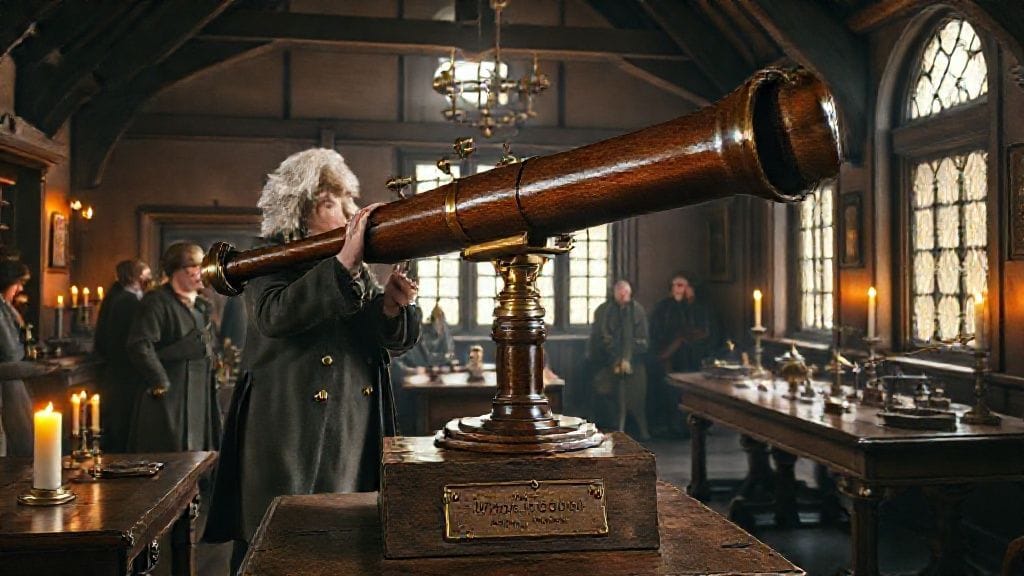
The cold air of a London winter in early January 1672 was pierced by a quiet, yet profound, moment that would forever shift humanity’s gaze upon the heavens. In a small chamber illuminated by candlelight and gathering shadows, a modest yet groundbreaking instrument was unveiled to an eager assembly of scholars and curious nobles. It was not just any device but a reflecting telescope — a creation that promised to overcome the stubborn flaws of traditional refracting telescopes. The man behind this revelation was none other than Isaac Newton, a polymath who had wrestled with optics, mathematics, and physics to bring forth this new eye to the cosmos.
The crowd’s anticipation was palpable. They bore witness to more than wood and glass — they saw the birth of a tool that would transform the very way we see the universe. Yet, this moment was not only a scientific milestone but also an emotional victory borne out of years of solitary toil, frustration, and unyielding curiosity.
Isaac Newton: The Man Behind the Telescope
Isaac Newton was by 1672 a figure both respected and mysterious. At 29 years old, he had already begun to etch his mark on the Royal Society’s pages with his groundbreaking studies in mathematics and optics. Raised amidst the quiet countryside of Woolsthorpe, his prodigious intellect was matched only by a deeply private nature and a relentless pursuit of truth.
Newton’s fascination with light and vision emerged as early as his Cambridge years. When the plague closed the university in 1665, he retreated to his family's estate, where he commenced revolutionary experiments on prisms and the nature of color. Unlike the classical understanding that white light was pure, Newton demonstrated that it was a mixture of many colors — a revelation that would question centuries of accepted dogma.
But Newton’s ambitions went further. The limitations of the instruments available to astronomers troubled him profoundly. The refracting telescopes, relying on lenses to bend light, suffered from imperfections that obscured their vision. Newton dreamed of a new type of telescope, one using mirrors instead of lenses, which would eliminate chromatic aberration and sharpen the eye of the observer.
The Limitations of the Old: Refracting Telescopes and Chromatic Aberration
Long before Newton, the telescope had already transformed humanity’s grasp of the cosmos. Galileo’s early models had revealed moons orbiting Jupiter and imperfections on the Moon’s surface. But these telescopes were refractors — devices that used lenses to converge light.
Despite their promise, these refracting telescopes faced a persistent and maddening problem: chromatic aberration. Because lenses refract different wavelengths of light by slightly different amounts, the image produced was smeared with colored fringes and blurred edges. The further astronomers pushed these instruments, the more glaring the defect became.
This flaw compromised their ability to discern fine celestial details. It was as if the universe mocked their attempts to pierce its veil with a rainbow halo distorting every glimpse.
Craftsmen and scientists wrestled with this problem for generations but to no avail. Some tried grinding and combining lenses of various types to reduce the aberration, but without complete success. The need for a revolutionary approach was clear.
The Spark of Innovation: Newton’s Conceptual Breakthrough
Newton’s mastery of optics found its ultimate test in this challenge. Drawing on his prismatic studies and a deep understanding of light’s fundamental nature, he proposed a radical departure: what if the telescope replaced the refractive lens with a reflecting mirror? A curved, polished metal surface could gather and focus light without separating its colors.
This idea was at once elegant and audacious. Mirrors do not disperse light in the way lenses do. Yet crafting a precise, smooth reflecting surface was a daunting technical problem. Moreover, many contemporaries were skeptical, believing mirrors would produce less sharp images or be too difficult to maintain.
Newton’s reflectors would use a concave primary mirror to focus light, and a small flat secondary mirror angled to redirect the image to an eyepiece at the side of the tube—thus allowing a more compact design and eliminating many issues plaguing the refractor.
His design married invention with profound insight—a true leap forward grounded in experimental rigor and theoretical acumen.
Crafting the Reflecting Telescope: Technical Challenges and Triumphs
Bringing this vision into reality was no simple feat. Newton had to overcome not only conceptual hurdles but also the pragmatic difficulties of metalwork and lens crafting.
He first fashioned a concave spherical mirror made from a mixture of tin and copper known as "speculum metal." Getting this mirror ground and polished to precise dimensions demanded painstaking labor, for even a slight imperfection could distort the image.
Newton then constructed a small, robust tube, placing the mirror at the base, and mounting the tiny flat mirror at a 45-degree angle near the top to divert the focused light sideways to the eyepiece. This arrangement minimized chromatic aberration and allowed for a smaller, more manageable instrument.
Installed atop a small equatorial mount, the telescope represented a compact and practical tool, far different from the long and fragile lenses of the day. Newton’s craftsmanship was meticulous—each component finished with exactitude born of countless experiments and disappointment.
When it was complete, Newton’s reflecting telescope was a modest object, scarcely more than a foot in length, yet it opened new celestial vistas. For the first time, observers could imagine perceiving distant stars and planets without chromatic distortion clouding their vision.
The First Public Presentation in London: January 11, 1672
On the evening of January 11, 1672, Newton presented his reflecting telescope to the Royal Society of London — an assembly of the era’s most elite thinkers, scientists, nobles, and curious minds.
The hall buzzed with anticipation as Newton, ever modest and somewhat reserved, unveiled his invention. With deft hands, he demonstrated the telescope’s capabilities. Observations through the instrument revealed stars as crisp points of light, undistorted by colored fringes. The ease with which the telescope focused light garnered immediate admiration.
This moment was electric. It was more than the unveiling of a machine; it was the dawn of a new way to observe the universe, affirming that progress often requires visionaries daring to break from tradition.
The Royal Society’s president, Sir Robert Moray, remarked on the significance of Newton’s work, writing in the Society’s minutes that this reflector showed “many things invisible by the common refractor.”
Reactions from the Royal Society and the Scientific Community
The reception was mixed but brimming with intrigue. Many saw Newton’s reflecting telescope as a masterstroke — a solution to a long-standing optical problem.
However, the skepticism among some scientists was palpable. Robert Hooke, a leading experimental philosopher and Newton’s contemporary rival, questioned the practical advantages of Newton’s design. Hooke himself was developing competing optical designs and was notorious for his sharp critiques and personal quarrels.
Nevertheless, Newton’s invention quickly captured the imagination of many astronomers and instrument makers. The Royal Society’s publications amplified the news, circulating treatises and descriptions that spread the innovation across England and beyond.
The scientific diaspora began adopting Newtonian reflectors as experimental tools, propelling the advancement of observational astronomy.
The Optics Debate: Newton versus Hooke and Others
The years following the presentation ignited a heated debate not only about the reflecting telescope’s superiority but also about credit, originality, and scientific priority.
Robert Hooke, an obsessive polymath and master of experimental mechanics, challenged parts of Newton’s optical theories. Their correspondence and public interactions reveal a clash of intellects; Hooke accused Newton of overreliance on theory and insufficient recognition of earlier work.
Newton, notoriously sensitive and disdainful of public controversies, responded with icy rigor, further straining their already tenuous relationship.
This rivalry framed much of the early discourse around telescopes and optics, underscoring how scientific progress often unfolds amidst personal passions and rivalries.
How the Reflecting Telescope Redefined Astronomy
Newton’s reflecting telescope was not merely a technical curiosity — it marked a paradigm shift in how astronomers could observe the universe.
By offering clearer, distortion-free images, it expanded the potential for discovery. The elimination of chromatic aberration meant that phenomena previously blurred or hidden could now be studied in detail.
Reflectors became particularly crucial in studying faint celestial bodies like nebulae and distant stars. Over the following decades, larger and more sophisticated reflectors built on Newton’s principles enabled stunning new observations — from faint craters on the Moon to the rings of Saturn.
The reflecting telescope helped supplant earlier models and encouraged a transition to more experimental and precise instruments, thus accelerating the scientific revolution’s forward march.
The Spread of Newtonian Telescopes Across Europe
News of Newton’s invention did not remain confined to London. Scholars and craftsmen across Europe took keen interest.
In France, the Académie des Sciences commissioned their own experiments with reflectors, though practical challenges delayed widespread adoption. In the Dutch Republic and the German states, instrument makers refined mirrors and polished tubes inspired by Newton’s design.
This diffusion triggered an arms race of optical innovation. Over the next century, reflecting telescopes grew in size and sophistication, culminating in powerful devices capable of deep-space observation.
Newton’s concept thus laid the foundation for international collaborations and competitions in scientific instrument-making.
The Cultural and Scientific Impact of Newton’s Invention
Newton’s reflecting telescope transcended its scientific utility to become a symbol of enlightened inquiry.
In an age still wrestling with old cosmologies and theological dogmas, the telescope challenged humanity’s place in the universe. It provided evidence that the heavens were vast, complex, and governed by laws accessible to human reason.
The instrument invigorated discussions about empirical observation and rational skepticism — key tenants of the Scientific Revolution.
Artists and writers would later invoke the telescope as a metaphor for human curiosity piercing darkness. Philosophers debated the implications for epistemology — how knowledge is acquired and understood.
Indeed, Newton’s reflecting telescope occupies a milestone not only in technology but in the intellectual and cultural history of Europe.
The Telescope and the Secrecy of Scientific Discovery
Newton was a man of paradoxes—open in his publishing of theories, yet fiercely guarded about certain inventions.
His reflecting telescope was initially kept somewhat secretive, shared only with trusted members of the Royal Society before wider dissemination.
Such reticence reflected the competitive nature of 17th-century science, where discovery was currency, and knowledge guarded like treasure. Patent laws were rudimentary, and priority disputes could make or break reputations.
Yet, this secrecy also slowed the immediate spread of the reflector. It took years before innovations became public knowledge and accessible for replication.
Thus, Newton’s telescope illustrates the tension between individual genius and collective progress in science.
Newton’s Telescope in the Broader Context of the Scientific Revolution
Newton’s reflecting telescope emerged amidst a seismic shift in scientific thinking and methodology.
The 17th century witnessed a gradual move away from scholasticism and Aristotelian dogma toward observation, experimentation, and mathematical description.
Figures like Copernicus, Galileo, Kepler, and Descartes had laid groundwork — Newton’s reflector embodied the practical realization of these ideas.
It was an age where nature was increasingly approached as a system of laws to be understood through precise instruments — with the telescope becoming a primary tool.
Newton’s invention signaled the maturity of this revolution, enabling more accurate and sophisticated astronomical inquiry.
Technological Legacies: Reflecting Telescopes Through the Centuries
Newton’s reflecting telescope was but the first step in a long journey of optical development.
In the centuries that followed, reflectors grew dramatically larger and more powerful with advances in glass-making, mirror-coating, and mechanical engineering.
From William Herschel’s massive 18th-century telescopes, which discovered Uranus, to the 20th century’s Hale Telescope, Newton’s principles endured and evolved.
Modern astronomical instruments, whether space-based like the Hubble or ground-based giant observatories, owe a debt to the reflecting design’s fundamental advantages.
This lineage highlights the enduring importance of the 1672 moment in scientific history.
The Human Side of the Invention: Passion, Rivalries, and Obsessions
Behind Newton’s reflecting telescope lies a story of intense personal dedication.
Newton’s solitary experiments, restless nights grinding mirrors, and painstaking calculations reveal a man driven by near-obsessive curiosity.
His fierce independence, sometimes verging on reclusiveness, shaped not only the invention but the atmosphere surrounding it.
The rivalry with Hooke and others added drama to the scientific narrative, reflecting human insecurities and ambitions behind the polished glass.
Understanding this human dimension enriches our appreciation of the telescope as not just a tool, but a product of passionate minds wrestling with nature’s mysteries.
Reflections in the Mirror: Philosophical Implications of Newton’s Work
Newton’s reflecting telescope invites deeper reflection beyond its practical use.
By enabling clearer vision, it metaphorically suggests truth emerges through careful observation and correction of distortions.
His work on light and optics interconnected with broader ideas about perception, reality, and human understanding.
Philosophers pondered how instruments mediate the relation between the observer and the observed — questioning objective knowledge and the limits of human senses.
In this way, the telescope stands as a symbol of Enlightenment ideals and challenges.
Astronomy’s New Eyes: Discoveries Enabled by Newton’s Telescope
The clearer images produced by Newton’s telescope empowered astronomers to discern fine details invisible before.
Subsequent observations highlighted lunar craters, star clusters, planetary rings, and nebulae — phenomena that expanded our cosmic perspective.
These discoveries not only enriched astronomy but also inspired new hypotheses about the nature and scale of the universe.
The reflecting telescope, therefore, was a tool of vision and knowledge, opening new frontiers in human understanding.
The Telescope’s Role in Challenging the Geocentric Universe
Newton’s invention contributed indirectly but profoundly to overturning the geocentric worldview that had dominated for millennia.
By enabling more precise observations supporting heliocentrism and celestial mechanics, the reflector strengthened arguments against Earth-centered models.
Such progress had enormous cultural and theological implications, shaking foundations of authority and worldview.
The telescope thus became an instrument of intellectual liberation as well as discovery.
Newton’s Reflector and the Dawn of Modern Optical Engineering
Beyond astronomy, Newton’s telescope laid groundwork for modern optical engineering.
Its principles guided later advances in lens crafting, mirror production, and instrument design.
Moreover, it promoted the scientific method’s integration into manufacturing and precision engineering.
The reflector was a catalyst, demonstrating how scientific theory and practical craftsmanship could join to produce revolutionary instruments.
This fusion is a hallmark of modern technology’s evolution.
The Enduring Legacy: From 17th Century London to Modern Astronomy
From its humble origins in a London chamber to the forefront of 21st-century astronomy, Newton’s reflecting telescope endures as an emblem of human ingenuity.
It represents an extraordinary leap—solving a vexing problem through insight, persistence, and craftsmanship.
Every time a new telescope gazes deeper into the cosmos, from Earth’s surface or the void of space, it traces its lineage to that moment on January 11, 1672.
Isaac Newton’s reflector opened humanity’s eyes to the stars, inviting us to explore, wonder, and understand a universe far greater — and far more beautiful — than ever imagined.
Conclusion
The unveiling of Isaac Newton’s reflecting telescope on a cold January evening in 1672 was far more than a presentation of scientific apparatus — it was a testament to human curiosity and resilience. Newton’s brilliance lay not just in theoretical insight but in his refusal to accept limitations imposed by tradition and technology. By daring to replace lenses with mirrors, he reshaped the tools of observation and the very structure of scientific inquiry.
This invention bridged gaps: between theory and practice, between the known and the unknown, and between human minds separated by rivalry and collaboration. The reflecting telescope stands as an enduring symbol of the Scientific Revolution’s spirit—a spirit that embraces challenge, nurtures innovation, and invites us to see the world through clearer, deeper lenses.
From that day in London to modern observatories that continue to reveal the universe’s secrets, Newton’s telescope reminds us that vision—both literal and metaphorical—requires courage, craft, and a willingness to look beyond what is comfortable into the infinite.
FAQs
Q1: Why was Newton’s reflecting telescope important compared to previous designs?
A1: Newton’s reflecting telescope addressed the problem of chromatic aberration, which compromised the clarity of images in refracting telescopes. By using mirrors instead of lenses, his design produced clearer, distortion-free astronomical observations.
Q2: How did Newton create the mirror in his telescope?
A2: Newton crafted the primary mirror from speculum metal, a mixture of copper and tin, which he carefully ground and polished to a precise curved shape capable of focusing light accurately.
Q3: What was the reaction of the Royal Society to Newton’s invention?
A3: The Royal Society received the telescope with intrigue and admiration. They recognized it as a significant improvement in optical instruments, although some scientists remained skeptical or competitive due to ongoing rivalries.
Q4: Did Newton face challenges from other scientists regarding his telescope?
A4: Yes, Robert Hooke and others contested parts of Newton’s theories and contributions, leading to personal and professional rivalries that colored the early history of the reflecting telescope.
Q5: How did Newton’s telescope influence astronomy in the long term?
A5: It paved the way for more precise observations, enabling discoveries of celestial phenomena previously hidden or obscured. It also inspired further technological advances in optical instruments through the centuries.
Q6: Was Newton’s telescope immediately widely adopted?
A6: No, while it was revolutionary, the reflecting telescope’s early adoption was slow due to technical challenges, secrecy, and skepticism. Over time, improving craftsmanship and recognition led to its broader use.
Q7: What philosophical ideas were influenced by Newton’s work on optics and telescopes?
A7: Newton’s work influenced Enlightenment ideas about perception, knowledge, and the role of instruments in mediating reality. It raised questions about how humans see and understand the natural world beyond their senses.
Q8: How does Newton’s reflecting telescope connect to modern astronomical instruments?
A8: Modern telescopes, including large reflectors and space-based observatories, build directly on Newton’s principle of using mirrors to gather and focus light, highlighting his enduring impact on optics and astronomy.