Table of Contents
- The Quiet Passing of a Revolutionary Mind
- Frombork: The Twilight of Copernicus’ Life
- Royal Prussia in the Mid-16th Century: A World in Flux
- The Final Days: Copernicus in May 1543
- The Deathbed Revolution: Publishing De Revolutionibus
- The Impact of Copernicus’ Last Breath on Astronomy
- The Burial and Memory of Copernicus in Frombork Cathedral
- Political Underpinnings: Royal Prussia’s Role in Copernicus’ Work
- The Lutheran Reformation and Its Shadows over Copernicus’ Legacy
- Copernicus’ Family and His Final Correspondence
- The Resurrection of Copernicus’ Ideas in the Scientific World
- The Controversy and Silence Surrounding His Death
- Copernicus’ Death and the Birth of a New Cosmology
- Frombork Cathedral: A Monument to a Silent Genius
- The Making of a Historical Icon: Copernicus in Posthumous Memory
- Modern Recognition: Copernicus and the Legacy of Royal Prussia
- The End of an Era: Copernicus’ Death Amidst Europe’s Transformation
- Scientific and Political Winds After 1543
The Quiet Passing of a Revolutionary Mind
It was a spring day like any other in May of 1543, yet within the humble chambers of an aged cathedral town by the Baltic Sea, the very foundations of human understanding trembled on the brink of transformation. Nicolaus Copernicus, the Renaissance polymath and revolutionary astronomer, breathed his last. His death, on May 24, 1543, in the fortified town of Frombork, then part of Royal Prussia, marked not only the end of a life but the quiet release of an idea poised to forever change our grasp of the cosmos.
Yet, unlike the firework of celebration or violent upheaval one might expect from such a profound shift in thought, Copernicus’ departure was marked by silence and near obscurity. His radical heliocentric theory—placing the sun rather than the Earth at the center of the universe—was barely known beyond a narrow circle of scholars, published only in the final moments before his death. The world did not yet grasp the full magnitude of his legacy.
Imagine that day: Copernicus, aged 70, bedridden in the canons’ palace of Frombork Cathedral, the air heavy with Baltic dampness and the faint smell of old wood and incense. A modest man, a canon at the cathedral chapter, a diligent scholar of church law, medicine, mathematics, and the skies, he had for decades cultivated an extraordinary vision. His voice, fragile and fading, carried a message that would echo through the centuries.
This was the quiet passing of a man whose thoughts would dismantle the old celestial order and lay the groundwork for the modern scientific revolution. But the story of Copernicus’ death is also deeply entwined with the vivid political, cultural, and religious tapestry of Royal Prussia—a land caught between empires, faiths, and newfound intellectual horizons.
Frombork: The Twilight of Copernicus’ Life
Frombork, perched on a peninsula jutting into the Vistula Lagoon, was a fortified town with sturdy Gothic churches and cobbled streets, ruled by the prince-bishops of Warmia. It was here that Copernicus spent the final decades of his life, serving as a canon of the cathedral chapter, overseeing administrative affairs, and, most importantly, pursuing his astronomical research. This was no grand palace housing a celebrated genius; rather a quiet and somewhat austere environment, conducive to scholarly contemplation but distant from royal courts or bustling capitals.
The last years saw Copernicus in declining health, contending with kidney stones and fatigue, yet his mind remained sharp. He refined his celestial calculations, aware of the storm his heliocentric ideas might unleash. His friendships with fellow churchmen and academics offered some solace, but also a buffer from the growing ideological tensions sweeping through Europe with the Protestant Reformation and the Catholic counter-movement.
Frombork was isolated but strategically significant, located within Royal Prussia—a semi-autonomous region under the Polish crown, itself a crucible of cultural interchanges between Catholic and Protestant lands. This geographical and political context shaped Copernicus' intellectual environment, blending traditional medieval scholasticism with Renaissance humanism and emerging astronomical inquiry.
Royal Prussia in the Mid-16th Century: A World in Flux
Royal Prussia of the 16th century was no mere provincial backwater. Once part of the monastic Teutonic Order’s domain, it had been absorbed into the Polish Crown following the Thirteen Years' War (1454–66), with considerable local autonomy maintained. The region was ethnically diverse—Poles, Germans, and Prussians lived side by side—its cities thriving as Baltic trading hubs under the Hanseatic League’s influence.
However, the political calm belied deep undercurrents of change. The Protestant Reformation, launched by Martin Luther in 1517, had reached these shores, shaking both religious and social structures. Royal Prussia found itself at a crossroads, its identity torn between Catholic loyalty and burgeoning Protestant sympathies.
Copernicus’ role was more than scholarly isolation; he was also a trusted administrator and advisor involved with the defense of the Church’s interests in this turbulent region. This dual role—scientist and churchman—would be a defining tension in his life and legacy, influencing how and when he chose to reveal his heliocentric model.
The Final Days: Copernicus in May 1543
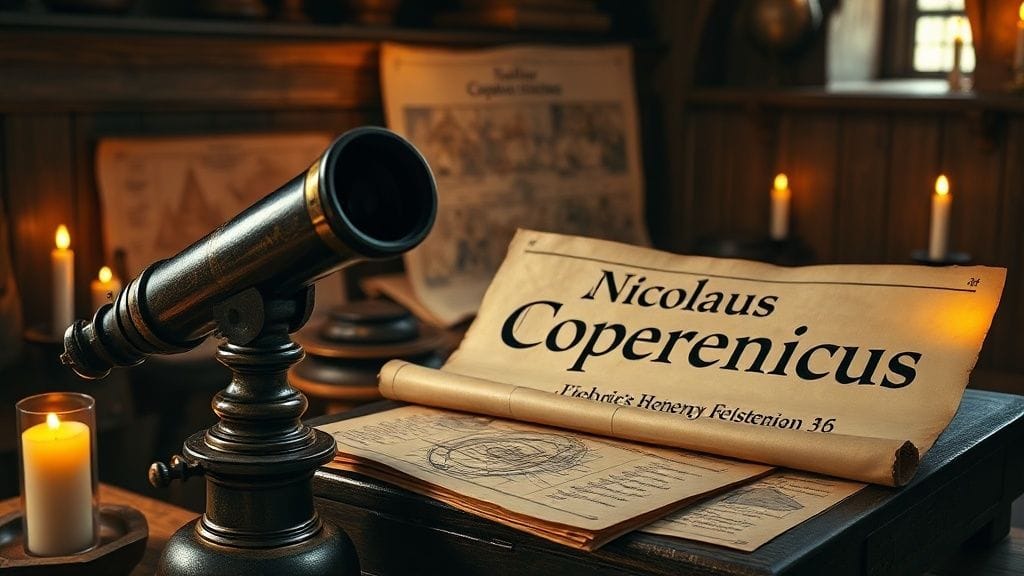
By May 1543, Copernicus’ health had severely deteriorated. According to witnesses, he was aware that death was near. It was around this time that the long-anticipated publication of his magnum opus, De revolutionibus orbium coelestium (On the Revolutions of the Heavenly Spheres), finally reached him—a work completed decades earlier but held back by caution and fear of ecclesiastical reprisal.
Legend holds that the first printed copy was delivered to his sickbed just days before he passed away. Some suggest that Copernicus glimpsed the proofs shortly before his death, while others note that he may have seen the published book itself, acknowledging his cosmic revolution before slipping into silence.
On the 24th of May, 1543, Nicolaus Copernicus passed quietly in Frombork. His death was recorded by the cathedral chapter, but events thereafter would obscure much about his final moments. Unlike the grand funerals reserved for great nobles, Copernicus’ burial was modest, leaving only a whispered memory to the man who had, in essence, turned the universe inside out.
The Deathbed Revolution: Publishing De Revolutionibus
De Revolutionibus was no ordinary book, nor was its publication a simple affair. Copernicus had spent years cautiously polishing and hiding his heliocentric theory. In an age where the Earth’s central place in the cosmos was almost unquestionable—rooted in Aristotelian physics and Ptolemaic astronomy—the idea that the Earth orbited the sun was radical, even heretical.
The publication in 1543 by Johannes Petreius in Nuremberg represented a seismic shift. Yet the book was dense, mathematical, and couched meticulously in academic language. Copernicus’ approach was cautious, attempting to provide a model that explained celestial movements without directly condemning geocentric orthodoxy.
Some accounts—even if apocryphal—suggest that the astronomer received a copy on his deathbed, exclaiming, “Finally, we imagine the heavens!” Whether true or romanticized, this narrative captures the bittersweet nature of Copernicus’ final act: handing over to posterity a revolution born from solitude and long years of intellectual labor.
The Impact of Copernicus’ Last Breath on Astronomy
In the immediate aftermath of Copernicus’ death, the heliocentric model struggled to rise above skepticism and outright hostility. Its challenge to orthodox cosmology was too great for most contemporaries. Yet, the seeds had been planted.
Copernicus’ death marked a moment of transition—the old medieval cosmology began to unravel, while a new age of inquiry dawned. Over the ensuing decades, figures such as Galileo Galilei, Johannes Kepler, and Isaac Newton would build upon and refine his model, transforming it into the bedrock of modern astronomy.
It is almost poetic that Copernicus’ last breath coincided with the birth of a new science. Yet, at the time, his ideas were circumspect, debated quietly within scholarly circles and church halls. It took the courage and controversy of later generations to propel heliocentrism to prominence.
The Burial and Memory of Copernicus in Frombork Cathedral
For centuries after his death, Copernicus’ resting place remained a mystery. His burial in Frombork Cathedral was unmarked, lost to time, war, and shifting political borders. The cathedral itself, a Gothic masterpiece, bore silent witness to the life and death of the astronomer, while the Baltic winds seemed to carry away his memory.
It was not until the 19th and 20th centuries that archeologists and historians scrambled to reclaim his remains and legacy. The rediscovery of his purported tombbones in the 20th century reignited public fascination, culminating in a grand reburial in Frombork Cathedral with honors befitting his lasting influence.
This posthumous recognition is emblematic of how Copernicus’ life was overshadowed by the slow, persistent spread of his ideas—the man himself quietly fading into the backdrop of global history.
Political Underpinnings: Royal Prussia’s Role in Copernicus’ Work
Royal Prussia was more than a backdrop; it was a crucible in which competing forces—political, ethnic, religious—influenced Copernicus’ intellectual pursuits. The relative autonomy of the region and its hybrid Polish-Germanic culture created an environment ripe for Renaissance humanism.
Additionally, Copernicus held administrative positions dealing with taxation and defense, particularly amid ongoing threats from the Teutonic Knights and regional unrest. These responsibilities occupied much of his time, perhaps slowing the dissemination of his astronomical work but also rooting him deeply in the societal realities of his era.
Royal Prussia’s blend of cultures and loyalties may have tempered the radicalism of Copernicus’ publication, embedding his scientific revolution within a cautious ecclesiastical framework aligned with the Polish crown.
The Lutheran Reformation and Its Shadows over Copernicus’ Legacy
The 16th century’s religious upheavals cast long shadows over Copernicus’ life and posthumous reputation. Though himself a Catholic clergyman, he lived amidst rising Lutheran influence in Royal Prussia and beyond.
This complex religious landscape affected both the reception of heliocentrism and Copernicus’ personal stance. To openly challenge the Ptolemaic system was tacitly to question church teachings. While Copernicus tread carefully in his writings, later religious authorities would react harshly to heliocentrism, especially during the Counter-Reformation.
The consequences of this fraught atmosphere meant Copernicus’ revolutionary ideas would simmer quietly before igniting decades later, often intertwined with confessional debates and the politics of knowledge control.
Copernicus’ Family and His Final Correspondence
Less known are the intimate details of Copernicus’ family life and relationships in his final years. Born into a well-established merchant family, he had close ties with his brother Andreas, who played a supportive role throughout his life.
Copernicus maintained correspondence with various scholars, church officials, and friends, revealing a man attentive to both human and cosmic affairs. His letters from the early 1540s show a mixture of concern for political events, health, and the fate of his astronomical work.
These private exchanges offer a window into the man behind the monumental theory—a figure as human as he was brilliant, balancing worldly duties with celestial dreams.
The Resurrection of Copernicus’ Ideas in the Scientific World
Though barely noticed at his death, Copernicus’ heliocentric model began a slow ascent following publication. By the late 16th and early 17th centuries, scholars such as Giordano Bruno, Johannes Kepler, and Galileo expanded upon the revolutionary concept, providing observational proofs and mathematical refinement.
The seismic shift heralded by Copernicus ultimately undermined the doctrine of an Earth-centered universe, paving the way for Newtonian physics and the Enlightenment. His death thus mirrors a symbolic passing from old to new, from mythic cosmos to scientific inquiry.
Without this resurrection of ideas, the modern view of the universe as dynamic and law-governed would be unimaginable.
The Controversy and Silence Surrounding His Death
Curiously, Copernicus’ death did not trigger immediate widespread commentary, either in scientific circles or political authorities. This silence could be attributed to the controversial nature of his work and his low public profile.
Moreover, the religious and intellectual perils of proposing heliocentrism made any public heralding of his death—and the ideas therein—potentially dangerous. Thus, his greatest gift to humanity passed with a whisper, ready to explode much later.
This paradox of a death both understated and profoundly transformative adds a poignant dimension to Copernicus’ story.
Copernicus’ Death and the Birth of a New Cosmology
Copernicus’ passing choreographed a poetic transition: his death marked both an end to a personal epoch and the beginning of a cosmological revolution. His heliocentric hypothesis demanded a fundamental reassessment not just of astronomy but of humanity’s place in the universe.
This new cosmology conflicted with centuries of tradition, religious dogma, and common sense, setting the stage for centuries of debate, discovery, and sometimes conflict. Copernicus became the symbolic threshold through which the modern world would pass from darkness to enlightenment.
Frombork Cathedral: A Monument to a Silent Genius
The Gothic spires of Frombork Cathedral still stand as a testament to the man who lived and died within its shadow. Today, it serves not only as a place of worship but also a shrine to Copernicus’ enduring legacy.
The cathedral’s quiet cloisters, where he wrought his cosmic revolution, invite reflection on the intersection of faith, science, and human curiosity. The site embodies the paradox of Copernicus’ life: a man rooted in tradition who dared to look beyond it.
The Making of a Historical Icon: Copernicus in Posthumous Memory
Copernicus’ identity transformed significantly long after his burial. From obscure canon and cautious scholar, he emerged as a heroic figure of scientific progress.
In the centuries following his death, especially during the Enlightenment and the rise of nationalism, Copernicus became a symbol of intellectual freedom and Polish cultural pride. His image has been commemorated in statues, currency, academic institutions, and global astronomy.
This evolution from quiet thinker to luminary reflects how history reshapes memory to meet its present needs.
Modern Recognition: Copernicus and the Legacy of Royal Prussia
Today, Copernicus stands as one of Royal Prussia’s—and indeed Poland’s—most revered historical figures. His life and death within the shifting political landscapes of 16th-century Eastern Europe highlight the intersection of culture, science, and identity.
Modern scientific inquiry venerates Copernicus not merely for his astronomical insights but for daring to question the established order. His legacy continues to inspire debates about knowledge, tradition, and innovation.
The End of an Era: Copernicus’ Death Amidst Europe’s Transformation
Copernicus died at a moment when Europe was undergoing profound transformation—religious upheaval, territorial conflicts, and the dawn of the Renaissance. His death symbolically closes the medieval age and ushers in the modern world.
Understanding his final days in Frombork provides a human anchor to this sweeping history, reminding us of the quiet origins of seismic change.
Scientific and Political Winds After 1543
The decades following Copernicus’ death saw Europe convulsed by war, reform, and discovery. His heliocentric model, gradually accepted and extended, became a foundational pillar of modern science.
Politically, Royal Prussia and the Polish Crown navigated a complex web of power struggles that mirrored the shifting intellectual debates. Copernicus’ legacy is thus inseparable from the wider currents that reshaped Europe.
Conclusion
The death of Nicolaus Copernicus in Frombork on that quiet May day in 1543 was far more than the passing of a learned canon—it was the closing chapter in the life of a visionary who dared to challenge the very cosmos. Amidst the medieval walls and turbulent politics of Royal Prussia, Copernicus labored silently, crafting a vision of the heavens that would shatter worldviews and ignite centuries of progress.
His deathbed reception of De revolutionibus captures the bittersweet truth of revolutionary ideas: they often arrive too late for their creators but carry the power to transcend generations. Copernicus passed as the world still slept under the geocentric sky, yet his legacy has illuminated the heavens ever since.
In remembering Copernicus, we encounter the fragile human at the heart of great revolutions—the scholar wrestling with doubt, the clergyman caught in faith and reason, the man facing mortality even as his ideas promise immortality. The universe he reimagined has since expanded beyond imagination, but the echoes of his final days in Frombork remain a profound testament to courage, curiosity, and change.
FAQs
Q1: What were the main causes leading up to Copernicus’ death in 1543?
A1: Copernicus’ death was natural, attributed to age and health issues such as kidney stones. He died after a lifetime of scholarship and public service in Frombork, his health finally declining in early 1543 amid the stress of finalizing the publication of his seminal work.
Q2: How did Royal Prussia influence Copernicus’ life and work?
A2: Royal Prussia’s political autonomy, cultural diversity, and religious conflicts created a unique environment for Copernicus. Serving as a canon there, he balanced ecclesiastical duties with his astronomical research, shaped by the region’s contested loyalties between Poland, Germany, and the Church.
Q3: Was Copernicus aware of the impact his work would have after his death?
A3: Copernicus was cautious and likely aware that his heliocentric theory was controversial and revolutionary. However, he probably did not foresee the profound global influence it would have. His death came soon after the publication of De Revolutionibus, meaning he never witnessed the full ramifications.
Q4: Where was Copernicus buried, and was his grave known?
A4: Copernicus was buried in Frombork Cathedral, but the exact location was lost for centuries. It was rediscovered only in the 20th century through archeological and DNA evidence, leading to his reburial with honors.
Q5: How did the religious context of the Reformation affect Copernicus’ work and legacy?
A5: The turbulent religious climate forced Copernicus to cautiously frame his heliocentrism, aware it challenged Church teachings. Protestant and Catholic tensions delayed acceptance of his model, intertwining his legacy with later theological and scientific debates.
**Q6: What was the immediate reaction to De Revolutionibus following Copernicus’ death?**
A6: The book was initially met with skepticism or ignored by most. It remained a niche scholarly text until later astronomers expanded on its ideas. Its revolutionary nature meant it needed decades before widespread acknowledgment.
Q7: How is Copernicus remembered today in Poland and Europe?
A7: He is a national hero and a symbol of intellectual courage in Poland and beyond. Statues, museums, and scientific institutions commemorate his work, underscoring his role as a pioneer of modern science born in Royal Prussia.
Q8: Did Copernicus face opposition during his lifetime for his theories?
A8: Public opposition was minimal during his lifetime, partly due to his cautious approach and limited circulation of his heliocentric ideas. The major controversies erupted decades later with the rise of figures like Galileo.