Table of Contents
- The Clash of Titans: Setting the Stage for the Norman-Byzantine Confrontation
- The Byzantine World in the Late 11th Century: An Empire Under Strain
- Rise of the Normans: From Wanderers to Conquerors
- The Stakes at Dyrrhachium: Gateway to the Balkans and Beyond
- Robert Guiscard’s Ambition: The Norman Vision of Empire
- Alexios I Komnenos: The New Emperor and His Imperial Challenges
- The Road to War: Diplomatic Failures and Strategic Maneuvers
- September 1081: The Norman Fleet Appears off the Balkan Coast
- The Siege of Dyrrhachium: Survival and Strategy in a Beleaguered City
- The Battle Unfolds: October 18, 1081, The Day of Reckoning
- Norman Warfare: Cavalry Tactics and the Power of Feudal Forces
- Byzantine Resistance: Infantry, Fortifications, and Komnenian Reforms
- The Turning Points: Mistakes, Bravery, and the Tide of Battle
- Aftermath at Dyrrhachium: What the Battle Meant for Byzantium
- The Norman Pursuit: Pressing the Advantage or Missing the Moment?
- The Wider Balkans: Impact on Local Powers and Political Stability
- The Legacy of the Battle: Long-Term Repercussions in Medieval Europe
- Voices from the Field: Chroniclers and Eyewitnesses
- Material Culture of the Conflict: Armor, Weapons, and Siegecraft
- Lessons in Leadership: Guiscard and Komnenos Compared
- Dyrrhachium in Later Memory: Symbolism and Historical Interpretation
- Conclusion: The End of an Era or the Dawn of a New Chapter?
- FAQs: Unraveling the Nuances of the Norman–Byzantine War
- External Resource
- Internal Link
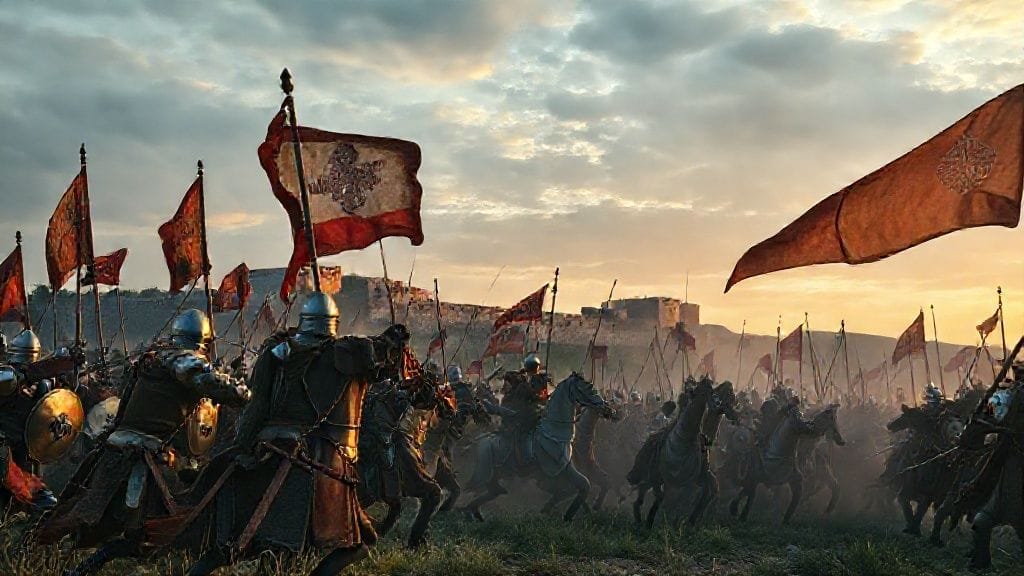
The autumn sun cast a golden haze over the restless waters of the Adriatic Sea, its light flickering upon the sheer walls of Dyrrhachium, the fortress city clinging to the rugged coastline of the Balkans. For weeks, the air had been thick with the clang of weapons, the murmurs of anxious defenders, and the ominous tolling of heraldic horns signaling the arrival of a fearsome enemy. On October 18, 1081, the destinies of two great medieval powers intertwined here in a clash as brutal as it was decisive. The Norman warriors, led by the indomitable Robert Guiscard, sought to carve out an empire from the fragments of Byzantine dominion. Opposing them, the young and determined Byzantine emperor Alexios I Komnenos marshaled a faltering but resilient force to defend his crumbling empire’s gateway. The Battle of Dyrrhachium was not just a battle for territory; it was a violent collision of ambitions, cultures, and visions for the future of the Mediterranean world.
This confrontation encapsulated the fragile balance of power in the late 11th century, a moment when empires teetered and warriors shaped history with the swing of swords and the charge of horses. But how did these two forces arrive at this precipice? What political tremors sparked the conflagration? And what echoes would the clash at Dyrrhachium send through centuries yet to come? Let us delve deep into the narrative of the Norman–Byzantine War as it reached its dramatic high point on that fateful day.
The Clash of Titans: Setting the Stage for the Norman-Byzantine Confrontation
The Norman-Byzantine War was no mere skirmish born of chance. It was the climax of decades of tension, ambition, and shifting alliances that had slowly destabilized the eastern Adriatic and the western Balkans. By the late 11th century, the Normans—descendants of Viking adventurers turned feudal lords—had forged a feared and respected domain in southern Italy, dominating Sicily and parts of the Italian peninsula. Their eyes now turned eastward, towards the wealthy, sprawling but vulnerable Byzantine Empire.
On the other side, the Byzantines had once ruled vast territories stretching from Anatolia to Italy, their capital Constantinople shimmering as the heart of Christendom’s east. Yet by 1081, cracks appeared everywhere—military defeats, territorial losses, and internal discord weakened imperial might. The Normans aimed to exploit these vulnerabilities, turning what had once been allies and trading partners into deadly adversaries.
Dyrrhachium, now modern-day Durrës in Albania, stood as a fortress city and critical port—an economic and military linchpin that connected the Adriatic Sea to the interior Balkans. Control of Dyrrhachium meant control over the gateway between Italy and Byzantium, making it a prize deeply coveted by both sides.
The Byzantine World in the Late 11th Century: An Empire Under Strain
The Byzantine Empire of the 11th century was at once awe-inspiring and perilous. The glory days of Justinian had long passed; now emperors grappled with multi-front threats—Normans in the west, Seljuk Turks in the east, Pechenegs and Serbs in the north. Economically, the empire struggled with shifting trade routes and the rise of Italian maritime republics, which chipped away at Byzantine maritime monopoly.
Alexios I Komnenos ascended the throne in 1081 amid this swirling storm. Young, yet possessing a keen mind and relentless determination, he inherited a treasury that was low, armies that were fragmented, and fractured alliances. His reign would be defined by restoration, warfare, and diplomacy designed to claw back the empire’s waning authority. Yet his first and most immediate challenge was the threat of Robert Guiscard and the Norman tide lapping at his empire’s doorstep.
Rise of the Normans: From Wanderers to Conquerors
The Normans were remarkable for their transformation from mercenary bands and settlers into formidable rulers. Since their arrival in Italy in the early 11th century, they had proven themselves adept at warfare, governance, and opportunistic expansion. Robert Guiscard, dubbed “the Cunning” and “the Fox,” was their most ambitious and brilliant leader, skilled in both battlefield tactics and political strategy.
Guiscard’s vision was bold: to wrest control of parts of Byzantine Italy and eventually to press into the Balkans, extending Norman influence across the Adriatic. Seizing Dyrrhachium was a critical first step in this grand design.
The Stakes at Dyrrhachium: Gateway to the Balkans and Beyond
Dyrrhachium was no ordinary city; it was an ancient bastion with origins tracing back to Greek colonists and later Roman imperial might. Strategically perched where the Via Egnatia met the sea, its control meant dominance over vital land routes into the Balkans and access for naval fleets. Holding Dyrrhachium would facilitate the projection of Norman power eastward, threatening Constantinople itself.
For the Byzantines, losing Dyrrhachium was not only a strategic setback but also a psychological blow. It symbolized the erosion of eastern dominion over former western provinces and weakened their ability to exert influence over Balkan affairs.
Robert Guiscard’s Ambition: The Norman Vision of Empire
Robert Guiscard’s life was a testament to resolute ambition. Rising from relatively modest origins, he skillfully navigated feudal politics, family rivalries, and papal alliances. By the late 1070s, Guiscard had consolidated control over southern Italy and Sicily, but his eyes remained fixed beyond the Adriatic.
His invasion of Byzantine territories was fueled by promises of spoils, papal support (though often complicated), and a drive to establish a Norman empire rivaling Byzantium and the rising Holy Roman Empire. This war was at once personal and political, an attempt to rewrite the balance of power in Mediterranean Europe.
Alexios I Komnenos: The New Emperor and His Imperial Challenges
Ascending the throne in a time of crisis, Alexios I was both a warrior and a shrewd statesman. His initial acts included reforming the military, re-organizing provincial governance, and seeking alliances with Western powers, including the Papacy. Yet his position was precarious. His authority was sometimes contested by powerful palace factions, and the empire’s borders teetered on collapse.
Against the Norman threat, Alexios tried a mixture of diplomacy and defense. Desperate for time, he hoped to stall the Normans, buy reinforcements, and prepare a counterattack that would restore Byzantine strength. Yet every moment seemed to favor the aggressive and well-led Norman forces.
The Road to War: Diplomatic Failures and Strategic Maneuvers
Before the clash at Dyrrhachium, efforts were made to prevent outright war. Envoys exchanged messages; promises were whispered in imperial courts. But mutual distrust ran deep. Guiscard refused to abandon his designs on Byzantine lands, while Alexios could not accept the loss of such key territories.
Deployments began in earnest in the summer of 1081, with both sides maneuvering troops, supplies, and allies. The Normans brought their hard-hitting cavalry and siege engines, while the Byzantines relied on fortified defenses and specialized infantry units. The stage was set for a decisive confrontation near the city walls of Dyrrhachium.
September 1081: The Norman Fleet Appears off the Balkan Coast
In early September, Norman ships, sleek and numerous, darkened the waters off Dyrrhachium. The intimidating fleet threatened to blockade the city and cut off its supply lines. Byzantine sailors scrambled to mount countermeasures, though their naval capabilities were fragmented and underfinanced.
This naval presence heralded a likely siege, spurring the city’s defenders to prepare for the inevitable. Meanwhile, Robert Guiscard’s forces dispersed to secure supply routes and diplomatic footholds among local Balkan chieftains, underscoring the broad scope of this military campaign.
The Siege of Dyrrhachium: Survival and Strategy in a Beleaguered City
The siege tested the city’s resilience to its limits. Byzantine forces engaged in desperate fortification repairs, rationed food and water, and launched sorties to weaken Norman siege works. The civilian population suffered, trapped between hunger, fear, and the clangor of incessant fighting.
Alexios personally oversaw defensive efforts, rallying troops and attempting to maintain morale. But the Normans’ effective use of siege weaponry—catapults hurling stones, mangonels cracking walls—began to take their toll. The defenders knew that the coming battle would decide the city’s fate.
The Battle Unfolds: October 18, 1081, The Day of Reckoning
The morning of October 18 opened foggy and tense. Both armies arrayed along the plains outside Dyrrhachium’s fortifications. Robert Guiscard’s forces formed into tight formations, his cavalry eager to charge. Alexios faced the daunting task of coordinating his diverse troops—ranging from heavy infantry to archers and auxiliary contingents—to hold ground.
As the sun climbed, the Normans launched a fierce cavalry assault. Byzantine lines initially held, demonstrating the disciplined training imposed by Komnenian reforms. Yet as the battle wore on, gaps appeared under relentless pressure. The Norman knights exploited these weaknesses with brutal efficiency. The sheer momentum of Guiscard’s horsemen tore through Byzantine defenses, forcing a retreat toward the city walls.
Norman Warfare: Cavalry Tactics and the Power of Feudal Forces
Norman warfare was renowned for the shock value of its mounted knights, heavily armored and wielding lances designed for devastating charges. Their feudal levies, though diverse, shared a culture of aggression and boldness. Guiscard’s ability to coordinate these forces in disciplined assaults was a hallmark of his military genius.
At Dyrrhachium, this cavalry partnership proved decisive. The Norman forces combined mobility with tactical cunning, striking at vulnerable points and maintaining pressure until the Byzantines faltered. Their siegecraft also allowed them to threaten the city’s walls directly, intertwining siege and field battle in one complex engagement.
Byzantine Resistance: Infantry, Fortifications, and Komnenian Reforms
The Byzantines, inheritors of an ancient military tradition, relied heavily on fortified cities and methodical infantry tactics. Alexios had begun reforms aimed at revitalizing the army: better training, new units like the Varangian Guard, and improved logistics. At Dyrrhachium, these efforts delayed total Norman victory and inflicted meaningful losses.
Courageous defenders repelled initial attacks, using archers and crossbowmen to harass Norman ranks, and counterattack parties tried to disrupt siege works. Yet the empire’s fractured nature, recruitment challenges, and the sheer strength of Norman cavalry limited these efforts.
The Turning Points: Mistakes, Bravery, and the Tide of Battle
No battle is won or lost in a single moment, yet historians point to key turning points at Dyrrhachium that sealed Byzantine fate. Some accounts recount a critical failure by Byzantine troops to hold a strategic hill, allowing Normans to gain a vantage point. Others highlight the remarkable bravery of Komnenian soldiers who bought time for a retreat with staggering losses.
Despite the defeat, Alexios escaped capture, preserving the leadership core for future campaigns. The battle’s outcome reinforced the dangerous reality that Byzantium could no longer defend all its holdings without profound changes.
Aftermath at Dyrrhachium: What the Battle Meant for Byzantium
The loss at Dyrrhachium was devastating. The city fell under Norman control, opening the Balkans to further incursions. It stirred unrest in provincial territories and exposed the empire’s military vulnerabilities. For the Byzantines, it was a stark warning that survival demanded adaptation, reform, and new alliances.
Yet, rather than signaling the immediate collapse of the empire, the battle also galvanized Alexios I. In coming years, he would rally forces, engage in delicate diplomacy, and lay foundations for prolonging Byzantine resilience, eventually shifting the tide against the Normans.
The Norman Pursuit: Pressing the Advantage or Missing the Moment?
Though victorious, Robert Guiscard did not immediately press on toward Constantinople. Strategic caution, logistical challenges, and the need to consolidate gains slowed further advances. This hesitation allowed Byzantium breathing room to regroup.
Had the Normans exploited their momentum fully, they might have changed the course of medieval Mediterranean history. Instead, their campaign became a war of attrition, marked by pockets of fierce resistance and fluctuating fortunes.
The Wider Balkans: Impact on Local Powers and Political Stability
The conflict at Dyrrhachium reverberated beyond empire capitals. Balkan principalities and tribal groups saw the Norman incursion as both threat and opportunity. Some sided with Byzantium, others with Normans, their internecine rivalries complicating the geopolitical landscape.
This period set the stage for centuries of Balkan contention—fragmentation, shifting alliances, and the interplay of Latin and Byzantine influences that would shape regional identity.
The Legacy of the Battle: Long-Term Repercussions in Medieval Europe
Dyrrhachium’s battle was more than a regional contest. It symbolized the growing clash between Latin West and Eastern Orthodox world, foreshadowing centuries of conflict and cultural exchange. It underscored the vulnerability of Byzantine might and the rise of new European powers eager to claim their place.
The war also influenced crusading ideals, weaving together Norman ambitions with broader Western Christian drives toward the East. The echoes of 1081 would resonate in military doctrines, diplomacy, and cultural memory.
Voices from the Field: Chroniclers and Eyewitnesses
Our view of the battle is filtered through the pens of chroniclers like Anna Komnene, daughter of Alexios, whose Alexiad provides a vivid if partisan account. Norman chroniclers, too, celebrated Guiscard’s victories and valorized his campaigns.
Their narratives are imbued with human drama: tales of valor and despair, betrayal and loyalty, heroism and tragedy. These voices remind us that behind the clash of armies lay individual lives forever changed.
Material Culture of the Conflict: Armor, Weapons, and Siegecraft
Historians and archaeologists have pieced together the material realities of this war—Norman chainmail and kite shields, Byzantine spathas and crossbows, siege towers and catapults. These elements reveal not only the technological level of the period but the brutal and personal nature of medieval warfare.
The equipment shaped tactics, morale, and the very texture of combat, turning the Battle of Dyrrhachium into a tableau of sword and stone woven into history.
Lessons in Leadership: Guiscard and Komnenos Compared
At the heart of this epic confrontation were two leaders epitomizing different approaches: Guiscard, the daring, aggressive tactician thriving on initiative and shock; Alexios, the cautious, strategic reformer focused on resilience and long-term survival.
Their decisions shaped the battle and its aftermath—teaching timeless lessons about leadership under pressure, the interplay between ambition and prudence, and the complexities of medieval statecraft.
Dyrrhachium in Later Memory: Symbolism and Historical Interpretation
Through centuries, Dyrrhachium has retained symbolic weight. For Byzantines, it was a site of heroic resistance; for Western chroniclers, a stepping stone in Norman ambition. Modern historians interpret the battle as a turning point in medieval geopolitics, a catalyst for change and enduring rivalry.
Archaeological sites and literary works keep this memory alive, binding past and present in a continuous dialogue about empire, identity, and conflict.
Conclusion
The Battle of Dyrrhachium in 1081 stands as a monumental episode where the tides of medieval history turned amidst the turmoil of war, ambition, and resilience. It was a crucible that tested the strength of empires and the mettle of rulers, shaping the destiny of the Balkans and the Mediterranean world for generations.
Though the Normans triumphed that autumn day, their victory was tempered by the indomitable spirit of Byzantium and the visionary leadership of Alexios I Komnenos. This battle was less an endpoint than a page in the ongoing saga of survival, adaptation, and power struggles that defined the medieval era.
In the dust and blood stained fields outside Dyrrhachium, the echo of clashing swords still whispers lessons about courage, the relentless flux of history, and the enduring fight to preserve identity against the forces of change.
FAQs
Q1: What were the main causes of the Norman-Byzantine War culminating at Dyrrhachium?
A1: The war stemmed from Norman ambitions to expand into Byzantine territories, particularly southern Italy and the Balkans, combined with the Byzantine Empire’s weakened military and political state. Strategic control of Dyrrhachium was central to these ambitions.
Q2: Who were Robert Guiscard and Alexios I Komnenos?
A2: Robert Guiscard was the Norman duke and military leader known for his cunning and aggression, while Alexios I Komnenos was the young Byzantine emperor determined to reform and defend his faltering empire.
Q3: How did the battle tactics differ between Normans and Byzantines?
A3: Normans excelled in cavalry charges and siege warfare, using heavy knights and feudal levies, while Byzantines relied on infantry operations, defensive fortifications, and combined arms strategies influenced by imperial reforms.
Q4: What was the significance of Dyrrhachium’s location?
A4: Dyrrhachium controlled a critical Adriatic port and the Via Egnatia trade route, serving as the gateway between Italy and the Balkans, thus making it a highly strategic military and economic hub.
Q5: What were the immediate consequences of the Norman victory at Dyrrhachium?
A5: The Normans secured a foothold in the Balkans, threatening Constantinople and destabilizing Byzantine control of the region, though logistical issues prevented an immediate further push.
Q6: How did the battle affect the Byzantine Empire’s future?
A6: It exposed military weaknesses prompting Alexios to enact reforms and diplomatic efforts that ultimately helped preserve Byzantine survival for several more decades.
Q7: How is the battle remembered in historical sources?
A7: Byzantine sources emphasize valor and tragedy, often portraying the battle as a temporary setback, while Norman chronicles celebrate it as a testament to their burgeoning power and conquest.
Q8: What does the Battle of Dyrrhachium teach about medieval warfare and leadership?
A8: It highlights the critical roles of cavalry tactics, fortifications, leadership vision, and the intricate balance between aggressive offense and strategic defense in medieval conflicts.

