Table of Contents
- The Last Stand of the Muslims: Palermo’s Fall in 1072
- Norman Ambitions in the Mediterranean: Vision of a New Kingdom
- The Arrival of Roger I: The Transformative Conqueror
- The Siege that Changed Sicily: Strategy, Sacrifice, and Siegecraft
- A Cultural Crossroads: Normans, Arabs, and Byzantines in Dialogue
- The Norman Military Machine: Innovations and Tactics
- Governance in Transition: From Muslim Emirate to Norman County
- The Role of the Church: Religion and Power in Norman Sicily
- Intermarriages and Alliances: Building a New Elite
- Economic Revival: Trade, Agriculture, and Urban Development
- The Norman Legacy in Architecture and Art: Palaces and Cathedrals
- Resistance and Rebellion: Challenges to Norman Rule
- Roger II’s Rise and the Seeds of a Kingdom (Post-1091)
- The Impact on Mediterranean Politics and Power Balances
- Sicily’s Multicultural Mosaic: A Firm Foundation
- Memory and Myth: The Norman Conquest in Sicilian Identity
- Conclusion: The Creation of a New Mediterranean Power
- FAQs
- External Resource
- Internal Link
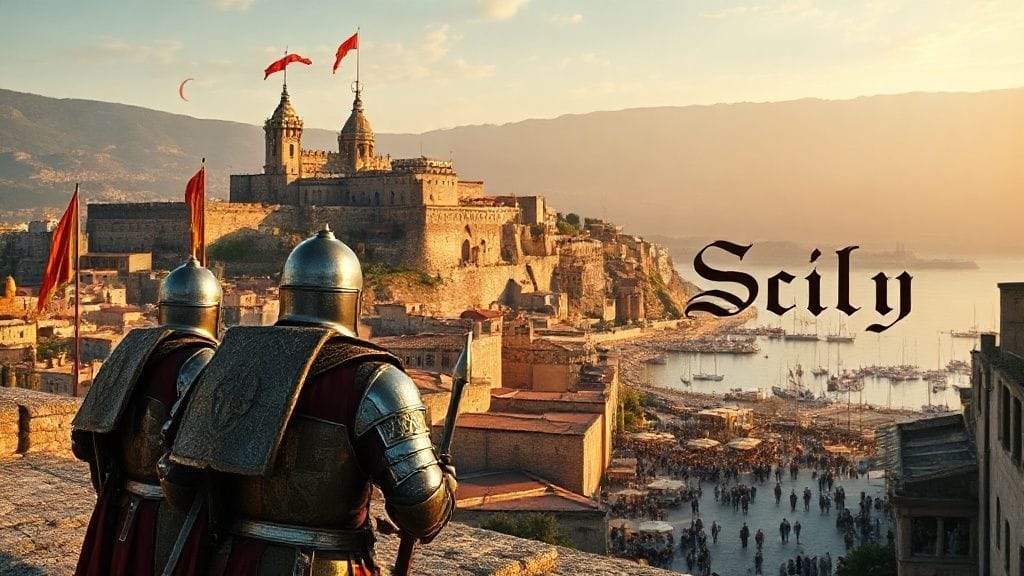
The Mediterranean sun was setting in a fiery haze over Palermo in 1072—its golden rays glinting off the towers of a city on the brink of irrevocable change. For over two centuries, the Emirate of Sicily had stood as a beacon of Arab culture, Islamic art, and Mediterranean commerce. Yet, the tide of history was turning. At the gates, a new force was asserting itself—Norman knights, led by the indomitable Roger I, were about to consolidate control over the island, reshaping not only the destiny of Sicily but the wider Mediterranean world. This moment was not merely a military conquest; it was a profound transformation of culture, governance, and identity.
1. The Last Stand of the Muslims: Palermo’s Fall in 1072
Palermo, the jewel of Sicilia, was known throughout the medieval world as a vibrant metropolis rich in culture, wealth and scientific innovation. But after waves of upheaval brought by the Byzantine reconquests and then the Norman advances, the city’s fate was sealed in 1072. The siege lasted months—a brutal trial marked by famine, vicious skirmishes, and desperate sallying forth by defenders who refused to abandon their home. The fall of Palermo was the end of Muslim political dominance on the island, but also the genesis of a new epoch. It was here that Roger I firmly established Norman control in Sicily, marking a decisive break with the island’s previous Islamic rulers.
To comprehend the scale of this climax, one must imagine the tension in the air—the clanging of steel, the murmur of whispered prayers in Arabic, and the flashing eyes of Norman horsemen preparing to breach the city walls. Palermo was more than a city; it was the heartbeat of an island at a crossroads of civilizations.
2. Norman Ambitions in the Mediterranean: Vision of a New Kingdom
The Norman conquest of Sicily was not an accident or a mere opportunistic raid. It was the culmination of a grander ambition—Norman knights who had carved out fiefdoms in northern France and England now looked southward to the Mediterranean’s wealth. Under leaders such as Robert Guiscard and his brother Roger, their eyes settled on Sicily’s lucrative markets, fertile lands, and strategic ports.
The Normans saw Sicily as the key to controlling the central Mediterranean trade routes. Their vision was of a kingdom blending the best of Norman military prowess, Byzantine administration, and Islamic culture’s sophistication. This blending would eventually birth one of medieval Europe’s most remarkable states—but the process began with a fierce campaign of conquest and consolidation.
3. The Arrival of Roger I: The Transformative Conqueror
Roger I, often overshadowed by his more famous brother Robert Guiscard, was the linchpin of Norman Sicily’s transformation. Arriving in the 1060s as a hardened warrior and savvy politician, Roger swiftly understood that victory required more than just the sword. He was a master of diplomacy, alliance-building, and governance.
Roger’s genius was to combine harsh military pressure with pragmatic accommodation of the multicultural population: Muslims, Byzantines, Lombards, and native Sicilians. Throughout his rule, he balanced respect for existing traditions with the imposition of Norman order—a balancing act that would define Sicilian politics for decades to come.
4. The Siege that Changed Sicily: Strategy, Sacrifice, and Siegecraft
The capture of Palermo stands as a testament to medieval siege warfare’s brutality and complexity. Roger’s forces employed siege towers, mining operations, and relentless blockades while withstanding sorties by the city’s defenders. The Normans who stormed Palermo fought not only for territories but for survival and destiny.
Famine ravaged the city’s inhabitants during the months-long siege, with vivid contemporary accounts describing how once proud citizens resorted to eating grass and even their own animals to endure. Eventually, walls that had stood since Byzantine times crumbled against battering rams and cunning use of explosives.
5. A Cultural Crossroads: Normans, Arabs, and Byzantines in Dialogue
What followed the conquest was not the wiping away of the past but its layering. Norman Sicily became a crucible where Latin Christianity, Islam, and Byzantine Orthodox traditions met and mingled. Arabic remained a vital language of administration and scholarship for decades. Churches, mosques, and synagogues coexisted in an uneasy but vibrant equilibrium.
In courts and markets, this mingling created a unique cultural tapestry. The Normans introduced feudal structures; the Arabs left legal codes and agricultural techniques; the Byzantines contributed bureaucratic expertise. This synthesis would usher in an era of relative tolerance and cultural flourishing.
6. The Norman Military Machine: Innovations and Tactics
Behind the conquest lay the Norman genius for warfare—combining heavily armored cavalry charges with light infantry maneuvering. Roger’s army was small but lethal, often composed of diverse troops: Norman knights, mercenaries from Italy and France, and even Muslim archers familiar with the terrain.
The Normans innovated siege equipment, logistical organization, and adapted their combat style to Sicily’s mountains and cities. Their ability to integrate local troops proved decisive, allowing rapid consolidation after battles.
7. Governance in Transition: From Muslim Emirate to Norman County
Governance of Sicily under Roger I was a careful blend of imposition and adaptation. He retained much of the existing Islamic administrative framework, adapting tax systems and legal codes rather than discarding them. This pragmatic approach preserved economic productivity and minimized unrest.
Roger established the County of Sicily as a vassal state of the Kingdom of Sicily, with Palermo as its capital. His courtiers included Muslims, Greeks, and Latins, reflecting his inclusive vision. This administrative pragmatism ensured that Sicily remained a prosperous crossroads rather than a divided colony.
8. The Role of the Church: Religion and Power in Norman Sicily
The Catholic Church underpinned Norman legitimacy, but its role was complex. While Roger promoted Latin Christianity, he often tolerated Muslim and Byzantine Christian practices. The Church gained land and influence, building cathedrals and monasteries, but it did not seek immediate conversions of the Muslim population.
Clerical figures like Archbishop Robert often acted as intermediaries, promoting Christian values but respecting existing traditions. This delicate religious balance reinforced Norman rule without provoking large-scale revolts.
9. Intermarriages and Alliances: Building a New Elite
The Normans cemented their power through strategic marriages and alliances. Roger I’s own family forged ties with Byzantine and Muslim elites, creating a network of loyalties across religious and cultural divides.
These alliances ensured political stability and facilitated cultural exchanges. They were not without tension, but they forged a new ruling class that embodied multicultural Sicily’s complexity.
10. Economic Revival: Trade, Agriculture, and Urban Development
Norman control breathed new life into Sicily’s economy. The island became a hub for Mediterranean trade, with Palermo’s markets bustling with goods from Africa, the Middle East, and Europe.
Agricultural techniques improved, combining Arab irrigation methods with Norman landholdings. New towns grew, infrastructures such as roads and ports expanded, and Sicilian crafts flourished. This prosperity was a foundation for later Norman kingship.
11. The Norman Legacy in Architecture and Art: Palaces and Cathedrals
Legacy in stone and decoration reveals the synthesis of Norman rule. The Palatine Chapel in Palermo, begun later in the 12th century, reflects the fusion of Latin, Byzantine, and Arab art styles—vivid mosaics, intricate woodwork, and Arabic inscriptions.
Though postdating Roger I slightly, structures initiated under his reign began this architectural flowering. Normans built castles atop old Muslim fortresses, symbolizing their victory but also their respect for local styles.
12. Resistance and Rebellion: Challenges to Norman Rule
Not all accepted Norman authority smoothly. Pockets of Muslim and Byzantine resistance flared periodically—sometimes supported by external powers like the Zirids or Fatimids.
Roger’s policy was a mix of military suppression and conciliation. His use of diplomacy to integrate or neutralize rivals was key to long-term stability, though some rebellions persisted into the 12th century.
13. Roger II’s Rise and the Seeds of a Kingdom (Post-1091)
Roger I’s death in 1101 passed the mantle to his son, Roger II, who would elevate Sicily from a County to a Kingdom. The foundations laid during the conquest and consolidation period enabled the creation of a centralized, multicultural state that became one of medieval Europe’s most dynamic polities.
Roger II expanded naval power, codified laws, and promoted culture, building upon his father’s pragmatic and inclusive vision.
14. The Impact on Mediterranean Politics and Power Balances
Norman Sicily was not just an island; it was a strategic pivot influencing wider politics. Control of Sicily allowed the Normans to project power into southern Italy, North Africa, and even the Crusader states in the Levant.
Their presence challenged Byzantine and Muslim powers alike, reshaping alliances and rivalries. The Norman kingdom became a model for cross-cultural rule, foreshadowing later medieval states’ pluralism.
15. Sicily’s Multicultural Mosaic: A Firm Foundation
The consolidation of Norman control perpetuated a uniquely Sicilian identity—one where Arabic, Byzantine, Latin Christian, and native elements coexisted and interacted. This mosaic endured beyond Roger I, influencing literature, music, cuisine, and law.
Sicilian society, forged in conquest and coexistence, became a precedent for medieval pluralism.
16. Memory and Myth: The Norman Conquest in Sicilian Identity
The Norman conquest entered folklore and collective memory as both heroic and transformative. Chroniclers like Hugo Falcandus painted Roger I as a shrewd but often ruthless ruler; meanwhile, local legends celebrate the endurance of Sicilian culture despite conquest.
This dual legacy—of warrior kings and cultural synthesis—shapes modern Sicilian identity.
Conclusion
The Norman consolidation of Sicily between 1072 and 1091 was far more than a mere conquest; it was the dawn of a new era at the Mediterranean crossroads. Roger I’s campaigns, culminating in the fall of Palermo, brought a turbulent yet fertile fusion of cultures, politics, and faiths. This period laid the groundwork for the unparalleled multicultural kingdom that Sicily would become under Roger II and subsequent rulers.
This chapter in history reminds us that conquest can be both a force of destruction and creation—where conflict births collaboration, and diverse peoples carve from strife a new, shared civilization. The Norman legacy in Sicily stands as a powerful testament to the resilience and adaptability of human societies, echoing even today through the island’s vibrant culture and history.
FAQs
Q1: Why were the Normans interested in conquering Sicily?
The Normans recognized Sicily's strategic location and economic wealth. Controlling the island allowed them to dominate Mediterranean trade routes and established their power far beyond northern Europe.
Q2: How did Roger I manage the diverse population after the conquest?
Roger I used a blend of tolerance and pragmatic governance, retaining many Islamic administrative systems and involving local elites regardless of religion, which ensured relative peace and prosperity.
Q3: What role did the Church play during Norman rule?
The Church was both a legitimizing force and a cultural influence, promoting Latin Christianity while often tolerating Muslim and Byzantine Christians to maintain stability in the newly conquered land.
Q4: Was the Muslim population all expelled or converted?
Not at all. Many Muslims lived under Norman rule for decades, continuing to practice their religion and culture. Some converted over time, but the Normans generally preferred coexistence over forced conversion.
Q5: How did the Norman conquest affect Mediterranean geopolitics?
Norman control of Sicily shifted the balance of power, challenging Byzantine and Muslim dominance and influencing alliances and conflicts across the Mediterranean, including southern Italy and the Crusader states.
Q6: What lasting cultural impacts did the Normans leave on Sicily?
They left a rich architectural heritage, administrative innovations, and a multicultural society that fused Latin, Byzantine, and Arab traditions, visible in art, law, language, and social customs.
Q7: Were there any significant rebellions against Norman rule?
Yes, localized resistance existed, often led by Muslim or Byzantine factions, but Roger I’s combination of military strength and diplomacy subdued these challenges, ensuring Norman dominance.
Q8: How is the Norman conquest remembered in Sicily today?
It is remembered as a formative moment of Sicilian identity—both celebrated for bringing stability and progress, and complex due to the upheaval it caused. The legacy persists in legends, architecture, and cultural pride.

