Table of Contents
- The Shaking Awakens: Dawn of the Northridge Earthquake
- California’s Fault Lines: A Landscape Poised for Disaster
- A City on Edge: Los Angeles Before the Quake
- January 17, 1994: The Moment the Earth Roared
- The Epicenter Unveiled: Northridge’s Hidden Fault
- The Immediate Impact: Crumbled Buildings and Fractured Lives
- Emergency Response: Courage Amidst Chaos
- Human Stories: Survival, Loss, and Resilience
- The Blind Spots of Preparedness: What Was Missed?
- Aftershocks and Uncertainty: The Days That Followed
- Economic Tremors: The Financial Fallout of the Earthquake
- Engineering Under Scrutiny: Lessons from the Collapse
- Urban Transformation: Rebuilding a Shaken Metropolis
- Psychological Scars: Trauma and Healing in the Earthquake’s Wake
- Policy Reforms and Building Codes: A New Era of Safety
- Comparing Disasters: Northridge in the Panorama of Earthquakes
- The Role of Media: Narrating Catastrophe in Real Time
- Community Solidarity: Stories of Support and Rebirth
- Scientific Advances: How Northridge Changed Seismology
- Remembering Northridge: Memorials and Collective Memory
The Shaking Awakens: Dawn of the Northridge Earthquake
It was a typically quiet morning in Southern California, a region known more for its sunny skies and endless highways than for the harrowing tremors that would soon redefine its history. At 4:30 AM on January 17, 1994, the earth beneath the San Fernando Valley ruptured violently, sending an invisible but relentless shockwave through the sprawling metropolis of Los Angeles. In the silent hours of dawn, while most of the city’s millions were still nestled in sleep, the ground shook with an intensity that startled even the most seasoned geologists. The Northridge Earthquake had arrived, an unpredictable visitor laying bare the fragile relationship between humans and the restless planet beneath them.
Windows shattered, freeways buckled, and homes that had stood for decades crumbled into rubble. The shock was not only geological but profoundly human: families were torn apart, livelihoods destroyed, and an entire city plunged into uncertainty. For many, the quake was a nightmare—a sudden chaos that transformed familiar streets into dangerous ruins. For others, it was a harsh reminder of nature’s indifferent power, rewriting lives in mere seconds.
California’s Fault Lines: A Landscape Poised for Disaster
To understand the Northridge Earthquake is to grasp the restless complexity of California’s geology. The state is a land split by catastrophic fault lines, none more infamous than the San Andreas Fault system stretching over 800 miles, a boundary where the Pacific and North American tectonic plates are locked in a slow but relentless duel. But Northridge was not a simple San Andreas quake—it ruptured a less conspicuous, concealed thrust fault buried beneath the city itself.
This hidden fault, running underneath the Santa Susana Mountains, had been a silent threat for centuries. Geologists had known the general risk: the region’s seismic history punctuated by the infamous 1971 Sylmar earthquake, itself a wake-up call. Yet, Northridge’s specific fault had not been fully identified in modern times, making the event as surprising scientifically as it was devastating socially.
The tectonic tension that built up over thousands of years had finally reached a breaking point. This did not just involve shifting rocks but a dynamic energy accumulated by millions of years of continental movement—a reminder that the land we often take for granted is in constant, subtle motion beneath our feet.
A City on Edge: Los Angeles Before the Quake
Before the shaking started, Los Angeles was a city perched on modern progress and urban sprawl, teeming with diversity and opportunity but shadowed by inherent vulnerability. By the early 1990s, the population had swelled to nearly four million, sprawling across the vast basin surrounded by mountains and crisscrossed by freeways—a city designed for cars, not earthquakes.
The built environment was a mosaic of old and new. Decades of rapid development had outpaced safety codes in some areas, and many structures were ill-prepared for the seismic forces they would soon endure. The hillsides bore the marks of fires and development, the highways were vital arteries often considered choke points in emergencies, and a growing awareness of earthquake risk coexisted uneasily with everyday life.
Californians had lived alongside earthquakes for centuries, adopting rituals of preparedness and maintaining a wary eye on the news—but the 1994 quake would test these measures in profound ways, exposing both the strengths and weaknesses of urban resilience.
January 17, 1994: The Moment the Earth Roared
At precisely 4:31 AM, the Northridge Earthquake struck with a magnitude of 6.7. The epicenter lay beneath the San Fernando Valley neighborhood of Northridge, a predominantly middle-class residential area that would be forever etched in seismic history.
The shaking lasted about 10 to 20 seconds—a blink of an eye that nevertheless felt like an eternity to those caught in its grip. Windows vibrated violently, lamps crashed to the floor, and in homes, the surreal sensation of the ground shifting side to side shattered the illusion of safety.
Freeways, the backbone of Southern California’s transportation system, buckled in dramatic fashion: overpasses collapsed, plunging vehicles into concrete crevices below. At the same time, power lines were felled, gas mains ruptured, and fires ignited—turning the disaster into a complex web of secondary crises.
Hospitals acted swiftly despite their own structural damage, emergency services mobilized, yet the sheer scale of the destruction quickly overwhelmed the region’s resources. The dawning light revealed a landscape of destruction and confusion.
The Epicenter Unveiled: Northridge’s Hidden Fault
The epicenter’s discovery came with surprise and confusion among seismologists. Initial analyses suggested that the quake had not originated on a known surface fault line but instead on a blind thrust fault concealed beneath the sediment and urban landscape.
This discovery was pivotal. It showed that earthquake hazards in populated areas might lurk beneath without clear surface evidence—raising new scientific questions and requiring revised approaches to earthquake detection and risk assessment.
The blind thrust fault, part of a complex network of fault systems in the region, was capable of producing violent shaking despite its invisibility at the surface. This redefined the scientific understanding of earthquake risk in urban areas and spurred new research into subterranean fault lines hidden from plain sight.
The Immediate Impact: Crumbled Buildings and Fractured Lives
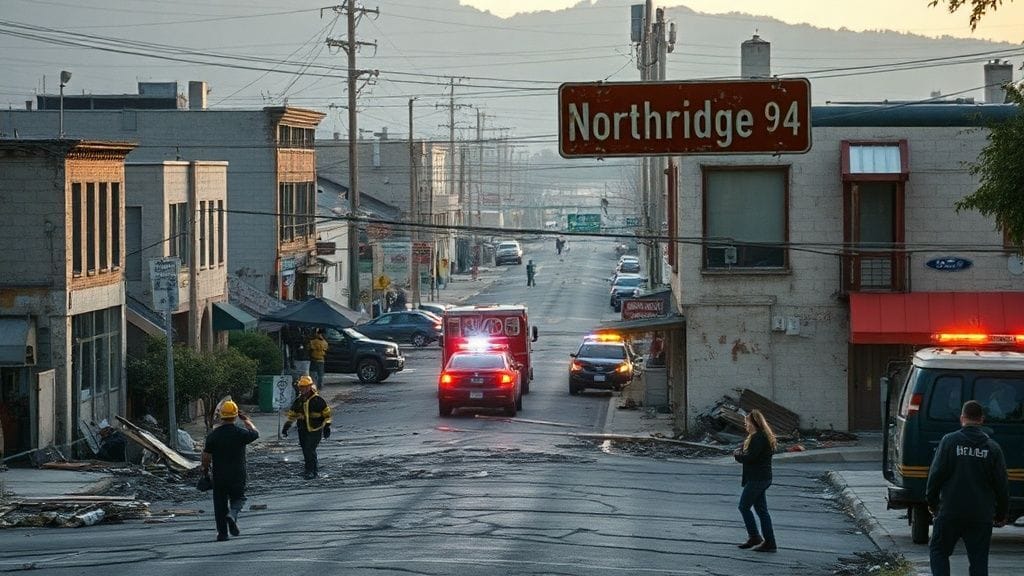
When dawn crept over the horizon, the full scale of destruction became apparent. Over 60 people were dead, and more than 9,000 injured—a grim toll that could have been worse without the early morning timing, which meant many were at home rather than in vulnerable workplaces or schools.
The infrastructure damage was staggering: approximately 20,000 buildings suffered damage, from high-rises downtown Los Angeles to residential neighborhoods. The most striking examples were the freeway collapse sites, such as the intersection of the I-5 and I-210 freeways, which became iconic images of the disaster.
Commercial districts saw shattered windows, fallen signs, and structural failures, while entire neighborhoods faced power outages and ruptured water supplies. The human cost extended beyond the immediate injury and death toll—the psychological impact was fierce, with thousands displaced from their homes, forced into shelters, and facing uncertain futures.
Emergency Response: Courage Amidst Chaos
Despite the overwhelming challenges, local, state, and federal emergency services mobilized rapidly. Firefighters, police officers, paramedics, and National Guard units worked together in what often seemed like a well-rehearsed operation, albeit amid immense logistical difficulties.
The city faced road closures, communication outages, and aftershocks that complicated rescue efforts. Yet the heroism of first responders and ordinary citizens alike emerged as a defining narrative—a testament to human solidarity under pressure. Neighbors pulling each other from rubble, volunteers opening their homes, and surgeons working through impossible conditions painted a portrait of courage in chaos.
The Federal Emergency Management Agency (FEMA) was soon involved, deploying resources to manage the crisis and coordinate long-term recovery efforts. But bureaucracy and missteps also drew criticism, revealing cracks in disaster preparedness that Californians would not forget.
Human Stories: Survival, Loss, and Resilience
Beyond the statistics and damage reports lie the deeply personal stories of survival and loss. One woman trapped under debris for hours, clinging to life by sheer will; a family reunited after the terrifying separation caused by collapsing buildings; emergency room doctors recalling the flood of casualties and the smell of smoke mingled with antiseptic.
Anthologies and oral histories collected after the quake reveal scenes of profound humanity: strangers guiding the blind, children comforting frightened pets, elders recounting past quakes and urging calm. Yet, there were also heartbreaking tales—homes lost to fire, livelihoods shattered, and the trauma that lingers long after the earth has ceased its violent dance.
These stories remind us that the Northridge Earthquake was more than a geological event; it was a human catastrophe marked by individual lives disrupted but also by a collective spirit of endurance.
The Blind Spots of Preparedness: What Was Missed?
Despite the region’s experience with earthquakes, the Northridge event exposed glaring gaps in preparedness. Many buildings constructed before modern seismic codes crumbled or were critically damaged, leading to debates about regulations and enforcement.
Communication networks faltered; hospitals struggled with damaged infrastructure; and evacuation plans revealed weaknesses. Some critics argue that the lessons of the Sylmar quake in 1971 had not been fully integrated into policy or practice, revealing a tension between economic growth and safety investments.
Insurance companies faced unprecedented claims that revealed underinsurance among homeowners and small businesses, destabilizing economic sectors and sparking urgent calls for better risk management.
Aftershocks and Uncertainty: The Days That Followed
The main shock was followed by thousands of aftershocks, some strong enough to cause additional damage and anxiety. These tremors kept the city on edge, turning homes into temporary prisons while engineers and inspectors assessed safety.
Aftershocks also provided valuable scientific data, helping researchers understand fault mechanics and stress distribution beneath Los Angeles. Yet for residents, the uncertainty was exhausting—sleep became sporadic, nerves were frayed, and the city’s pulse remained erratic.
Lawsuits, political disputes over rebuilding funds, and media scrutiny compounded the challenges, illustrating how disaster recovery is often as complex as the disaster itself.
Economic Tremors: The Financial Fallout of the Earthquake
The Northridge Earthquake exacted a massive economic toll, estimated at $20 billion, making it at the time the costliest natural disaster in U.S. history. Infrastructure damage, business interruptions, and rebuilding expenses rippled through public and private sectors.
Insurance industries grappled with claims that strained reserves, while local governments faced strained budgets due to emergency response and recovery efforts. Many small businesses closed permanently, unable to rebuild quickly enough.
Yet, reconstruction also spurred economic activity, with construction firms, engineers, and urban planners gaining work—a paradox where devastation also triggers economic cycles of repair and redevelopment.
Engineering Under Scrutiny: Lessons from the Collapse
Northridge forced engineers and architects to reevaluate assumptions about building resilience. The unexpected collapse of steel-frame buildings, once considered among the safest, challenged long-held beliefs and prompted extensive research into structural vulnerabilities.
New design standards were drafted, emphasizing ductility, energy dissipation, and redundancy in building components. The quake became a case study in earthquake engineering worldwide, influencing seismic codes not only in California but across quake-prone regions globally.
It also highlighted the need for retrofitting older buildings, spurring policies aimed at upgrading structures to withstand future shocks more effectively.
Urban Transformation: Rebuilding a Shaken Metropolis
In the years following the earthquake, Los Angeles undertook a monumental rebuilding effort. From freeway overpasses to residential homes, the city was physically reshaped by the desperate need for stronger infrastructure.
Community input, technological advances, and political will converged to design an urban landscape more mindful of seismic risk. The reconstruction was not only about fixing what was broken but about envisioning a city prepared for the future.
Architectural innovation met social necessity, with increased attention to affordable housing, public safety, and emergency preparedness programs.
Psychological Scars: Trauma and Healing in the Earthquake’s Wake
The Northridge Earthquake left more than bricks and mortar broken—it fractured psyches. Mental health professionals observed spikes in post-traumatic stress disorder (PTSD), anxiety, and depression among survivors.
Schools incorporated trauma counseling, and community centers became hubs of support. The emotional aftermath underscored the necessity of integrating psychological care into disaster response.
Healing—both personal and communal—became a slow, deliberate process, marked by anniversaries of remembrance as well as hope for resilience.
Policy Reforms and Building Codes: A New Era of Safety
Perhaps the quake's most lasting legacy was its impact on policy. California swiftly revised seismic safety regulations—demanding more stringent building codes, mandatory retrofits for vulnerable structures, and enhanced emergency response planning.
Legislators and urban planners embraced a proactive stance: disaster readiness became a permanent priority rather than a reactive measure. California's policies influenced national discussions on natural disaster preparedness and urban safety.
Public awareness campaigns educated millions, embedding earthquake culture deep into the Californian identity.
Comparing Disasters: Northridge in the Panorama of Earthquakes
In the grand theater of seismic events, Northridge holds a distinctive place—not the deadliest, but one of the most costly and scientifically enlightening earthquakes in the United States.
Compared to 1906 San Francisco or 1989 Loma Prieta quakes, Northridge demonstrated how even moderate-to-strong earthquakes could devastate densely populated urban areas without precedent.
Its lessons continue to inform global seismic risk management, standing as a cautionary tale of urban fragility and human resilience.
The Role of Media: Narrating Catastrophe in Real Time
Television broadcasts rolled live images of collapsed highways and emergency interventions directly into American homes, shaping public perception of the disaster. Media coverage oscillated between sensationalism and sober reporting, influencing aid flows and government responses.
Photojournalists and reporters formed a frontline chronicling both calamity and courage, turning Northridge into a shared national experience.
This instant storytelling accelerated the role of media in disaster mitigation strategies and public awareness.
Community Solidarity: Stories of Support and Rebirth
Against the backdrop of destruction, stories of community spirit emerged as a beacon of hope. Neighborhood groups mobilized support, faith organizations offered refuge, and volunteers distributed food and aid.
This social solidarity was not only compassion but survival—a collective effort that softened the earthquake’s harshness.
Years later, these bonds endured as foundational elements of Los Angeles’ ongoing resilience, reinforcing an ethos of mutual aid in times of crisis.
Scientific Advances: How Northridge Changed Seismology
Northridge’s hidden fault and unexpected damage patterns propelled seismic science into new frontiers. Instruments recorded detailed ground motions, helping refine predictive models and earthquake simulation.
Seismologists adopted innovative technologies like GPS mapping and computer modeling, deepening the understanding of fault mechanics and rupture processes.
The quake catalyzed global research cooperation—a scientific awakening from tremors beneath an ordinary city.
Remembering Northridge: Memorials and Collective Memory
Today, Northridge is commemorated not only in academic papers but also in memorials—spaces where survivors gather annually to honor those lost and reflect on the fragility and perseverance of life.
Museums and educational programs preserve memories, teaching new generations about the earthquake’s impact and the importance of readiness.
The event remains a defining chapter in California’s history—a somber and instructive legacy etched into the landscape and collective consciousness.
Conclusion
The Northridge Earthquake was not merely a geological event—it was a human story of sudden upheaval, tragic loss, and indomitable spirit. It exposed the vulnerabilities of a sprawling metropolis perched atop a volatile earth and, through destruction, offered hard-earned lessons in science, engineering, policy, and humanity.
For California, and indeed the world, Northridge stands as a powerful reminder: the earth’s movements are inevitable, but how we prepare, respond, and rebuild defines the trajectory of recovery. In the rupture of cracked concrete and fractured lives emerged a renewed commitment to resilience—a testament that even when the ground gives way, human resolve can create the foundations of a safer, more aware future.
FAQs
1. What caused the Northridge Earthquake?
The earthquake was caused by the sudden rupture of a previously unknown blind thrust fault beneath the San Fernando Valley, part of the broader complex of faults related to the Pacific and North American plate boundary.
2. How strong was the Northridge Earthquake?
It measured a magnitude of 6.7 on the Richter scale, producing violent shaking that lasted about 10 to 20 seconds.
3. How many casualties resulted from the Northridge quake?
Approximately 60 people died, and over 9,000 were injured, making it one of the deadliest earthquakes in California's recent history.
4. What were the main structural failures during the quake?
The collapse of freeway overpasses, damage to steel-framed buildings, and older, unretrofitted residential and commercial buildings contributed to widespread destruction.
5. How did the Northridge Earthquake impact building codes?
It led to major revisions in seismic safety regulations, including stricter building codes and mandatory retrofitting of vulnerable structures across California.
6. What role did media play during the disaster?
Media outlets broadcast live images and news from affected areas, raising public awareness, shaping national perception, and influencing emergency resource allocation.
7. How did the earthquake affect Los Angeles economically?
It caused an estimated $20 billion in damage, impacting infrastructure, businesses, insurance industries, and public budgets.
8. What lasting scientific contributions resulted from the Northridge Earthquake?
The event advanced the understanding of blind thrust faults, improved earthquake modeling, and spurred innovations in seismic monitoring technology.