Table of Contents
- The Fractured Realm: Norway on the Brink of Chaos
- The Death of King Sigurd I: A Kingdom Unmoored
- A Clash of Claims: Harald Gille’s Arrival and the Seeds of Discord
- The Birth of the Civil Wars: Bergen and Trondheim in Turmoil
- The Battle Lines Drawn: The Factions and Their Champions
- Sverre Sigurdsson: The Rise of a Rebel King
- The Church and the Crown: Spiritual Power in a Bloody Conflict
- The Era of Captains: Lords, Raiders, and Their Shifting Loyalties
- The Anatomy of Warfare: Brutality, Strategy, and Symbolism
- The Impact on the People: Lives Torn Apart Amidst Endless Battles
- Norway’s Neighboring Powers: Scandinavia’s Role in the Turmoil
- The Role of Women and Families in the Civil Wars
- The End of an Era: The Battle of Sekken and the Waning of Conflict
- Political Innovation Amid Chaos: The Consolidation of Royal Authority
- Civil War’s Legacy: Forging the Modern Norwegian State
- Remembering the Wars: Historical Memory and National Identity
- Conclusion: From Ruin to Renewal—The Unseen Birth of a Nation
- FAQs: Understanding Norway’s Twelfth-Century Civil Wars
- External Resource
- Internal Link
The year was 1130. The air hung heavy over Norway’s fjords, thick with the scent of smoke and the cries of countless lives shattered by inescapable strife. In the heart of Bergen and Trondheim, once majestic seats of power, shadowy figures plotted the next move in a decades-long chess game, where swords spoke louder than words, and loyalty was as fickle as the northern winds. Norway, a kingdom forged in Viking fire, was tearing itself apart, as competing bloodlines ignited a struggle that would last more than three turbulent decades—the Norwegian Civil Wars.
The Fractured Realm: Norway on the Brink of Chaos
When King Sigurd I Haraldsson, known as Sigurd the Crusader, died in 1130, Norway was thrust into an abyss of uncertainty. The kingdom he had ruled with relative stability for over a decade found itself without a clear successor. King Sigurd had spent years abroad, journeying to the Holy Land—a venture that elevated his standing but left the domestic political landscape precariously fragile. The king’s passing exposed the raw nerves of dynastic tension, tribal loyalties, and regional ambitions that simmered beneath the surface.
Norway in the early twelfth century was not a monolithic state but a patchwork of powerful noble families and chieftains, each guarding their territory fiercely. The islands, peninsulas, and fjords of western and central Norway were natural fortresses but also barriers to central authority. The provincial wealth and power centered in Bergen and Trondheim were attractors for those who sought the crown. But how to claim the throne? Unlike the smooth hereditary successions of later monarchies, Norway’s sagas speak of kingship as both bloodright and battlefield, granted only to those who could wield power decisively.
The Death of King Sigurd I: A Kingdom Unmoored
King Sigurd’s death was both an ending and a beginning. He left behind no legitimate heir who was uncontested, but several claimants emerged, each asserting their right to rule. Among them was Harald Gille, a man who claimed to be Sigurd’s half-brother—though his origins were clouded in mystery and scandal—and Magnus IV Sigurdsson, Sigurd’s son. The kingdom looked toward these men, but also feared what their rivalry would do to Norway’s fragile fabric.
Harald Gille landed on Norwegian shores from Ireland—a foreigner to many—demanding recognition as a legitimate heir. His arrival was provocative. To the people of Bergen, Trondheim, and beyond, his claim threatened the delicate balance of power that had held since the age of Harald Hardrada. The political atmosphere was alight with tension as noble factions aligned themselves behind these competing kings.
A Clash of Claims: Harald Gille’s Arrival and the Seeds of Discord
Harald Gille’s life reads like a saga itself—a mysterious origin, a bold declaration to the king, and a public oath sworn before clerics and nobles to affirm his bloodline. Yet doubts lingered, and his claim was contested fiercely. To Magnus’s supporters, the son of Sigurd was the legitimate heir, sanctified by birth. Harald’s assertion was a challenge to both the family and the existing order.
The kingdom soon split: staggeringly, Harald and Magnus shared kingship for a time—an uneasy co-rule doomed by mistrust and ambition. Each sought allies among the powerful chieftains, and the first sparks of civil war kindled. Bergen, the western maritime capital, and Trondheim, the traditional heart of Norwegian kingship, became capitals of different factions. Blood was spilled, but the battle was as much for hearts and minds as for land.
The Birth of the Civil Wars: Bergen and Trondheim in Turmoil
By the early 1130s, Norway was no longer a single kingdom united under one rule but a divided realm, braced for conflict. Bergen and Trondheim bore the brunt of this strife. Bergen was a bustling port city, where trade and Viking heritage intertwined. Its streets thronged with loyalists of Harald Gille’s cause. In contrast, Trondheim, with its religious significance as the seat of Archbishopric and its ancient royal palace, was a bastion for Magnus’s loyalists.
The tensions escalated rapidly. Skirmishes gave way to pitched battles. Norwegians, once bound by a shared identity forged in Viking unity, found themselves fighting neighbors, kin, and sometimes even fathers against sons. From 1135 onwards, a relentless cycle of battle, negotiation, and betrayal embroiled the land.
The Battle Lines Drawn: The Factions and Their Champions
The complexity of the Norwegian Civil Wars lies in the shifting alliances and ever-changing rivalries. Claims to the throne were often bolstered by regional loyalty and mercenary forces drawn from Norway’s rugged landscapes and Viking descendants from across the North Atlantic. The main factions—sometimes called the “Baglers” and “Birkebeiners”—would form later in the conflicts, but the foundations of civil strife were already laid in these early years.
Beyond kings and nobles, several key figures emerged. Harald Gille himself was assassinated in 1136, a victim of the very violence he helped unleash. Magnus continued to grapple with internal challenges, only to be deposed and murdered in 1139. The cycle of claimants and usurpers fostered an environment in which military skill, cunning, and brutality were more valuable than birthright alone.
Sverre Sigurdsson: The Rise of a Rebel King
The arrival of Sverre Sigurdsson marked a turning point. Claiming to be the illegitimate son of King Sigurd II, Sverre emerged as a force to be reckoned with by the 1170s. His charismatic leadership and tactical brilliance reinvigorated the Birkebeiner faction, who had been marginalized and weakened by earlier defeats.
Sverre’s rise was not merely military but ideological: he challenged the traditional power of the aristocracy and the church, positioning himself as a king for the people and for the law. His story—of exile, rebellion, and eventual kingship—is emblematic of the era’s brutal contest for legitimacy. The narrative of a “people’s king” opposing corrupt nobles remains one of the most enduring legends from the Civil Wars.
The Church and the Crown: Spiritual Power in a Bloody Conflict
Religious authority was not separate from political power in medieval Norway; indeed, it was intertwined deeply. The Church’s role was ambiguous and crucial. Bishops and archbishops often acted as power brokers, granting divine sanction to one claimant or another and wielding influence that could tip the balance of power.
The ecclesiastical establishment sometimes supported kings such as Magnus, while opposing others like Sverre, who challenged church privileges. For instance, Sverre’s disputes with Archbishop Eirik caused a schism that led to his excommunication—a powerful symbol, even if it did not end his reign. The Church's support or opposition could galvanize armies or legitimize rebellion.
The Era of Captains: Lords, Raiders, and Their Shifting Loyalties
Norwegian society was fiercely stratified but also personal in its bonds of loyalty. Powerful warlords, regional chieftains, and even mercenary leaders commanded armies drawn from kinship networks, local communities, and the wider Viking diaspora.
Many captains shifted allegiances as fortunes changed, embodying a pragmatism born of survival in uncertain times. The Navy became a key instrument: ship raids and naval engagements along the fjords dictated control of territories and access to resources. The Civil Wars were not static battles but a kaleidoscope of shifting fronts and unexpected alliances.
The Anatomy of Warfare: Brutality, Strategy, and Symbolism
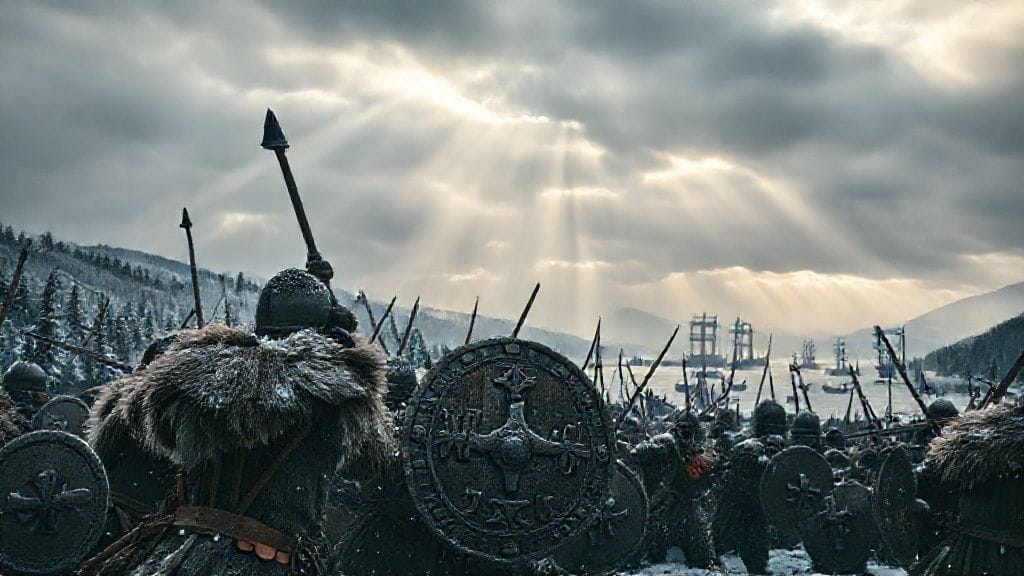
Combat during the Norwegian Civil Wars was brutal and atmospheric. The rugged natural environment shaped warfare: narrow fjords, dense forests, and forbidding mountains set the stage for ambushes, naval skirmishes, and sieges of wooden fortresses.
Tactics combined the old Viking warrior spirit with growing influences from Christian knighthood and European warfare methods. Armies numbered in the thousands at times, but often comprised small, fierce groups of warriors whose loyalty was personal and transactional.
A striking aspect was the symbolic importance of royal regalia—the crown, banners, and sacred relics often captured or defended fiercely, representing more than power: they were a sign that divine favor was on one’s side.
The Impact on the People: Lives Torn Apart Amidst Endless Battles
The Norwegian Civil Wars were not confined to the palaces and battlefields of kings and nobles. For the ordinary people—farmers, fishermen, craftsmen—the wars meant devastation. Fields were burned, villages plundered, and trade disrupted. Famine and disease followed the armies.
People were forced to choose sides, sometimes at the cost of their families being targeted by rivals. Many fled their homes or became refugees within their own country. The human cost transcended the political; it reshaped Norwegian society’s very fabric.
Norway’s Neighboring Powers: Scandinavia’s Role in the Turmoil
The instability in Norway reverberated throughout Scandinavia. Sweden and Denmark, both emerging as kingdom-states themselves, watched carefully. Some chieftains and claimants received external support or sanctuary, complicating the civil strife with diplomatic intrigue.
At times, neighboring kingdoms exploited Norway’s weakness for their own ambitions, while at others, they sought alliances through marriage or trade agreements to stabilize the region. Norway’s Civil Wars thus became a chapter in the wider Scandinavian power struggle of the twelfth century.
The Role of Women and Families in the Civil Wars
Often overshadowed by tales of warriors and kings, women nonetheless played vital roles. Queens and noblewomen acted as diplomats, bearers of lineage claims, and sometimes regents. They navigated a male-dominated world with resilience and subtle influence.
Families were fractured, both because of competing dynastic claims and the cruel reality of war—where kinship bonds could lead to deadly rivalries. The saga literature of the period occasionally highlights the tragic fates of women caught in these storms, offering a humanizing lens on war’s collateral damage.
The End of an Era: The Battle of Sekken and the Waning of Conflict
By the mid-1160s, a gradual exhaustion took hold. Although sporadic conflicts continued, several decisive battles—such as the Battle of Sekken in 1162 where Earl Erling Skakke and King Magnus V fought to secure the throne—shifted momentum. The emergence of stronger royal authority and the consolidation of power under later kings began to restore relative peace.
The roots of Norway’s transition from fractured kingdom to centralized monarchy can be traced back to the lessons and bloodshed of this turbulent period.
Political Innovation Amid Chaos: The Consolidation of Royal Authority
Surprisingly, the Civil Wars also catalyzed political development. The necessity of controlling rival factions led to innovations in governance—such as formal recognition of heirs, establishment of clearer laws of succession, and growing cooperation between crown and church.
These changes laid foundations that would strengthen the Norwegian monarchy in the centuries to come, turning civil war trauma into political evolution.
Civil War’s Legacy: Forging the Modern Norwegian State
Norway’s Civil Wars left scars but also helped forge national identity. The stories of valor and tragedy recorded in sagas and oral histories became cornerstones of a shared cultural memory. Moreover, the conflict’s resolution paved the way for Norway’s medieval consolidation, influencing politics, culture, and society well into the modern age.
Historians regard this period as both a dark chapter and an unrecognized crucible for Norwegian statehood.
Remembering the Wars: Historical Memory and National Identity
Through centuries, the Norwegian Civil Wars have been remembered—and sometimes romanticized—in literature, folklore, and scholarship. The era’s figures, especially leaders like Sverre Sigurdsson, remain emblematic of resistance, justice, and the complexities of power.
Modern Norway’s engagement with these events reflects a desire to understand the costs of division and the enduring quest for unity. Museums, historical reenactments, and academic debates continue to shed light on the Civil Wars’ profound legacies.
Conclusion
The Norwegian Civil Wars of the 1130s to 1160s were more than a series of battles for a throne—they were a crucible where the old Viking ways met the emergence of medieval monarchy and Christianity’s growing influence. Amidst the fjords and fortresses of Bergen and Trondheim, ordinary lives were shattered, kingdoms fractured, and legends born from fire and blood.
Yet, from this turbulent era arose a stronger, more centralized Norway. The wounds, while deep, became the foundation for a unified nation. The story of these civil wars is not merely one of conflict but of resilience, adaptation, and the human capacity to rebuild after devastation. Norway’s history, like the wild northern shores, is shaped by storms—but also by the enduring promise of peace.
FAQs
1. What caused the Norwegian Civil Wars of the 12th century?
The wars stemmed primarily from unclear succession laws, multiple competing claimants to the throne after King Sigurd I’s death, and regional power struggles combined with complex noble alliances.
2. Who were the main figures involved in the conflict?
Key figures included Harald Gille, Magnus IV, Sverre Sigurdsson, and later regional lords such as Earl Erling Skakke. Each played roles in the evolving civil war dynamics.
3. How did the Church influence the wars?
The Church was a powerful political actor supporting or opposing kings, using spiritual authority to legitimize rulers or condemn rebels, which directly influenced alliances and conflicts.
4. What impact did the wars have on ordinary Norwegians?
They suffered heavily: displacement, famine, violence, and social disruption were widespread, deeply affecting Norway’s demographic and economic landscape.
5. How did the Civil Wars end?
The wars gradually subsided with the rise of strong leaders like Sverre, culminating in key battles and political innovations that established clearer royal succession and centralized authority.
6. What is the legacy of the Civil Wars in Norwegian history?
The wars helped forge the modern Norwegian state, deeply influencing national identity, legal traditions, and cultural memory.
7. Were neighboring countries involved in the conflict?
Yes, Sweden and Denmark were involved indirectly by supporting claimants and skirmishing on borders, influencing the conflict’s course.
8. How are these wars remembered today?
Through sagas, literature, historical research, and commemorations, Norwegians remember the wars as pivotal in defining their nation’s past and character.

