Table of Contents
- The Winds of Change over the Hebrides: A Prelude to the Treaty
- Norway and Scotland in the 13th Century: Two Kingdoms at a Crossroads
- The Hebrides: Jewel of the North Atlantic
- Norwegian Sovereignty over the Hebrides: History and Challenges
- The Rise of Scottish Ambitions: King Alexander III’s Vision
- The Battle of Largs (1263): Clash of Titans or Icy Stalemate?
- From Warfare to Diplomacy: The Shift in Power
- Negotiating peace: The Road to the Treaty of Perth
- July 2, 1266: Signing the Norwegian–Scottish Treaty of Perth
- Terms of the Treaty: More Than Just Land Exchange
- The Price of Power: 4,000 Marks and the Ceding of the Hebrides
- The Isle of Man: A Separate Piece of the Puzzle
- Political Reactions: Norway’s Internal Dissent and Scotland’s Triumph
- The Hebrides After the Treaty: Integration and Resistance
- Cultural Impacts: Norse and Gaelic Legacies Entwined
- Economic Shifts in the North Atlantic Sphere
- The Treaty’s Role in Shaping Medieval Scottish Identity
- Norway’s Northern Focus Post-Treaty
- The Treaty in the Light of Modern Historiography
- The Hebrides’ Long Road to Scottish Sovereignty
- The Treaty’s Echoes in Later Scottish-Norwegian Relations
- Conclusion: Beyond Borders, the Making of History
- FAQs: Understanding the Treaty of Perth
- External Resource
- Internal Link
The seagulls cried overhead, their sharp calls slicing through the salty air as the old wooden ships bobbed gently on the cold waves of the North Sea. The distant horizon shimmered beneath a pale summer sun, marking an end to decades of turbulence in a remote archipelago strewn like jewels across the Atlantic. On July 2, 1266, a quiet but decisive pact was sealed in Perth, Scotland—a treaty that would redraw the map of the North Atlantic world and echo through centuries: the Norwegian–Scottish Treaty of Perth.
This was no simple handshake between monarchs but a careful negotiation born from years of conflict, entwining the ambitions of two great kingdoms and the identities of people living in the mist-veiled Hebrides. It was a story of shifting allegiances, hard-fought battles, and the inexorable advance of medieval statecraft. But more than that, it was about the land itself—the rugged islands caught between fjords and isles, shaped by storms and saga, tied together by Norse ships and Gaelic tales.
The Winds of Change over the Hebrides: A Prelude to the Treaty
The mid-13th century North Atlantic was a landscape of flux. The Hebrides, a sprawling chain of islands off the west coast of Scotland, had for generations been a Norse satellite, their lords descended from Viking settlers who had blended with the native Gaels. Yet, as the centuries turned, the steady expansion of the Scottish Kingdom beneath the rule of Alexander II and later his son, Alexander III, brought new ambitions and fresh tensions over these remote territories. The Hebrides represented far more than mere land—they were strategic naval bases controlling access to the western seas, rich fishing grounds, and culturally complex nodes where Norse and Gaelic worlds met.
The tides of power were shifting, propelled by both war and diplomacy. Norway’s hold on the British periphery was increasingly tenuous, strained by distance, internal politics, and the evolving landscape of medieval Europe. For Scotland, the Hebrides embodied a long-overdue unification of the lands of Alba, crucial for consolidating a kingdom that still wrestled with its fragmented past.
Norway and Scotland in the 13th Century: Two Kingdoms at a Crossroads
On one side stood the Kingdom of Norway, whose rulers at that time balanced Scandinavia’s northern expanse with holdings stretched to the British Isles. The line from the fortress of Bergen to the Hebrides traced a tenuous claim to the edge of Europe’s western fringes. Norse kings, heirs to Viking legacies, were grappling with the complexities of centralized rule and the demands of nobility and local chieftains.
In Scotland, King Alexander III ascended the throne in 1249, determined to assert royal authority beyond the mainland. His reign marked a crucial phase in Scottish history—an era characterized by legal reform, infrastructural development, and territorial expansion. The Hebrides, along with the Isle of Man and Caithness, were naturally aligned as key parts of this vision.
The interaction of these two realms was inevitably fraught. Norway sought to maintain its far-flung dominions despite growing internal preoccupations, including pressures from Danish neighbors and challenges from within the Norwegian aristocracy. Scotland, meanwhile, looked westward with renewed vigor.
The Hebrides: Jewel of the North Atlantic
The Hebrides themselves were not just strategic islands but living, breathing communities with their own identities formed through centuries of Norse-Gaelic fusion. From the cold peat bogs of Eilean Mòr to the rocky shores of Mull, clans lived amid windswept hills and ancient ruins.
Historically, the Hebrides had belonged to the Kingdom of the Isles, a semi-autonomous Norse-Gaelic polity. Its rulers, often called the Lords of the Isles, commanded allegiances that wove together Viking sea lords with Celtic chieftains. For Norse kings, the Hebrides were a spoiled prize, offering naval supremacy and a foothold in western Britain. For Scots, they represented an integral but still unclaimed part of their land.
Norwegian Sovereignty over the Hebrides: History and Challenges
Norwegian sovereignty over the Hebrides was solidified in the centuries following Viking expansion in the 9th and 10th centuries but was not unchallenged. Scottish kings had intermittently claimed suzerainty, and Gaelic influence remained resilient. The Lords of the Isles often acted as intermediaries, walking a political tightrope between Oslo and Edinburgh.
But as the 13th century advanced, Norway’s ability to project authority waned. Long communication lines, expensive military commitments, and political distractions in Scandinavia weakened control. Jacobite kinships in the western islands maintained Norse culture, but their allegiance to Norway became more symbolic than strong.
The Rise of Scottish Ambitions: King Alexander III’s Vision
Alexander III was a monarch with a clear vision of consolidating Scotland’s territorial integrity. His ambition to reunite distant parts of his kingdom was driven not just by strategic calculations but by an evolving sense of identity. The Scottish crown had long regarded the western islands as part of its historic patrimony.
His court was vibrant, filled with Norman, Gaelic, and emerging Scottish influences, fueling aspirations for centralization. Diplomatic ventures and selective military pressure were increasingly aimed at eroding Norwegian claims.
There was pragmatism as well: the Scottish king recognized that direct confrontation with Norway risked protracted conflict but that carefully orchestrated diplomacy combined with subtle military demonstrations could tilt the balance.
The Battle of Largs (1263): Clash of Titans or Icy Stalemate?
The tensions culminated in a direct confrontation in October 1263 during the winter months off the Ayrshire coast near Largs. The so-called Battle of Largs was less a grand naval engagement than a violent, chaotic skirmish borne of a standoff between the Norwegian fleet, led by King Haakon IV, and Scottish forces.
Haakon’s mighty fleet had sailed westward to reassert control over the Hebrides, but severe storms and poor weather disrupted his plans. The engagement at Largs, though inconclusive militarily, was a political turning point: it symbolized the limits of Norwegian reach and the rising strength of the Scots.
Chroniclers of the time would debate its importance for centuries; some painted it as a heroic Norse venture, others as a pointed Scottish triumph. What is certain is that it marked the cessation of Norway’s effective military campaign in the region.
From Warfare to Diplomacy: The Shift in Power
Despite the battle’s ambiguous outcome, the strategic balance had shifted irreversibly. Haakon IV died the following year, his ability to continue the struggle undercut. His successor, Magnus VI, took a markedly different approach: focusing on peace, pragmatism, and domestic consolidation.
For the Scots, this was an opportunity. The deaths on both sides and the ongoing logistical difficulties of warfare made continued conflict unsustainable. Discussions began to evolve from battlefield tactics to negotiation rooms.
It was a moment where medieval realpolitik met the windswept shores—kingdoms recognizing the limits of force and the benefits of accord.
Negotiating Peace: The Road to the Treaty of Perth
The process that led to the Treaty of Perth was complex, stretching over several years. Envoys traveled between Bergen and Edinburgh, scopes of negotiation alternated between territorial claims, monetary compensation, and mutual recognition.
The Scottish envoys pressed hard on the integration of the Western Isles into the kingdom. Norway, in turn, sought to secure favorable terms and maintain honor in surrender.
Historical records paint a picture of cautious hostility softened by mutual respect; a treaty that would not only end hostilities but lay out a framework for future relations.
July 2, 1266: Signing the Norwegian–Scottish Treaty of Perth
Finally, on July 2, 1266, a formal agreement was signed in Perth, Scotland. This treaty officially ceded the Hebrides and the Isle of Man to Scotland in return for a significant sum of money and a promise of peaceful relations.
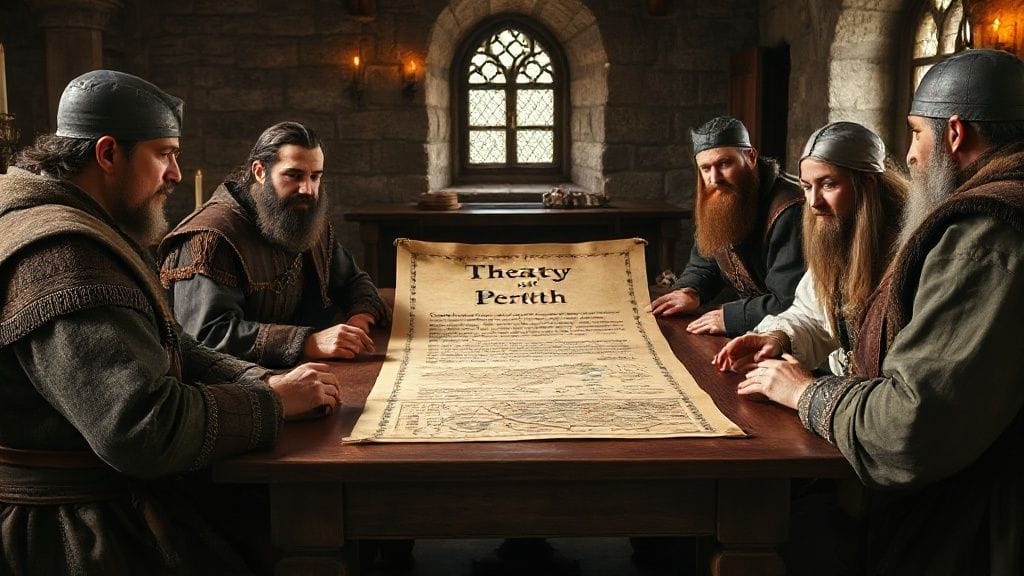
For Norway, it was a pragmatic concession; for Scotland, a major territorial consolidation that would shape its coastal identity for centuries. The scene in Perth was likely austere yet charged with the gravity of change—representatives of two great northern kingdoms endorsing a new era.
Terms of the Treaty: More Than Just Land Exchange
While the headline was the transfer of the Hebrides and the Isle of Man, the treaty’s terms included nuances of military allegiance, economic arrangements, and formal renunciation of claims.
Norway received 4,000 marks—a substantial amount at the time—while Scotland agreed to respect certain Norwegian rights elsewhere. Moreover, Norway retained control over Orkney and Shetland, sustaining a foothold in the islands but conceding the prized western isles.
This balance symbolized the shifting spheres of influence between the two kingdoms.
The Price of Power: 4,000 Marks and the Ceding of the Hebrides
The payment of 4,000 marks was not a mere transaction but underscored the intrinsic value and complexity of the islands. It highlighted the interplay of warfare, economy, and diplomacy.
Contemporary accounts attest to the sum being a heavy burden, yet a small price compared to the cost of ongoing conflict. The financial element served as a recognition from Scotland of Norway’s former rights and a gesture to smooth relations.
The Isle of Man: A Separate Piece of the Puzzle
While formally ceded alongside the Hebrides, the Isle of Man followed a more intricate path of allegiance and governance. Its unique culture and political structure distinguished it from the wider Scottish realm.
The treaty’s inclusion of the Isle of Man reflected the interconnectedness of maritime territories and the strategic importance of controlling shipping lanes and fishing waters.
Yet, its fate would remain more fluid in subsequent decades, often turning between English, Scottish, and Norse hands.
Political Reactions: Norway’s Internal Dissent and Scotland’s Triumph
Back in Norway, the treaty sparked mixed feelings. While celebrated by the central monarchy as a diplomatic victory and a means to consolidate resources, many nobles and coastal lords lamented the loss of traditional lands.
In Scotland, Alexander III’s prestige rose sharply. His vision of a united kingdom seemed closer to realization, and the treaty became a keystone of his legacy.
However, tensions persisted among island chieftains and clans, some resistant to mainland rule, signaling that the treaty’s impact was only the opening chapter of a longer process.
The Hebrides After the Treaty: Integration and Resistance
The islands now under Scottish control faced a new reality. Royal officials and law enforcement sought to extend authority, instituting taxes, courts, and military garrisons.
The process was gradual and met with both acceptance and rebellion. Norse-Gaelic culture did not vanish overnight but blended into emerging Scottish customs.
The Lords of the Isles, still powerful figures, navigated this new landscape, sometimes allying with the crown, sometimes asserting autonomy.
Cultural Impacts: Norse and Gaelic Legacies Entwined
The Treaty of Perth did not erase the complex cultural tapestry of the Hebrides. Norse influence lingered in place names, customs, and architecture, while Gaelic language and tradition remained vibrant.
This blend would shape the region’s identity for generations. The shared history of conflict and accord fostered a unique hybrid culture, a testament to the dynamic interactions between peoples and polities.
Economic Shifts in the North Atlantic Sphere
Control of the Hebrides altered trade routes and economic networks. Scotland gained access to crucial fisheries and strengthened its maritime trade.
Norway’s economic focus shifted northward, concentrating on its Scandinavian heartlands. The redistribution of wealth and resources had ripple effects on regional economies.
Ports like Oban and Dumbarton grew in importance, integrating the islands into broader Scottish commercial activity.
The Treaty’s Role in Shaping Medieval Scottish Identity
The acquisition of the Hebrides under Alexander III was more than territorial expansion; it was foundational in crafting a cohesive Scottish identity.
Medieval chronicles celebrated the unification, and the islands’ inclusion in the kingdom reinforced the idea of Scotland as a maritime power and diverse nation.
The treaty symbolized transition from a fractured landscape to a consolidated medieval state.
Norway’s Northern Focus Post-Treaty
Freed from obligations in the Hebrides, Norway turned its attention inward, fortifying northern territories and addressing internal governance.
The treaty allowed Norwegian kings to manage their realm with greater focus and pragmatism, but marked the retreat from Britain as a dominant player.
This recalibration would resonate through Scandinavian history in later centuries.
The Treaty in the Light of Modern Historiography
Modern historians view the Treaty of Perth as a landmark in medieval diplomacy. Its ramifications reach beyond mere territory, encompassing identity formation, legal precedent, and international relations.
Historical debates have evolved—with some stressing the treaty’s inevitability, others the contingency of events. The erosion of Norwegian authority is seen both as strategic retreat and as the emergence of a more centralized Scottish state.
The Hebrides’ Long Road to Scottish Sovereignty
Though treaty-bound, the full integration of the Hebrides into Scotland unfolded over decades. The local clans retained autonomy, and periodic uprisings tested Scottish kings.
The Treaty of Perth was thus a beginning, a formal recognition of sovereignty that required ongoing political and military effort.
The islands remained a distinct, sometimes restless part of Scotland.
The Treaty’s Echoes in Later Scottish-Norwegian Relations
Though the treaty ended claims to the Hebrides, Scotland and Norway maintained ties through trade, marriage alliances, and occasional conflict.
The acknowledgement of spheres of influence helped stabilize relations but never erased the historical memory of their shared past.
Centuries later, the treaty stands as a reference point in legal and diplomatic history.
Conclusion: Beyond Borders, the Making of History
The Norwegian–Scottish Treaty of Perth was more than a medieval document; it was a turning point where history, identity, and politics converged. It tells us about kingdoms grappling with their limits, about cultures entangled across seas, and about the enduring human drive to make sense of the lands they inhabit.
In that quiet July day of 1266 in Perth, a chapter closed on Viking dominance and opened new possibilities for Scotland’s future. For the peoples of the Hebrides, it would signal centuries of adaptation, resilience, and the weaving of stories that still echo in the winds and waves of those ancient isles.
FAQs
1. Why was the Treaty of Perth significant in medieval history?
The Treaty of Perth marked the formal cession of the Hebrides and Isle of Man from Norway to Scotland, reshaping political boundaries and setting a precedent for medieval diplomacy in the North Atlantic region.
2. What led to the decline of Norwegian control over the Hebrides?
A combination of long-distance governance challenges, shifting political priorities in Norway, military setbacks like the Battle of Largs, and Scottish ambitions eroded Norwegian influence leading up to the treaty.
3. How did the Scottish crown benefit from the treaty?
Scotland consolidated its western territories, gained important strategic and economic advantages, and reinforced the idea of a united kingdom under Alexander III.
4. Did the Treaty of Perth end all conflicts over the Hebrides?
No. While it established Scottish sovereignty, resistance from local clans and ongoing power struggles meant integration was a gradual process with recurrent conflicts.
5. How did the treaty affect the cultural landscape of the Hebrides?
The treaty initiated political change but the islands retained strong Norse–Gaelic cultural elements that blended over time, influencing language, customs, and governance.
6. Was the Isle of Man permanently included in Scotland after the treaty?
Though ceded as part of the treaty terms, the Isle of Man’s political status remained contested and changed hands multiple times in subsequent centuries.
7. Who were the key figures involved in negotiating the treaty?
King Alexander III of Scotland and King Magnus VI of Norway were central, supported by royal envoys, chieftains, and advisors navigating complex diplomatic talks.
8. What does the treaty tell us about medieval diplomacy?
It highlights the balance between warfare and negotiation, the importance of symbolic gestures like monetary payments, and the pragmatic approaches kingdoms took toward territorial disputes.