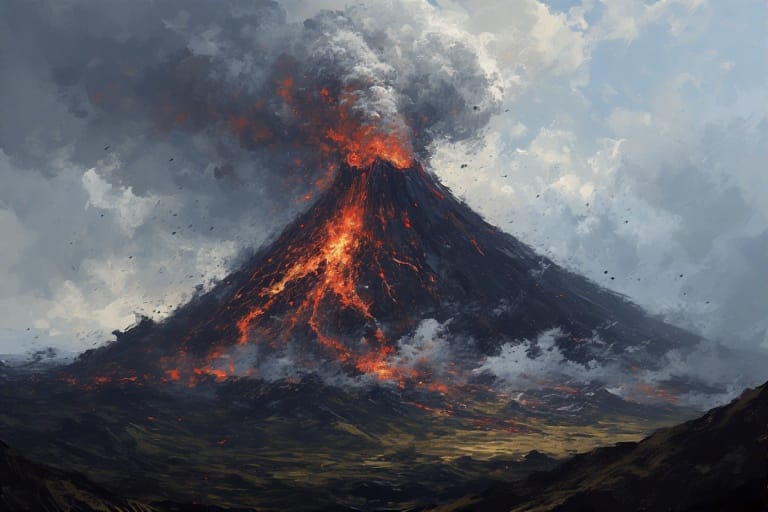
Novarupta 1912: The Explosion That Dwarfed All Others
Table of Contents
- Introduction
- Alaska’s Volcanic Landscape
- Prelude to an Eruption
- The Eruption of June 6, 1912
- Valley of Ten Thousand Smokes
- Ashfall and Atmospheric Effects
- Local and Regional Impact
- Scientific Revelations
- Comparison with Other Eruptions
- Long-Term Changes and Recovery
- Conclusion
- External Resource
- Internal Link
1. Introduction
When most people think of massive volcanic eruptions, names like Krakatoa or Vesuvius come to mind. But in the remote wilderness of Alaska, a little-known volcano named Novarupta erupted on June 6, 1912, producing the largest volcanic explosion of the 20th century.
This eruption unleashed a fury so immense that it outclassed even the infamous Mount St. Helens eruption by a factor of 30 in volume. Despite its intensity, Novarupta remains an underappreciated chapter in Earth’s violent geologic history.
2. Alaska’s Volcanic Landscape
Located in Katmai National Park, Novarupta is part of the Aleutian volcanic arc, where the Pacific Plate subducts beneath the North American Plate.
✔️ The region includes over 40 active volcanoes.
✔️ It’s one of the most volcanically active areas on Earth.
✔️ Prior to 1912, Novarupta wasn’t even identified as a separate volcano.
3. Prelude to an Eruption
In the spring of 1912, seismic activity increased around Mount Katmai, raising alarms.
✔️ Small earthquakes and tremors became more frequent.
✔️ Locals observed changes in steam emissions.
✔️ No one anticipated the sheer scale of what was coming.
4. The Eruption of June 6, 1912
At 1 PM, a massive explosion rocked the Alaskan Peninsula. Over the next 60 hours, a continuous series of violent eruptions expelled more than 13 cubic kilometers of magma.
✔️ Ash clouds rose 20 miles into the atmosphere.
✔️ Lava domes and pyroclastic flows reshaped the region.
✔️ The sky darkened, and ash rained over thousands of miles.
The eruption created a caldera at Mount Katmai, but the actual magma source came from Novarupta.
5. Valley of Ten Thousand Smokes
The eruption produced a unique feature: the Valley of Ten Thousand Smokes.
✔️ Named for the countless fumaroles (steam vents) rising from the ash-covered valley.
✔️ Spanning over 40 square miles.
✔️ Layered in more than 200 feet of ash and pumice.
The valley became one of the most surreal landscapes on Earth.
6. Ashfall and Atmospheric Effects
✔️ Ash reached as far as Seattle, over 1,500 miles away.
✔️ Ships at sea reported visibility near zero.
✔️ Fine ash circled the globe, lowering global temperatures.
Though not as prolonged as the Laki or Tambora eruptions, Novarupta had a tangible impact on weather patterns and agriculture in the following months.
7. Local and Regional Impact
The nearby Native Alaskan villages suffered deeply:
✔️ Homes and food sources were buried.
✔️ Livelihoods vanished under thick volcanic ash.
✔️ Survivors had to relocate permanently.
The Katmai River was dammed by debris, changing water systems entirely.
8. Scientific Revelations
The eruption redefined what scientists thought possible from subduction zone volcanism.
✔️ Introduced the world to “plinian eruptions” on a new scale.
✔️ Triggered the foundation of modern volcanology in Alaska.
✔️ Inspired decades of study by the National Geographic Society.
Even today, Novarupta is a goldmine of geological insight.
9. Comparison with Other Eruptions
✔️ Novarupta released 30x more material than Mount St. Helens.
✔️ It was 10x larger than the 1883 Krakatoa eruption.
✔️ Despite its size, few deaths were recorded due to the remote location.
Its lack of notoriety is perhaps due to its distance from population centers and wartime distractions in media coverage.
10. Long-Term Changes and Recovery
✔️ Katmai National Park was established in 1918 to protect the site.
✔️ The Valley of Ten Thousand Smokes became a major research and tourist destination.
✔️ Ecosystems eventually recovered, offering insight into volcanic succession.
11. Conclusion
The Novarupta eruption of 1912 is a monumental but often overlooked event in Earth’s history. Its power, scale, and legacy continue to shape our understanding of geologic forces.
What it lacked in immediate death toll, it made up for in scientific and environmental magnitude.
12. External Resource
🌐 Wikipedia: 1912 Novarupta eruption

