Table of Contents
- A Moment Suspended in Time: The Dawn of Offa and Charlemagne’s Diplomatic Dance
- The Winds of Change in Early Medieval Europe
- The Kingdoms of Francia and Mercia: Titans of Their Age
- Offa of Mercia: The Architect of Anglo-Saxon Power
- Charlemagne: The Apex of Carolingian Might
- The Diplomatic Overture: Why Letters Became Swords
- The Role of Marriage Alliances in Political Negotiation
- The Letters that Shaped History: Correspondences Between Kings
- Economic Ambitions and Trade Routes: The Real Stakes
- Religious Context: Christianity, Authority, and Influence
- The Numismatic Nexus: Coins as Political Messengers
- The Breakdown: From Dialogue to Distrust
- The Mercian and Carolingian Borders: Frontiers of Power and Threat
- The Impact on Anglo-Francia Relations for Decades to Come
- Legacy in Medieval Diplomacy: Lessons from Offa and Charlemagne
- The Historical Mystery of Offa’s Queen Bertha
- Charlemagne's Response and the Propaganda of Power
- Mercian Identity and Frankish Hegemony: A Complex Balance
- The Role of the Papacy and the Church in the Exchanges
- Cultural Exchanges Beyond Politics: Language, Art, and Ideas
- Conclusion: Beyond Kings and Letters—the Human Story of Rivalry and Respect
- FAQs: Understanding the Offa–Charlemagne Exchanges
- External Resource
- Internal Link
A Moment Suspended in Time: The Dawn of Offa and Charlemagne’s Diplomatic Dance
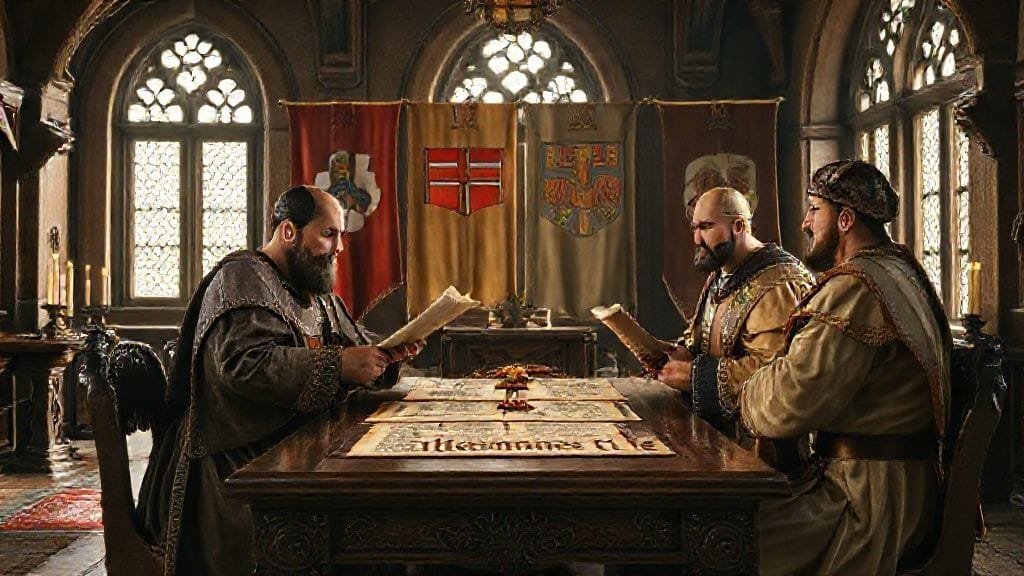
In the flickering candlelight of a late eighth-century European evening, two rulers—separated by the swell of the North Sea—engaged in an extraordinary dialogue. Not by sword or shield, but parchment and pen. The year was 789. Offa, king of Mercia, stood as the most potent Anglo-Saxon monarch, while Charlemagne, King of the Franks and soon-to-be Emperor, was reshaping the continent with sweeping reforms and conquests. Their diplomatic exchanges from 789 to 796 would become one of the most intriguing episodes of early medieval history, a slow-burning game of power, respect, negotiation, and rivalry that revealed not only the ambitions of two rulers but the complex weave of European politics.
This was a world where letters carried the weight of empires, where marriages were battles, and coins bore the imprimatur of legitimacy. The letters flying back and forth between Offa and Charlemagne were more than mere correspondences; they were declarations of sovereignty, bargaining chips, and in their silences, threats. The narrative of these exchanges is at once political, cultural, and deeply human—a story of respect and suspicion intertwined.
But to fully grasp this nuanced episode, we must journey back further, peering into the foundations of the kingdoms involved, the personalities steering them, and the wider European context in which these rulers operated.
The Winds of Change in Early Medieval Europe
The late eighth century was a tumultuous time. The Roman Empire had long vanished in the West, leaving a fragmented patchwork of kingdoms and principalities vying for dominance. The Mediterranean world was adjusting to the rise of the Abbasid Caliphate, while northern and western Europe began to see the consolidation of power by nascent states. Yet, unlike today, Europe’s political landscape was far from fixed; borders were fluid, and allegiances often as fragile as parchment.
Carolingian Francia, under Pepin the Short and later Charlemagne, grew from a kingdom to what contemporary chroniclers hailed as the “Kingdom of the Romans.” It spread its influence through military campaigns but also religious and cultural reforms, aiming to revive a sense of unity long absent. Across the channel, the Anglo-Saxon Heptarchy simmered with rivalries. Mercia, under Offa, asserted its supremacy over other English kingdoms, pushing toward a vision of a centralized, powerful realm.
In this dynamic environment, interactions between the two powers were inevitable. The exchange of letters and envoys opened a rare window into diplomacy before nation-states—a time when kings balanced ambition and respect in letters and gifts, absent of the modern bureaucracy but rich in symbolic gestures.
The Kingdoms of Francia and Mercia: Titans of Their Age
Francia by 789 was not merely a kingdom but a continental powerhouse. Charlemagne, who had ascended in 768 and had since conquered Lombardy in Italy and Saxony farther north, fashioned himself the defender of Christendom and a restorer of Roman glory. His court in Aachen became a hub of intellectual revival and administrative sophistication. Yet beneath the façade of imperial grandeur, continual military campaigns and administration of a sprawling territory demanded careful diplomacy.
Mercia, though geographically dwarfed in comparison, wielded impressive power within Britain. Offa, who ruled from 757 until his death in 796, engineered a compact and strikingly effective political entity. His reach extended through sponsorship of monastic foundations, control over trade routes, and military success. Mercia’s wealth and military might allowed Offa to style himself as the “king of the English,” an assertion that resonated beyond his shores.
Both kings shared a desire for legitimacy. Charlemagne’s claim to imperial status awaited uncontested recognition, while Offa sought to bolster Mercia’s position by aligning diplomatically with the continent’s most powerful ruler.
Offa of Mercia: The Architect of Anglo-Saxon Power
Little is known about Offa’s early life, but his reign has been marked by historians as a pinnacle of Mercian ascendancy. Often called the “English Charlemagne,” Offa’s policies were bold: he improved inland administration, built Offa’s Dyke along the border with Wales—a massive earthwork serving as a physical assertion of his domain—and centralized authority unlike any of his predecessors.
Offa’s ambition transcended military might; he understood the value of diplomacy and culture. He was a patron of the Church, fostering ties with the Papacy, and engaged in commercial expansions with the continent, including trade agreements and coinage reforms. Foremost was his recognition that Mercia’s survival depended on respected alliances—or at least, on appearing a worthy peer to the powers across the sea.
Charlemagne: The Apex of Carolingian Might
Charlemagne’s life was a study in contrasts: a warrior king, a pious Christian reformer, and a visionary ruler. His efforts to unite the fragmented Frankish kingdoms under a single rule culminated in an empire that inspired awe among contemporaries.
His correspondence reveals a monarch whose grasp extended not only over armies but also subtle diplomatic maneuvers. His reign was marked by the revival of literacy, legal codification, and strict administrative control, along with a tireless expansion of territory.
The exchanges with Offa presented Charlemagne with both an opportunity and a challenge: to wield influence over the British Isles without direct conquest, to secure his western flank, and to affirm his role as the paramount Christian monarch in Europe.
The Diplomatic Overture: Why Letters Became Swords
The earliest known letters between Offa and Charlemagne date from 789. At first glance, their correspondences appeared courteous and mutually respectful. But beneath the formal salutations and epistolary conventions lay sharp political undertones.
In an age when the written word was rare and precious, every phrase mattered. Offa’s letters often emphasized Mercia’s prestige and autonomy, while simultaneously seeking alliances potentially against common enemies, such as the Saxons or the Welsh. Charlemagne, meanwhile, balanced flattery with subtle demands, aiming to secure Mercia’s position firmly within his sphere of influence—but on his own terms.
It is fascinating that these exchanges contained discussions of proposed marriage alliances—an age-old political strategy—further demonstrating how personal relations between monarchs and their families served as critical diplomatic currency.
The Role of Marriage Alliances in Political Negotiation
One of the defining moments in Offa and Charlemagne’s exchanges was the negotiation of a proposed marriage between Charlemagne’s son, Charles the Younger, and Offa’s daughter (often identified as Ælfflæd or Bertha). This proposal was laden with implications: it symbolized an alliance of equals and a merging of two powerful dynasties.
Yet the negotiations faltered. Charlemagne’s later demand that Offa’s son Ecgfrith marry his own daughter, a condition widely considered an insult, caused deep offense. This brewing marital dispute became a significant rupture in their relations, illustrating how personal slights in royal marriage politics could inflame interstate tensions.
The episode underscores the delicacy of medieval diplomacy: marriages were forced into the service of empire-building, but pride and mistrust often derailed these grand designs.
The Letters that Shaped History: Correspondences Between Kings
The extant letters—though fragmentary—show a fascinating progression from cautious courtesy to increasing frustration and suspicion. Offa’s missives reveal a ruler keen to assert Mercia’s dignity as equal to the Carolingians, rejecting any implications of vassalage or inferiority.
One famous letter from Charlemagne, after the breakdown of marriage talks, reportedly denounced Offa’s “insolence,” signaling the slippage from diplomatic exchange to barely concealed antagonism.
These letters have become critical sources for historians, offering rare glimpses into the mindset of two rulers grappling with power in a pre-modern world, valuing reputation as much as territory.
Economic Ambitions and Trade Routes: The Real Stakes
Beyond politics and marriage, commerce played a quiet but pivotal role in Offa and Charlemagne’s relations. Mercia controlled vital English trade routes, exporting goods like wool, skins, and metalwork. Charlemagne’s empire sought access to British markets and commodities.
Coinage reforms initiated by Offa, characterized by the famous “Offa’s Penny,” echoed Carolingian models—both signaling an economic sophistication and a claim to sovereignty. These coins were not merely money but symbols of legitimate royal authority and economic connectivity.
Trade discussions in the letters reveal how intertwined diplomacy and economics were; control of trade could enhance power without bloodshed.
Religious Context: Christianity, Authority, and Influence
Religion stood at the heart of both kingdoms’ legitimacy. Charlemagne portrayed himself as the Defender of the Faith, a mantle that would culminate in his imperial coronation by Pope Leo III in 800. Offa’s Mercia, likewise Christianized, sought close ties with Canterbury and Rome.
The church was a diplomatic actor in its own right. Offa’s efforts to secure a Mercian archbishopric independent of Canterbury challenge the church hierarchy and reflect broader ambitions for ecclesiastical independence and power.
Religious patronage was thus not only devotional but inseparable from political strategy—an instrument to weave tighter allegiances or assert autonomy.
The Numismatic Nexus: Coins as Political Messengers
Offa’s coins, especially the silver pennies emulating Carolingian standards, were ingenious political tools. They broadcast royal authority across realms and embodied economic stability, which in turn enhanced political credibility.
Charlemagne’s coinage reforms standardized currencies across his territories, extending from northern Italy to Saxony. Mercia's adoption of similar coin standards can be read as both a signal of sophisticated governance and a tacit acknowledgment of Carolingian influence.
Thus, the humble coin became a subtle language of diplomacy, spoken in marketplaces and courts alike.
The Breakdown: From Dialogue to Distrust
By 796, the diplomatic exchanges deteriorated rapidly. The failed marriage agreements, amid accusations of disrespect and overreach, led to a chilling of relations. Charlemagne reportedly closed Frankish ports to English traders, an economic retaliation that showcased the tangible costs of failed diplomacy.
Offa died the same year, perhaps without witnessing the full fallout of these breakdowns. His successors struggled to maintain Mercia’s dominance amid growing external pressures.
The collapse of this tentative détente had lasting consequences, embedding mistrust between Anglo-Saxon England and the Frankish realms.
The Mercian and Carolingian Borders: Frontiers of Power and Threat
Though physically separated by the English Channel, Mercia and Francia were united by a shared concern over border security and expansionism. Both rulers feared rivals at their margins—Vikings, Welsh rebels, Saxons—and sought to secure their domains.
Their correspondence reveals a delicate balancing act: assertiveness without provocation, diplomacy alongside preparation for hostility.
The channel itself was a frontier, a liminal zone where sea and sky connected two very different worlds, yet also separated them in strategic terms. Control over coastal fortifications and maritime routes was a silent element in their rivalry.
The Impact on Anglo-Francia Relations for Decades to Come
Though short-lived, the Offa–Charlemagne diplomatic exchanges cast a long shadow. They set patterns for future relations: a mixture of collaboration and competition, suspicion, and diplomatic formalism.
Subsequent English rulers echoed Offa’s challenge for recognition, while Frankish monarchs continued to assert continental primacy.
The marriage negotiations, failed but revealing, became a case study in medieval diplomacy’s limits. Trade embargoes introduced by Charlemagne marked one of the earliest known uses of economic sanctions in European history.
Legacy in Medieval Diplomacy: Lessons from Offa and Charlemagne
This period reveals how diplomacy in the early Middle Ages transcended simple power plays. It was a sophisticated art of language, symbolism, and negotiation.
The use of letters over messengers, the implication of religious institutions, and the intertwining of family and politics illuminated the complexity of rulers’ efforts to navigate a volatile world.
Offa and Charlemagne demonstrated early models of statecraft, influencing medieval diplomacy for generations. Their story underscores that even in seemingly distant times, human ambition and the quest for respect familiar to us today were at work.
The Historical Mystery of Offa’s Queen Bertha
Less documented but equally fascinating is the figure of Offa’s queen, Bertha, who some speculate influenced these diplomatic exchanges. A woman of royal Frankish origins? Possibly a bridge between the two houses?
Though details remain elusive, her existence reminds us how often medieval queens operated as crucial but largely invisible agents of diplomacy and culture.
Charlemagne's Response and the Propaganda of Power
Charlemagne’s reactions, far from mere correspondence, served as political theater. His disparaging comments about Offa colored chroniclers’ portrayals of Mercia and perhaps concealed insecurities about the limits of his influence.
His eventual imperial coronation was the ultimate assertion of supremacy—posturing beyond letter-writing. Yet his engagement with Offa marks an important moment of early international recognition.
Mercian Identity and Frankish Hegemony: A Complex Balance
Mercia’s challenge was to assert an identity distinct yet respected within the shadow of Carolingian power. Offa’s reign was an attempt to craft this identity through displays of strength, religious patronage, and diplomacy.
Charlemagne, though dominant, navigated this challenge carefully, balancing respect for a worthy rival with demands for hierarchical submission.
This tension between local power and imperial ambition is a timeless narrative in state-building history.
The Role of the Papacy and the Church in the Exchanges
The church was a shadow participant. Both rulers sought the papal blessing to legitimize their rule, and papal emissaries functioned as diplomatic intermediaries.
Offa’s crowning of Mercian bishops and Charlemagne’s close ties with Pope Leo III reveal how religious authority was a vital tool for political consolidation.
Church diplomacy often preceded or accompanied royal correspondences.
Cultural Exchanges Beyond Politics: Language, Art, and Ideas
Beyond the court intrigues and treaties, cultural exchanges subtly shaped the relationship. Artistic styles, manuscript illuminations, and liturgical practices flowed between Mercia and Francia.
Carolingian Renaissance scholars might have influenced Anglo-Saxon intellectuals; conversely, Mercian missionaries spread continental Christian practices.
This cross-pollination underpinned a shared medieval European culture despite political divisions.
Conclusion: Beyond Kings and Letters—the Human Story of Rivalry and Respect
The Offa–Charlemagne diplomatic exchanges stand as a remarkable testament to the complexities of early medieval politics. Here, ambition met caution, respect entwined with rivalry, and distant realms found themselves inexorably linked by letters and negotiation.
Offa and Charlemagne were not mere figures of power but human beings navigating a world without instant communication or reliable borders, relying on words to bridge oceans and cultures. Their story reminds us that even in distant epochs, the echoes of diplomacy—the balance of pride, pragmatism, and hope—resonate deeply.
As we reflect on these exchanges, we see the fragile beginnings of modern international relations, an enduring dance that continues to shape our world.
FAQs
Q1: Why were the diplomatic exchanges between Offa and Charlemagne significant?
A1: They represent one of the earliest documented examples of sustained diplomacy between two powerful monarchs in medieval Europe, showcasing how politics, marriage, economics, and religion intertwined to shape early international relations.
Q2: What role did marriage negotiations play in these exchanges?
A2: Marriage proposals between the royal families were crucial diplomatic tools aimed at forging alliances and asserting equality. The failure of these talks was a key factor in the deterioration of relations.
Q3: How did economic interests influence Offa and Charlemagne’s relationships?
A3: Control of trade routes and currency reforms underscored economic stakes. Charlemagne’s embargo of English traders after diplomatic disputes demonstrated the tangible impact of commerce on medieval diplomacy.
Q4: To what extent was religion involved in the diplomatic exchanges?
A4: Religion legitimized power; both rulers sought papal support to strengthen their claims. Ecclesiastical politics played a critical role, especially in church appointments and fostering Christian unity.
Q5: Did the Offa–Charlemagne exchanges affect future Anglo-Francia relations?
A5: Yes, they established patterns of diplomacy, competition, and mistrust that influenced relations for decades, setting precedents for political and economic interactions between the realms.
Q6: Who was Bertha, and why is she important?
A6: Bertha was Offa’s queen, likely of Frankish origin, and may have played a subtle yet important role in diplomatic efforts, symbolizing the intersection of personal and political ties between Mercia and Francia.
Q7: What insights do the surviving letters provide to historians?
A7: They offer a rare glimpse into medieval diplomacy, revealing the language of power, negotiation tactics, and the personal dynamics between two of Europe’s great rulers.
Q8: How did these exchanges influence the development of medieval diplomacy?
A8: They highlighted the importance of written correspondence, marriage alliances, economic sanctions, and religious legitimacy as tools of statecraft—a template for later diplomatic practice.

