Table of Contents
- Dawn of the Red Dawn: June 22, 1941 in Brest
- The Calm Before the Storm: Europe on the Brink
- The Ambitions of a Führer: Hitler’s Eastern Vision
- The Soviet Bear Unprepared: Intelligence Failures and Denial
- Strategic Imperatives: Why Barbarossa Was Launched
- Breaking the Silence: The First Bombs Over Brest Fortress
- Blitzkrieg Unleashed: The Thunder of Tanks and Planes
- Brest Fortress: The First Bastion of Soviet Resistance
- Human Stories in the Chaos: Soldiers, Civilians, and Survival
- The Three-Pronged Assault: Army Groups North, Centre, and South
- The Soviet Counterattack Illusion: Attempts at Defense
- Stalingrad’s Shadow: The Early Signs of a War of Attrition
- Ideologies at War: Nazism versus Stalinism
- The Global Ripple: How Barbarossa Reshaped WWII
- The Brutality and Horror: Civilian Suffering Under Occupation
- Breaking the Myth of Invincibility: Nazi Overreach and Soviet Tenacity
- International Reactions: Allies, Neutrals, and the Axis
- The War of Logistics: Supply Lines, Weather, and Terrain Challenges
- The Role of Intelligence and Deception on Both Sides
- Lessons from Brest: Symbol of Soviet Heroism and Defiance
- Stalin’s Leadership Tested: Purges, Paranoia, and War Command
- The Turning Tide: From Initial Catastrophe to Soviet Resurgence
- Barbarossa’s Shadow on Postwar Memory and Modern Geopolitics
Dawn of the Red Dawn: June 22, 1941 in Brest
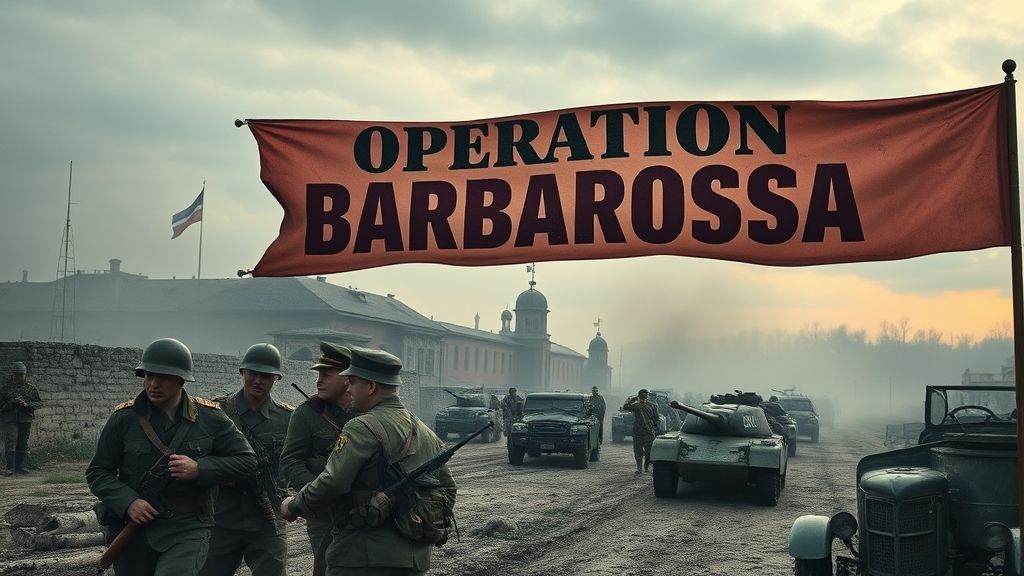
On a grey, mist-soaked dawn in late June 1941, the city of Brest, nestled on the western edge of the Soviet Union, awoke to thunderous skies and a horizon ablaze with fire. It was here, where the ancient fortress stood defiant, that the relentless engines of Operation Barbarossa—Adolf Hitler’s colossal invasion of the Soviet Union—first roared to life. As the church bells tolled in anguish, the skies above Brest were pierced not by the hopeful chirping of birds but by a ferocious swarming of German Stuka dive bombers, artillery shells, and the alarming rattle of machine guns. The fortress, once a tranquil outpost on the boundary between empires, instantly transformed into a crucible of destruction, courage, and unimaginable human suffering.
This morning was not merely a battle’s beginning but the beginning of a global upheaval. More than three million German soldiers, accompanied by thousands of tanks and aircraft, surged across a front that spanned nearly 1,800 miles. The peace of Brest was shattered forever, pushing the world into one of its bloodiest chapters. The events at Brest were a microcosm, a violent spark that ignited an inferno engulfing millions and reshaping the very fabric of geopolitics.
But why did this assault unfold here, and what did it mean in the larger tapestry of World War II? The story that followed would be one of hubris, brutality, resilience, and a war that challenged the limits of human endurance.
The Calm Before the Storm: Europe on the Brink
Europe in the spring of 1941 was a continent tense and trembling. The year prior, Nazi Germany, under the iron grip of Adolf Hitler, had already conquered vast swaths of territory—from the ruins of Poland to the conquest of France in a breathtaking blitzkrieg campaign. Yet the eastern frontier remained a dormant powder keg, a gigantic beast shackled but very much awake.
The Molotov-Ribbentrop Pact of August 1939, a brutal non-aggression agreement between Nazi Germany and the Soviet Union, had carved Eastern Europe into spheres of influence, buying time for both powers. But this pact was a fragile veil masking deep mistrust and conflicting ambitions. The Soviet Union, led by Joseph Stalin, had spent the years building up its military industry and expanding its borders westward, absorbing the Baltic states and eastern Poland. Meanwhile, Hitler's vision of Lebensraum—"living space"—demanded the conquest and subjugation of the vast lands beyond.
But beneath the uneasy peace lay a frantic diplomatic chess game. Germany harbored secret plans to invade the USSR almost from the pact’s inception. Stalin, despite warnings, clung to faith in the agreement and underestimated Hitler’s appetite for war in the East. The tension was palpable, but most in Europe held their breath, uncertain when or if the sleeping giant to the east would be roused.
The Ambitions of a Führer: Hitler’s Eastern Vision
For Adolf Hitler, the invasion of the Soviet Union was far more than a military campaign; it was a crusade launched from the dark wellsprings of ideological fanaticism. The ideological core driving Operation Barbarossa was enmeshed in the twisted doctrines of racial purity, anti-Bolshevism, and imperial conquest.
Hitler viewed the Soviet Union as a degenerate, communistic plague led by Jews and Bolsheviks, standing in the way of Germany’s destiny. Beyond ideology, Stalin’s vast natural and human resources offered an irresistible prize—a bounty that promised to fuel the Third Reich’s war machine for decades. The promise of seizing Ukraine’s fertile lands, the oilfields of the Caucasus, and crushing the perceived Slavic “inferior races” under Germanic dominion propelled Hitler’s obsession.
The plan, painstakingly developed by German General Staff under the codename Operation Barbarossa, was to deliver a swift, decisive blow, annihilate the Soviet Red Army, and capture Moscow before winter. This overwhelming lightning strike would, Hitler believed, end the war in the East within months. But his hubris blinded him to the sheer scale, the resolve, and the tenacity that the Soviet Union—and its people—would summon in response.
The Soviet Bear Unprepared: Intelligence Failures and Denial
Behind the curtain of Soviet state security paranoia and Stalin’s dictatorship loomed one crushing reality: the USSR was catastrophically unprepared for the invasion. Despite warnings from spies, frontline observers, and foreign intelligence, Stalin clung obstinately to his belief that Hitler would honor the pact.
The Soviet intelligence apparatus was rife with contradictions and purges in the late 1930s had decimated experienced military leaders. Stalin viewed any dissent as sabotage, crippling the Red Army’s command structure at a critical juncture. Reports of German troop build-ups were dismissed or, worse yet, set aside as provocations.
In Brest and across the western border, this deadly miscalculation had tragic consequences. Troops were caught sleeping, artillery batteries unready, and airfields vulnerable. The first ragged Soviet attempts at aerial defense were overwhelmed by the precision and ferocity of the German Luftwaffe. This unwillingness to accept the looming threat sealed the fate of millions on the opening day.
Strategic Imperatives: Why Barbarossa Was Launched
Why risk launching such a titanic invasion without guaranteed success? The reasons were complex and intertwined—political, strategic, economic, and ideological.
Hitler’s refusal to accept a two-front war meant that the Soviet Union had to be decisively beaten before full confrontation with Great Britain and the United States became inevitable. The clock was ticking. Germany’s war economy needed the vast resources of the USSR to sustain itself, especially vital oil supplies and grain for feeding its population and army.
Moreover, there was a deep-seated conviction that the Red Army was weak, a product of communist incompetence and decades of backwardness. German generals and propagandists predicted a rapid collapse.
This convergence of political mania and military calculation drove Germany’s war machine to bear down on Brest and beyond with overwhelming force.
Breaking the Silence: The First Bombs Over Brest Fortress
At precisely 03:15 on June 22nd, 1941, the eerie silence of early morning was shattered. A German air raid, spearheaded by Stuka dive bombers, unleashed hell upon Bresk (Brest), a strategically vital city defended by the historic Brest Fortress. The fortress’s thick walls and moats were centuries old, but they faced an enemy armed with modern tanks, planes, and artillery.
The initial bombardment was savage, designed to quickly disable Soviet commanders and break the morale of defenders. Yet, the fortress held, its soldiers fiercely firing back despite the devastation raining down around them. The resistance at Brest became symbolic, a beacon of Soviet defiance even as chaos reigned.
The skies above were aflame with tracer rounds; the air throbbed with explosions. Civilians scrambled for shelter; soldiers readied themselves for the brutal ground assault to come. For many, it was clear that this morning was the onset of a nightmare that would forever alter the world’s balance.
Blitzkrieg Unleashed: The Thunder of Tanks and Planes
Operation Barbarossa was a masterclass in Blitzkrieg (“lightning war”) tactics, perfected in the Western campaigns but now unleashed on an even grander scale. Columns of Panzer tanks thundered forward across the border, tearing through Soviet defensive lines with terrifying speed and coordination.
Overhead, the Luftwaffe dominated the skies, executing devastating tactical bombing runs to disrupt communications and destroy transport hubs. Infantry followed, backed by artillery barrages, as German forces sliced into Soviet territory in a relentless push.
The initial days saw massive encirclements and the surrender or death of hundreds of thousands of Soviet troops, confirming Hitler’s belief that victory was near. Yet these early tactical triumphs masked a grueling, grinding war ahead.
Brest Fortress: The First Bastion of Soviet Resistance
While much of the western border crumbled in the opening hours, the defenders of Brest Fortress stood apart. Roughly 9,000 Red Army soldiers and militia resisted the onslaught for weeks, outnumbered and outgunned, yet unbowed.
Their fight became legendary, a narrative carefully cultivated by Soviet propaganda but founded on real courage and sacrifice. Houses turned to rubble; trenches dug in ruined courtyards; cannon fire echoed day and night. Communications crumbled, food supplies evaporated, yet the defenders refused to surrender.
The defense of Brest became a symbol not only of Soviet tenacity but of a larger message: the invasion would not be a mere stroll toward Moscow; it would be a brutal, violent struggle to the last drop of blood.
Human Stories in the Chaos: Soldiers, Civilians, and Survival
History is often told in movements of armies and lines on maps, but beneath the grand narratives lie untold stories of individual lives caught in the maelstrom.
Private Ivan Petrovich, a young artilleryman, wrote in his diary how the first shells fell like an apocalyptic storm, yet how his comrades sang songs of home in the dank trenches to stave off despair. Meanwhile, in Brest, families were torn apart—mothers hiding children in cellars, desperate civilians scavenging for food.
Amid the cacophony of war, acts of humanity emerged—Soviet medics risking their lives to carry the wounded, soldiers sharing rationed bread, local partisans beginning to plan resistance behind enemy lines.
These personal narratives weave through the wider tapestry, reminding us that history’s grand events are, at their core, deeply human.
The Three-Pronged Assault: Army Groups North, Centre, and South
Germany’s invasion plan was ambitious beyond measure, organizing over three million troops into three massive army groups advancing on divergent axes.
Army Group North swept toward Leningrad, Hitler’s prize of historic and symbolic value. Army Group Centre, the spearhead, aimed directly for Moscow, the Soviets’ political heart. Army Group South sought to seize Ukraine’s rich agricultural and industrial centers.
This triad was designed for a knockout punch to destroy Soviet military power in a swift campaign. The strategy relied on rapid advances, flanking maneuvers, and encirclement tactics meant to trap large Soviet formations.
While initially successful, the logistical strains and stubborn Soviet defenses began to sap German momentum, exposing fatal weaknesses in the plan.
The Soviet Counterattack Illusion: Attempts at Defense
Contrary to Nazi expectations, the Soviet Union was not ready to collapse like a house of cards. Stalin’s command, initially paralyzed, eventually shifted to marshaling fresh troops from the vast interior.
The Red Army began conducting counterattacks, using their knowledge of terrain and sheer numbers to slow the enemy's advance. The first major battles of Rzhev and Smolensk hinted at the Red Army’s budding resilience.
Though these attempts often resulted in heavy Soviet losses, they bought precious time—time that would later prove vital for the defense of Moscow and the turning of the tide in the East. This hard-learned lesson demonstrated the cost of initial unpreparedness but also the indomitable spirit of Soviet resistance.
Stalingrad’s Shadow: The Early Signs of a War of Attrition
Even as German spearheads rushed forward, the grim reality of Barbarossa set in: the vastness of Soviet territory, the harshness of its winters, and the determined will of its people transformed the conflict into a grinding war of attrition.
The seeds of the future Battle of Stalingrad were sown in these early months. Cities and industrial centers became deadly gauntlets as Soviet urban resistance stiffened. The Red Army’s inability to be crushed quickly foreshadowed the bloody protracted battles that would bleed German resources.
Operation Barbarossa was not just a campaign; it was the opening act of a brutal saga of endurance and sacrifice that would define the Eastern Front.
Ideologies at War: Nazism versus Stalinism
At its core, Operation Barbarossa was a terrifying clash of ideologies as much as armies. The Nazi vision sought a world order of racial hierarchy, brutal subjugation, and territorial expansion. The Soviet Union—despite its own authoritarian excesses—represented proletarian internationalism, communism, and a defiant bulwark against fascism.
This ideological confrontation exacerbated the savagery of the war. It justified, in the eyes of many commanders and leaders, brutal reprisals, mass executions, and a war waged not just against soldiers but entire populations deemed ‘subhuman’ or enemies of the regime.
The conflict became a fight for survival, ideas, and ultimately the future of Europe itself.
The Global Ripple: How Barbarossa Reshaped WWII
The invasion of the Soviet Union changed the trajectory of World War II dramatically. Before June 1941, Nazi Germany seemed unstoppable. After Barbarossa commenced, the war expanded into a colossal, multi-theater clash between totalitarian titans.
Most crucially, it drew the Soviet Union into the Allied camp alongside Britain and, eventually, the United States. The material and human resources the Soviets brought to bear played a decisive role in the eventual defeat of Nazi Germany.
Barbarossa’s opening salvo in Brest thus stands as a pivotal moment when the war was transformed from a European conflict to a true world war with ideological stakes, global alliances, and catastrophic human cost.
The Brutality and Horror: Civilian Suffering Under Occupation
With the rapid German advance came brutal occupation policies that inflicted horrific suffering on civilian populations. Einsatzgruppen (mobile killing squads) followed the army's footsteps, perpetrating mass shootings of Jews, political commissars, and civilians.
In cities and villages across Ukraine, Belarus, and Western Russia, mass starvation, forced labor, and reprisal killings became grim daily realities. Brest and its hinterlands were no exceptions. The human toll was catastrophic, with millions of innocent lives extinguished in the shadow of the military campaign.
This dimension of Barbarossa remains one of the darkest, underscoring the war's genocidal nature beyond conventional battles.
Breaking the Myth of Invincibility: Nazi Overreach and Soviet Tenacity
The initial weeks of Barbarossa created a myth of German invincibility, with unstoppable armored thrusts and battlefield victories that stunned the world. Yet beneath this veneer lay cracks—overextended supply lines, rising partisan warfare behind the lines, and growing Soviet industrial and manpower mobilization.
Despite catastrophic losses, Soviet resistance grew fierce and cunning, adapting to modern warfare’s demands. German troops encountered not just enemy units but deep forests, harsh winters, and a population fiercely hostile to occupation.
These factors converged to slow and then halt German advances, eventually forcing a bloody stalemate and contributing to Hitler’s catastrophic strategic errors.
International Reactions: Allies, Neutrals, and the Axis
The launch of Barbarossa sent shockwaves across the globe. Britain, still standing resilient against Nazi Germany, found in the Soviet Union a reluctant but vital ally. The United States, still officially neutral, began ramping up material aid to the Soviets through the Lend-Lease program.
Meanwhile, Axis partners like Finland, Romania, and Hungary joined the campaign to varying degrees, seeking territorial gains. Neutral countries watched with apprehension, calculating survival amid the shifting balance of power.
This global reaction reaffirmed the ideological and military stakes involved and transformed World War II into the total war that history remembers.
The War of Logistics: Supply Lines, Weather, and Terrain Challenges
As German tanks rolled eastward, logistical nightmares multiplied. The sheer vastness of the Soviet Union, combined with poor infrastructure and the infamous Russian mud seasons (rasputitsa), ground mechanized violence to a halt.
Supply lines stretched thin; fuel and ammunition were often delayed or insufficient. German troops encountered sub-zero winters that froze equipment and flesh alike, revealing a lack of preparation that proved disastrous in the months ahead.
For the Soviet defenders, these challenges were brutal but familiar terrain—adaptation and resilience became their greatest assets in both defensive and offensive operations.
The Role of Intelligence and Deception on Both Sides
Operation Barbarossa was shaped by a complex interplay of intelligence successes and failures. German espionage had penetrated Soviet defenses, but Soviet double agents and deceptive tactics sowed confusion.
Stalin’s refusal to heed intelligence warnings eclipsed the value of the information available. Conversely, Soviet efforts in cryptography and partisan warfare behind enemy lines disrupted German operations.
This shadow war of spies, misinformation, and code-breaking played a subtle yet vital role in the campaign’s shifting fortunes.
Lessons from Brest: Symbol of Soviet Heroism and Defiance
Brest Fortress, battered but unbroken, became a symbol in the Soviet imagination. Its defenders’ heroism and sacrifice were immortalized in Soviet literature, film, and education, exemplifying the spirit of resistance.
This symbolism extended beyond borders—Brest teaches us about the resilience of ordinary people caught in extraordinary circumstances, the tragic costs of war, and the enduring human capacity to stand against overwhelming odds.
Even today, the fortress remains a poignant memorial, reminding us of June 22, 1941—not just as a date marking invasion but as a testament to courage.
Stalin’s Leadership Tested: Purges, Paranoia, and War Command
Stalin’s command during Barbarossa is a study in paradox. His earlier purges had debilitated the Red Army leadership, sowing distrust and confusion. Yet, faced with existential threat, Stalin transformed into a wartime leader who bore immense burdens in directing the USSR’s defensive and offensive efforts.
His purges came back to haunt the Soviet military’s early coherence, but his relentless drive to mobilize industry, manpower, and ideology helped turn the tide. The relationship between Stalin and his generals was fraught but ultimately crucial.
Analyzing this leadership gives insight into the Soviet state’s brutal but effective wartime governance.
The Turning Tide: From Initial Catastrophe to Soviet Resurgence
The first months of Barbarossa were catastrophic for the USSR; millions of soldiers captured, cities lost, despair widespread. But this was the crucible from which Soviet resilience and ingenuity emerged.
By late 1941 and into 1942, the Soviet Union adapted—new leadership, strategic depth, and sheer human tenacity blunted and eventually reversed German advances. The Battle of Moscow would become the first major Soviet victory against the Wehrmacht.
This turnaround marked the beginning of a relentless pushback that would culminate at Kursk, Stalingrad, and ultimately Berlin.
Barbarossa’s Shadow on Postwar Memory and Modern Geopolitics
Operation Barbarossa cast a long shadow over world history. It revealed the catastrophic consequences of ideological hatred, total war, and the fragility of international agreements.
In postwar memory, the Eastern Front is often seen as the decisive theater of World War II, shaping the Cold War’s divisions and narratives. The heroism and suffering of the Soviet Union are foundational to Russian identity and national memory.
Modern geopolitics continues to grapple with the legacies of borders redrawn and historical grievances rooted in these fateful events of June 22, 1941.
Conclusion
Operation Barbarossa—launched in the early dawn fires over Brest—was more than a military campaign. It was a seismic rupture, a clash of empires that laid bare the darkest potentials of human ambition and the brightest sparks of resilience. The day the German war machine unleashed its fury was the start of a journey that tested entire nations and defined the twentieth century’s course.
Yet, amid the carnage and destruction, stories of courage, defiance, and sacrifice endure. The battlefields and cities along the Soviet-German frontier remain silent witnesses to the price of war and the hope that humanity, even in its darkest moments, can resist obliteration.
Remembering Barbarossa, in all its tragedy, teaches us about the costs of hubris, the complexities of history, and the indomitable human spirit.
FAQs
Q1: What triggered Operation Barbarossa despite the Nazi-Soviet non-aggression pact?
A1: Hitler’s expansionist ideology and desire for resources drove him to break the pact. Although the two sides had agreed not to fight, Hitler saw the Soviet Union as a threat and a prize, deciding that a swift invasion would enable Germany’s dominance in Europe.
Q2: How prepared was the Soviet Union when Barbarossa began?
A2: The Soviet Union was largely unprepared due to Stalin’s denial of invasion warnings, military purges, and logistical difficulties. This resulted in devastating early losses.
Q3: Why was Brest Fortress so significant during the invasion?
A3: Brest Fortress was strategically located on the border and symbolized Soviet resistance due to its prolonged and fierce defense despite overwhelming odds.
Q4: How did Barbarossa impact the global dynamics of World War II?
A4: It expanded the war significantly, bringing the Soviet Union into the Allied camp and opening the Eastern Front, which became crucial in the eventual defeat of Nazi Germany.
Q5: What role did ideology play in the brutality of Barbarossa?
A5: Nazi racial ideology and anti-Bolshevik hatred legitimized extreme violence against civilians and prisoners, leading to mass massacres and genocidal policies.
Q6: How did the weather and geography affect the campaign?
A6: The vast distances, poor infrastructure, and harsh Russian winters hampered German logistics and operations, contributing to the campaign’s eventual failure.
Q7: What was Stalin’s role in the Soviet war effort despite earlier purges?
A7: Stalin shifted from skepticism to active wartime leadership, centralizing command, mobilizing resources, and exerting tight control despite human costs.
Q8: How is Operation Barbarossa remembered today?
A8: It is remembered as a pivotal and tragic turning point in WWII, especially in Russia and former Soviet states, symbolizing both suffering and heroic resistance.