Table of Contents
- The Dawn of a Dynasty: Charles the Great’s Vision for Empire
- From Majesty to Mortality: The Death of Charlemagne and the Question of Succession
- The Political Landscape of Early 9th Century Francia
- The Birth of Ordinatio Imperii: A Legal Framework for Stability
- The Key Figures: Louis the Pious and His Brothers
- The Imperial Assembly at Aachen: Setting the Stage for Ordinatio Imperii
- Defining the Heirs: The Partition of a Vast Empire
- The Primacy of Louis the Pious: Emperor and Father of the Realm
- The Role and Territories of Pippin, Louis the German, and Charles the Bald
- The Mechanisms of Succession: Unity versus Division
- Immediate Reactions at Court and Among the Nobility
- The Ordinatio Imperii in the Light of Carolingian Legitimacy
- The Problem of Younger Sons: Challenges and Discontent
- The Struggle for Power: Seeds of Future Conflict
- The Ordinatio Imperii’s Influence on Medieval European Governance
- The Legacy of Aachen 817: The Blueprint for Empire and Its Fractures
- The Document’s Reception Over Time: Praise and Criticism
- The Ordinatio Imperii and the Evolution of Feudalism
- Louis the Pious’ Reign Post-Ordinatio: Maintaining or Crumbling the Vision?
- The Ordinatio in Historical Memory: A Turning Point or a Prelude?
- Lessons from 817: Authority, Family, and Empire
- Conclusion: The Ordinatio Imperii—Order in Chaos or a Fragile Peace?
- FAQs
- External Resource
- Internal Link
1. The Dawn of a Dynasty: Charles the Great’s Vision for Empire
In the burning glow of an early medieval dawn, a dazzling figure stood atop the crumbling Roman legacy. Charlemagne, or Charles the Great, had forged a realm so vast, stretching from the North Sea to the Mediterranean, that Europe had scarcely seen anything of its kind before. His shadow loomed large over the continent, a beacon of unity and imperial strength. But as the sunset of his reign approached, a profound question stirred in the corridors of Aachen’s palatial halls: who would inherit this great empire, and on what terms? The Ordinatio Imperii was soon to answer—or at least attempt to answer—that very question.
2. From Majesty to Mortality: The Death of Charlemagne and the Question of Succession
Charlemagne’s death in 814 marked not only the end of a striking chapter in European history but also opened a labyrinth of uncertainties. His son, Louis the Pious, inherited a kingdom that dazzled in its magnitude but teetered on the edge of fragility. Unlike the iron-willed emperor, Louis was more pious and scholarly, a ruler burdened by the weight of his father’s achievements and the complexities of an empire bristling with competing powers. The challenge: how to preserve this empire intact while ensuring its governance passed smoothly to the rightful heirs?
3. The Political Landscape of Early 9th Century Francia
The early 9th century was a mosaic of fragmented loyalties, dynastic ambitions, and nascent feudal ties. Francia was not a monolith but a collection of duchies, counties, and territorial units, each controlled by nobles and ecclesiastics with vested interests. The Carolingian dynasty, though commanding, had to navigate the treacherous waters of these competing claims. Louis the Pious was well aware that any misstep in succession planning could fracture the empire irreparably.
4. The Birth of Ordinatio Imperii: A Legal Framework for Stability
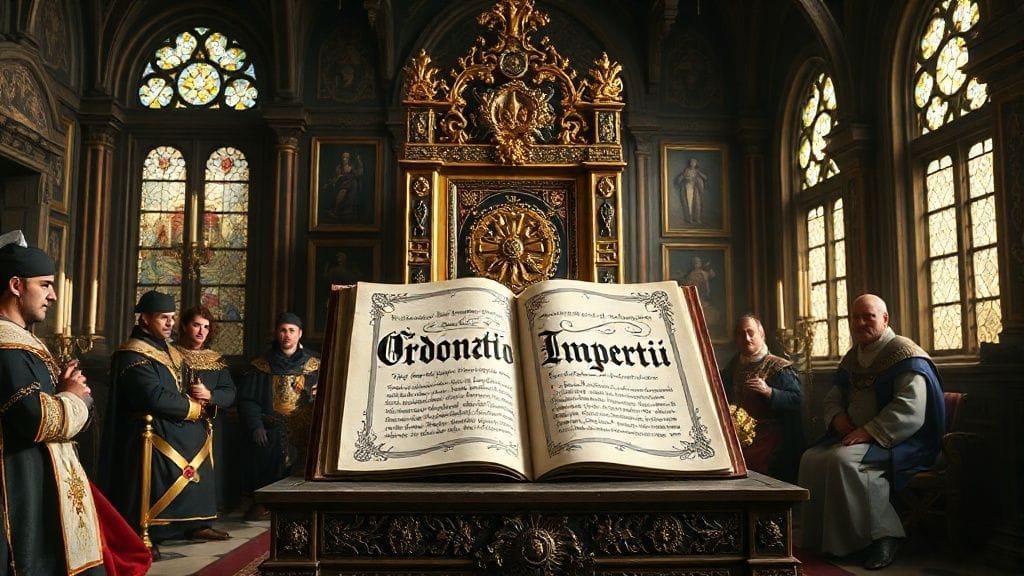
Against this swirling maelstrom, the Ordinatio Imperii of 817 emerged as a moment of sublime legal and political engineering. It was more than a mere division of lands; it was Louis the Pious’s bold attempt to create a framework where succession would not be left to chance or strife but bound by imperial decree. Convened at Aachen, the heart of Carolingian authority, the assembly sought to legislate order amid the chaos looming beyond the palace walls.
5. The Key Figures: Louis the Pious and His Brothers
Central to the drama were the principal heirs—Louis the Pious himself, his brothers Pippin and Louis the German, and the youngest, Charles the Bald, though at the time an infant and yet to influence the proceedings. The dynamics within this family exemplified the tension between blood ties and political pragmatism. Louis, as the eldest and crown prince, sought undisputed primacy but knew he had to accommodate his siblings lest a civil war erupt.
6. The Imperial Assembly at Aachen: Setting the Stage for Ordinatio Imperii
The year 817 found Aachen’s palatine chapel bustling with dignitaries, clerics, and nobles. It was a gathering that mixed solemn religious rites with the brute reality of power politics. Louis stood before the assembly, flanked by advisors and the papal legate, ready to proclaim the Ordinatio Imperii, a document that would shape medieval governance and dynastic succession models for centuries.
7. Defining the Heirs: The Partition of a Vast Empire
The Ordinatio decreed a clear line of succession. Louis the Pious was to retain the imperial title and the core kingdom of Francia with its capital in Aachen. His brothers were assigned subordinate kingdoms: Pippin received Aquitaine, and Louis the German took Bavaria. This territorial partition aimed to satisfy dynastic claims without breaking the overarching imperial unity. But the division was delicate, and its balance was tethered to Louis’s overarching authority.
8. The Primacy of Louis the Pious: Emperor and Father of the Realm
Central to the Ordinatio Imperii was the explicit affirmation of Louis the Pious as the primary emperor. His brothers were designated kings, but with a clear acknowledgment of his supremacy. This hierarchical order was essential to maintaining "one empire, one emperor" amidst divided sub-kingdoms. It reflected the Carolingian vision of unity through primogeniture tempered by pragmatic decentralization.
9. The Role and Territories of Pippin, Louis the German, and Charles the Bald
Pippin’s kingdom, Aquitaine, was renowned for its distinct cultural identity, a western gateway that promised both opportunity and challenges. Louis the German’s Bavaria represented the empire’s eastern frontier, with its unique ties to Slavic and Bavarian nobility. The youngest son, Charles, though unnamed in the Ordinatio due to his infancy, loomed as a silent challenge to future equilibrium, an unresolved element in the tapestry of succession.
10. The Mechanisms of Succession: Unity versus Division
The Ordinatio Imperii was as much a political manifesto as a succession law. It wrestled openly with a paradox: how to divide power without undermining imperial unity? It sought a system where the emperor’s word was final, even over the lesser kings, but this resting on personal loyalty rather than structural enforceability was a delicate gamble.
11. Immediate Reactions at Court and Among the Nobility
Behind the public approval, whispers of discontent and skepticism rapidly spread. Nobles calculated who would gain or lose from this arrangement, while the brothers themselves received their allotments with mixed emotions. Pippin and Louis the German, older and ambitious, viewed their roles with suspicion—were they princes or mere dukes in disguise? The seeds of dissent were quietly planted.
12. The Ordinatio Imperii in the Light of Carolingian Legitimacy
Carolingian legitimacy rested on sacred anointment and a sense of divine right. The Ordinatio was aligned with these traditions, reinforced by ecclesiastical endorsement. It reinforced the sacral stature of Louis the Pious while attempting to contain dynastic rivalries under the aegis of royal law and religious sanction.
13. The Problem of Younger Sons: Challenges and Discontent
One of the fundamental tensions lay in the fate of younger sons, especially Charles the Bald. Excluded in 817 due to youth and political expediency, his later claims would threaten the fragile order. This reflects a broader medieval dilemma: succession laws grappling with multiple claimants and limited realms, often leading to conflict rather than consensus.
14. The Struggle for Power: Seeds of Future Conflict
Despite its intent, the Ordinatio Imperii did not eliminate discord. Instead, it delayed it. The ensuing decades witnessed rebellions, shifting alliances, and familial betrayals that fractured the Carolingian dynasty. Louis the Pious’s efforts met obstacles as the empire slowly unraveled, giving rise to the dynastic fragmentation that would characterize medieval Europe.
15. The Ordinatio Imperii’s Influence on Medieval European Governance
Beyond its immediate family drama, the Ordinatio Imperii set precedents for medieval political thought—primogeniture balanced with territorial division, kingship as a layered hierarchy, and the role of legal frameworks in dynastic stability. Future European monarchies would wrestle with these themes, echoing lessons both successful and tragic from 817.
16. The Legacy of Aachen 817: The Blueprint for Empire and Its Fractures
Aachen in 817 was a symbolic crucible where empire and family intersected, where law was crafted to channel ambition into order. Yet, the legacy of the Ordinatio is dual: it was both the blueprint for Carolingian rule and a harbinger of its dissolution. The grandeur of unity ultimately bowed to the centrifugal forces set loose by inheritance and human nature.
17. The Document’s Reception Over Time: Praise and Criticism
Historians have long debated the Ordinatio Imperii. Some praise it as Louis’s masterstroke of political foresight, a rare attempt to forestall civil war through law. Others see it as an imperfect, fragile compromise, doomed by its reliance on personal loyalties and overlooking the complexity of dynastic rivalries.
18. The Ordinatio Imperii and the Evolution of Feudalism
The document also inadvertently contributed to the growth of feudal structures—partitioned lands ruled by kings under a supreme emperor anticipated the fragmentation of power into localized authorities. It is a pivotal moment where empire began evolving into the patchwork feudal kingdoms that shaped medieval Europe.
19. Louis the Pious’ Reign Post-Ordinatio: Maintaining or Crumbling the Vision?
In the years following 817, Louis’s reign was marked by strained attempts to uphold the Ordinatio. Internal rebellions by his sons, shifting noble loyalties, and external pressures tested the document’s authority. His reign became a tragic effort to hold together a delicate political fabric woven in idealism but unraveling in practice.
20. The Ordinatio in Historical Memory: A Turning Point or a Prelude?
To modern eyes, the Ordinatio Imperii stands as a pivotal historical moment—a crossroads where empire was both consolidated and destined to fragment. It foreshadows the complex diplomacy, dynastic contests, and legal rituals that would define European monarchy for centuries.
21. Lessons from 817: Authority, Family, and Empire
The Ordinatio Imperii teaches us that empire is as fragile as the bonds of family and law that structure it. It is a reminder of the human ambitions, fears, and strategies that underpin history’s great events, and a reflection on how rulers strive to turn vision into reality amid the unpredictability of life and legacy.
Conclusion
The Ordinatio Imperii of 817 was no mere document; it was an act of profound hope and fraught realism. Louis the Pious, standing in Aachen’s grand halls, sought to bind the fragile Carolingian empire with legal threads that might withstand the storms of succession. Yet, beneath its careful language flickered the deep tensions of family rivalry, territorial ambition, and political necessity. This delicate balancing act between unity and division illustrates a universal narrative: the challenge of sustaining power amid the complex human ties that define history. While the empire eventually splintered, the Ordinatio Imperii remains a testament to an emperor’s attempt to impose order on chaos, a story that echoes across the centuries and resonates in the heart of governance itself.
FAQs
Q1: What prompted the creation of the Ordinatio Imperii in 817?
The death of Charlemagne in 814 left an extensive empire vulnerable to division and conflict. Louis the Pious sought to establish a clear, legally binding succession plan to maintain unity and prevent civil war among his brothers and future heirs.
Q2: Who were the main heirs designated in the Ordinatio Imperii?
Louis the Pious was acknowledged as emperor with primacy; his brothers Pippin and Louis the German were assigned subordinate kingdoms—Aquitaine and Bavaria respectively. Charles the Bald was not initially granted territory due to his youth.
Q3: Did the Ordinatio Imperii successfully prevent civil war?
While it temporarily imposed order, the Ordinatio failed to prevent later disputes. Rebellions and conflicts among Louis's sons broke out, notably after Louis the Pious’s death, leading to the eventual fragmentation of the Carolingian Empire.
Q4: How did the Ordinatio Imperii influence medieval succession laws?
It set a precedent for balancing primogeniture with territorial division within a legal framework, influencing later European dynasties wrestling with succession and governance.
Q5: What was the significance of Aachen for the Ordinatio Imperii?
Aachen, Charlemagne’s capital and administrative center, was a symbolic and political heart of the empire, making it a fitting place to proclaim laws governing imperial succession.
Q6: How is the Ordinatio Imperii viewed by historians today?
Historians view it as both a visionary attempt to maintain imperial unity and a fragile compromise that ultimately could not prevent dynastic conflict.
Q7: Did the Ordinatio Imperii contribute to the rise of feudalism?
Indirectly, yes. By dividing the empire into semi-autonomous sub-kingdoms under a central emperor, it foreshadowed the decentralized feudal structures that emerged later.
Q8: What role did the Church play in the Ordinatio Imperii?
The Church endorsed the plan, reinforcing Carolingian legitimacy by sanctioning the division of power through divine authority and ceremony, crucial in medieval political culture.

