Table of Contents
- The Last Stretch of the Continent: Setting the Stage for the Oregon Question
- Competing Visions: United States and British Interests in the Pacific Northwest
- The Era of Manifest Destiny and Expansionist Pressures
- The Frontier Diplomacy: Early Negotiations and Stalemates
- The Boundary Line of Contention: Defining “Fifty-four Forty or Fight!”
- Rising Tensions and the Specter of War
- Behind Closed Doors: The Quiet Diplomacy in Washington and London
- The Oregon Treaty Signed: June 15, 1846
- Drawing the Line on the Map: Geography, Rivers, and Mountains as Borders
- Reaction in the United States: Triumph, Disappointment, and Political Debate
- British and Canadian Perspectives: A Divided Legacy
- Settlers, Native Peoples, and the Changing Landscape
- The Treaty’s Impact on U.S. Westward Expansion and State Formation
- Oregon Trail and Beyond: Migration Patterns and Economic Growth
- Long Term Geopolitical Implications for North America
- The Oregon Treaty and International Law of Borders
- Echoes in Modern Border Disputes and Diplomacy
- Remembering the Oregon Question: Historical Memory and Cultural Narratives
- Lessons from 1846: Diplomacy, Compromise, and National Identity
- Conclusion: A Border Forged in Compromise and Ambition
- FAQs: Answering Key Questions about the Oregon Treaty
- External Resource
- Internal Link
The Last Stretch of the Continent: Setting the Stage for the Oregon Question
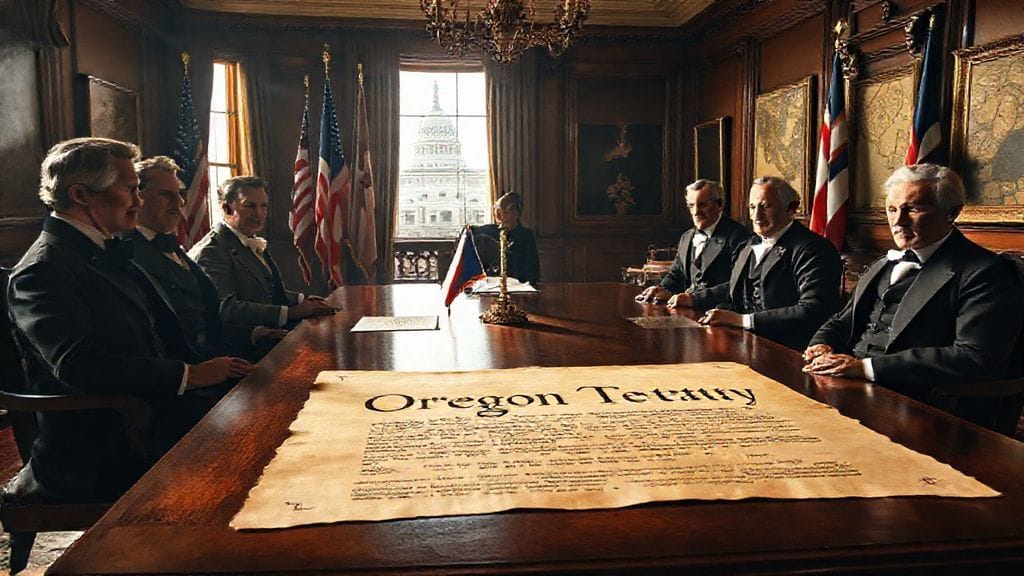
On a late spring morning, June 15, 1846, amidst the solemn halls of the Department of State in Washington, D.C., British and American diplomats signed a treaty that would forever define the western boundary of two burgeoning nations. The Oregon Treaty, often overshadowed by the grandeur of other 19th-century American milestones like the Mexican-American War or California Gold Rush, encapsulated a fraught negotiation that balanced ambition with pragmatism, setting the U.S.-Canada border from the Rockies to the Pacific.
Imagine the vast expenditure of wild lands—dense forests, rugged mountains, and endless rivers—stretching into the remote northwest. This was an era when borders were not merely ink lines but real edges to empires, livelihoods, and destinies. At stake was control of the region known as Oregon Country, vast in its untamed beauty and potential, simultaneously coveted and contested by two powerful empires. The treaty did not just settle a boundary; it drew a line between dreams, sovereignties, and futures.
Competing Visions: United States and British Interests in the Pacific Northwest
From the early 19th century, the Oregon Country had been a shared space—de facto—between American settlers and British fur traders, primarily the Hudson’s Bay Company (HBC). Both powers had laid claim, motivated by economic opportunity, strategic positioning, and national pride.
The British saw Oregon as a critical gateway to the Pacific and Asia, vital for fur trade routes and naval presence. For Britain, the HBC was not just a commercial enterprise but a political stake in a disputed frontier. British maps and documents traced lines northward, envisioning an expansive Canadian reach all the way to the west coast.
Conversely, the United States was spurred by the ideology of Manifest Destiny, the fervent belief that Americans were fated to expand across the continent. Settlers moving west through the Oregon Trail, missionaries spreading Christianity, and the allure of fertile lands created a groundswell of popular support to claim the territory. This clashed head-on with British commercial and naval interests, making Oregon one of the last unsettled questions between the two empires in North America.
The Era of Manifest Destiny and Expansionist Pressures
The mid-1840s were a time of intense American nationalism colored by Manifest Destiny. Newspapers echoed cries of “Fifty-four Forty or Fight!” — demanding U.S. sovereignty over the entire Oregon Country up to latitude 54°40′, the southern boundary of Russian Alaska.
President James K. Polk, elected in 1844, had campaigned on an expansionist platform, promising to claim Oregon and annex Texas. The slogan became a rallying call for those who saw British influence south of the 49th parallel as an affront to American destiny.
Yet, the increasing possibility of war with Mexico over Texas complicated matters. Polk faced the political challenge of putting pressure on Britain without sparking two simultaneous wars. The volatile mix of expansionist enthusiasm and diplomatic prudence set the scene for a tense but restrained negotiation.
The Frontier Diplomacy: Early Negotiations and Stalemates
Negotiations over the Oregon boundary had been ongoing in fits and starts since the first joint occupation arrangements of 1818, which allowed citizens of both nations free settlement and trade in the region.
By the late 1830s and early 1840s, the growing influx of American settlers gave the United States an electoral and moral claim, but the British were slow to concede, emphasizing the Hudson’s Bay Company’s established posts and resources.
Multiple conferences and treaties faltered over the exact demarcation—should the boundary follow the Columbia River, mountain ranges, or a simple latitude line? Both sides dug in, often hampered by ambiguous geography and competing maps.
The situation was particularly delicate because neither side wanted to open the door to conflict; economic interests in trade and western expansion required resolution without warfare.
The Boundary Line of Contention: Defining “Fifty-four Forty or Fight!”
The slogan “Fifty-four Forty or Fight!” referred to the northernmost line of latitude claimed by the United States, matching Russia’s southern Alaska boundary. American expansionists framed the debate as a national imperative—accept anything less was weakness.
However, behind the nationalist bluster, officials recognized the need for compromise. The British insisted on holding the 49th parallel, a latitude that already formed a boundary in the eastern territories. This line was a logical and already established geographic divider, easing diplomatic concerns.
The public rhetoric excited citizens on both sides, especially in Oregon and Washington territories, where settlers wondered which empire would prevail.
Rising Tensions and the Specter of War
As 1845 ticked into 1846, tensions mounted. Military units positioned themselves along disputed areas, and warships prowled the Pacific Ocean. Rumors of an impending conflict circulated, causing anxiety along the frontier.
Yet, war was far from inevitable. Both London and Washington admitted that simultaneous conflict with Mexico and Britain would overextend resources. Business leaders, politicians, and military commanders quietly urged diplomatic solutions.
Behind the war cries and rhetoric lay a simmering acknowledgment: the future of the Pacific Northwest depended not on the sword but on the pen.
Behind Closed Doors: The Quiet Diplomacy in Washington and London
In chambers far from the public eye, diplomats worked tirelessly to avoid catastrophe. British Foreign Secretary Lord Aberdeen and U.S. Secretary of State James Buchanan exchanged proposals and counterproposals.
The negotiations blended patience with pragmatism. Both sides recognized the economic costs of conflict and the difficulties of enforcing claims over remote, rugged territory. Rather than insisting on maximalist positions, they sought a middle ground.
Eventually, both powers agreed in principle to set the border along the 49th parallel from the Rocky Mountains to the Strait of Georgia, with an exception to grant Vancouver Island wholly to Britain, despite its southern tip falling slightly below the 49th parallel.
The Oregon Treaty Signed: June 15, 1846
On June 15, 1846, the Oregon Treaty was formally signed in Washington, cementing a compromise. The treaty established the 49th parallel as the boundary from the Rockies westward to the Pacific Ocean, with the stipulation on Vancouver Island.
This marked the end of nearly three decades of dispute dating to the early days of American and British westward expansion. The treaty balanced American aspirations with British strategic concerns and ensured a peaceful resolution that avoided military confrontation.
William L. Marcy, Under Secretary of State, and British representatives John C. Calhoun and Richard Pakenham, were among those instrumental in the negotiations.
Drawing the Line on the Map: Geography, Rivers, and Mountains as Borders
The border established by the Oregon Treaty was not just a simple line—it was a carefully negotiated compromise shaped by natural geography.
The treaty stipulated that the boundary should follow the 49th parallel from the Rockies to the middle of the channel separating the continent from Vancouver Island, then down the channel to the Pacific Ocean.
This avoided dividing populated or economically sensitive areas such as Vancouver Island and reflected an understanding of nature’s complicated contours rather than a purely geometric boundary.
The Oregon Treaty set a precedent for later boundary definitions between the United States and British North America, where rivers, mountains, and latitudes often combined to form lines of sovereignty.
Reaction in the United States: Triumph, Disappointment, and Political Debate
The Oregon Treaty received mixed reactions across the United States. While many celebrated the achievement as a diplomatic success preserving peace and consolidating American territory, hardliners felt betrayed.
The fiery slogan of “Fifty-four Forty or Fight!” had raised expectations that the entire Oregon Country would fall under U.S. control. Settlers who had risked everything to make homes wondered about their future under negotiated compromise.
Politicians debated the merits of the treaty, with some accusing the administration of weakness, while others praised Polk for averting unnecessary conflict.
Nevertheless, the treaty was ratified by the Senate and became a defining moment in the country’s westward expansion.
British and Canadian Perspectives: A Divided Legacy
Across the Atlantic and in British North America, the Oregon Treaty was met with resignation, relief, and concern. Many in Britain and Canada viewed the treaty as a pragmatic solution to a dispute that could have escalated into costly warfare.
The Hudson’s Bay Company lamented the loss of southern claims in the territory, seeing the 49th parallel line as a limitation on trade and expansion.
Canadian settlers and officials feared American westward pressure, yet the treaty’s clarity prevented open conflict and allowed for continued British influence in Vancouver Island and northern lands.
The treaty influenced emerging Canadian identity, especially in western territories, shaping attitudes toward their powerful neighbor to the south.
Settlers, Native Peoples, and the Changing Landscape
While diplomats signed papers in distant cities, the people living in Oregon Country were the true bearers of change. Settlers from the United States poured over the Oregon Trail in increasing numbers, creating towns, farms, and economies that solidified American claims.
For Native American peoples, the treaty was often ignored or violated on the ground. Their lands, sovereignty, and ways of life were profoundly disrupted by the influx of settlers and new governments.
The treaty did not involve indigenous nations in its negotiation, reflecting a colonial mindset that saw the land as divided only between European powers.
This tragic sidelining seeded decades of conflict and dispossession that would scar the Pacific Northwest.
The Treaty’s Impact on U.S. Westward Expansion and State Formation
By settling the northern border, the Oregon Treaty enabled the United States to turn attention southward and westward with greater clarity. Territories such as Oregon, Washington, and Idaho eventually formed from the lands secured.
The treaty indirectly accelerated statehood for Oregon in 1859 and encouraged settlers to further push west and north, bolstered by the security of defined borders.
It also helped the federal government allocate resources, extend railroads, and manage land policies without fear of British encroachment.
Oregon Trail and Beyond: Migration Patterns and Economic Growth
The Oregon Treaty’s ratification in 1846 coincided with the peak years of migration along the Oregon Trail. Thousands of families and adventurers traversed the treacherous plains and mountains to claim new opportunities.
The economic growth that ensued established farming, lumber, and maritime industries, transforming Oregon Country into a vital region within the U.S. economy.
The treaty’s peace allowed infrastructure development, connecting Pacific ports with eastern markets, shaping the transcontinental narrative of American progress.
Long Term Geopolitical Implications for North America
The Oregon Treaty was a cornerstone of peaceful Anglo-American relations in North America. By preventing war, it laid the foundation for the longest undefended border in the world.
The treaty’s principles of negotiation and compromise proved crucial as Canada evolved into a self-governing dominion by the late 19th century, and as the U.S. solidified its role as a Pacific power.
Geopolitically, settling the Oregon question helped focus attention on other theaters and prevented a multi-front conflict that could have altered North American development profoundly.
The Oregon Treaty and International Law of Borders
The treaty was an important example of 19th-century international law in action, relying on clear definitions, geographic markers, and mutual respect.
It highlighted the challenges of translating political claims into physical boundaries in wilderness areas and underscored the importance of diplomacy over warfare.
The negotiations influenced later treaties worldwide where natural features were preferred over arbitrary lines, shaping modern standards in boundary-making.
Echoes in Modern Border Disputes and Diplomacy
Centuries later, the Oregon Treaty remains a reference point for peaceful resolution of border disputes. The U.S.-Canada border defined then has seen minor adjustments but no significant conflict.
It stands as a model of diplomatic restraint despite popular pressures or nationalist rhetoric, demonstrating that even the most contested lands can be divided peacefully.
Modern boundary commissions and negotiations often cite the principles embodied by the Oregon Treaty as a foundational case.
Remembering the Oregon Question: Historical Memory and Cultural Narratives
In Oregon, Washington, and British Columbia, the history of the Oregon Question forms part of local identity. Museums, historical societies, and educational curricula explore the complex stories of settlers, Native peoples, and diplomats.
Popular culture retells the saga with romanticized trails and political intrigue, though critical perspectives now highlight indigenous dispossession and environmental change.
Anniversaries and historical reenactments bring the treaty to life, reaffirming its place in North American history as both a hard-fought achievement and a complicated legacy.
Lessons from 1846: Diplomacy, Compromise, and National Identity
The Oregon Treaty teaches us that nations, no matter how ambitious, must sometimes compromise to avoid destruction. It underscores the paradox of national pride balanced by pragmatic moderation.
The treaty reminds us that futures are shaped not simply by borders but by the lives that cross them—settlers, indigenous peoples, governments, and visionaries alike.
1846’s resolution echoes today as a testament to diplomacy’s power amidst fervor and rivalry.
Conclusion: A Border Forged in Compromise and Ambition
The Oregon Treaty of June 15, 1846, was far more than a mere line on a map; it was the culmination of persistent negotiation amid the turbulent forces of empire, nationalism, and human aspiration.
It prevented war between two great powers, enabling peaceful coexistence in North America that endures to this day. Yet, its legacy is complex, carved from compromise and ambition, and shadowed by the consequences borne by indigenous peoples and settlers alike.
This treaty shaped the destiny of a continent’s northwest, nurtured the growth of states and nations, and offered a historic example of diplomacy in motion. In its quiet signatures and deliberate strokes, the Oregon Treaty reminds us that borders are not just lines—they are stories bound in ink and human resolve.
FAQs
Q1: Why was the Oregon Country so important to both Britain and the United States?
The Oregon Country offered access to the Pacific Ocean, fertile lands for settlement, and crucial fur trade routes. For Britain, it was strategic for its empire and naval presence; for the U.S., it was central to the vision of Manifest Destiny.
Q2: What does the phrase “Fifty-four Forty or Fight!” mean?
It was a U.S. expansionist slogan demanding the Oregon boundary be set at latitude 54°40′ north, corresponding to Russian Alaska’s southern border, reflecting maximalist American claims.
Q3: How did the Oregon Treaty affect Native American tribes?
The treaty ignored indigenous nations’ sovereignty, leading to increased American settlement and eventual displacement, loss of lands, and conflict for many tribes in the region.
Q4: Did the treaty immediately end all tensions in the Oregon region?
While it prevented war between Britain and the U.S., tensions on the frontier with Native peoples and between settlers persisted for decades.
Q5: How did the Oregon Treaty influence the future U.S.-Canada border?
It established the 49th parallel as a key boundary, forming the basis for the longest undefended border in the world and guiding future border negotiations.
Q6: Were there any exceptions to the boundary line set by the treaty?
Yes, Vancouver Island was granted entirely to Britain, even though its southern tip lies south of the 49th parallel.
Q7: What role did President James K. Polk play in the treaty?
Polk’s administration pursued the settlement to avoid war with Britain while focusing on the Mexican-American War, choosing compromise over confrontation.
Q8: How is the Oregon Treaty remembered today?
It is recognized as a landmark in peaceful diplomacy between great powers, a symbol of compromise, and a turning point in American westward expansion.