Table of Contents
- A Winter Sky Over Rome: Setting the Stage in 966
- The Making of an Emperor: Otto I and the Dream of Renewal
- The Roman Church in Turmoil Before Otto’s Arrival
- Pope John XIII: A Learned Noble on a Dangerous Throne
- Rebellion in the Holy City: The Arrest and Exile of John XIII
- Otto Hears the News: Outrage in the Imperial Court
- Crossing the Alps Again: The Emperor Marches on Rome
- Siege, Fear, and Bargains: Rome Faces Imperial Wrath
- In the Shadow of St. Peter’s: Otto I Restores Pope John XIII
- Punishment and Performance: Justice on the Roman Streets
- Crowning the Future: The Young Otto II and a New Imperial Vision
- Empire and Papacy Entwined: The Ottonian System of Rule
- Rome Reacts: Nobles, Clergy, and the Ordinary People
- After 966: John XIII’s Later Reign and Quiet Reforms
- Echoes Across Europe: From German Bishops to Byzantine Diplomats
- Memory, Myth, and the Medieval Chroniclers
- From 10th-Century Crisis to Medieval Papal Monarchy
- Conclusion
- FAQs
- External Resource
- Internal Link
Article Summary: In the winter of 966, when Emperor Otto I restores Pope John XIII to the papal throne in Rome, the scene crystallizes a decisive moment in the tangled relationship between empire and Church. This article traces how that restoration was not a simple act of rescue, but a carefully staged assertion of imperial power over a fractured and volatile city. We follow Otto from his German heartlands, across the Alps, into a Rome torn by noble rebellion, tracking how otto i restores pope john xiii became a turning point in the history of the papacy. Along the way, we explore the networks of bishops, nobles, soldiers, and common Romans whose lives were shaped by this confrontation. The narrative uncovers the emotional landscape of fear, hope, and humiliation that accompanied the emperor’s intervention. It also shows how this event reverberated across Europe, influencing ideas of legitimate authority and the future of Christendom itself. By the end, the reader sees how a single moment, when otto i restores pope john xiii, helped pave the way for later medieval struggles between spiritual and temporal power—and left a lasting imprint on the memory of Rome.
A Winter Sky Over Rome: Setting the Stage in 966
The winter of 966 settled over Rome with a damp, creeping chill. The Tiber ran sluggish and brown between its banks, swollen from seasonal rains, while the wind that swept through the city’s half-ruined forums carried with it both the smell of smoke and the murmurs of discontent. This was not the marble Rome of the Caesars, nor yet the busy commercial city of later centuries. Instead, it was a city caught between grandeur and decay—crumbling amphitheaters reused as fortresses, ancient columns leaning like tired sentinels over crooked streets, and noble families living behind fortified towers that cast long shadows over the poor.
Yet the city still mattered more than any other. Rome, with its shrines and the tombs of the apostles Peter and Paul, was the beating spiritual heart of Latin Christendom. And on paper, the bishop of this battered city, the pope, stood as the spiritual father of the Christian West. But “on paper” meant little when set against the ambitions of Roman aristocrats, the fears of ordinary townspeople, and the ambitions of rulers from far beyond the Alps. Within this setting, the drama in which Emperor Otto I restores Pope John XIII would unfold—a drama in which the stones of the city themselves seemed to listen.
Only a year earlier, imperial banners had fluttered in the Roman wind. Otto I, king of the East Franks and now emperor, had come south, received a crown from the papal hands of John XII in 962, and imagined a new revival of the Christian Roman Empire. But since then, popes had come and gone, conspiracies had been woven in the shadowed corners of noble palaces, and the citizens had seen more than one pontiff driven out or brought low. Rome was tired, angry, and volatile. The very idea that otto i restores pope john xiii would soon become a matter of survival and domination was not yet clear to the city’s inhabitants, but the tension in the air was unmistakable.
On that winter horizon, riders moved along the old roads from the north. Rumors raced faster than horses: the emperor is coming; he has heard of the insult to his pope; he brings an army; he brings justice. For some Romans, that word “justice” tasted like hope; for others, it tasted like fear. Everyone understood one thing: the delicate balance of power in Rome was about to be shattered.
The Making of an Emperor: Otto I and the Dream of Renewal
Long before the moment when otto i restores pope john xiii, the emperor’s path had been forged in the crucible of war, politics, and ambition. Born in 912, Otto was heir to the East Frankish kingdom, the realm that would later be called the German kingdom. He inherited from his father, Henry the Fowler, not only a crown but a project: to bind together restless duchies, to tame powerful nobles, and to face relentless foes on every frontier.
Otto grew into a ruler who believed that kingship was not just an office, but a sacred burden. He crushed rivals at the Battle of Lechfeld in 955, where his armies broke a major Magyar invasion. Chroniclers like Widukind of Corvey, who admired Otto deeply, cast the battle as a new kind of deliverance, as if God himself had chosen this king to protect Christendom. Here already, one can glimpse the idea that would later influence his actions in Italy: a ruler anointed to guard not only his people’s borders but the faith itself.
Power in the 10th century was fragile. Alliances needed to be constantly reinforced, and Otto’s solution was bold. He relied on bishops and abbots—men whose authority came from the Church—as pillars of his rule. By appointing and supporting loyal churchmen, he intended to build a structure of power that could outlast the whims of secular nobles. Thus, for Otto, the health and obedience of the Church were not merely pious concerns; they were instruments of governance. When the day would come that otto i restores pope john xiii, these same instincts would guide his hand. To him, a pope loyal to the imperial vision was the keystone of his broader political and religious architecture.
In 962, when Otto knelt before Pope John XII and received the imperial crown, the ceremony in St. Peter’s bound his destiny to Rome. The ancient Roman imperial title, asleep for generations, seemed to wake again on his head, now fused with Christian meaning. But the partnership with John XII soon soured. Accusations of scandal, political betrayal, and plots against the emperor led Otto to intervene and support a rival pope, Leo VIII. The city boiled with factional anger. This was the background noise of Roman life: popes installed and deposed, Rome alternating between imperial and aristocratic control.
When John XIII eventually ascended to the papacy, Otto saw in him a chance for stability. A pope who understood the necessity of cooperation, who would share in the imperial project rather than resist it. Yet the nobility of Rome were not so easily tamed, and events inside the city quickly spiraled toward rebellion. The emperor, distracted by duties in the north, might have hoped that his influence alone would hold the city in check. He was wrong.
The Roman Church in Turmoil Before Otto’s Arrival
To grasp why the episode in which otto i restores pope john xiii became so explosive, one must understand just how chaotic the Roman Church of the 10th century had become. Historians sometimes speak of this era as the “Saeculum obscurum,” the “dark age” of the papacy, not because the light of faith went out, but because politics, violence, and family ambition often dictated who wore the papal tiara.
Rome’s powerful families—such as the Crescentii and, earlier, the descendants of the infamous Theophylact—had long treated the papal office as a prize to be captured. Control of the papacy meant control of Rome’s revenues, of patronage, of the city’s prestige. It also meant the power to crown emperors and influence kings. The result was constant intrigue: popes backed by one family were opposed by others, and the threat of abduction, exile, or assassination ran like a cold current beneath every papal election.
The city itself was fractured. Ancient monuments were fortified and turned into strongholds. The Mausoleum of Hadrian, long abandoned as an imperial tomb, was refashioned into the Castel Sant’Angelo, a fortress looming over the Vatican district. Families and factions controlled different neighborhoods, and the pope’s capacity to govern often depended on complex, precarious truces. The laity, ordinary Romans, were not simple spectators; they could be stirred to anger, manipulated by slogans, or swayed by promises of lower taxes or protection from rival gangs.
In the decades before 966, the papal throne changed occupants with alarming speed. There were notorious popes, like John XII, whose rumored vices—gamed over by later chroniclers with moral outrage—became emblematic of Roman corruption. As one medieval writer, Liudprand of Cremona, famously wrote with clear hostility, Rome in these years seemed a place where “Christians did not live, but monsters.” His words are obviously exaggerated, fueled by political grievance, yet they reveal how observers from beyond the Alps perceived the city: decadent, treacherous, in need of reform.
When John XIII was elected pope in 965, it was against this troubled backdrop of noble rivalry and moral critique. To some, he represented continuity with traditional Roman aristocracy; to others, especially in the imperial orbit, he seemed a bridge figure who might stabilize relations between Rome and the empire. But his installation would provoke fierce resistance from those who saw in his papacy the tightening grip of an increasingly powerful emperor.
Pope John XIII: A Learned Noble on a Dangerous Throne
John XIII did not climb to the papal throne from obscurity. He came from a noble Roman lineage—likely connected to the powerful family of the Counts of Tusculum—and had already held important ecclesiastical offices, including the bishopric of Narni and the role of archdeacon in Rome. He was a man formed by both the politics of aristocratic Rome and the liturgical and administrative life of the Church.
Sources hint that John was learned, fluent in the complex liturgical rites and the legal language that framed the Church’s claims to property and privilege. He was not, in other words, an inexperienced priest suddenly dropped into the maelstrom. He knew the currents he would have to navigate. Yet knowledge alone could not avert danger. The very qualities that made him a capable pope—his noble connections, his perceived closeness to the imperial cause—also marked him as a target for those who feared the emperor’s reach.
From Otto’s perspective, John XIII was an excellent choice. Here was a man who owed much to the imperial presence in Italian politics, one who would be inclined to support Otto’s broader agenda of creating a renewed Christian empire in which the pope and emperor stood as twin pillars. It is not surprising that later chroniclers framed the episode in which otto i restores pope john xiii as a moment of righteous triumph: the emperor saving a loyal shepherd from rebellious wolves.
Within Rome, however, the picture was far more complicated. John XIII’s installation in 965 was contested by elements of the urban aristocracy and segments of the population who resented imperial interference. The memory of how Otto had previously deposed pope John XII and supported Leo VIII still stung. Rome had not forgotten the humiliation of seeing its own bishop judged and replaced at the word of a foreign king. For many Romans, John XIII looked less like a free pope of Rome and more like the emperor’s man.
Still, John tried to act as a pope in his own right. He presided over liturgies, issued decisions on Church property, and attempted to balance competing factions. But even as he walked through the nave of St. Peter’s or processed along the city’s streets in solemn ceremony, whispers spread in noble halls: this pope was too close to Otto; he threatened traditional Roman liberties; something had to be done. Those whispers would soon become shouts.
Rebellion in the Holy City: The Arrest and Exile of John XIII
The crisis came swiftly. In the hot, restless summer of 965, a coalition of Roman nobles and city officials, backed by elements of the urban militia, moved against the pope. The exact triggers remain debated by historians: some emphasize John’s alleged attempts to curb the power of certain offices, such as the city’s prefect; others point to a more general backlash against imperial influence. But the result was clear. In a dramatic, almost sacrilegious act, the pope was seized.
Imagine the scene. The Lateran Palace or another papal residence, its walls echoing with hasty footsteps, shouts, perhaps the clatter of weapons. Armed men, emboldened by aristocratic patrons, forced their way in. Papal attendants scattered or tried to shield their lord. John XIII, robed not as a warrior but as a shepherd of souls, found himself dragged from the security of his household into the hands of his enemies. For a bishop of Rome, the very vicar of Peter, to be treated so roughly within the city that should have guarded him was an act of profound symbolic violence.
The rebels imprisoned the pope, reportedly confining him in the stronghold of Castel Sant’Angelo, that old imperial tomb turned fortress. Then, to remove him from immediate danger and perhaps to buy time, they exiled him from Rome altogether. John wandered through territories still loyal to him and the emperor, seeking shelter and support. The image of a pope in exile—cut off from his own see, dependent on the hospitality of allies—was a damning commentary on the state of Christendom’s supposed center.
In Rome, a new regime attempted to stabilize its authority. The rebels may have hoped to install a more compliant pontiff or at least to negotiate with Otto from a position of strength. They calculated that the emperor, occupied with matters in the German kingdom, might hesitate to march south again so soon. Perhaps they believed that the city’s ancient prestige and fortifications would deter him. If so, they had badly misread the emperor’s character.
News of these events could not be contained within Rome’s walls. Merchants, messengers, and clerics carried word north. In monasteries and bishoprics loyal to Otto, the story of a pope’s humiliation caused outrage—and opportunity. This was precisely the kind of instability that Otto had promised to end when he accepted the imperial crown. To allow it to pass unanswered would shatter his carefully nurtured image as protector of the Church.
Otto Hears the News: Outrage in the Imperial Court
Somewhere in his northern realm—perhaps at a great assembly of nobles and bishops—Otto I received the message that would set the stage for the event in which he would restore the pope. One can almost see the scene in an imperial palace hall: candles flickering, nobles standing in their heavy winter cloaks, bishops in sober robes, and a messenger stepping forward, travel-stained, to kneel before the emperor and present letters from Italy.
The contents were incendiary. The pope, John XIII, had been deposed by a Roman rebellion, imprisoned, and exiled. The city of Rome had once again defied imperial authority, mocking the very alliance that had crowned Otto as emperor only a few years earlier. For a ruler who framed his kingship in religious terms, the insult was as theological as it was political. The bishop of Rome—whose blessing had sanctified Otto’s imperial role—was now a fugitive. How could the emperor claim to be the defender of Christendom if he allowed such an affront to stand?
Bishops in Otto’s circle, already disposed to see Rome’s turbulence as evidence of moral decay, would not have been slow to offer interpretations. Some might have quoted Scripture: the shepherd struck, the sheep scattered. Others would have recalled the unstable years of recent papal history, arguing that only firm imperial oversight could prevent chaos. Together, they formed a chorus urging action. Chroniclers describe Otto as deeply angered and resolute; his sense of injured justice burned into a decision.
Otto had faced rebellions before—in Saxony, in Bavaria, on the frontiers—and each time he responded with a combination of military force and calculated mercy. But Rome was different. The city was the symbolic heart of his new imperial dignity. If he could not ensure stability there, his entire political project would be threatened. And so, even in the thick of northern affairs, the emperor began preparing a second Italian campaign. The story in which otto i restores pope john xiii would not be a quiet diplomatic exchange; it would be written with marching feet and crossed swords.
His courtiers and allies understood the weight of the coming expedition. It meant mobilizing troops from various duchies, arranging supplies for a long march, and managing the delicate politics of leaving the German kingdom without its ruler for an extended period. It also meant sending messages ahead into Italy, calling upon loyal counts, bishops, and princes to be ready. John XIII, wherever he now sheltered, would need to hold on until the imperial eagle appeared in the southern skies.
Crossing the Alps Again: The Emperor Marches on Rome
By late 965 and into 966, imperial banners once more moved southward. The route across the Alps was a hard one, especially in winter or early spring, when passes could be treacherous with snow and ice. Yet Otto and his predecessors had walked these paths before. Long lines of men—armored knights, infantry, camp followers, priests, and servants—snaked along the narrow mountain roads. The clatter of hooves and the murmured prayers of travelers rose into the cold air.
For many of these German soldiers, Italy was a strange land of promise and peril. They had heard tales of Rome’s glory, but also of its duplicity. Some had perhaps fought there in earlier campaigns. Now they marched again, under an emperor who believed—or at least proclaimed—that his journey was a sacred duty, a mission to rescue the Church’s head. In sermons given along the way, bishops traveling with the army likely framed the campaign as a righteous crusade avant la lettre, though the actual word “crusade” would not yet exist. They reminded the troops that to restore the rightful pope was to defend the very soul of Christendom.
The logistics were as important as the symbolism. Food had to be procured from local territories, alliances renewed or enforced. In northern Italy, cities and lords who had benefited from Otto’s earlier interventions generally opened their gates. They knew that being on the wrong side of imperial power could be catastrophic. In some castles and abbeys, people would have watched the imperial host pass with a mix of awe and apprehension, murmuring the now-familiar tale: otto i restores pope john xiii was the reason the emperor was on the move.
As the army advanced, news of its approach reached Rome just as swiftly as word of the pope’s exile had reached Otto. This time, however, it was the rebels who felt the chill of distant hoofbeats. Roman nobles, who had calculated that the emperor was too entangled in northern affairs to return quickly, now had to reconsider. Had they overplayed their hand? Factions began to form even among the conspirators: some argued for negotiation, others for stubborn resistance. The city braced itself for the arrival of an enraged emperor.
And somewhere in central Italy, John XIII waited. Sheltered in friendly territories—possibly within the domains of princes who remained loyal to the empire—he followed developments anxiously. The reports of the imperial army’s approach would have stirred not only relief but also apprehension. To be restored by an emperor was to be indebted to him, and such debts could weigh heavily. Still, for a pope dispossessed by rebellion, there was no alternative. His fate was now inextricably tied to Otto’s march.
Siege, Fear, and Bargains: Rome Faces Imperial Wrath
By the time Otto’s forces neared Rome, the psychological battle had already begun. The city’s walls, partly ancient and partly repaired in later centuries, stood as a visible symbol of defiance. Yet fortifications are only as strong as the unity and morale of their defenders, and both were fraying fast. In the palaces of the leading rebels, heated discussions raged late into the night. Should they prepare for a siege, trusting in their fortresses and the difficulty of winter campaigning? Or should they seek terms, hoping that expressions of contrition might soften the emperor’s anger?
Otto, for his part, advanced carefully but decisively. He knew that a prolonged siege of Rome could be costly and might alienate allies. At the same time, he could not afford to appear weak. The story that would be told—how otto i restores pope john xiii—needed a clear moral arc: rebellion punished, order restored, the rightful pope triumphant. That called for a visible display of imperial authority.
Negotiations began in fits and starts. Envoys from Rome ventured out to the imperial camp, bearing messages of supposed loyalty, excuses for the recent turmoil, and perhaps hints of scapegoats to be offered up in exchange for leniency. Otto listened, but his patience was limited. The emperor demanded more than words; he wanted the rebels’ submission and the city’s formal acceptance of John XIII as pope. He also wanted those chiefly responsible for the pope’s exile handed over for judgment.
Accounts of exactly how the city fell back into imperial hands vary, but most sources suggest a mixture of pressure and attrition. Some gates may have opened quietly at night, as factions within the city decided that risking the emperor’s wrath was madness. Others held out longer, only to capitulate when it became clear that no relief would come. Ordinary Romans, caught between fear of imperial retribution and resentment of their own nobles, could only wait and watch as events unfolded above their heads.
When at last imperial troops entered the city—whether by negotiated entry or after brief confrontations—the atmosphere must have been electric. Armed Germans pacing Rome’s streets, the clang of armor in ancient forums, the sight of foreign banners near the basilicas: all of this would have driven home the reality that Rome’s fate lay again in distant hands. The papal throne was empty; the pope himself still absent. The final act, in which otto i restores pope john xiii, was about to begin.
In the Shadow of St. Peter’s: Otto I Restores Pope John XIII
At the heart of the drama lies the moment for which our keywords insist: otto i restores pope john xiii. It is not recorded in a single theatrical scene by one eyewitness, yet through scattered accounts and careful historical reconstruction, we can imagine how that restoration might have unfolded in the shadow of St. Peter’s.
First, the pope had to return to the city. Summoned by imperial messengers, John XIII came back along the roads he had once traveled as an exile. The emotional weight of that journey must have been immense. Every mile that brought him closer to the walls of Rome brought back memories of humiliation: the day he had been dragged from his residence, the cold confinement in Castel Sant’Angelo, the uncertainty of exile. Now, however, the wind carried a different song—the murmur of imperial standards, the watchful gaze of soldiers who marched as his protectors.
As he approached, Otto arranged a ceremonial restoration. The emperor understood the language of ritual and spectacle. To heal the wound inflicted by rebellion, he needed the faithful of Rome, the bishops of Italy and Germany, and the wider Christian world to see that order had returned. And so, under a grey Roman sky, the pope processed toward St. Peter’s, flanked by clergy, perhaps by chanting cantors, while imperial guards lined the route.
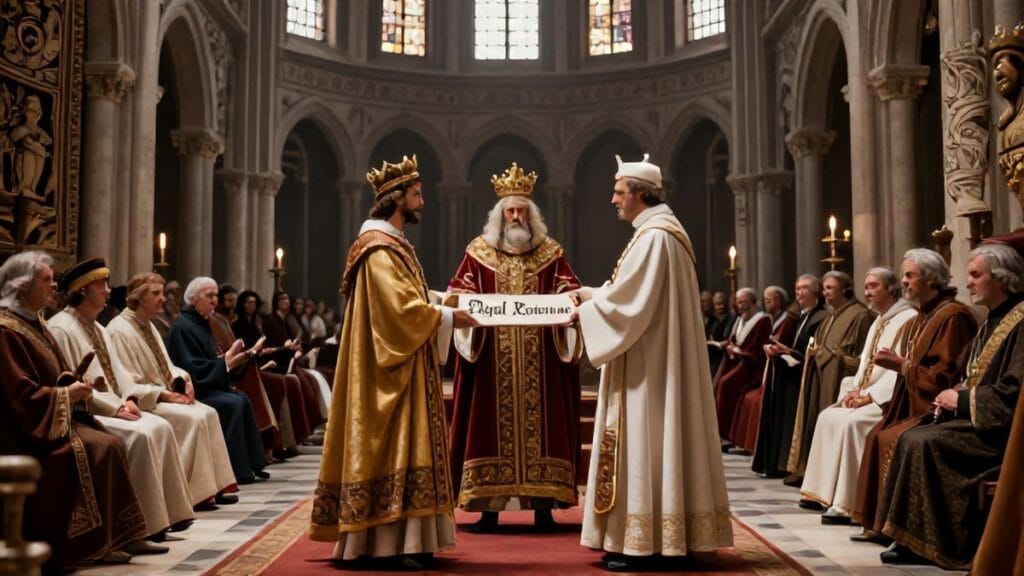
Inside or before the great basilica—a building that itself had seen centuries of triumph and disaster—the meeting took place. The emperor, crowned and robed, and the pope, in his pontifical vestments, stood again together. Some accounts suggest a mutual acknowledgment of their roles: the pope as spiritual head, the emperor as secular protector. Yet the balance between them was not truly equal. Everyone knew that it was Otto’s army, not John’s prayers alone, that had reopened the gates of Rome.
Still, the moment carried deep symbolism. Before the assembled clergy and nobles, Otto publicly recognized John XIII as the rightful pope, while John, for his part, blessed the emperor and affirmed the bond between empire and papacy. In liturgical terms, this could have included Mass celebrated in thanksgiving for peace restored, solemn litanies, and perhaps a Te Deum of gratitude. Chroniclers would later emphasize the unity this scene represented, casting it as a sign that God had intervened through the emperor’s strong arm.
When we say, then, that otto i restores pope john xiii, we speak not only of a political act but of a carefully choreographed performance of legitimacy. The rebels’ actions were implicitly condemned; the pope’s authority was dramatically reaffirmed; the emperor’s role as defender of the Church was etched into the memory of the participants. For the ordinary Roman watching from the fringes of the crowd, the message was clear: Rome’s fate now hinged on the goodwill of a distant ruler who, when offended, could return with steel-clad judgment.
Punishment and Performance: Justice on the Roman Streets
Restoring the pope was only half the story. The other half was punishment. Power in the 10th century relied not just on mercy but on visible, sometimes brutal, demonstrations of what happened to those who defied rightful rulers. In Rome in 966, justice walked the streets in chains and blood.
Otto I, guided no doubt by his own sense of order and by the counsel of loyal Roman and Italian figures, identified the leading rebels responsible for John XIII’s arrest and exile. Some were city officials—like the prefect of Rome—others members of powerful noble families. One by one, they were seized and brought before imperial and papal judgment. Contemporary sources, such as Liudprand of Cremona, describe how harsh sentences were carried out, though we must read these accounts with some caution, recognizing their bias in favor of Otto.
According to these narratives, some of the ringleaders were paraded in humiliating fashion. One famous tale, repeated in several later retellings, describes how the city’s prefect was forced to ride through Rome backwards on a donkey, his hands tied, a mockery of his former authority. Others faced imprisonment, exile, or even death. The city watched as its once-arrogant leaders were reduced to spectacles of disgrace. Justice was not only done; it was displayed.
This public theater had a clear purpose. By turning punishment into performance, Otto and John XIII sent a message to Rome and to the wider world: the alliance of pope and emperor was not to be trifled with. When otto i restores pope john xiii, he does so not as a supplicant but as a judge. And the pope, restored, did not object to this. His own position had been threatened; his survival now depended on showing that defiance of the papacy and defiance of the empire were one and the same sin.
For ordinary Romans, the spectacle must have been unsettling. Some may have cheered the downfall of hated aristocrats. Others, however, would have felt the weight of imperial vengeance as a new form of fear. If noble leaders could be dragged through the streets and humiliated, what security did lesser folk have? The city that prided itself on its ancient liberties had been taught a sharp lesson in the realities of 10th-century power politics.
Crowning the Future: The Young Otto II and a New Imperial Vision
Otto’s Roman campaign in which he restored John XIII was about the present, but it was also about the future. One of the most significant acts associated with this period was the elevation of his young son, Otto II, to the status of co-emperor. In a world where dynastic continuity was never guaranteed, this was a bold effort to secure the imperial project beyond one lifetime.
In a solemn ceremony, again likely within the sacred space of St. Peter’s, the boy was crowned. The pope—restored and grateful—played a central role, placing the imperial crown on the child’s head, blessing him, and thereby integrating him into the sacred narrative of Christian rulership. Father and son now stood together, not only as king and heir but as co-emperors, a visible sign that the empire was to be a lasting institution, not a fleeting accident.
This move had profound implications. By linking his dynasty so closely to the papacy, Otto sought to ensure that any future rebellion in Rome would face not a distant, untested ruler but an imperial house deeply woven into the city’s recent history. The story that otto i restores pope john xiii thus becomes also the story of how Otto tried to bind his bloodline to the structures of Church and empire.
For John XIII, the coronation of Otto II was both an act of gratitude and a strategic decision. Supporting the emperor’s son strengthened his alliance with the ruling house and gave him greater leverage over Roman nobles, who now faced not just one but two imperial figures with claims on their obedience. The ceremony projected an image of harmony: pope and emperors, united for the governance and salvation of Christendom.
Yet even in this moment of apparent triumph, one can glimpse tensions that would surface in later centuries. By participating so actively in imperial succession, the papacy was tying itself to the fortunes of a particular dynasty. If relations soured in the future, the very closeness that now seemed like strength could become a source of bitter conflict. History would later show, in the age of the Investiture Controversy, just how explosive the relationship between empire and papacy could become.
Empire and Papacy Entwined: The Ottonian System of Rule
The episode in 966 when otto i restores pope john xiii is often seen by historians as emblematic of what is sometimes called the “Ottonian system” of rule. This was not a formal constitution but a pattern of practice: the emperor working through, and in alliance with, the Church—especially its higher clergy—to maintain control over a vast and diverse territory.
In the German kingdom, Otto had long relied on bishops and abbots as his agents. He granted them lands, privileges, and protection, while they in turn served as imperial administrators and loyal supporters. Unlike hereditary nobles, churchmen could not pass their offices to their sons, so imperial influence over appointments gave Otto a powerful tool. Extending this model to Italy, and particularly to Rome, seemed a natural step. A pope who cooperated with Otto could become not only a spiritual ally but a linchpin of imperial governance in the south.
After the restoration of John XIII, the emperor’s influence was everywhere visible. Imperial advisors helped shape papal policies; Italian bishops friendly to the empire gained prominence; charters and decrees reflected a joint vision of order. Some chroniclers, like Thietmar of Merseburg writing a generation later, looked back admiringly on this unity of sword and crozier, seeing it as a high point of Christian governance. In his narrative, otto i restores pope john xiii not just to save one man, but to secure the godly order of Europe.
Yet this intertwining of empire and papacy carried inherent risks. When one side faltered, the other was affected. If imperial armies suffered defeat, the pope’s prestige could wane with them; if papal legitimacy was questioned, the emperor’s claims to divine sanction might look fragile. Moreover, local elites—Roman nobles, Italian princes, German dukes—could resent the concentration of power in the hands of a sacralized imperial center. Their discontent simmered beneath the surface, waiting for moments of weakness to erupt.
For now, however, the Ottonian system seemed to be working. The image projected to the world was one of harmony: the emperor defending the Church, the pope blessing the emperor, both standing as guardians of Christian civilization. The events of 966 were presented as proof that this alliance could overcome even the most brazen of rebellions.
Rome Reacts: Nobles, Clergy, and the Ordinary People
Inside Rome itself, the restoration of John XIII and the presence of the imperial army reshaped the city’s internal landscape. The great noble families, chastened by the punishments inflicted on the rebels, adapted quickly. Those who had sided with the rebellion tried to distance themselves from its leaders or to proclaim their belated loyalty. Others, more farsighted, sought closer ties with the papacy and the empire, offering service and gifts to prove their usefulness.
The clergy of Rome experienced a mixture of relief and anxiety. On the one hand, the return of order—and the protection of the emperor—meant that church property and privileges were safer, at least for the moment. On the other, the growing influence of the German ruler raised uncomfortable questions about the independence of the Roman Church. Could the bishop of Rome truly be the universal shepherd if his own city relied on a foreign emperor for stability?
For ordinary Romans, the effects were more immediate and practical. The presence of imperial troops brought both disruption and opportunity. Soldiers needed food, lodging, services; some citizens profited from supplying the army. But foreign troops could also be rowdy, and tensions between locals and outsiders were inevitable. The city’s daily rhythms—market days, religious festivals, neighborhood quarrels—now unfolded under the watchful eye of an occupying force.
Certainly, the memory of the pope’s exile and restoration lingered in rumor and story. In the taverns and workshops of Trastevere or near the Forum, people retold the events in their own language: how the nobles had overreached, how the emperor had come like a storm, how otto i restores pope john xiii had become the excuse for a new assertion of distant power over Rome’s affairs. Some spoke with bitterness, others with relief. All recognized that something fundamental had shifted in the city’s relationship to the wider world.
Over time, as the army withdrew and daily life reasserted itself, that shift became more subtle but no less real. Papal officials, now more conscious than ever of their dependence on imperial support, governed with one eye always turned north. Noble families recalibrated their strategies, balancing local rivalries with the need to avoid further imperial wrath. The shadows of 966 lengthened across the next decade, shaping decisions in ways that contemporaries might not have fully grasped, but that historians can trace with the benefit of hindsight.
After 966: John XIII’s Later Reign and Quiet Reforms
Once restored, John XIII did not reign for long, but the years he had left were marked by relative stability compared to the chaos that had preceded them. Protected by the aura of imperial favor, he was able to turn his attention—at least in part—from mere survival to governance and reform.
John worked to strengthen ecclesiastical discipline, confirm church properties, and support monastic communities. He also continued to cultivate ties with the Ottonian court, issuing privileges to German churches and abbeys in ways that reaffirmed the bond between Rome and the empire. In doing so, he helped to embed the papacy more firmly within a network of transalpine connections that would prove crucial in later centuries when Rome sought allies in its struggles with local powers.
In Italy, John encouraged the consolidation of ecclesiastical structures that could resist the fragmentation of authority typical of the 10th century. His letters and charters, though surviving only in fragments, hint at a pope who understood that power in his age depended on alliances, not simply on ancient claims. The memory that otto i restores pope john xiii was never far from his mind. Many of the decisions he took can be read as efforts to ensure that such a dramatic intervention would not be needed again—or, if needed, would occur on terms favorable to the papacy.
John XIII died in 972, likely in Rome, having navigated a perilous decade. His name does not loom large in popular memory compared to towering figures like Gregory VII or Innocent III, yet his pontificate represents one step in the gradual emergence of a more self-conscious, reform-minded papacy. It is telling that some later reformers, looking back on the 10th century, recognized in John and his allies early attempts to reshape the Church’s internal life, even if those attempts remained overshadowed by the dominant politics of the age.
When he was laid to rest, perhaps within the precincts of one of Rome’s ancient basilicas, the city he left behind was not peaceful in any modern sense. Factionalism persisted; the balance between emperor, pope, and nobles remained precarious. But one lesson had been clearly and painfully inscribed into Rome’s political memory: to lay hands on the pope was to invite the emperor’s return, with consequences written in iron.
Echoes Across Europe: From German Bishops to Byzantine Diplomats
The restoration of John XIII did not resonate only in Rome or in Otto’s German heartlands. Its echoes reached far across Europe, shaping perceptions of imperial and papal authority in regions as distant as England and Byzantium. For bishops and abbots under Ottonian rule, the event became a powerful narrative of legitimization: they could point to their emperor as the one who had defended the Church’s head against rebellious laity. This strengthened their readiness to accept imperial oversight in their own affairs.
In monastic scriptoria, where texts were copied and chronicles compiled, the story of how otto i restores pope john xiii entered the wider memory of the Latin West. It joined other tales of righteous kings defending the Church—Charlemagne’s coronation, Louis the Pious’s piety—as a model for how a Christian monarch should act. Time would smooth over some of the harsher edges of the story: the humiliations, the blood, the fear in the streets of Rome. What remained, in many retellings, was the moral: rebellion against the rightful pope and emperor would not stand.
Farther east, in Constantinople, where the Byzantine Empire maintained its own proud traditions of emperor–patriarch relations, news of Otto’s actions in Rome would have been weighed carefully. The Byzantines saw themselves as the true Roman Empire, heirs to an unbroken imperial line. Otto’s claims to be “emperor of the Romans” were therefore a direct challenge. Yet politics is ever pragmatic, and there were also moments of diplomatic courtship between Otto’s court and Constantinople. The stability Otto promised in Italy—and his control over the papacy—were factors that Byzantine diplomats had to consider.
Even in distant kingdoms like England, where monastic reform was underway and churchmen looked eagerly to continental examples, the episode held significance. The ideas of a reforming, disciplined Church led by a strong alliance of pope and righteous king appealed to reformers like Dunstan of Canterbury. While specific details of the Roman rebellion might not have been widely known, the broader pattern—imperial support bolstering papal authority—fit into a trans-European conversation about how to combat corruption and disorder within the Church.
In this way, the moment when otto i restores pope john xiii became part of a larger, evolving narrative about Christian rulership, ecclesiastical reform, and the proper relationship between sword and altar. Its impact was not immediate revolution, but a gradual shaping of expectations, ideals, and cautionary tales that would inform political and religious thought for generations.
Memory, Myth, and the Medieval Chroniclers
We know what we know about 966 largely because medieval writers chose to remember it—and to remember it in particular ways. Chroniclers such as Liudprand of Cremona, who had his own complex relationship with Italy and the Ottonian court, provided vivid, often partisan accounts. In his works, the Romans who rebelled against John XIII appear as arrogant, faithless, and morally corrupt, while Otto strides through the narrative as a stern but just avenger. It is through his pen, in part, that the phrase “otto i restores pope john xiii” acquires its triumphant glow.
Yet we must ask: whose voices are missing from these accounts? The rebels themselves left no diaries; ordinary Romans recorded no memoirs of the fear they felt as imperial troops entered their streets. Even John XIII’s own thoughts are largely lost to us, except where they can be inferred from formal documents. The chronicle tradition, while invaluable, is a chorus dominated by elites who mostly supported the Ottonian cause. The complexity of Roman sentiment—the doubts, the anger, the quiet pragmatism—can only be glimpsed between the lines.
Over time, later medieval writers folded the story of 966 into broader narratives about papal reform and imperial power. Some cast the age as one of darkness rescued by northern intervention, a Rome sinking into decadence until strong German emperors arrived to restore order. Others, especially in later centuries when conflicts between popes and emperors grew sharper, painted the Ottonian era in more ambivalent hues. They saw in events like the restoration of John XIII the seeds of later overreach by secular rulers.
Modern historians have tried to peel back these layers of interpretation. Working with charters, letters, archaeological evidence, and careful readings of the chronicles, they reconstruct a more nuanced picture. As historian Gerd Althoff and others have argued, the Ottonian world was built on elaborate rituals of consensus, negotiation, and symbolic action, not just on brute force. Even when otto i restores pope john xiii, he does so within a culture that prized public performance of agreement—ceremonies in which emperor, pope, and nobles all played their parts.
This awareness does not strip the episode of its drama; rather, it deepens it. We see the restoration not as a simple rescue but as a carefully staged moment of political theater, designed to communicate to a wide audience the norms and boundaries of acceptable behavior. In that sense, the chroniclers, with all their biases, were not wrong to focus on pageantry and symbolism. They recognized, perhaps instinctively, that power in their world was as much about story as about steel.
From 10th-Century Crisis to Medieval Papal Monarchy
Looking forward from 966, one can trace a winding path from the fragile alliance of Otto I and John XIII to the assertive papal monarchy of the 12th and 13th centuries. The papacy that would one day challenge emperors in the Investiture Controversy and beyond did not spring fully formed from the darkness; it grew through episodes like this, learning, adapting, and sometimes recoiling from its own compromises.
In the short term, the Ottonian model—symbolized by the event in which otto i restores pope john xiii—seemed to promise a stable integration of empire and papacy. But in the longer term, it raised crucial questions about independence. If a pope owed his throne to an emperor’s intervention, could he truly act as the supreme spiritual judge, above earthly powers? Reformers of the 11th century, such as those associated with Pope Gregory VII, would later answer that question with a resounding “no.” They argued that the Church must free itself from secular control, whether through simony (the buying and selling of offices) or lay investiture (the appointment of bishops by lay rulers).
The memory of 10th-century turmoil—rebellious nobles, morally compromised popes, emperors acting as kingmakers—haunted these reformers. In their rhetoric, they often evoked the need to rescue the Church from worldly entanglements. Ironically, this meant that the very kind of imperial intervention that had once saved popes from local threats now came to be seen as part of the problem. The alliance that seemed so necessary in 966 looked more ambiguous a century later.
Yet the institutional strength that allowed later popes to stand up to emperors had roots in the Ottonian era. The support of rulers like Otto I enabled the papacy to consolidate properties, jurisdiction, and international connections. The story of how otto i restores pope john xiii can thus be read in two ways: as an assertion of imperial dominance over the Church, and as an episode in the Church’s long journey toward structural coherence and self-awareness.
By the time medieval Europe reached its so-called High Middle Ages, with papal courts functioning as hubs of canon law, diplomacy, and moral authority, the chaotic scenes of 966 might have seemed distant. But they were not forgotten. In the layered memory of Christendom, they remained as a warning of what could happen when spiritual and temporal powers clashed or colluded without clear boundaries—a warning that later ages would sometimes heed and sometimes ignore, at their peril.
Conclusion
When we follow the winding path of events that converge on the winter of 966, the scene in which otto i restores pope john xiii emerges as more than just a dramatic footnote in medieval history. It is a crucible where competing visions of authority, faith, and community were tested. Rome, a city suspended between the remnants of imperial grandeur and the rough realities of 10th-century politics, became the stage on which emperor, pope, nobles, and ordinary citizens acted out a struggle over who should rule and why.
In that struggle, Otto I saw himself as a divinely mandated defender of the Church, a king whose sword served the altar. His decision to cross the Alps again, to risk men and resources, and to confront rebellious Romans in order to restore a pope speaks to a powerful conviction: that the order of Christendom depended on the unity of spiritual and temporal authority. John XIII, for his part, accepted restoration at the hands of the emperor, binding his papacy more tightly to the fortunes of a northern dynasty, yet also gaining the breathing space needed to pursue modest reforms and strengthen the Church’s institutional framework.
The costs were real. Roman nobles were humiliated and punished; ordinary people lived for a time under the shadow of occupation and vengeance. But the consequences rippled far beyond Rome’s walls. The event became a story told in cloisters and courts across Europe, reinforcing ideals of righteous kingship and dutiful popes while also planting the seeds of later debates over independence and control. Historians today, sifting through the partisan reports of chroniclers and the dry evidence of charters, see in this moment both the fragility and resilience of medieval institutions.
It is astonishing, isn’t it, that a single episode—an emperor marching on a rebellious city to reinstall a pope—could shape how generations would think about the balance between throne and altar? Yet that is the legacy of 966. Beneath the banners and processions, the chains and coronations, we glimpse enduring questions: Who guards the guardians? Who has the right to define justice in God’s name? And how far should power go in claiming to protect faith? The answers that Otto and John offered were rooted in their own perilous age, but the questions echo still.
FAQs
- Who were Otto I and Pope John XIII?
Otto I, also known as Otto the Great, was king of the East Franks and later crowned emperor in Rome in 962, becoming the leading secular ruler of Latin Christendom. Pope John XIII was a Roman noble and churchman who became pope in 965, closely aligned with Otto’s imperial program and seeking to stabilize the turbulent Roman Church. - Why was Pope John XIII deposed and exiled from Rome?
John XIII was deposed by a coalition of Roman nobles and city officials who resented his close ties to Emperor Otto I and feared growing imperial influence over the city. They seized him, imprisoned him—likely in Castel Sant’Angelo—and then forced him into exile in friendly territories outside Rome. - How did Otto I respond to the rebellion against the pope?
When Otto I learned of John XIII’s arrest and exile, he viewed it as a grave insult to both the papacy and the imperial office. He organized a new Italian campaign, marched his army across the Alps, pressured and partially besieged Rome, and forced the city to accept the pope’s return, thus ensuring that otto i restores pope john xiii in a highly public and symbolic way. - What happened in Rome after Otto I restored Pope John XIII?
After the restoration, Otto and John imposed harsh punishments on the leaders of the rebellion, including public humiliations, imprisonment, and exile. The city came under tighter imperial influence, and John XIII ruled with increased security, though at the cost of greater dependence on Otto and his successors. - Why is the restoration of John XIII historically important?
The episode is important because it illustrates the deep entanglement of empire and papacy in the 10th century. It shows how an emperor could act as both protector and master of the pope, setting patterns of cooperation and conflict that influenced later medieval struggles between secular rulers and the Church. - Did this event contribute to later Church reforms?
Indirectly, yes. The dependence of popes like John XIII on imperial power highlighted the dangers of excessive secular control over the Church. Later reformers used memories of such episodes as arguments for freeing the papacy from lay domination, which eventually led to the great reform movements and conflicts of the 11th and 12th centuries. - How do we know what happened in 966?
Our knowledge comes from a combination of medieval chronicles, such as those by Liudprand of Cremona, papal and imperial charters, and later historical analysis. These sources are often biased and incomplete, so modern historians compare them carefully to reconstruct a plausible narrative of how otto i restores pope john xiii and what it meant at the time.
External Resource
Internal Link
Other Resources
- Encyclopaedia Britannica – general search for the exact subject
- Google Scholar – academic search for the exact subject
- Internet Archive – digital library search for the exact subject

