Table of Contents
- On the Edge of Two Worlds: Caffa Before the Storm
- The Genoese Maritime Empire and the Jewel of Crimea
- Ottoman Ambitions in the Black Sea
- Shadows Over the Harbor: Rising Tensions in Caffa
- The Spring of 1475: War Fleets on the Horizon
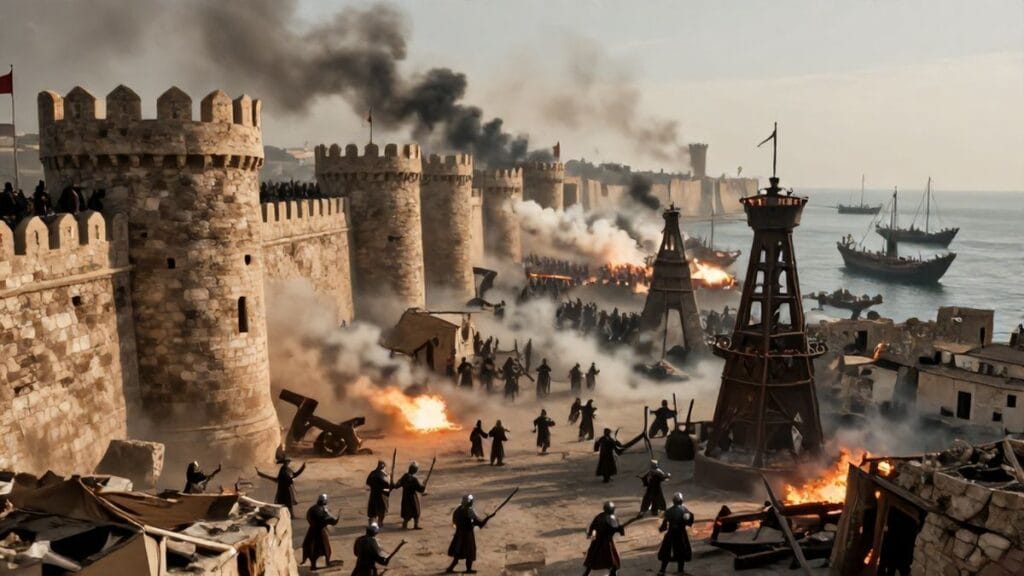
- Siege Begins: Cannon Smoke Over the Cliffs
- Inside the Walls: Fear, Faith, and Factionalism
- The Fall of 6 June 1475: Breaking of the Lion’s Gate
- Captives, Conversions, and Negotiations: The Human Aftermath
- From Genoese Colony to Ottoman Stronghold
- Tatars, Slavs, and Greeks: How Local Societies Were Remade
- Commerce Rewired: Slaves, Silk, and the Closed Sea
- Echoes in Europe: Venice, Genoa, and the Western Powers React
- Memory, Chronicle, and Legend: How the Conquest Was Remembered
- Historians at Work: Sources, Silences, and Debates
- Caffa’s Long Shadow: From Ottoman Fortress to Modern Feodosia
- Conclusion
- FAQs
- External Resource
- Internal Link
Article Summary: In June 1475, the Ottoman conquest of Caffa reshaped the political and commercial map of the Black Sea, closing one of the last great windows through which Latin Christendom peered into the Eurasian interior. This article follows the rise of Caffa as a Genoese trading colony wedged between steppe khanates, Italian merchant republics, and a rapidly advancing Ottoman Empire. It traces how the port’s riches—grain, furs, spices, and above all slaves—made it irresistible to sultans intent on controlling the seas and containing rival powers. Through the lens of the ottoman conquest of caffa, we watch alliances crack, mercenaries hesitate, and townspeople weigh desperate choices as the Ottoman fleet darkens the horizon. After the gates fall on 6 June 1475, the narrative turns to the fate of prisoners, the reorganization of power in Crimea, and the transformation of trade routes under Ottoman rule. The ottoman conquest of caffa is shown not as an isolated event but as a culmination of long trends within Mediterranean geopolitics, Christian–Muslim rivalry, and steppe diplomacy. By exploring chronicles, archival traces, and later memories, the article reveals how this violent turning point echoed through Venetian boardrooms, Tatar encampments, and Orthodox monasteries. In doing so, it argues that the ottoman conquest of caffa was both an ending—the fall of a Latin stronghold—and a beginning: the moment when the Black Sea became, in effect, an Ottoman lake.
On the Edge of Two Worlds: Caffa Before the Storm
The city that would fall on 6 June 1475 did not look, at first glance, like a frontier destined for conquest. Caffa, perched on the southern Crimean coast, clung to a crescent-shaped bay framed by dry hills and chalky cliffs. From the sea, sailors approaching at dawn saw a forest of masts rocking gently in the swell, the glint of tiled roofs, and the heavy stone walls that rose in tiers from the quayside up toward the citadel. Bells from Latin churches mingled with the chanted liturgy of Greek Orthodox priests and the cry of the muezzin from scattered Muslim quarters. It was a place where languages overlapped as much as borders: Genoese and Ligurian in the counting-houses, Kipchak and Tatar in the markets, Greek in the alleyways, Armenian and Hebrew in quieter, more reserved streets.
Yet beneath this apparent cosmopolitan calm, the ottoman conquest of caffa was already being prepared by forces no one citizen could fully grasp. The Black Sea, once a basin shared by Byzantium, Italian republics, and steppe powers, was gradually being drawn into the orbit of a single rising empire. The Ottoman sultans had already taken Constantinople in 1453, a shock that had reverberated through every harbor from the Adriatic to the Levant. Caffa’s merchants had tried to adjust, renegotiating treaties, paying new tolls, and reassuring themselves that commerce, like water, always found a way. But this was only the beginning. What they could not admit—at least not aloud—was that the logic of power increasingly pointed toward a direct collision between the Sultan’s navy and their own embattled outpost on the Crimean shore.
For the people who lived and died there, Caffa was more than a pawn in imperial games. It was a home. Children ran through narrow lanes chasing each other between warehouses stacked with furs from Muscovy and grain from the steppe. Women haggled over spices and textiles, occasionally glancing up as galleys from Genoa, Venice, or Trebizond glided into port, bringing rumors from distant courts. In taverns lit by smoky oil lamps, sailors told stories of Ottoman admirals and their swift new warships, of ports along the Anatolian coast that had accepted the sultan’s rule in exchange for stability—or simply because there was no other choice.
By 1475, the year of the ottoman conquest of caffa, there was a sense—subtle but growing—that the city stood between worlds that were ceasing to be equal. To the south and west loomed the Ottoman Empire, bristling with soldiers, cannons, and an ideology of sovereignty rooted in conquest and order. To the north and east stretched the looser, shifting power of the Crimean Khanate and the Golden Horde’s splintered successors, their horsemen still terrible when united but increasingly divided by rivalries and dependent on foreign trade. To the west, far across the sea, were Genoa and its oligarchs, whose dreams of maritime supremacy had been undermined by Venetian competition and the relentless expansion of Ottoman might.
This was the stage upon which the drama of 1475 would play out: a bustling port whose residents hoped that treaties might hold longer than fortification walls, that old arrangements might somehow survive in a new age of empire. It is astonishing, isn’t it, how often people living at the edge of great historical ruptures cling to small routines—bargains in the market, coins stacked carefully in a chest—as if habit itself could ward off the thunder of distant cannon.
The Genoese Maritime Empire and the Jewel of Crimea
To understand why the ottoman conquest of caffa mattered so deeply, one must first see Caffa through Genoese eyes. From the fourteenth century onward, Genoa had built a sprawling, if fragile, maritime empire along the shores of the Mediterranean and the Black Sea. Unlike landbound kingdoms with clear frontiers, this empire was made of islands, concessions, and fortified outposts: Pera across from Constantinople, Chios in the Aegean, and on the northern shore of the Black Sea, a string of colonies that culminated in Caffa.
Genoese chroniclers described Caffa with a kind of possessive pride. It was, in effect, their eastern capital: a place where consuls dispensed justice in the name of the Commune, where notaries filled thick registers with contracts and shipping manifests, and where churches dedicated to Latin saints rose over streets humming with steppe-born trade. From here, caravans pushed northeast into the Eurasian interior, linking Italian merchants to the markets of Astrakhan, Sarai, and beyond. Goods that passed through Caffa’s warehouses could end up on the tables of Florentine bankers or in the treasuries of Parisian kings.
The city’s prosperity rested on three pillars. First, there was grain, the daily bread of empires, drawn from the fertile chernozem of the steppe and shipped south to feed cities along the Mediterranean. Second, there were high-value commodities: furs, wax, honey, and hides, passing from Slavic and Tatar hands into the holds of Genoese galleys. And third—most controversially—there was the slave trade. Medieval and early modern commentators alike, whether Latin, Greek, or Muslim, knew Caffa as one of the principal European marts for human beings. Men, women, and children from the steppe, the Caucasus, and even deeper into Rus’ were bought and sold here, their fates tied to the whims of merchants and the demands of distant masters in Cairo, Istanbul, or the households of Italian cities.
This trade enriched the Genoese but also made them targets. For the Crimean Tatars, Caffa was an indispensable outlet for their own raiding economy; for the Mamluk sultans of Egypt, it was a crucial supplier of military slaves; for the Ottomans, it appeared as both a rival and an opportunity—an established system of extraction that could be repurposed under their flag. When Genoese authorities looked out from the walls, they did not see neutral neighbors but partners whose loyalty could shift with the wind, and enemies biding their time.
Yet Caffa was never only a Genoese city. Its population formed a patchwork of communities bound together by necessity rather than love. Greek Orthodox priests officiated in domed churches; Armenian and Jewish merchants ran their own networks of credit and supply. Muslim Tatars and Turks frequented the markets, sometimes staying in their own quarters just beyond the Latin heart of town. Some married across confessional lines; others watched their neighbors with thinly veiled suspicion. The Genoese consuls sat at the top of this hierarchy, but they ruled more by negotiation and custom than by sheer force. Their garrison was small, their finances strained, and their reliance on local intermediaries profound.
By the middle of the fifteenth century, the Genoese system was cracking. The cost of defending distant colonies was rising, while profits were squeezed by Venetian competition and the disruption of traditional caravan routes. Worse still, the fall of Constantinople to Mehmed II in 1453 meant that the main gateway to the Black Sea was now in Ottoman hands. Genoa could no longer simply rely on treaties with a Byzantium too weak to enforce its will; instead, it had to deal with an ascendant empire for whom tolerating Latin enclaves was at best a temporary expedient.
Some in Genoa understood the danger clearly. In petitions and letters preserved in archives, they warned that Caffa, however valuable, could not be held indefinitely against a determined Ottoman assault. Others clung to the belief that diplomacy and payments could secure their colony. This tension—between realists and optimists—would shape the half-hearted support sent to Crimea in the crucial months leading up to 1475, leaving Caffa proud but under-defended on the eve of the storm.
Ottoman Ambitions in the Black Sea
From the Ottoman perspective, Caffa was not merely a distant Latin city; it was a keystone in a larger strategic arch. Since the late fourteenth century, the Ottoman beylik-turned-empire had pushed outward in every direction, testing the limits of its military capacity and administrative ingenuity. By the time Sultan Mehmed II ascended the throne for his second reign in 1451, the empire controlled much of western Anatolia and the Balkans. Yet crucial stretches of coastline and key ports still lay in other hands: Venetian, Genoese, or those of semi-independent dynasties.
Mehmed II, later styled “the Conqueror,” was acutely aware that to secure his empire, he needed to dominate the seas bordering his territories. The conquest of Constantinople had given him control over the Bosporus, that narrow throat connecting the Mediterranean to the Black Sea. But full mastery required more. As long as powerful Latin colonies like Caffa, and rival regional powers such as the Crimean Khanate and the remnants of the Golden Horde, maintained their own direct ties to the maritime world, the Black Sea would remain contested ground.
Strategically, then, the ottoman conquest of caffa emerged as part of a broader project: the transformation of the Black Sea into what Ottoman historians would later call a “closed sea,” one whose trade passed under the sultan’s watchful gaze and from which rival powers were progressively excluded. This was not only a matter of pride or religious rivalry, although both played roles; it was also about revenue, logistics, and security. A fleet capable of sailing unchallenged from Istanbul to Trebizond, from Sinope to Crimea, could ferry troops quickly, interdict enemy shipping, and tax commerce at will.
Mehmed’s court in Istanbul drew upon a sophisticated web of intelligence. Envoys, merchants, renegade sailors, and Greek clerics whispered into the ears of viziers and admirals. They spoke of Genoa’s political divisions, of Caffa’s reliance on local Tatar support, of the city’s aging walls and small garrison. They relayed news of shifting alliances among the Crimean Tatars and the weakening of the Golden Horde’s authority. From these fragments, a picture emerged of an opportunity: a major Genoese stronghold whose fall would reverberate across the Black Sea and demonstrate, once again, the inevitability of Ottoman expansion.
Religiously, the conquest could be framed as a continuation of jihad against infidel powers clinging to eastern shores. Yet Ottoman rulers were nothing if not pragmatic. They had no desire to wipe out commerce or eradicate non-Muslim communities; on the contrary, they intended to harness existing networks and redirect their profits. The Caffa that Mehmed II imagined under his rule was not an empty ruin but a bustling port, emptied of hostile garrisons and obedient to the sultan’s governors.
To enact such a vision, the empire needed a navy commensurate with its ambitions. In the years after 1453, shipyards along the Golden Horn clanged with the sound of hammers and saws as galleys were built, masts stepped, and artillery mounted on reinforced decks. Commanders like Gedik Ahmed Pasha, the admiral who would ultimately lead the Crimean campaign, emerged from this crucible of experimentation and expansion. They understood both naval warfare and the delicate politics of negotiating surrenders, installing garrisons, and integrating conquered ports into the imperial system.
When historians later pieced together the logic behind the campaign of 1475, they saw it as almost inevitable: Constantinople, Amasra, Sinope, Trebizond, and then the Crimean ports. One modern scholar of Ottoman expansion, for instance, has written that “the Black Sea littoral, once opened, could not remain a patchwork of sovereignties; it had to be folded into a single political horizon.” That “folding” would come at a high cost for Caffa and its people.
Shadows Over the Harbor: Rising Tensions in Caffa
In the years just before 1475, signs of approaching danger multiplied, though not everyone chose to read them. Travelers arriving in Caffa spoke in hushed tones of Ottoman victories along the Anatolian coast and of a growing fleet that now regularly patrolled the Black Sea. Captains reported being stopped and inspected by Ottoman officials, their cargoes taxed more heavily than in the past. Diplomatic envoys from Genoa, Venice, and the Crimean Khanate moved restlessly between courts, seeking to preserve their interests through a fraught dance of oaths and threats.
Within Caffa, the Genoese authorities tried to project calm. The palazzo of the consul, with its stone façade and carved windows, remained the symbolic heart of Latin power. Yet behind closed doors, the debates were intense. Could the city rely on the Crimean Khan to aid in its defense? Would Genoa send enough ships and men to repel an Ottoman attack? Should the colony seek a separate agreement with Mehmed II, trading autonomy for security?
These questions filtered down, in distorted form, into the markets and taverns. Rumors spread that an immense Ottoman armada was being assembled; others insisted that the sultan was too occupied with affairs in the Balkans to worry about distant Caffa. A sense of unease settled over the city like a sea fog. Some wealthy families began quietly transferring assets to safer havens—gold shipped westward, relatives sent back to Italy. Others, particularly among the indigenous Greek and Armenian communities, saw little choice but to stay and hope that any conqueror would need their skills and local knowledge.
The Crimean Tatars watched all this with a mixture of anxiety and calculation. Their khan, Hadji Giray and then his successors, balanced between the great powers: needing Genoese trade and gifts, wary of angering the Ottoman sultan, and dependent on the steppe nobility, who profited from raiding and commerce alike. For Tatar elites, the weakening of Genoese control in Caffa promised an opportunity to renegotiate terms—but a full Ottoman takeover might reduce them from partners to clients. As Ottoman envoys began visiting Tatar camps more frequently, promising protection and support in exchange for loyalty, some noble clans shifted their allegiance while others hesitated.
Inside the city walls, preparations for defense were uneven. Extra cannon were mounted on strategic bastions; the militia was drilled more regularly. But supplies of gunpowder and shot were limited, and many of the walls, though imposing, had not been modernized to withstand sustained artillery bombardment. Some sections still reflected the defensive logic of an earlier age, when siege engines and ladders posed the main threat, not heavy guns firing iron balls shipped from imperial foundries.
Social tension sharpened the sense of fragility. Latin elites, especially those tied to the Genoese administration, feared that if the Ottomans attacked, segments of the local population might welcome them or at least refuse to resist. After all, the tax burdens imposed by the Genoese had grown heavier, and resentment simmered among those who felt excluded from power. In private, some Greek and Armenian notables mused that Ottoman rule—harsh but predictable—might be preferable to the uncertainty of a distant and fractious Genoa.
Yet behind the calculations, there was also denial. Ports like Caffa had weathered storms before: Tatar incursions, rival Italian raids, outbreaks of plague. The memory of the Black Death, which had ravaged the city in the mid-fourteenth century and perhaps even traveled from here westward into the Mediterranean world, still haunted local chronicles. Compared with such apocalyptic suffering, political change could seem almost mundane. This time, people told themselves, would be no different. Treaties would be signed; tribute would be paid; life would go on. They were wrong.
The Spring of 1475: War Fleets on the Horizon
Early in 1475, winds blew news northward from Istanbul: Sultan Mehmed II had ordered a large expedition to the Black Sea under the command of Gedik Ahmed Pasha. Officially, the campaign aimed to deal with rebellious or unreliable coastal lords and to secure the sultan’s authority over key ports. Unofficially, experienced observers saw a more sweeping goal: the final assertion of Ottoman supremacy over the region’s maritime arteries, an objective that made the ottoman conquest of caffa almost a foregone conclusion.
Ottoman shipyards had been preparing for months. Carpenters worked day and night fashioning the ribs of new galleys; rope-makers twisted thick cables; cannon founders cast bronze and iron pieces destined for naval carriages. When the fleet finally assembled in the waters off Istanbul, it must have been a formidable sight: dozens, perhaps hundreds, of vessels, from light fustas to heavy galleys bristling with oarsmen and armed soldiers. Contemporary chroniclers differ on the exact numbers, as they so often do, but all agree on its intimidating scale.
News traveled ahead of the fleet. Venetian and Genoese merchants in Istanbul wrote hurried letters to their compatriots farther north, warning them of impending operations. Envoys dispatched to the Crimean Khanate reported that Ottoman messengers had arrived offering new terms of alliance. On the open sea, neutral and hostile ships alike occasionally sighted the moving armada, its oars pulling in relentless rhythm, its banners snapping in the wind.
In Caffa, each new ship that entered the harbor was met with a flurry of questions. What had the sailors seen? How many galleys? Which ports had already fallen or surrendered? As fragmentary reports accumulated, a picture of the campaign emerged. Ottoman forces struck first at other Genoese strongholds and semi-independent coastal enclaves along the southern and eastern Black Sea: Amasra on the Anatolian coast, the ports of the former principality of Theodoro in southwestern Crimea, and other strategic points. Each success brought the armada closer to Caffa’s waters.
The Genoese administration in Caffa sent pleas for aid westward, invoking contracts, shared faith, and the honor of the republic. Some reinforcements did arrive: a handful of ships, additional soldiers, perhaps a new commanding officer whose task was to organize a defense that might at least delay the inevitable. But the response was too small and too late. Genoa itself was embroiled in internal factional disputes and weary of pouring money and blood into distant colonies that seemed impossible to hold.
As spring deepened, so did anxiety. The sea, once a source of livelihood and connection, began to feel like a looming threat. Citizens scanned the horizon for signs of unusual sail formations. The harbor authorities imposed stricter controls on navigation, wary of spies and saboteurs. Yet trade did not simply stop; too many lives depended on daily transactions. Grain still arrived, and ships still left laden with goods, even as everyone whispered that this might be the last season of normal commerce.
Among the city’s clergy—Latin, Greek, and Armenian—prayers for deliverance grew more urgent. Processions wound through the streets; relics were displayed; sermons warned of divine judgment but also held out hope of miraculous intervention. Some preachers framed the looming Ottoman assault as a test of Christian steadfastness, while others focused on repentance, suggesting that moral decay had invited God’s chastisement. Their words fell on ears already ringing with more worldly fears: the whistle of incoming shot, the clash of steel, the screams of the captured.
Siege Begins: Cannon Smoke Over the Cliffs
When the Ottoman fleet finally appeared off the Crimean coast in late May or early June 1475, there was no longer any room for denial. Witnesses described a “forest of masts” filling the horizon, the ships arranging themselves with grim efficiency. Gedik Ahmed Pasha had not come to negotiate in the abstract; he had come with soldiers, artillery, and orders from Mehmed II. Before turning his full attention to Caffa, he likely secured the submission or destruction of nearby ports—steps designed to isolate the Genoese stronghold, cut its lines of communication, and deny it local allies.
The opening moves of the ottoman conquest of caffa followed a script honed in previous campaigns. An envoy, probably under a flag of truce, approached the city with demands: surrender, accept the sultan’s protection, and allow a garrison to be installed—or face the consequences. For the Genoese leadership, accepting such terms would mean the end of their political authority, the likely confiscation of key properties, and perhaps personal humiliation or worse. The decision was not simple. Some argued that resistance was hopeless, pointing to the fate of other ports that had tried to fight and been crushed by Ottoman guns. Others insisted that honor and duty required them to hold out, trusting in their walls and in possible relief from the west.
In the end, they chose defiance. Whether out of calculation, pride, or the sheer momentum of their own rhetoric, they refused unconditional surrender. Their cannons were readied; watchmen were posted along the ramparts; the gates were barred. The streets of Caffa, normally filled with the sounds of commerce, now echoed with the tramp of armored boots and the creak of siege engines being moved into position.
Gedik Ahmed Pasha responded in kind. Ottoman troops landed and established camps on the heights overlooking the city. Engineers and artillery officers surveyed the walls, identifying weak points, calculating ranges, and choosing positions for their heavy guns. Within days, the slopes around Caffa sprouted earthworks and gun emplacements. Supply lines back to the ships and along the coast were secured; the siege tightened like a noose.
The first salvos must have been terrifying. Medieval and early modern artillery was as much a psychological weapon as a physical one. The roar of guns, the crash of stone and iron against masonry, the sudden collapse of a wall section—all of this signaled to defenders that the old equations of defense and attack had changed. Whereas earlier sieges could drag on for months or years, the age of gunpowder had accelerated the tempo of conquest. Each day that Caffa held out risked not only death in battle but devastation if the city was taken by storm.
Inside, the population sought shelter as best they could. Wealthier residents retreated to fortified houses or cellars, while the poor huddled in churches and communal spaces. Supplies were rationed. The port, once an open gate to the sea, now lay under the guns of Ottoman ships; any attempt to break out would be fraught with danger. Still, some smaller vessels may have slipped away in the night, carrying desperate refugees toward friendlier coasts.
The defenders’ artillery answered the Ottoman fire, but with less weight and precision. They inflicted some casualties, perhaps sinking a few lighter vessels or damaging siege works, yet their efforts could not offset the overwhelming material superiority of their opponents. Day after day, the pounding continued, shards of stone and clouds of dust filling the air above the walls. The very geography that had once made Caffa so secure—its cliffs, its enclosed bay, its layered fortifications—now turned into a killing ground where defenders were exposed to relentless bombardment.
Inside the Walls: Fear, Faith, and Factionalism
Even as cannon roared and walls cracked, the greatest threat to Caffa may have been internal. Siege conditions magnified every existing tension: between Latins and Greeks, Genoese officials and local elites, rich and poor, civilians and soldiers. Each group had its own priorities, its own threshold for risk, its own view of what the future might hold under Ottoman rule.
In the palazzo of the consul, hasty councils weighed options. Could a partial surrender be negotiated—perhaps allowing the safe departure of Genoese officials and their families in exchange for the city’s voluntary capitulation? Should they attempt a surprise night attack on Ottoman siege works, gambling that a bold stroke might damage enemy morale? Every plan seemed to falter against the hard realities of numbers and firepower. Letters drafted to Genoa or allied courts would, in all likelihood, never make it through the encircling fleet.
Among the general population, panic alternated with grim resolve. Some Latin merchants, facing the loss of everything they had built, pressed for immediate talks, hoping to save at least their lives and a portion of their movable wealth. Others, including certain clergy, exhorted residents to fight on, framing surrender as betrayal of the faith. In Greek and Armenian quarters, views were equally divided. A few influential families, aware of the Ottoman practice of allowing non-Muslim communities a measure of autonomy and religious freedom under the millet system, leaned toward accommodation. Others, fearing looting, enslavement, or forced migration, urged resistance.
One can imagine small scenes that rarely make it into formal chronicles: a mother whispering to her children in a dim cellar, promising that God would not abandon them; a priest or imam struggling to find words of comfort as the stonework of a nearby wall shudders under impact; merchants hastily burning sensitive documents or burying coins in hidden pits, clinging to the hope they might one day return to dig them up. Siege is, above all, a slow grinding down of the structures—physical, social, psychological—that hold a community together.
Factionalism also touched the city’s defenders. Mercenaries from various lands—Italians, Albanians, perhaps Catalans or Slavs—had been hired to bolster the garrison. They were brave enough in open battle but seldom eager to die for a foreign cause once defeat seemed inevitable. Promises of extra pay or land grants could only go so far. Desertions, though risky, became more tempting as Ottoman strength became undeniable. Some chroniclers hint at men slipping over the walls or down to the shore at night, trying to reach enemy lines to offer their services or simply escape.
Religious interpretations of the siege colored behavior. Latin clerics might cite the fall of Jerusalem or Antioch, casting Caffa’s defense as another chapter in a long struggle between Christendom and Islam. Orthodox preachers, by contrast, could recall the sack of Constantinople by Latin Crusaders in 1204, reminding their flocks that not all crosses were the same and that alliances with Westerners had brought suffering as well as protection. For Muslim residents or visitors trapped inside, the sight of the Ottoman banners outside the walls may have raised complex feelings: hope for co-religionists’ victory, fear of being caught in the crossfire, uncertainty about how their neighbors would treat them if the siege dragged on.
The longer the bombardment lasted, the more openly people spoke of surrender. Food stocks, though not yet exhausted, were finite. Water supplies could be compromised. Once a significant breach was opened in the walls, the defenders faced a brutal calculus: negotiate while they still had some leverage, or risk a sack in which soldiers, drunk on victory and bloodlust, might ignore the pleas of their own commanders. Everyone in Caffa knew stories of cities taken by storm, where no age or status guaranteed safety. The threat hung over their nights like a dark, oppressive cloud.
The Fall of 6 June 1475: Breaking of the Lion’s Gate
On or around 6 June 1475, the siege’s internal logic reached its final, bloody conclusion. The ottoman conquest of caffa, long anticipated and feared, compressed itself into hours of chaos that would be remembered for generations. Contemporary and near-contemporary sources, both Ottoman and Latin, agree that the city’s resistance was ultimately broken not by a single dramatic charge but by the cumulative effect of artillery, exhaustion, and negotiation conducted under the shadow of imminent ruin.
By this point, one or more major breaches had likely opened in the fortifications. The so-called Lion’s Gate—whether that exact name was used then or later by local memory—stood as a symbol of the city’s defiance, its heraldic imagery now pockmarked by shot. Ottoman troops tested the defenses with probing assaults, sometimes repelled, sometimes gaining footholds that had to be fought over savagely. Each skirmish sapped the defenders’ strength, claimed more lives, and proved the futility of prolonged resistance.
At some moment in those final hours, the Genoese leadership, perhaps in concert with key local notables, decided to seek terms. Envoys bearing white cloths or other signs of truce moved between lines, risking nervous arrows or stray bullets. Gedik Ahmed Pasha, experienced in siege warfare, understood the advantage of taking a city by negotiated capitulation rather than full-scale storming. A surrender secured under his promise of protection would preserve more of Caffa’s infrastructure and population, keeping its economic value largely intact for the sultan, while avoiding the unpredictable frenzy of an uncontrolled sack.
But negotiation under duress is rarely straightforward. What counts as “surrender” to one side can look like “humiliation” to the other. The Genoese sought safe conduct for themselves, their families, and perhaps certain categories of citizens, along with guarantees for property and religious rights. The Ottomans, for their part, demanded the handover of the citadel, the disarmament of the population, the placement of an imperial garrison, and the recognition of Mehmed II’s sovereignty. They also expected slaves, spoils, and hostages—standard currency in the politics of conquest.
As the hours ticked by, news of ongoing talks spread through the city, sparking waves of relief and outrage in equal measure. Some hailed the possibility of avoiding a massacre; others denounced the negotiators as cowards bartering away honor for personal safety. In many sieges, such divisions explode into outright violence, with factions attempting to seize gates or depose leaders. Whether Caffa saw such open conflict or only tense muttering in side streets, the strain must have been palpable.
Eventually, an agreement—however partial and contested—was reached. Ottoman troops entered the city in more or less orderly fashion, banners flying, drums beating. The sight would have seared itself into the minds of onlookers: rows of armored infantry and cavalry streaming through the gates, sailors and marines disembarking at the quays, officers taking possession of key strongpoints. For some, especially Muslims and those hoping for lenient treatment under the new regime, this might have been a moment of cautious hope. For many Latins, it likely felt like the end of a world.
Despite attempts to control events, the entry of a conquering army often brings looting and violence. Houses associated with Genoese authority or wealth were prime targets. Soldiers sought valuables, souvenirs, and captives. The line between sanctioned confiscation and opportunistic theft was thin. Yet compared with total slaughters described in other medieval sieges, the fall of Caffa appears—so far as our fragmentary sources suggest—to have been more constrained, shaped by Gedik Ahmed Pasha’s desire to preserve the city’s economic potential.
Still, there were victims. Some defenders who refused to lay down arms were cut down where they stood. Others were taken prisoner, their fates to be decided later: ransom, forced service, or sale into slavery. The Genoese political order in Caffa was dismantled with bureaucratic efficiency. The consul’s authority evaporated; the Genoese flag came down from the citadel. In its place rose the banner of the sultan, signaling to all the Black Sea that a new master ruled these waters.
Captives, Conversions, and Negotiations: The Human Aftermath
Once the guns fell silent, the more intimate violence of sorting the living from the dead, the free from the captive, began. The ottoman conquest of caffa was, like most early modern conquests, also a massive redistribution of human beings. Soldiers expected a share of prisoners as part of their reward. Officers and the admiral himself claimed high-value captives: wealthy merchants who could fetch substantial ransoms, skilled artisans, and young people considered suitable for service in elite households or the imperial administration.
The Genoese elite fared variably. Some, if protected in the surrender terms, were allowed to depart with a portion of their movable property, boarding ships under Ottoman supervision and heading toward safer ports. Others, deemed too valuable or too dangerous to release, were kept as hostages. Their presence in Ottoman hands could be used as leverage in subsequent negotiations with Genoa or allied powers. Lower-status Latin inhabitants, lacking powerful patrons, were more vulnerable to being seized and sold.
Non-Latin communities also faced sorting and reclassification. Greek and Armenian residents, as Christians with a long-established status under Islamic law, could be integrated into the Ottoman system as dhimmis: protected but subordinate subjects paying special taxes in exchange for the right to practice their religion. Many of them might have quickly sought the patronage of Ottoman officials, offering their local knowledge, commercial contacts, and administrative skills. For Jewish inhabitants, Ottoman rule often brought relative improvement; Mehmed II, like some of his successors, recognized the economic value of Jewish merchants and artisans and extended a limited but real measure of protection.
Conversions, both voluntary and coerced, added another layer to the transformation. Some captives, facing the bleak prospects of slavery or exile, accepted Islam, sometimes sincerely drawn by new social ties or spiritual conviction, sometimes as a strategic move. In the fluid world of Ottoman frontiers, such conversions could unlock opportunities within the military or bureaucracy that were closed to most non-Muslims. Others clung fiercely to their ancestral faiths, even if that meant harsher conditions or fewer privileges.
One can imagine scenes in which families were torn apart on the quayside: fathers separated from sons, wives from husbands, as soldiers categorized prisoners by age, sex, and potential value. Some would be marched inland, others loaded onto ships bound for markets deeper within the empire. Their names, for the most part, do not appear in surviving documents. We know them only as numbers in tax records, entries in slave registers, or vague mentions in chronicles lamenting the fall of the city.
At the same time, negotiation did not stop with the city’s formal surrender. Representatives of surviving communities petitioned Gedik Ahmed Pasha and his subordinates for specific rights: to rebuild churches, to continue certain commercial practices, to retain partial control over communal institutions. Ottoman authorities, guided by both law and pragmatism, often agreed to these requests—within limits. The goal was not to extinguish local society but to reorient it toward Istanbul, to embed it within the fiscal and administrative networks of the empire.
In the weeks after the conquest, the shock began to settle into a new, uneasy normalcy. Markets reopened under new regulations; the harbor bustled again, now with Ottoman ships and merchants playing a larger role. The trauma of loss lingered, but for many, especially those too poor or too rooted to leave, survival required adaptation. Children born in the years after 1475 would grow up never having known Genoese rule; for them, the sultan’s sovereignty would be an unquestioned fact, the old Latin banners little more than tales murmured by elders who had seen them fall.
From Genoese Colony to Ottoman Stronghold
Politically and strategically, the transformation of Caffa under Ottoman rule was swift and profound. The city, once a semi-autonomous Genoese enclave, was now an imperial outpost integrated into the administrative machinery of a centralized state. Its new name—Kefe, in Ottoman usage—signaled both continuity and change: the same place, heard through a different linguistic and political filter.
The first priority for Ottoman authorities was security. A permanent garrison was installed in the citadel and at key points along the walls. Existing fortifications were repaired and, where necessary, updated to reflect the demands of gunpowder warfare. Artillery emplacements were oriented not only seaward, to deter hostile fleets, but inland as well, to guard against potential rebellions or incursions by Tatar or other forces. The city became a hinge between land and sea power, a place where Ottoman soldiers, sailors, and administrators interacted daily.
Administratively, Kefe fell under the control of appointed governors answerable to Istanbul. Tax systems were reorganized; some revenues that had formerly enriched Genoese private investors now flowed into the coffers of the sultan. Waqf endowments—charitable foundations under Islamic law—began to appear, funding mosques, schools, fountains, and other public works. Over time, the skyline changed subtly: minarets rising alongside older church towers, new public buildings asserting an Ottoman presence in stone and tile.
Yet the empire did not seek to erase the city’s role as a hub of commerce. On the contrary, it wanted Kefe to thrive, albeit under new terms. Trade privileges were recalibrated rather than obliterated. Certain Italian merchants, including some from Venice and even from humbled Genoa, continued to operate in the port under capitulations and agreements that recognized their usefulness as intermediaries in long-distance trade. Local Armenian, Greek, and Jewish traders found ways to adapt, sometimes partnering with Muslim colleagues, sometimes leveraging old connections reoriented through Ottoman channels.
The slave trade—a dark constant in Caffa’s history—continued under new management. Crimean Tatar raiders, increasingly tied to the Ottoman sphere, funneled captives from the steppe and Slavic lands through Kefe and other ports. From there, they were distributed throughout the empire and beyond. Ottoman officials taxed this commerce, regulated it to some extent, and occasionally intervened to redirect specific categories of slaves to state service. The moral debates that would later swirl around slavery in Europe were only dimly reflected here; for contemporaries, it was a grim but ordinary feature of the social landscape.
In this way, the ottoman conquest of caffa did not so much end the city’s functions as reshape them. What had been a Latin-controlled gateway to the Eurasian interior now became an Ottoman-controlled gatehouse, its hinges creaking in time with the rhythms of imperial policy. The Black Sea, increasingly ringed by ports under direct or indirect Ottoman rule, began to resemble the “closed sea” envisaged in Istanbul: foreign ships admitted only on sufferance, commerce channeled through routes that maximized the sultan’s power.
Tatars, Slavs, and Greeks: How Local Societies Were Remade
Beyond Caffa’s walls, the conquest rippled outward through Crimean and steppe societies. The Crimean Khanate, whose rulers had long balanced between Genoese, Lithuanian, and other powers, now found themselves more firmly anchored in the Ottoman orbit. Treaties and vassalage arrangements linked the khans to Istanbul, providing them with military backing and legitimizing their authority in exchange for pledged loyalty and participation in imperial campaigns.
For Tatar elites, this shift offered both stability and constraint. On the one hand, Ottoman alliance secured access to wider markets, including those of the Mediterranean and Near East, through ports like Kefe. On the other, it limited their freedom to maneuver between rival powers. Over time, the khans became increasingly dependent clients of the sultan, their autonomy circumscribed by the realities of military and economic imbalance. The hills and plains surrounding Caffa, once a contested borderland, settled into a pattern of vassalage and mutual expedience.
Slavic populations in the broader region felt the change most acutely through the intensification of raiding and enslavement. As Kefe and other ports under Ottoman influence facilitated the export of captives, Tatar raids into Ukrainian and Russian territories—areas linked to Poland-Lithuania, Muscovy, and other states—became a constant menace. Villages burned, families were taken, and entire regions adapted their architecture and social structures to the demands of defense. Watchtowers, fortified churches, and local militias proliferated. In this sense, the ottoman conquest of caffa indirectly reshaped societies far from the Black Sea shore, forcing them to reckon with a new geography of fear.
Greek communities, both in Crimea and elsewhere around the Black Sea, navigated the transition with a mixture of resignation and resilience. Many had already lived under Ottoman rule in other regions and knew the patterns of accommodation: paying the jizya tax, maintaining internal ecclesiastical hierarchies under the umbrella of the Orthodox Church, and serving as intermediaries in trade and administration. For some, the fall of Caffa was another chapter in a long story of adaptation, the loss of one Latin overlord replaced by the demands of a Muslim one whose methods were, in some respects, more predictable.
Within Kefe itself, the demographic mosaic shifted but did not dissolve. Muslims—Turks, converted locals, immigrants from elsewhere in the empire—gradually increased in number, especially in positions of authority. Christian and Jewish communities regrouped, aligning themselves with new patrons and adjusting their economic strategies. Intermarriage, conversion, and everyday interaction slowly knitted together a social fabric that bore both the scars of conquest and the threads of continuity.
Culturally, this process produced hybrid forms. Architectural styles blended Italian, Byzantine, and Ottoman influences. Local cuisines incorporated new spices and ingredients carried in on imperial trade routes. Languages borrowed from one another: Turkish words popping up in Greek or Armenian speech, Italian commercial terms lingering in ledgers even as official records shifted to Ottoman Turkish. The result was a Crimean society that, while increasingly integrated into the Ottoman imperial sphere, retained a distinctive regional character shaped by centuries of cross-cultural contact.
Commerce Rewired: Slaves, Silk, and the Closed Sea
In the wake of 1475, merchants and rulers across Europe and the Near East had to redraw their mental maps of the world’s trade routes. The ottoman conquest of caffa, combined with earlier and subsequent Ottoman moves, effectively sealed the Black Sea from direct Latin maritime dominance. While Venetian and even Genoese traders continued to operate there under strict conditions, they did so at the sultan’s pleasure, not as autonomous actors protected by fortified colonies.
The economic consequences were multifaceted. On one level, the Ottomans gained a tighter grip on lucrative commerce in grain, furs, wax, hides, and slaves. Taxes collected at ports like Kefe bolstered state revenues. On another level, Western European powers had to adjust. Some sought alternative overland routes, others doubled down on Mediterranean trade or looked increasingly toward the Atlantic and the new possibilities that would soon open there. Historians have long debated the extent to which Ottoman control over eastern routes “pushed” Europeans toward oceanic exploration. While simplistic cause-and-effect narratives are misleading, there is little doubt that the contraction of direct Latin access to the Black Sea formed part of the background against which figures like Columbus and Vasco da Gama pursued their ventures.
Within the Black Sea basin itself, commercial networks were not destroyed but reconfigured. Caravan routes linking Muscovy, the steppe, and the Caucasus to southern ports persisted, now paying tolls to Ottoman officials or their Tatar allies. Muslim merchants from deeper within the empire, including Anatolia, Syria, and the Balkans, found opportunities in this restructured environment, collaborating with local non-Muslim traders who provided linguistic and cultural bridges. Kefe’s markets once again thrived, their stalls filled with goods whose origins spanned thousands of kilometers.
The slave trade, already mentioned, deserves particular emphasis as a driver of these transformations. Demand for slaves in Ottoman lands remained high: for household service, agriculture, craft production, and the military. Kefe became one of several key nodes in a system that linked raiding on the frontiers to consumption in imperial centers. Captives from Polish-Lithuanian, Russian, and other territories passed through the city’s pens and sales yards, their individual stories largely lost but their collective impact enormous. Regions subject to such predation experienced demographic distortions, shifting labor patterns, and a deep sense of vulnerability that shaped their politics and culture for centuries.
Not all commerce under Ottoman rule was extractive. The empire’s relative stability and extensive infrastructure allowed for more reliable movement of goods along certain axes. Merchants who learned to navigate Ottoman legal and fiscal frameworks could prosper. In some cases, even former adversaries of the empire came to appreciate the predictability it provided. A Venetian report from the late fifteenth century, for instance, grudgingly acknowledged that trade in Ottoman ports could be secure and profitable, provided one accepted the required terms and paid the expected dues.
Thus, the economic legacy of Caffa’s fall was not a simple story of decline but one of redirection. Wealth continued to flow through Crimea; it simply flowed into different hands and along different channels, embedding the region’s commerce within an imperial project that reached from the Danube to the Euphrates, from the Adriatic to the Persian frontier.
Echoes in Europe: Venice, Genoa, and the Western Powers React
News of Caffa’s fall reached Western Europe slowly, riding on ships and carried in letters that took weeks or months to arrive. When the story finally landed in Genoa, Venice, and other maritime centers, reactions mingled shock, anger, and weary resignation. For Genoa, the loss was both material and symbolic. The city’s ruling families had long derived prestige from their overseas possessions, presenting themselves as masters of distant harbors and guardians of trade routes to the East. The failure to defend Caffa underscored not only their military weakness but also their internal divisions, which had hampered decisive action.
Genoese chroniclers and petitioners responded in the idiom of their time. Some cast the event as a tragedy for Christendom, deploring the expansion of “the Turk” and the enslavement of Christian souls. Others focused on the economic blow: the collapse of investments, the loss of customs revenues, the shuttering of firms whose fortunes had been tied to Black Sea commerce. Calls for a concerted crusade against the Ottomans flared up, as they often did, in council chambers and diplomatic correspondence. Yet these calls rarely translated into action. The political landscape of late fifteenth-century Europe was too fractured, its rulers too preoccupied with local conflicts and dynastic ambitions.
Venice, Genoa’s great rival, responded more cautiously. On the one hand, the Republic of Saint Mark had every reason to fear Ottoman advances that might threaten its own commercial lifelines. On the other hand, Venetian diplomacy was famously pragmatic. The loss of Caffa weakened Genoa more than Venice and consolidated an Ottoman system with which Venice, at least for the time being, sought to coexist through treaties and trade agreements. Venetian envoys in Istanbul weighed how to leverage the new situation without provoking a war their state might not win.
Elsewhere in Europe, the fall of Caffa added to a growing litany of Ottoman successes that preoccupied courts and pulpits. In Rome, Paris, and various German principalities, preachers and pamphleteers invoked the advance of the “infidel” as both a warning and a fundraising tool, urging contributions for defense or crusade. Yet distance dulled urgency. The suffering of Caffa’s inhabitants, the reshaping of Crimean societies, the reconfiguration of Black Sea commerce—all this seemed abstract compared with local burdens and threats.
Some voices, particularly among humanist scholars and more discerning diplomats, recognized deeper patterns. They understood that events like the ottoman conquest of caffa signaled not merely the rise of a single empire but a shift in the balance between land and sea powers, between older medieval structures and a new kind of centralized, armed state. In private letters, they marveled at the organizational capacity of the Ottomans, their ability to project force across great distances and integrate conquered regions into a coherent system. Admiration and fear coexisted uneasily in these assessments, reflecting the complex ways in which early modern Europeans perceived their Muslim rivals.
Memory, Chronicle, and Legend: How the Conquest Was Remembered
Over time, as direct witnesses to 1475 died and new generations took their place, the ottoman conquest of caffa passed from lived experience into memory and written record. Each community shaped that memory to fit its own needs, anxieties, and hopes. Genoese and other Latin sources tended to emphasize loss and betrayal: the courage of defenders, the perfidy of allies who failed to come to their aid, the suffering of captives dragged into slavery. In some later retellings, the story of Caffa became a cautionary tale about overextension and the dangers of neglecting strategic outposts.
Ottoman chronicles, by contrast, folded the conquest into a triumphant narrative of Mehmed II’s reign. Works such as those by the court historian Tursun Bey celebrated the sultan’s relentless expansion and the incorporation of key ports into the imperial domain. Caffa’s fall appeared as one more link in a chain of victories: a demonstration of divine favor and the sultan’s prowess as “ghazi,” a warrior for the faith. The economic and administrative subtleties of the transition received less attention than the spectacle of banners raised and enemies subdued.
Local memories—Crimean Tatar, Greek, Armenian, and others—are harder to trace but no less important. Snatches of oral tradition, later recorded by travelers and ethnographers, suggest that the conquest lingered in folk songs, family stories, and religious commemorations. A ruined tower pointed out to a visiting scholar might be identified as “where the Genoese fought the Turks,” the details blurred but the association enduring. A family’s pride in an ancestor who “came with the sultan’s army” or, conversely, who “defended the city until the end,” shaped their sense of identity generations later.
Memory also interacted with broader narratives of Christian–Muslim encounter. As early modern Europe grappled with Ottoman power, losses like Caffa’s could be woven into a larger tapestry of decline and resistance. Conversely, in Ottoman lands, successes such as the Black Sea conquests bolstered a sense of providential mission and imperial destiny. Each side, reading its own chronicles, found confirmation of its chosen story: for Latins, a tale of embattled Christendom; for Ottomans, one of expanding dar al-Islam under a just and mighty ruler.
Modern historians, sifting through these layered accounts, face the challenge of disentangling fact from rhetoric. A mid-twentieth-century scholar of Genoese colonies, for example, dismissed some of the more melodramatic Latin descriptions of the siege as “literary embellishment,” while still acknowledging the profound trauma it inflicted. Conversely, critical readings of Ottoman texts reveal how victories like Caffa’s were used to shore up the image of the sultan and justify further campaigns. As with many events at the crossroads of empires, what “really happened” coexists uneasily with what people needed to believe had happened.
Historians at Work: Sources, Silences, and Debates
Reconstructing the story of the ottoman conquest of caffa requires not only narrative skill but also a certain humility before the limits of the sources. Archival materials from Genoa, Istanbul, and elsewhere provide glimpses rather than a full panorama. Notarial records, tax registers, diplomatic correspondence, and chronicles each shed light on different facets but leave others in shadow.
Genoese documentation is particularly rich regarding the colony’s earlier history: contracts describing property rights, shipping logs, and legal disputes between merchants. These help us understand Caffa’s social and economic structures before 1475. Yet they thin out in the crucial final years, a reflection of both the chaos of war and later archival losses. Ottoman records, while extensive overall, do not always foreground Crimea in the way a modern historian might wish. Kefe appears in tax surveys and administrative reports, revealing population figures, fiscal burdens, and the outlines of institutional change, but rarely offering detailed narrative about the conquest itself.
In between stand the chronicles—Latin, Ottoman, and others. They provide drama and specificity: stirring speeches, heroics on the walls, acts of brutality or mercy. But they also reflect their authors’ agendas. An Ottoman chronicler writing to honor Mehmed II had every incentive to smooth over complexities, to present conquests as swift and inevitable. A Genoese writer might exaggerate numbers or highlight betrayal to evoke sympathy and funding for future ventures. As the French historian Fernand Braudel once observed about Mediterranean history, events like sieges and battles are “surface disturbances” on deeper currents of social and economic change; both levels must be examined together.
Scholarly debates cluster around several issues. One concerns the extent to which Caffa’s fall accelerated broader shifts in Eurasian trade. Some argue that it marked a decisive step in redirecting European energies toward Atlantic exploration, while others caution against overstating its impact relative to other factors. Another debate centers on the local experience of conquest: how harsh was Ottoman rule in the immediate aftermath? Did certain groups, such as Greeks or Armenians, benefit more than others from the new order? Here, the scarcity of first-person testimonies makes firm conclusions difficult.
Yet in the gaps and silences, historians also find meaning. The absence of widespread reports of pogroms or total destruction suggests that the Ottomans pursued a strategy of pragmatic integration rather than indiscriminate annihilation. The continued importance of Kefe in later sources, both as a commercial hub and as a strategic naval base, confirms that the city’s vitality survived, even if its political masters changed. Where documentation fails, careful comparison with better-recorded conquests and the application of broader models of imperial expansion help fill in some blanks—though always with an awareness that each place, each moment, retains its own particularities.
Caffa’s Long Shadow: From Ottoman Fortress to Modern Feodosia
The story of Caffa did not end in 1475, nor with the gradual consolidation of Ottoman rule over Crimea. Over the following centuries, the city—now Kefe—weathered further upheavals. The Crimean Khanate’s fortunes rose and fell; regional alliances shifted; wars between the Ottoman Empire and powers such as Russia and Poland-Lithuania periodically turned the Black Sea into a contested zone once more. Kefe’s strategic value ensured that it remained a focal point for both military operations and diplomatic maneuvering.
By the eighteenth century, the balance of power around the Black Sea was again changing. The Russian Empire, under rulers like Catherine the Great, pushed southward, determined to secure warm-water ports and project influence into the Caucasus and the Balkans. Conflicts with the Ottoman Empire culminated in treaties that progressively eroded Ottoman control over Crimea. In 1783, Russia formally annexed the peninsula, and Kefe—like other Crimean cities—was drawn into a new imperial framework. Its name shifted once more, becoming Feodosia, a revival of an ancient Greek toponym that subtly linked the region’s future to its pre-Ottoman past.
Under Russian rule, Feodosia’s demographic and cultural profile changed again. New settlers arrived: Russians, Ukrainians, and others. Some of the city’s older communities—Tatars, Greeks, Armenians—remained, adapting as they had before, while others gradually dwindled through migration or assimilation. Architecturally, layers of history accumulated: Ottoman-era buildings stood alongside Orthodox churches, Russian administrative structures, and, eventually, modern constructions of the industrial age.
Yet echoes of earlier eras persisted. Travelers in the nineteenth and early twentieth centuries reported seeing remnants of Genoese and Ottoman fortifications, sometimes crumbling but still imposing. Local guides pointed out “Genoese towers” or “Turkish walls,” weaving fragmentary historical knowledge into their explanations. Scholars visiting the region sought to match these physical traces with archival references, piecing together the continuity between the medieval port of Caffa and the modern city of Feodosia.
The twentieth century added its own layers of turmoil: revolutions, world wars, changes in state borders, and mass deportations—most tragically, the forced removal of Crimean Tatars under Stalin. Through these storms, Feodosia endured as a regional center, its harbor and mild climate ensuring continued relevance. Yet beneath Soviet-era narratives of progress and unity, the deeper palimpsest of imperial conquests and cultural crossings remained, if often unspoken.
Today, when historians and visitors stand amid the ruins and streets of modern Feodosia, they can, with some effort, trace the outlines of the old Caffa: the contours of the bay, the locations of former walls, the siting of churches and mosques. The ottoman conquest of caffa no longer determines the city’s day-to-day life, but it remains one of the key hinges in its long history, a moment when the axis of power in the Black Sea definitively tilted toward Istanbul and set in motion a chain of changes still felt in the region’s political geography.
In this sense, Caffa’s story is not simply local. It illuminates larger patterns: the rise and fall of maritime empires, the ways in which economic interests and religious identities intertwine, the human costs and adaptive strategies that accompany each shift of sovereignty. Looking back across the centuries, the June day in 1475 when Ottoman banners rose over Caffa’s walls appears less as an isolated catastrophe or triumph than as one chapter in the broader, ongoing saga of how communities at the crossroads of continents endure, transform, and remember.
Conclusion
The fall of Caffa on 6 June 1475 was at once a local catastrophe, a regional turning point, and a microcosm of broader transformations in the late medieval and early modern world. What began as a fortified Genoese trading post on a distant shore ended as an Ottoman stronghold, its walls, markets, and people repurposed to serve a different imperial vision. In the days and weeks of siege—the roar of guns, the fearful councils, the desperate bargaining—one can perceive how the logic of power had shifted: artillery and centralized navies now outweighed the older safeguards of charters, alliances, and private militias.
Yet the ottoman conquest of caffa did not erase the city’s importance; it reoriented it. Trade continued, though under new regulations; communities endured, though under different hierarchies. The Black Sea, once a shared space among Byzantine, Latin, and steppe powers, became overwhelmingly Ottoman, with all the economic and political consequences that entailed. Far away, in European courts and counting-houses, the loss of Caffa forced reconsiderations of strategy and opened mental space for alternative routes and ambitions that would soon reshape the globe.
For the men, women, and children who lived through 1475, the conquest was less about grand strategy than about survival: finding shelter as walls shook, pleading for mercy at newly established tribunals, deciding whether to flee, to convert, or to adapt. Their names are mostly lost to us, preserved only in scattered records and the hardened sediment of collective memory. Yet by piecing together the city’s fate from charters, chronicles, and ruins, historians can at least restore some sense of their world: a multiethnic port perched between steppe and sea, between rival faiths and empires, whose transformation speaks volumes about how power works across time.
Ultimately, Caffa’s story reminds us that great historical shifts are lived in small spaces: on crowded quays, in cramped council rooms, beneath the shadow of walls that seem, for a time, indestructible. The banners change, the languages of rule evolve, and maps are redrawn, but the underlying human drama—of fear and courage, loss and reinvention—remains hauntingly constant. To listen closely to the echoes of 1475 is to hear, behind the thunder of cannons, the quieter, enduring rhythms of lives caught at the hinge of history.
FAQs
- What was Caffa before the Ottoman conquest?
Caffa was a major Genoese trading colony on the Crimean coast of the Black Sea, founded in the thirteenth century and developed into a bustling, fortified port that linked Mediterranean merchants with the markets of the Eurasian steppe, Rus’, and the Near East. - Why did the Ottomans target Caffa in 1475?
The Ottomans sought to control the entire Black Sea littoral, secure key trade routes, and eliminate rival Latin strongholds. Conquering Caffa fit into Sultan Mehmed II’s broader strategy of turning the Black Sea into an Ottoman “closed sea” and redirecting regional commerce under imperial supervision. - Who led the Ottoman conquest of Caffa?
The campaign was led by the Ottoman admiral and commander Gedik Ahmed Pasha, acting under orders from Sultan Mehmed II. He commanded a large naval and land force that systematically reduced nearby strongholds before besieging and capturing Caffa in June 1475. - How long did the siege of Caffa last?
The exact duration is uncertain due to fragmentary sources, but evidence suggests that the city endured a relatively short, intense siege in late spring and early June 1475, with heavy artillery bombardment hastening the decision to negotiate surrender rather than face a full-scale assault. - What happened to Caffa’s inhabitants after the conquest?
The population experienced a mix of outcomes: some Genoese elites were allowed to leave under negotiated terms, many residents were taken captive and sold into slavery or held for ransom, and others—particularly local Greek, Armenian, Jewish, and some Muslim communities—were integrated into the new Ottoman-administered city, now called Kefe. - Did the conquest end trade in the region?
No. Trade continued and in some respects even flourished under Ottoman rule, but it did so under new regulations and fiscal regimes. The main change was in who controlled and profited from the commerce: Genoese autonomy vanished, and the Ottoman state, along with its local partners, took a leading role. - How did the fall of Caffa affect Europe?
The loss undermined Genoa’s position in the Black Sea, strengthened the Ottomans’ strategic and economic hand, and contributed to a broader sense in Europe that access to eastern markets via traditional routes was shrinking. This perception, among many other factors, formed part of the backdrop to growing interest in Atlantic exploration. - What is Caffa called today?
The city is known today as Feodosia, located in modern Crimea. Over the centuries it has borne several names—Theodosia in antiquity, Caffa under Genoese rule, Kefe under the Ottomans—each reflecting a different phase of its political and cultural history. - Are there visible remains of the Genoese and Ottoman periods in Feodosia?
Yes. Though many structures have been altered or destroyed over time, remnants of Genoese fortifications and later Ottoman constructions can still be identified, allowing archaeologists and visitors to trace elements of the city’s medieval and early modern past in its present-day landscape. - Why does the conquest of Caffa matter today?
It offers a vivid case study of how empires expand, how trade and war intertwine, and how multiethnic societies adapt to sudden changes in sovereignty. Understanding the conquest helps illuminate the long and often contested history of the Black Sea region, whose strategic significance continues into the present.
External Resource
Internal Link
Other Resources
- Encyclopaedia Britannica – general search for the exact subject
- Google Scholar – academic search for the exact subject
- Internet Archive – digital library search for the exact subject

