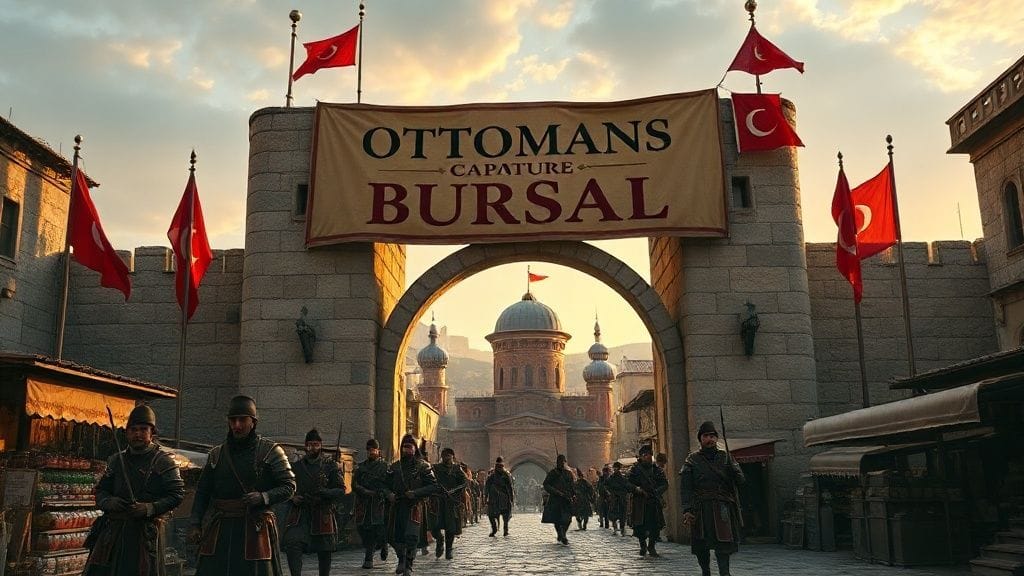
Table of Contents
- The Dawn of a New Power: The Capture of Bursa
- Anatolia in Turmoil: The Aftermath of the Seljuk Decline
- Osman I: The Visionary Leader Forging a Dynasty
- Bursa on the Brink: The City Between Two Worlds
- The Siege Begins: Strategies and Struggles
- Inside the Ancient Walls: Life Amidst Siege
- The Final Assault: Turning Point in 1326
- The Fall of Bursa: A New Ottoman Capital is Born
- Immediate Repercussions across Anatolia and Beyond
- The Silk Road and Bursa’s Economic Transformation
- Cultural Renaissance under Ottoman Rule
- The Strategic Importance of Bursa in Regional Politics
- Foundations of Empire: Bursa as the Ottoman Launchpad
- Religious and Social Shifts Post-Conquest
- The Legacy of Bursa’s Capture: From Fortress to Metropolis
- How the Capture of Bursa Redefined Anatolian History
- Memory and Myth: Bursa in Ottoman and Turkish Imagination
- Conclusion: The Seed of Empire Sown in the Shadows of 1326
- FAQs about the Capture of Bursa
- External Resource
- Internal Link
1. The Dawn of a New Power: The Capture of Bursa
In the sweltering summer of 1326, as the sun rose over the undulating hills of northwestern Anatolia, a seismic shift was unfolding behind the stout walls of Bursa. The air was thick with anticipation and the clangor of weapons. Soldiers, hardened by years of conflict and hope alike, prepared for a final, fateful push that would not only seize a city but signal the birth of a new empire.
Bursa, an ancient city with a history stretching back to Roman and Byzantine times, was no stranger to sieges or conquests—but the arrival of the Ottomans, led by Osman I’s son Orhan, would transform its very soul. It was a turning point as much symbolic as strategic, marking the Ottomans' first major foothold in Anatolia and setting the stage for centuries of imperial power.
2. Anatolia in Turmoil: The Aftermath of the Seljuk Decline
The early 14th century was a period of fragmentation and uncertainty in Anatolia. The once-mighty Seljuk Sultanate of Rum, which had been the dominant Muslim power in the region, was now a shadow of itself following a decade of internal strife, external pressures, and Mongol incursions. The political map was fractured into myriad beyliks—small principalities ruled by Turkic lords—each vying for dominance, survival, or alliances.
At the heart of this chaos, the Ottoman principality, a relatively young and small beylik centered around Söğüt, began carving its space. Against a backdrop of Byzantine decline and the lingering menace of Mongol influence, the Ottomans maneuvered skillfully between diplomacy, war, and tribal loyalty. Their roots were humble, and yet their ambitions vast.
3. Osman I: The Visionary Leader Forging a Dynasty
Osman I, whose name would be immortalized in the dynasty that bears his name, was a leader forged in the crucible of tribal conflict and frontier warfare. Although his life is partially veiled in legend, he is credited with uniting disparate Turkic groups and initiating aggressive expansion into Byzantine territory.
His death around 1323-1324 passed the mantle to his son Orhan, a leader both resolute and astute. Orhan had by then already demonstrated strategic competence and a vision that extended beyond mere survival; he sought consolidation and urban conquest.
4. Bursa on the Brink: The City Between Two Worlds
Bursa was more than a fortified city; it was a jewel of economic ambition and cultural crossroads. Located near fertile lands and key trade routes, Bursa had been an important hub under Byzantine control, with walls strengthened through centuries of conflict.
However, the city’s Byzantine governors were struggling to maintain order and defense against the rising Turkish beyliks. Inside its walls, the population was diverse: Greeks, Armenians, Jews, and Turks intermingled, whose loyalties were as complex as the city’s mosaic of streets and markets.
5. The Siege Begins: Strategies and Struggles
The siege of Bursa was no hastily mounted affair. Historical accounts suggest a prolonged campaign that combined tactical encirclement, siege engines, and strategic cuts to supply lines. Orhan understood the importance of patience and psychological warfare, aiming to weaken the Byzantine defenders over months.
Ottoman forces established camps around Bursa, disrupting communication and trade. The defenders, stubborn and well-organized, mounted fierce resistance backed by local militias and mercenaries. Prolonged starvation and turmoil inside the city ensued, while outside, the Ottomans solidified alliances with neighboring Turkic groups.
6. Inside the Ancient Walls: Life Amidst Siege
For the inhabitants trapped within Bursa, the siege was a period of cascading hardship. Food supplies grew scarce; disease thrived in cramped quarters. Yet, there were moments of resilience and hope. Religious leaders and local elites negotiated terms, sought external aid, and maintained networks of information that kept the spirit alive.
These human stories—often lost in grand historical narratives—paint a vivid portrait of a city on the edge, where families hid from arrows and prayed in whispered tones for deliverance or mercy.
7. The Final Assault: Turning Point in 1326
After years of pressure and failed relief attempts by Byzantine forces, the Ottomans launched what would become the decisive assault. The summer of 1326 saw battering rams breaking walls, tunnels undermining fortifications, and close-quarter combat in the narrow streets.
Contemporary chroniclers convey the desperation of defenders and the determination of the Ottomans. The capture was punctuated by moments of chaos and bravery on both sides—heroic last stands, secret betrayals, and the violent assertion of a new order.
8. The Fall of Bursa: A New Ottoman Capital is Born
When the dust settled on Bursa’s shattered gates, it was clear that the city had fallen. Orhan’s leadership was now undisputed, and Bursa was poised to become the first true Ottoman capital—a seat of political power, economic activity, and cultural development.
This transfer was more than administrative; it marked a psychological victory, a statement to rival beyliks and the Byzantine Empire that a new power was rising. Bursa’s capture paved the way for further expansion into Europe and Asia.
9. Immediate Repercussions across Anatolia and Beyond
News of Bursa’s fall sent ripples through the region. Neighboring principalities, fearful of Ottoman ambitions, either sought uneasy alliances or prepared defenses. The Byzantines were shaken, their hold on Asia Minor slipping faster than ever.
The Mongol Ilkhanate, dominant in Persia and influencing Eastern Anatolia, observed cautiously. Bursa’s position allowed Ottomans to control critical trade routes, forcing regional powers to reassess their strategies.
10. The Silk Road and Bursa’s Economic Transformation
Bursa’s location near the Silk Road lent it immense commercial significance. Once under Ottoman control, the city became a thriving center for silk production, textile manufacturing, and trade. The new rulers invested in infrastructure, built caravanserais, and fostered a climate where merchants from all over could flourish.
This economic boom was instrumental in providing the financial backing the Ottomans needed to launch further campaigns.
11. Cultural Renaissance under Ottoman Rule
The capture of Bursa also ignited a cultural flowering. Islamic art, architecture, and scholarship found fertile ground. Orhan and his successors commissioned mosques, schools, and public baths, transforming the city’s skyline. The Green Mosque of Bursa, built later in the 15th century, stands as a testimony to this merging of spiritual aspiration and imperial ambition.
The influx of artisans, scholars, and traders created a vibrant, cosmopolitan society, blending Anatolian, Byzantine, Persian, and Turkic influences.
12. The Strategic Importance of Bursa in Regional Politics
Politically, Bursa served as a lynchpin for Ottoman governance. Its fortifications allowed the Ottomans to project military power deeper into Byzantine lands and rival beyliks. Embassies were established, administrative structures formalized, and Bursa became a model for subsequent Ottoman cities.
This shift from a nomadic to an urban-centered authority was crucial in shaping the empire’s trajectory.
13. Foundations of Empire: Bursa as the Ottoman Launchpad
Historians often call Bursa the “cradle of Ottoman greatness.” It was here that the dynasty began to think of itself as more than warlords or tribal leaders—an empire in the making. From Bursa, the Ottomans expanded into Thrace and beyond, laying the groundwork for the eventual conquest of Constantinople in 1453.
With Bursa as its heart, the Ottoman state evolved a complex bureaucracy, standing armies, and a legal system blending sharia and local customs.
14. Religious and Social Shifts Post-Conquest
The Ottoman conquest altered the religious landscape. Christian communities frequently retained a degree of autonomy under the millet system, while the increasing presence of Islam reshaped public life. This gradual yet profound shift introduced new social dynamics and cultural negotiations between groups.
Religious scholars and Sufi orders gained prominence, spreading Ottoman ideologies and legitimizing the new rulers.
15. The Legacy of Bursa’s Capture: From Fortress to Metropolis
Over the centuries, Bursa blossomed from a war-torn fortress to a bustling metropolis. Its capture was a foundational myth, celebrated in Ottoman chronicles and Turkish historiography. The city remained a symbol of the dynasty’s origins and persistence, a reminder of the audacity required to found an empire amidst uncertainty and conflict.
16. How the Capture of Bursa Redefined Anatolian History
Looking back, the fall of Bursa was a watershed. It marked a shift from fragmented Turkic beyliks and Byzantine control toward a centralized Ottoman authority that would dominate the region for centuries. Anatolia was no longer a patchwork of competing principalities but the birthplace of one of history’s most enduring empires.
17. Memory and Myth: Bursa in Ottoman and Turkish Imagination
In Ottoman memory, Bursa’s capture became shrouded in tales of divine favor and heroic virtue. It was portrayed not merely as a military conquest but as a destined ascension. Modern Turkey continues to honor Bursa as a historical jewel, hosting festivals, museums, and academic research that bring these medieval moments to life.
18. Conclusion: The Seed of Empire Sown in the Shadows of 1326
The capture of Bursa was far more than an episode of conquest; it was the moment when the Ottoman dream dared take shape. From battered walls and starved defenders rose a new order, one that would connect continents and centuries.
Bursa stands as a testament to resilience, vision, and the sometimes unpredictable forces that birth empires. It reminds us that in history, moments of siege and struggle can ignite possibilities far beyond themselves—witness to human ambition writ large across the ages.
Conclusion
The siege and capture of Bursa in 1326 was a turning point not only in Ottoman history but in the broader narrative of Anatolia and the medieval world. Emerging from the ruins of once-powerful empires fragmented by war and political infighting, the Ottomans demonstrated an ability to blend military prowess, political savvy, and cultural innovation.
Bursa became not just a city in the empire but its heart and soul, a place where the seeds of empire were sown and nurtured. Studying this event lets us glimpse the complex interplay of conquest, culture, and human endurance that shapes our past—and deepens our understanding of how empires begin, grow, and leave their mark forever.
FAQs about the Capture of Bursa
Q1: Why was Bursa so important to the Ottomans?
A1: Bursa’s geographical location near key trade routes and fertile lands made it economically and strategically vital. Capturing it allowed the Ottomans to control the region and establish a stable base for further expansion.
Q2: Who led the Ottoman forces during the siege?
A2: Orhan, son of Osman I, was the key figure leading the siege and subsequent capture of Bursa. His leadership marked the transition from a tribal beylik to a centralized state.
Q3: How did the fall of Bursa affect the Byzantine Empire?
A3: Ankara’s fall weakened Byzantine control in Anatolia, accelerating the empire’s decline and limiting its influence in the region.
Q4: What role did the local population play during the siege?
A4: Civilians endured immense hardship but maintained social and religious institutions. Some groups negotiated to survive or sided with the Ottomans, reflecting complex loyalties.
Q5: How did Bursa’s capture influence Ottoman administrative development?
A5: Bursa became the administrative center, setting precedents for governance, military organization, and urban development throughout the empire.
Q6: Were there any significant cultural changes following the conquest?
A6: Yes, Bursa saw the introduction of Islamic arts, architecture, and education institutions, blending with local traditions to create a vibrant cultural milieu.
Q7: Did the Ottoman capture of Bursa impact trade in the region?
A7: Absolutely. The Ottomans enhanced trade infrastructure, making Bursa a key Silk Road hub, boosting the empire’s economic power.
Q8: Is Bursa still significant today?
A8: Bursa remains historically and culturally important, attracting scholars, tourists, and serving as a symbol of early Ottoman heritage.

