Table of Contents
- A City Between Bells and Gunfire: Ghent on the Eve of 1576
- From Burgundian Splendor to Habsburg Rule: The Long Road to Revolt
- Faith, Fire, and Taxation: How Religion and Money Tore the Low Countries Apart
- The Duke of Alba and the Council of Blood: Terror as Policy
- The Spanish Fury at Antwerp and the Shock That Shook Europe
- All Eyes on Ghent: Delegates Converge on a Torn Netherlands
- Negotiating the Impossible: Inside the Halls Where the Pacification Was Forged
- The Articles of Hope: What the Pacification of Ghent Actually Said
- William of Orange and the Dream of a United Netherlands
- Jubilant Streets, Quiet Doubts: Popular Reactions Across the Provinces
- Between Cross and Chalice: Religion Under the Pacification’s Fragile Umbrella
- Spain Responds: Philip II, Don Juan of Austria, and the Struggle to Reverse the Pact
- Cracks in the Unity: From Joyful Union to Distrust and Civil Strife
- From Ghent to Utrecht and Arras: How the Pacification Shaped Later Unions
- Merchants, Artisans, and Soldiers: Ordinary Lives in the Shadow of the Pacification
- Europe Watches: Diplomats, Pamphleteers, and the Image of Rebellion
- A Half‑Remembered Turning Point: Historians Debate the Legacy of Ghent
- Conclusion
- FAQs
- External Resource
- Internal Link
Article Summary: On 8 November 1576, in the embattled city of Ghent, representatives of nearly all the provinces of the Low Countries signed what became known as the pacification of ghent, a desperate attempt to weld together a fractured land against Spanish rule. This article follows the story from the long roots of Burgundian and Habsburg domination through the firestorms of religious conflict and fiscal oppression that made such a pact both necessary and nearly impossible. It recreates the tense days of negotiation, the clamor of the streets, and the quiet calculations of leaders like William of Orange who saw in the pacification of ghent a fleeting chance to rescue unity from civil war. Yet behind the trumpets and proclamations, we trace the contradictions baked into the agreement—especially its uneasy handling of religion—that would soon tear it apart. The narrative then follows the reaction from Madrid and the brutal efforts of Philip II’s commanders to undo the settlement by force and intrigue. Across the story, the pacification of ghent emerges less as a final peace than as a hinge moment that pointed toward both the later Dutch Republic and the split with the southern, largely Catholic provinces. By weaving political analysis with human detail, this article shows how the pacification of ghent was experienced not only by princes and generals but also by merchants, artisans, and soldiers whose lives pivoted on its promises. In closing, we consider why the pacification of ghent, though fragile and short‑lived, still stands as a landmark in the history of revolt, compromise, and the search for coexistence.
A City Between Bells and Gunfire: Ghent on the Eve of 1576
On a damp November morning in 1576, Ghent did not look like the cradle of a new political order. Smoke from chimneys hung low over the canals, mingling with the grimmer fumes of hastily forged weapons and burnt-out warehouses. The city bells, which once rang for saints’ days and trade fairs, now tolled mostly for alarms and funerals. Rumors moved faster than the Scheldt’s waters: mutinous Spanish troops had ravaged Mechelen; Zutphen was a charnel house; and in Antwerp, the “Spanish Fury” had drenched one of Europe’s richest cities in blood.
And yet, inside the imposing guildhalls and townhouses of Ghent, men talked not of surrender but of agreement. Representatives from the provinces—Holland and Zeeland in the north, Brabant and Flanders in the commercial heartland, Hainaut and Artois from the francophone south—arrived by horse, by boat, and on aching feet. They came under different banners, speaking different tongues, holding different interpretations of the same God. Some were dyed‑in‑the‑wool Catholics fearful of heresy above all. Others were committed Protestants, Calvinists fired by psalms and sermons, who had already tasted exile and loss.
Yet they were bound by shared exhaustion and outrage. Spanish soldiers, long unpaid, had turned their discipline into extortion; their king, Philip II, ruled from distant Madrid, issuing edicts that seemed to ignore the local rights and customs—the “liberties”—on which Netherlandish elites prided themselves. Above all, the sack of Antwerp on 4 November 1576 shocked even those who had remained loyal to Spain. Within days, as one Belgian historian later observed, “the horror of the Spanish Fury accomplished what years of Protestant preaching had not: it made unity not a dream but a necessity.”
Into this cauldron stepped Ghent, a city with its own long history of revolt against princes. It was no accident that the pacification of ghent took shape here. Ghent’s rich weavers and stubborn magistrates had clashed with Burgundian dukes in the fifteenth century, and in the sixteenth it remained fiercely jealous of its privileges. As envoys argued late into the night, candles guttering in smoky air, the past weighed on them. They were not just negotiating an end to mutinies; they were deciding what it meant to be “Netherlandish” in an age when religion, loyalty, and identity no longer ran in straight lines.
The days were punctuated by the sounds of life that refused to yield to war: market women bargaining over fish, apprentices shouting in workshops, children chasing each other along narrow streets. But even those everyday noises carried an edge. One wrong word, one stray rumor of Spanish spies, and a street scuffle could erupt into a riot. It’s astonishing, isn’t it, how much history can hinge on whether men behind shuttered windows manage to keep talking just a little longer than they shout?
From Burgundian Splendor to Habsburg Rule: The Long Road to Revolt
To understand why the gathering at Ghent in 1576 mattered so deeply, one has to step back a century to the age when the Low Countries were stitched together by the Burgundian dukes. In the fifteenth century, the duchy of Burgundy extended from Dijon to the North Sea, a patchwork quilt of territories, languages, and laws. The Burgundian court, especially under Philip the Good and Charles the Bold, dazzled contemporaries with its feasts, tournaments, and patronage of the arts. Towns like Bruges, Ghent, and later Antwerp flourished as hubs of European trade, where Italian bankers met English wool merchants and German metal dealers.
But unity under the Burgundians was always precarious. The “Netherlands” were not a single state but a collection of counties and duchies—Flanders, Brabant, Holland, Zeeland, Hainaut, and more—each with its own estates, charters, and stubborn sense of autonomy. The princes’ power rested on constant negotiation with provincial elites. When Charles the Bold died at Nancy in 1477, his only heir, Mary of Burgundy, had to grant the Great Privilege to her subjects, reaffirming many local liberties. The message was clear: rule here was possible only through consent, however grudging.
Mary’s marriage to Maximilian of Habsburg brought the Low Countries into the orbit of one of Europe’s most ambitious dynasties. Their grandson, Charles V, born in Ghent in 1500, would inherit an empire on which the sun increasingly did not set—from Spain and its American possessions to the Holy Roman Empire and the Netherlands. Charles understood the Netherlands intimately; he spoke their languages and knew their elites. Yet his policies still pushed toward greater centralization. New councils, new taxes, and a more assertive royal presence began to unsettle the balance between local privilege and princely authority.
When Charles abdicated in 1555 in the great hall of the Coudenberg Palace in Brussels, passing the Netherlands to his son Philip II, some wept openly. The old emperor, frail and gout‑ridden, cast his departure as the end of an era. Many in the assembled estates saw in the serious, Spanish‑raised Philip a less flexible ruler. They were not wrong. Philip brought with him not only a devout Catholicism but also a governing style shaped by the Spanish monarchy’s growing bureaucracy and the logic of imperial war against France and the Ottoman Empire.
Under Philip, pressure for funds to maintain armies and navies increased. So did the drive to enforce religious uniformity in the face of Protestant “heresy.” These twin demands—money and obedience—were at the core of the later crisis. The broad arc from Burgundian experiment to Habsburg empire had given the Low Countries prosperity and a place at the center of European commerce. But it had also sown the seeds of conflict: a proud, wealthy region accustomed to negotiated autonomy now found itself squeezed between imperial ambition and confessional discipline. The pacification of ghent would be, in many ways, the last great attempt to restore an older balance under radically changed circumstances.
Faith, Fire, and Taxation: How Religion and Money Tore the Low Countries Apart
The Reformation reached the Low Countries early and in varied forms. Luther’s writings circulated in the 1520s, but it was the more radical currents—Anabaptism and, later, Calvinism—that frightened authorities most. In cities like Antwerp, Ghent, and Amsterdam, new preachers found eager audiences among artisans, merchants, and, in some regions, parts of the nobility. Secret gatherings in fields—the famous hagepreken, or hedge sermons—drew thousands, armed not only with psalm books but sometimes with pikes and muskets.
For the Habsburg rulers, this was more than a religious problem; it was a political one. Heresy appeared to threaten not just souls but order itself. Charles V and Philip II both issued placards—harsh edicts prescribing death for obstinate heretics. The Inquisition, never as omnipresent in the Netherlands as legend sometimes has it, nonetheless weighed heavily on the imagination. Stories, some true, some embellished, of men and women burned or drowned for their beliefs spread unease and anger.
At the same time, new taxes stirred resentment across confessional lines. The Netherlands were wealthy, but their wealth was fragile, dependent on trade routes, stable credit, and confidence. In the 1540s and 1550s, wars against France and the Ottoman Empire devoured resources. Charles V resorted to the beden—extraordinary subsidies negotiated with provincial estates—but the requests grew ever more frequent. In 1569, the Duke of Alba, acting for Philip II, would attempt to impose permanent taxes—most infamously the “tenth penny,” a 10 percent tax on sales—that threatened to upend commercial life.
Religion and money combined explosively in the iconoclastic riots of 1566, known as the Beeldenstorm. That summer, following bad harvests and amid rumors of looming crackdowns, Protestant crowds attacked Catholic churches and monasteries, smashing statues, tearing down altarpieces, and defacing images of saints and the Virgin Mary. To devout Catholics, this was sacrilege; to many Protestants, it was the purging of idolatry. To Philip II, it was rebellion.
Even among those who did not condone the violence, there was sympathy for its deeper grievances. A petitioning movement—the “Compromise of the Nobles”—had already called for moderation of the anti‑heresy laws. When Margaret of Parma, the regent, appeared to hesitate, local magistrates in some cities took matters into their own hands, tolerating Protestant preaching. The authority of the crown was visibly weakening. “Our country,” a contemporary Catholic observer wrote, “is like a ship whose captain quarrels with the crew just as the waves begin to rise.” It was into this storm that Philip II would send his most feared servant.
The Duke of Alba and the Council of Blood: Terror as Policy
Fernando Álvarez de Toledo, Duke of Alba, arrived in the Netherlands in 1567 at the head of a veteran army. He was, in many ways, the embodiment of the militant Catholic monarchy Philip II aspired to uphold: a hard, experienced commander, proud of his loyalty and his record in battle. For many Netherlanders, his presence signaled the end of any hope for compromise.
Alba’s brief was unforgiving. He was to restore royal authority, punish those responsible for the 1566 disorders, and ensure the enforcement of religious edicts. Almost immediately, he established the Council of Troubles, which locals quickly dubbed the “Council of Blood.” It summoned hundreds of nobles, magistrates, and citizens to answer for their alleged complicity in rebellion or heresy. Sentences of exile, confiscation, and death followed. The executions of Counts Egmont and Hoorn—respected Catholic nobles who had nonetheless opposed some royal policies—sent shockwaves through the aristocracy.
Terror, however, did not restore stability; it deepened resistance. William of Nassau, Prince of Orange, had already gone into exile in Germany rather than submit to Alba. From there he launched a series of military campaigns, sometimes successful, often ragged, but gradually giving shape to a more organized revolt, especially in the northern provinces. Alba’s attempt to finance his occupation through permanent taxes further alienated merchants and town councils. Antwerp’s traders protested; Holland’s and Zeeland’s estates pushed back. Even some Catholic elites, who had no love for Calvinism, began to fear that obedience to Philip II meant the destruction of their traditional liberties and fortunes.
Alba’s regime marked a turning point. Violence became more systematic on both sides. The Spanish and their German mercenaries sacked towns; rebels resorted to guerrilla tactics, piracy, and the forcible imposition of Calvinist regimes where they gained control. “In those years,” a later chronicler wrote, “one could scarcely tell whether it was the king who had driven his people to despair or the people who had driven their king to fury.” The pacification of ghent would inherit the bitter legacies of Alba’s rule: hardened confessional identities, mutual fear, and a landscape scarred by firing squads and gallows.
The Spanish Fury at Antwerp and the Shock That Shook Europe
By the mid‑1570s, the Spanish monarchy was straining under its own enormous commitments. Wars against the Ottoman Empire in the Mediterranean and against Protestant powers elsewhere, combined with the costs of occupying the Netherlands, pushed royal finances to the brink. Even silver from the Americas could not plug the gaps forever. In 1575, Philip II declared bankruptcy, suspending payments to many of his creditors. The consequences rippled across the empire.
In the Netherlands, the most immediate impact was on the army. Spanish troops, many of them veterans of decades of campaigning, had already endured irregular pay. Discipline eroded. Garrison towns heard the ominous word mutiny whispered more and more often. Mutinous units did not simply lay down their arms; they seized towns, extorted ransoms, and lived off the land. Local populations, already angry at the presence of foreign soldiers, now faced organized looting.
The worst of these outbreaks erupted in Antwerp in November 1576. There, unpaid troops—Spanish, Italian, and Walloon—turned on the city after quarrels over arrears. For three days, they looted, burned, and killed. Contemporary estimates of the dead ranged from 7,000 to 10,000. The city’s famed bourse, heart of European finance, was ravaged; warehouses and homes burned, their goods carried off or destroyed. Flames lit the night sky, and the cathedral’s spire loomed over streets running with blood and wine.
News of the “Spanish Fury” spread with terrifying speed. Merchants in London, Hamburg, and Venice recalculated risks; some closed their accounts with Antwerp entirely. The psychological impact on the Netherlands’ elites was profound. Even loyal Catholics were horrified. If such chaos could be unleashed on Antwerp, whose loyalty mattered? “This was not punishment,” one Brabantine noble wrote bitterly, “but a beast’s rage, which devours friend and foe alike.”
It was in direct response to this cataclysm that the provincial estates summoned emergency meetings. In Brussels, the States General convened without the governor’s prior approval, a bold move that signaled a shift in sovereignty. Across the provinces, the cry went up: the foreign troops must leave. The sack of Antwerp did what sermons, pamphlets, and earlier rebellions had not fully achieved—it brought together, for a crucial moment, Catholic moderates and Protestant rebels in common cause. The pacification of ghent would be born out of this shared horror and the urgent need to impose some order on a situation that threatened to dissolve into anarchy.
All Eyes on Ghent: Delegates Converge on a Torn Netherlands
In the weeks after Antwerp’s devastation, carts overloaded with refugees trundled along the roads. They carried what little they could save—bales of cloth, ledgers, family portraits, sometimes just a chest of linens and a Bible. Many headed toward other major cities: Brussels, Ghent, Bruges. These cities were not safe, exactly, but they were not yet smoldering ruins. In Ghent, the mood was taut. City leaders juggled their own fears of unrest with the knowledge that the future of the whole region might soon be debated in their streets.
Why Ghent? Strategically, it sat in Flanders, one of the wealthiest and most densely urbanized provinces. Symbolically, it harked back to an older tradition of urban autonomy and resistance. To assemble there was to claim that provincial estates and cities, not foreign armies, would decide the country’s fate. By early November, envoys from nearly all the seventeen provinces of the Habsburg Netherlands had arrived or were en route. Only Luxemburg, remote and more closely tied to the empire’s German side, would ultimately abstain.
The delegates varied widely: landed nobles in fine cloaks, urban magistrates in sober black, clerics in cassocks, lawyers carrying thick portfolios of documents. Behind them trailed secretaries, servants, guards. Lodgings were tight; the city’s inns overflowed. Some envoys stayed with sympathizers; others rented rooms from families who eyed their new tenants with a mix of curiosity and hope. Every evening, taverns filled with murmurs: Would the prince of Orange’s men try to dominate the talks? Would Catholic hardliners sabotage any agreement that seemed to favor heretics?
William of Orange himself did not immediately stride into Ghent as a triumphant savior. He was operating primarily from the north, where his support was strongest, especially in Holland and Zeeland. There, his followers had already embraced a broadly Calvinist regime, using the prince’s name as a banner. However, Orange’s envoys and allies in Ghent made his presence felt. They carried letters outlining his demands and his vision of a Netherlands united first against Spanish troops, with religious questions to be settled more cautiously.
Not everyone trusted him. Some Catholic nobles suspected that Orange saw the crisis as an opportunity to spread Protestantism throughout the Low Countries. On the other hand, radical Calvinists, hardened by years of persecution, feared that any compromise would sacrifice their gains on the altar of political expedience. Between these poles lay a broad swath of moderates—both Catholic and Protestant—whose overriding priority was to end the chaos. It was in this uneasy triangle that the pacification of ghent would take shape.
Negotiating the Impossible: Inside the Halls Where the Pacification Was Forged
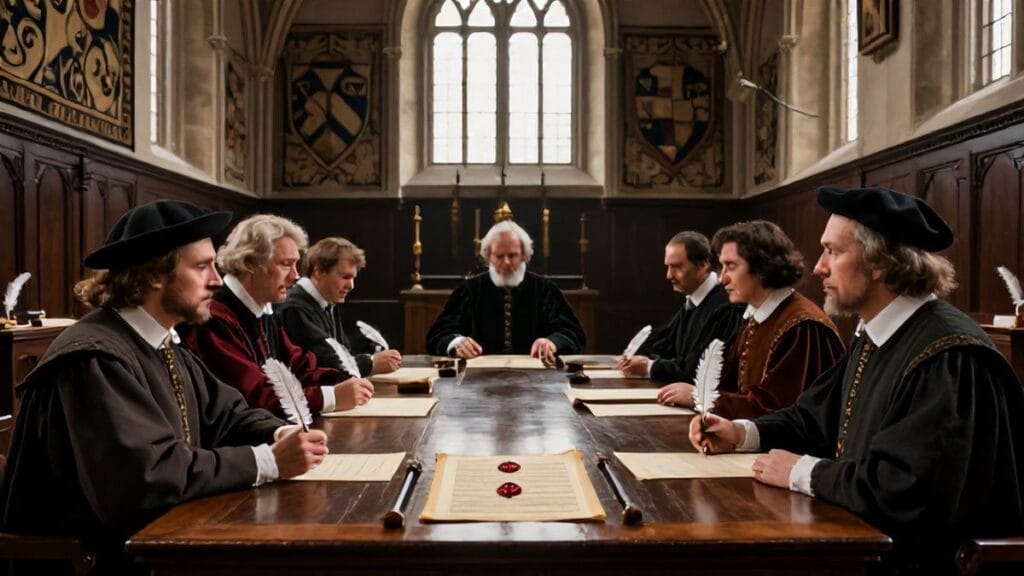
Negotiations began in earnest in early November 1576. Delegates met in large council chambers where the cold crept up from stone floors despite braziers and roaring fireplaces. They also gathered in smaller side rooms, where the real bargaining often took place over cups of wine or jugs of beer. Outside, soldiers paced, their breath visible in the chill air; inside, quills scratched across parchment as scribes tried to keep pace with speeches and amendments.
The central challenge was stark: how to craft a common front against Spanish forces when the provinces disagreed so deeply about religion and the ultimate relationship with the king. Some delegates wanted outright independence; others insisted that they were loyal vassals seeking only redress of abuses. A few clung to the hope that Philip II, properly informed, would dismiss the worst of his advisers and restore a more lenient, Charles‑like rule. As one contemporary pamphleteer, sympathetic to the estates, wrote, “We do not wish to throw off the yoke of our lawful prince, but the chains of his unjust ministers.”
Drafts of the agreement circulated, corrections in cramped marginal script. Arguments rose over wording: should they demand the immediate withdrawal of all foreign troops, or only Spanish ones? Could they insist that William of Orange be recognized as the king’s lieutenant in Holland and Zeeland without admitting that those provinces had already slipped partly beyond royal control? Most contentious of all: what to say about religion. The northern provinces, especially Holland and Zeeland, had installed Calvinism as the dominant faith and suppressed public Catholic worship in many towns. The southern provinces remained overwhelmingly Catholic and feared the spread of “heresy” under the cover of political unity.
There were moments when it seemed the entire enterprise would collapse. Tempers flared. One delegate reportedly slammed his fist on the table, shouting that he would sooner see his province “burned like Troy” than surrender the true faith. Another replied that no mass or procession could be worth the lives being lost daily to marauding troops. Behind these public clashes, mediators worked tirelessly. Men like Philip Marnix of Saint‑Aldegonde, a close ally of Orange, and more moderate Catholic nobles tried to find formulations that could be read differently in different places—deliberately ambiguous, yet binding enough to hold.
But this was only the beginning of the drama. The States General, which had convened in Brussels, also had to be brought on board. Their delegates in Ghent were in constant correspondence with colleagues back in the capital. Every new clause risked offending some interest: merchants, guilds, clergy, urban councils, rural nobility. Fear lent urgency, though. Each new rumor of troop movements, each report of another town threatened, reminded the negotiators that delay might mean ruin.
In the end, necessity forged what pure conviction could not. On 8 November 1576, the provinces present agreed to a text that came to be known as the pacification of ghent. It was not a perfect document—far from it—but it was the best that men hemmed in by war, religious division, and imperial pressure believed they could achieve. Outside, church bells rang, this time in something closer to celebration than alarm. For a brief moment, hope and fear were held in precarious balance.
The Articles of Hope: What the Pacification of Ghent Actually Said
The pacification of ghent was not a single‑minded declaration of independence, nor a neat blueprint for a new state. It was a dense, carefully hedged political pact, composed of multiple articles that tried to reconcile competing demands. At its core lay a few key principles.
First and foremost, the provinces agreed to unite in demanding the withdrawal of Spanish and other foreign troops. This was the immediate trigger for their unity: the shock of the mutinies and the sack of Antwerp. The pacification stipulated that the States General would assume responsibility for maintaining order until such time as the king, presumably chastened, could govern through more acceptable means. This was, implicitly, a claim that sovereignty in the Netherlands resided not solely in the monarch but also in the representative bodies of the provinces.
Second, the pact reaffirmed the traditional “liberties” of the provinces. These were not abstract ideals but concrete privileges: the right of provincial estates to consent to taxation, the maintenance of local laws and customs, the autonomy of towns in regulating their internal affairs. By invoking these, the pacification linked the current crisis to a longer history of resistance to overreaching princes. It cast the union not as a revolution but as a restoration.
Third, and most delicately, came the question of religion. Here the text walked a tightrope. In most provinces, the Catholic faith was confirmed as the official religion. The placards against heresy, however, were to be suspended, at least temporarily. In Holland and Zeeland, where Calvinism had entrenched itself under Orange’s protection, the existing religious arrangements were to be tolerated until a general settlement could be reached by the States General or a future national assembly. This was an intentional ambiguity: it did not grant full religious freedom, but it halted official persecution and tacitly accepted de facto Protestant strongholds.
Fourth, William of Orange was recognized in his authority in Holland and Zeeland, and prisoners taken in the course of the conflict were to be released. Acts of hostility between provinces were to cease, and joint efforts would be made to suppress banditry and restore commercial confidence. In short, the pacification of ghent sought to transform a patchwork of separate, sometimes warring jurisdictions into a coordinated front—if not yet a single state, then at least a coalition.
Yet behind the solid language lurked fragility. The settlement’s religious compromise pleased few zealots on either side. Catholic clergy worried that suspending the anti‑heresy laws would allow Protestantism to spread unchecked. Radicals among the Calvinists grumbled that the agreement left the “idolatrous mass” in place across most of the country. Moreover, Philip II had not agreed to any of this; his consent was assumed or hoped for, not secured. The pacification was, in many respects, an act of collective self‑assertion dressed in the garments of loyal reform.
Nonetheless, on that November day, as copies of the agreement were dispatched to cities and towns, there was a tangible sense of relief. For merchants crippled by insecurity, it promised safer roads and ports. For towns terrorized by mutinous garrisons, it held out the prospect of demilitarization. For ordinary believers of various stripes, it opened, at least briefly, a space in which one might worship without the constant specter of denunciation or sudden arrest.
William of Orange and the Dream of a United Netherlands
No figure is more closely associated with the revolt of the Netherlands than William of Nassau, Prince of Orange. Born into a German noble family and educated partly at the Habsburg court, William began his career as a loyal servant of Charles V and then Philip II. He held high offices, commanded armies, and moved comfortably in aristocratic circles. The path from royal favorite to leader of rebellion was neither simple nor inevitable.
William’s religious journey mirrored the complexities of the age. Raised a Lutheran, he conformed outwardly to Catholicism while serving the Habsburgs, then moved gradually back toward Protestantism, eventually embracing Calvinism more explicitly. His opponents labeled him a turncoat; his supporters saw in him a pragmatic statesman willing to bridge divides. What is clear is that William envisioned a Netherlands where political unity could coexist with a degree of religious pluralism—an idea still radical in the 1570s.
The pacification of ghent fit closely with this vision. Though he was not physically present at the signing, William’s correspondence and envoys significantly shaped its provisions, especially those granting Holland and Zeeland their special status. For him, the priority was to remove Spanish troops and to secure recognition of a political structure that gave the provinces and their estates real power. Religious questions, he believed, should be settled gradually, with a bias toward toleration to prevent a descent into sectarian civil war.
Yet William’s dream was beset by mistrust. Many southern Catholics suspected him of wanting to impose Calvinism everywhere. Some northern Protestants, conversely, worried that his commitment to unity would lead him to sacrifice their newly won ecclesiastical reforms. In private, William fretted about these cross‑pressures. As a later chronicler paraphrased his letters, “He desired a country in which neither king nor preacher should command the conscience of men, but both sides, jealous of their truth, clung to the sword.”
In the months following the pacification, William worked tirelessly to shore it up. He recognized that the agreement was less a finished product than a framework needing constant political labor. Through pamphlets, speeches, and diplomatic missions, he tried to persuade both foreign powers—like England and France—and domestic skeptics that the Netherlands were not falling into anarchy but seeking a just peace. His efforts would have mixed results. Nevertheless, without his persistent advocacy, the fragile edifice erected at Ghent might have crumbled even sooner.
Jubilant Streets, Quiet Doubts: Popular Reactions Across the Provinces
When word of the pacification of ghent reached the cities and towns of the Netherlands, reactions varied from jubilation to guarded skepticism. In Ghent itself, church bells pealed and processions wound through the streets. Citizens, long anxious about the presence of mutinous troops nearby, dared to hope for calmer days. Guild flags fluttered from windows; taverns did brisk business as men toasted “our liberties” and cursed the “Furies” that had ravaged Antwerp.
In Antwerp, the mood was more somber. Survivors of the Spanish Fury sifted through ruins and counted their losses. News of the pacification brought a measure of consolation, particularly the demand for troop withdrawal. Yet for many, the agreement had come too late. What good was a pledge of unity when loved ones were dead and fortunes destroyed? Some merchants quietly explored moving their businesses to safer cities—Amsterdam, perhaps, or even London—anticipating that Antwerp’s days as Europe’s premier entrepôt might never fully return.
In the more rural provinces—Friesland, Groningen, parts of Hainaut—the impact was slower to register. Peasants had borne the brunt of foraging armies and disrupted markets. To them, promises made in distant council halls were only as good as the soldiers’ behavior on the ground. Still, when mutinous troops began to withdraw from certain garrisons under the pacification’s terms, there was genuine relief. Harvests that had risked being trampled or requisitioned could be brought in, if the weather cooperated.
Religious minorities reacted with a mixture of hope and caution. Calvinists in the south saw in the suspension of the placards a chance to worship more openly, though many still preferred semi‑clandestine gatherings to avoid provoking Catholic neighbors. Anabaptists, persecuted by both Catholic and Protestant authorities, read the news with particular skepticism. They had little reason to trust any government and often chose to keep their communities as inconspicuous as possible, regardless of official decrees.
Among the urban poor, whose lives were precarious in the best of times, the pacification was both blessing and abstraction. If peace brought work—on the docks, in the looms, in the shipyards—they welcomed it. If it proved merely a pause before the next round of fighting, their loyalties would be shaped less by high politics than by who fed them and who threatened them. Unrest did not simply vanish. In cities like Ghent and Brussels, radical groups remained capable of turning economic grievances into political tumult, sometimes in the name of religion, sometimes in the name of the “common man.”
Yet behind the celebrations and the doubts lay a real, if fragile, sense that something new had been attempted. The pacification was the first time such a broad coalition of Netherlandish provinces had formally articulated common demands in the face of royal power. For ordinary people, even if they could not recite its articles, that shift in who spoke for them—the estates, not just the king’s governors—carried a quiet, potent significance.
Between Cross and Chalice: Religion Under the Pacification’s Fragile Umbrella
Religion remained the unquiet heart of the entire crisis. The pacification of ghent, by design, did not resolve it. Instead, it attempted to cordon off the religious question, to postpone definitive decisions while addressing the more immediate political and military emergencies. In real life, of course, faith could not be so neatly bracketed.
In Catholic‑majority provinces like Brabant, Flanders, and Hainaut, the Church’s public life continued largely as before. Masses were said, processions held, monasteries maintained their routines. Yet beneath the surface, the Church’s authority was less secure. The suspension of the heresy laws, even if only partially enforced, meant that Protestant communities could breathe more easily. Secret gatherings were now semi‑tolerated in some areas, much to the consternation of zealous clergy. Some parish priests complained that their flocks were being led astray by itinerant preachers, while bishops worried about the erosion of their jurisdiction.
In Holland and Zeeland, where Calvinist regimes had taken hold, the situation was reversed. Catholic worship, in many cities, retreated into hidden chapels or private homes. The new Reformed consistories organized public services, disciplined their members, and sought to reshape civic life along more godly lines. Yet even there, the pacification’s insistence on a broader political unity forced Calvinist leaders to temper some of their ambitions, at least for a time. They needed the southern Catholic provinces to remain in the common front against Spain.
The result was an uneasy, asymmetrical toleration. Officially, public Catholicism predominated in most of the country, with pockets of tolerated Protestantism; unofficially, both confessions jockeyed for influence, using the slightly more relaxed environment to consolidate communities, print catechisms, and train clergy. “We live,” wrote one Antwerp Catholic in a letter quoted by a modern historian, “in a time when God seems to test us by placing truth and error side by side in the same streets.”
Interconfessional relations varied from town to town. In some places, neighbors of different faiths maintained civil, even friendly, relations, bound together by trade, kinship, and shared memories of older conflicts—such as urban revolts against Burgundian tax collectors—that had nothing to do with doctrine. In others, especially where recent violence had been intense, suspicion ran deep. Sermons fanned fears: Catholics warned of the “Genevan plague,” while Protestants denounced the “Babel of Rome.”
The pacification’s religious compromise was thus a kind of armistice line, not a peace treaty. It allowed the temporary coexistence of rival confessional projects but provided no clear mechanism for long‑term settlement. Its very vagueness, while useful in 1576, would come back to haunt its architects as radicals on both sides pushed against its limits.
Spain Responds: Philip II, Don Juan of Austria, and the Struggle to Reverse the Pact
News of the pacification of ghent reached Philip II in Madrid through official dispatches and private reports that filtered across the Pyrenees and the sea. To the king, who saw himself as a divinely appointed defender of Catholic orthodoxy and royal authority, the agreement was deeply troubling. It smacked of rebellion: subjects acting collectively without his authorization, suspending his edicts, and effectively seizing control of key aspects of governance.
Philip, however, was not in a position simply to crush the movement by sending another massive army. Spain’s finances were still fragile after the 1575 bankruptcy, and its military obligations stretched from the Mediterranean to the Atlantic. Moreover, the image of Spanish troops as ravagers—etched into European opinion by the Spanish Fury at Antwerp—made further heavy‑handed intervention diplomatically costly. France and England, both rivals and occasional partners, watched closely, ready to exploit any misstep.
Into this delicate situation stepped Don Juan of Austria, Philip’s half‑brother, famed victor of the Battle of Lepanto against the Ottoman fleet in 1571. Appointed governor‑general of the Netherlands in 1576, Don Juan arrived with both military prestige and instructions to try a mixture of conciliation and firmness. His task was to regain control without triggering an all‑out collapse.
Initially, Don Juan seemed willing to accept some elements of the pacification. In February 1577, under the “Perpetual Edict,” he agreed to withdraw Spanish troops and to recognize the pacification’s main political provisions, in exchange for the provinces’ renewed declaration of loyalty to Philip II and their agreement to maintain Catholicism where it was still dominant. This was a tactical move: by outwardly embracing parts of the Netherlands’ own settlement, Don Juan aimed to isolate the more radical rebels and reassert royal influence from within.
The truce, however, was short‑lived. Distrust abounded on both sides. Many Netherlandish leaders suspected that Don Juan’s concessions were temporary and that once he had regrouped, he would seek to dismantle their gains. Some of Don Juan’s own advisers, and certainly hardliners at the Spanish court, urged a tougher line, arguing that any compromise only emboldened rebellion. Skirmishes and intrigues multiplied. William of Orange, skeptical from the start, warned that only sustained unity among the provinces could prevent the Perpetual Edict from becoming a trap.
By late 1577, open conflict resumed. Don Juan seized the citadel of Namur; the States General, increasingly influenced by Orange’s supporters, declared him an enemy. The brief moment when the pacification of ghent and the royal government seemed reconcilable collapsed. Once again, the Netherlands hurtled toward war, with the added complication that now they had experienced, however briefly, a taste of self‑organization and interprovincial solidarity.
Cracks in the Unity: From Joyful Union to Distrust and Civil Strife
The pacification of ghent had always been a house built on fault lines. As the immediate shock of the Spanish Fury faded and new crises emerged, those fault lines widened. The religious question, the distribution of military burdens, and diverging economic interests all conspired to erode the fragile unity.
In the southern provinces, especially in Artois and Hainaut, conservative Catholic elites grew increasingly uneasy. They had joined the pacification primarily to rid themselves of mutinous troops and to restore traditional liberties, not to see Protestantism advance. As Calvinist communities in some mixed cities became more assertive—taking over churches, pushing for broader recognition, sometimes persecuting Catholics in turn—southern nobles and clergy began to fear that the movement that had promised to save their world might instead overturn it.
In the north, radical Calvinists were equally unhappy. They regarded any lingering deference to Catholic structures as a betrayal of the Gospel. In cities like Ghent and Brussels, popular movements sometimes pushed beyond what cautious politicians in the States General desired, expelling priests or seizing church property. Urban militias, once directed primarily against foreign troops, now occasionally clashed with fellow Netherlanders over confessional control.
Economic tensions compounded these disputes. The closure or disruption of trade routes hurt some regions more than others. Merchants in Holland and Zeeland, who benefited from maritime commerce and privateering, could see opportunities even in instability. Landed elites in the south, dependent on stable markets for agricultural products and more directly exposed to Spanish pressure from neighboring territories, had different calculations. They increasingly doubted whether continued union with the more rebellious northern provinces was worth the risks.
By 1579, the divergence had become stark. That year, two key treaties symbolized the unraveling of the pacification’s hopes. In January, several largely Catholic southern provinces signed the Union of Arras, reaffirming loyalty to Philip II and seeking separate negotiations that would preserve their religion and privileges under royal authority. In response, in Utrecht, the northern and more strongly Protestant provinces formalized their own Union of Utrecht, a defensive alliance that over time would evolve into the constitutional foundation of the Dutch Republic.
The pacification of ghent had not caused this split, but it had framed the terms on which it occurred. Its attempt to maintain a single political community with differing religious arrangements proved unsustainable in the face of deepening mistrust and external pressure. Still, even as unity fractured, the memory of the 1576 agreement continued to haunt discussions. Both sides, in later pamphlet wars, would invoke its language of liberties and collective rights, each claiming to be the true heir of its spirit.
From Ghent to Utrecht and Arras: How the Pacification Shaped Later Unions
If the pacification of ghent was a brief experiment, its afterlife was long. The later Unions of Arras and Utrecht did not emerge in a vacuum; they were, in many ways, children of Ghent, inheriting both its aspirations and its failures.
The Union of Arras, concluded in 1579, gathered provinces like Artois, Hainaut, and parts of Flanders and Brabant that favored reconciliation with Philip II. Its signatories emphasized loyalty to the Catholic Church and to the traditional social order. Yet they also demanded respect for provincial privileges and a withdrawal of at least some foreign troops. The very vocabulary they used—liberties, estates, ancient customs—echoed the language of the pacification. Where Ghent had sought to combine these principles with a broader, cross‑confessional unity, Arras narrowed them to a more exclusively Catholic, royalist framework.
The Union of Utrecht, by contrast, drew upon the pacification’s assertion of provincial self‑government to craft a more explicitly anti‑Spanish and increasingly Protestant alliance. Signed initially by Holland, Zeeland, Utrecht, Gelderland, and a few others, it left room for local variations but bound the signatories to mutual defense and cooperative governance. Over time, Utrecht’s Union would acquire constitutional trappings: joint decision‑making on foreign policy and war, common finances for shared military efforts, and mechanisms for resolving disputes. In this institutional creativity, one can see the seeds of a new type of polity, neither a centralized monarchy nor a loose feudal confederation.
Both unions wrestled with religion. Utrecht, especially as Calvinism became more dominant, moved toward a Reformed public church while allowing limited toleration for other faiths, particularly in commercial hubs where diversity was economically advantageous. Arras, leaning into Counter‑Reformation currents, aligned more closely with the Catholic renewal that swept much of Europe in the late sixteenth century, backed by Spanish arms and Jesuit zeal. The common umbrella envisioned at Ghent thus split into two divergent canopies, each offering shelter to different communities.
Historians often debate whether the failure of the pacification made the eventual division of the Netherlands inevitable, or whether a different handling of religion and provincial interests might have preserved a larger, more inclusive polity. One influential modern scholar argues that “Ghent marked the last serious attempt to imagine a Netherlands not yet divided into ‘north’ and ‘south,’ Protestant and Catholic, rebel and royalist.” Whether or not one accepts this verdict, it is clear that later generations, both in the Dutch Republic and in the Spanish‑ruled southern Netherlands, looked back to 1576 as a moment when other paths still seemed possible.
Merchants, Artisans, and Soldiers: Ordinary Lives in the Shadow of the Pacification
High politics, treaties, and princely letters form the backbone of most narratives about the pacification of ghent, but beneath that backbone lay the lives of countless ordinary people who rarely appear by name in chronicles. Their experiences give vital texture to the story.
Consider the Antwerp cloth merchant who survived the Spanish Fury, his warehouse reduced to ashes, his partners scattered. For him, the pacification’s provisions about troop withdrawal and the restoration of order were not abstractions but matters of survival. Without stable roads and secure rivers, his trade could not resume. When he read—or had read aloud to him—the articles promising an end to mutinies and a reassertion of urban authority, he weighed them against the hard reality of empty coffers and trembling apprentices.
In Ghent, a master weaver might have viewed events through a different lens. His guild had long fought for its rights against both princely officers and urban patricians. The arrival of provincial envoys stirred hopes that the guilds’ voices would carry more weight in any new order. Yet he also feared economic downturns that political turmoil could trigger. Was the pacification a gateway to renewed prosperity under more responsive government, or just another stage in a conflict that could ruin his workshop?
Soldiers’ lives were perhaps the most precarious. A Walloon pikeman in Spanish service, months or years behind in pay, might be torn between loyalty to his officers, fear of mutiny’s consequences, and the lure of plunder. The pacification threatened him with disbandment without guaranteed arrears; yet continued mutiny risked branding him a criminal in the eyes of both sides. On the other side, a Dutch rebel marine—one of the Watergeuzen, or “Sea Beggars”—might see the agreement as either a vindication of their cause or an attempt by cautious politicians to rein them in just when victory seemed within reach.
Women’s experiences were equally complex and often overlooked. They ran shops, managed households in the absence of men at war, and sometimes served as informal bankers or smugglers. In besieged towns, they hauled water, tended the wounded, and, in some cases, took up arms on the walls. For them, the promise of pacification meant the prospect of predictability: less fear of sudden violence at the city gates, more stable prices for bread and fuel. Yet social norms and legal structures limited their direct participation in the formal politics that produced the agreement.
Artisans and printers played a quiet but vital role in shaping how the pacification was understood. They produced broadsheets, pamphlets, and illustrated leaflets explaining (or distorting) its terms for a broader public. One surviving woodcut shows allegorical figures of “Liberty” and “Concord” clasping hands over the symbols of different provinces, a visual attempt to make the arcane language of estates and privileges into an accessible story. Through such media, the idea of a shared Netherlandish cause—however contested—began to seep into popular consciousness.
Europe Watches: Diplomats, Pamphleteers, and the Image of Rebellion
The pacification of ghent did not unfold on an isolated stage. Across Europe, courts and cities followed events in the Netherlands with keen interest. For Protestant powers—above all, England and some German principalities—the crisis offered both an ideological cause and a geopolitical opportunity. For Catholic monarchies like France and the Habsburg heartlands, it posed a more delicate puzzle: how to support or oppose elements of the movement without undermining their own authority at home.
Elizabeth I’s England, wary of Spanish power in the Channel and sympathetic to Protestant co‑religionists, watched Ghent with particular attention. English merchants had deep investments in Low Countries trade, especially in cloth. The prospect of a more autonomous, perhaps friendlier Netherlands was attractive, but Elizabeth was cautious. Open support for rebels could provoke war with Spain. Instead, English policy oscillated between covert aid—money, volunteers, the tacit sheltering of privateers—and diplomatic gestures urging moderation all around.
In France, torn by its own brutal wars of religion, reactions were ambivalent. The French crown, under Charles IX and later Henry III, had no desire to see a strong Spanish presence dominate its northern frontier. At the same time, it feared the contagion of rebellion; French Protestants (Huguenots) and Catholics alike watched the Dutch experiment in religious and political compromise with a mixture of hope and dread. Some French Huguenot writers praised the Netherlanders’ courage in resisting tyranny, drawing parallels with their own struggles.
Pamphleteers across the continent seized on the pacification as a touchstone. Some lauded it as a model of estates asserting their ancient rights against royal overreach. Others denounced it as sedition cloaked in legalistic language. In Italian and Spanish circles loyal to Philip II, the agreement was often portrayed as manipulated by heretics and foreign enemies of Spain. In German Protestant lands, it became a symbol of confessional solidarity and resistance.
One contemporary humanist, writing from Cologne, marveled at the scale of the experiment: “In that small corner of the world, where water, wind, and trade have made men bold, they attempt a work that joins the liberty of the ancient republics with the counsel of princes. Whether it shall stand or fall, posterity will judge.” His words, preserved in a later collection of letters, capture both the curiosity and skepticism with which many educated Europeans regarded the unfolding drama.
Diplomatic observers filed reports to their masters that mixed accurate detail with rumor. They noted the text of the pacification, the speeches of key figures, and the mood in major cities. But they also speculated freely about hidden motives, secret clauses, and foreign intrigues. The Netherlands, already a crossroads of trade, became in these years a crossroads of information and disinformation. The image of the revolt, and of the pacification itself, was thus constructed not only in Ghent’s halls but also in the imaginations of distant readers and rulers.
A Half‑Remembered Turning Point: Historians Debate the Legacy of Ghent
In the centuries since 1576, the pacification of ghent has alternately shone brightly and faded into the background of historical memory. In the Dutch Republic of the seventeenth century, it was often cited as a foundational moment, but one overshadowed by the more enduring Union of Utrecht. In the Spanish‑ruled southern Netherlands, later to become Belgium, it was remembered more ambivalently—as both a courageous assertion of liberties and the prelude to a painful division.
Nineteenth‑century nationalist historians, writing in the age when new nation‑states were taking shape across Europe, tended to read the pacification through the lens of their own projects. Dutch historians emphasized it as a stepping stone toward independence and as proof of an early, shared “national” consciousness among the provinces that would form the Netherlands. Belgian historians, seeking to construct a distinct identity separate from both Dutch and French models, sometimes highlighted Ghent as a symbol of a broader, plural Netherlandish past in which “Belgian” territories played a central role.
Twentieth‑century scholarship introduced more nuance. Some historians argued that the pacification was less about modern nationalism and more about defending a composite monarchy’s constitutional balance. They pointed out that many signatories still imagined a future under a Habsburg king, provided he respected their privileges and moderated religious policy. From this perspective, the agreement was a conservative revolution—seeking to restore a perceived earlier harmony rather than to create something entirely new.
Others have stressed the pacification’s importance as an early experiment in managing religious diversity within a single political framework. Long before the Peace of Westphalia (1648) formalized a new European order after the Thirty Years’ War, Ghent’s compromise hinted at the possibility that different confessions might coexist under shared institutions. Its failure, in this reading, underscores the depth of sixteenth‑century confessional passions—but also the courage of those who tried, however imperfectly, to transcend them.
Modern social historians have also turned to the pacification as a window into broader processes: the politicization of urban populations, the role of print in mobilizing opinion, the interplay of economic and religious motives. By examining local records—city council minutes, guild archives, court cases—they have traced how the grand pact filtered down into everyday life. In some towns, the pacification’s language of “liberties” became a rallying cry for artisans seeking greater say in municipal affairs. In others, it remained a distant phrase, overshadowed by immediate concerns like food prices and plague.
Citations to the pacification appear in works as varied as Geoffrey Parker’s studies of the Dutch Revolt and regional monographs on Flemish cities. As Parker notes, “The Pacification of Ghent marked the apex of the Netherlands’ attempt to remain one body under one ruler, yet it also exposed the rifts—in confession, class, and region—that would make that unity so hard to sustain.” That dual legacy—a peak and a fracture—continues to fascinate scholars and to complicate any simple narrative of nation‑building.
Conclusion
The pacification of ghent was born in a moment of crisis, amid burning cities, mutinous soldiers, and shattered certainties. It was, above all, an attempt by the provinces of the Low Countries to seize back some control over their destiny, to reassert ancient liberties in the face of imperial centralization and confessional absolutism. In doing so, it briefly aligned Catholic and Protestant, noble and burgher, northerner and southerner in a common cause, however fragile and conditional.
Its achievements were real but limited. The pacification helped bring about the withdrawal of Spanish troops, restored a measure of order in some regions, and provided a political framework within which the States General could act with unprecedented authority. It also, crucially, carved out a precarious space for religious coexistence, suspending persecution even without fully embracing toleration. For a few years, it held open the possibility of a unified Netherlands that might combine provincial autonomy, estates’ power, and confessional diversity under a reformed Habsburg monarchy.
Yet its contradictions proved too deep. The same religious passions that had fueled resistance to persecution now drove communities apart; the same insistence on provincial and urban liberties that had made unity possible also made it hard to sustain when interests diverged. External pressures—from Madrid’s determination to restore control, from neighboring powers’ opportunism—exploited internal rifts. Out of the wreckage of Ghent’s dream emerged the twin paths of Arras and Utrecht, leading toward a divided Netherlands.
Still, to view the pacification only as a failed prelude is to miss its broader resonance. It stands as a testament to the capacity of societies in turmoil to experiment with new political forms, even under immense strain. Its language of liberties and collective negotiation would echo in later constitutional struggles, not only in the Low Countries but across Europe. Its tentative approach to religious coexistence, though overshadowed by later settlements, anticipated debates that continue in various guises to this day.
Walking today through Ghent’s medieval streets, past guildhalls and churches that have survived wars and revolutions, it is possible to imagine the anxious, hopeful throngs of 1576. They did not know how their story would end; they knew only that in the face of terror and ruin, they could either fracture or attempt, however imperfectly, to stand together. The pacification of ghent was their answer—partial, temporary, but deeply human—to that stark choice. Its legacy lies not in tidy success but in the brave, flawed effort to reconcile liberty, faith, and peace in an age when all three seemed to demand blood.
FAQs
- What was the Pacification of Ghent?
The Pacification of Ghent was a political and military agreement signed on 8 November 1576 by representatives of most of the provinces of the Habsburg Netherlands in the city of Ghent. It united Catholic and Protestant provinces in a common front to expel Spanish and other foreign troops, restore provincial liberties, and suspend harsh anti‑heresy laws, while leaving the ultimate religious settlement and relationship with King Philip II deliberately ambiguous. - Why did the provinces agree to the Pacification?
The immediate trigger was the “Spanish Fury” at Antwerp and other mutinies by unpaid Spanish troops, which horrified even loyal Catholics and devastated commerce. Provinces that had previously been divided by religion and politics now saw a shared interest in reasserting control over security and finances, protecting their traditional privileges, and preventing further devastation by foreign garrisons. - Did the Pacification of Ghent grant religious freedom?
Not in the modern sense. It confirmed Catholicism as the public religion in most provinces but suspended enforcement of the harsh anti‑heresy placards, effectively easing persecution. In Holland and Zeeland, where Calvinism dominated, existing arrangements were tolerated. This created a patchwork of local religious situations under an umbrella of temporary peace, rather than a blanket principle of freedom of conscience. - How did Philip II of Spain react to the Pacification?
Philip II viewed the pacification with suspicion and hostility, seeing it as a usurpation of royal authority. However, financial and strategic constraints limited his ability to respond with immediate force. Through his governor‑general, Don Juan of Austria, he initially appeared to accept some elements of the agreement in the Perpetual Edict of 1577, but mutual distrust led quickly to renewed conflict as both sides maneuvered to undo or reinterpret the pact. - Why did the Pacification of Ghent ultimately fail?
The agreement failed because it could not resolve deep religious divisions, reconcile divergent regional economic interests, or withstand sustained Spanish pressure. Radical Calvinists and conservative Catholics alike grew dissatisfied; southern provinces like Artois and Hainaut shifted back toward royalist, Catholic positions, while northern provinces moved toward a more firmly Protestant, anti‑Spanish alliance. By 1579, the split between the Union of Arras and the Union of Utrecht signaled the effective breakdown of Ghent’s broader unity. - What is the historical significance of the Pacification of Ghent?
The pacification marks a pivotal moment in the Dutch Revolt and the broader history of the Low Countries. It represents the highest point of interprovincial unity across confessional lines and an early attempt to balance provincial autonomy, representative institutions, and limited religious coexistence. Although short‑lived, it influenced later constitutional developments, shaped the emergence of the Dutch Republic, and left a lasting imprint on debates about liberty, sovereignty, and tolerance. - How is the Pacification of Ghent remembered today?
Today, the pacification is studied by historians as a key episode in early modern European politics and the Dutch Revolt. In the Netherlands and Belgium, it features in historical narratives about the origins of their respective states, often as a symbol of a shared, if ultimately divided, past. Public memory tends to focus more on later milestones like the Union of Utrecht, but Ghent’s 1576 agreement remains an important reference point in scholarly and educational discussions of compromise, conflict, and state formation.
External Resource
Internal Link
Other Resources
- Encyclopaedia Britannica – general search for the exact subject
- Google Scholar – academic search for the exact subject
- Internet Archive – digital library search for the exact subject

