Table of Contents
- The Roar Before the Ash: Dawn of the Pago Volcano
- Living on the Edge: New Britain’s Volcanic Landscape
- Pockets of Peace: The Communities Surrounding Pago
- Early Signs: Whispers Beneath the Earth
- February 2002: The First Tremors Shake New Britain
- The Volcano Awakens: Smoke and Fire over the Pago Crater
- Ash Clouds and Lava Rivers: The Dramatic Unfolding
- Airborne Darkness: How the Eruption Shrouded the Island
- Human Stories Amidst the Pyroclastic Fury
- Emergency Response: Local and International Efforts Unite
- Scientific Eyes: Monitoring the Volcano’s Fury
- The Aftermath: Land and Lives Transformed
- Economic Quakes: The Cost Beyond the Ash
- Cultural Resilience: Traditions Tested by Nature’s Wrath
- Lessons From Pago: Volcanic Awareness in Papua New Guinea
- Pago’s Place in Global Volcanology: A Chapter in Earth’s Fiery Story
- The Long Shadow: Environmental Impact Over Time
- Memory and Myth: How Pago’s Eruption Entered Local Lore
- Recovery and Rebuilding: The Road Back to Normalcy
- Volcanoes and Identity: Living With the Threat
- Pago 2002 in Retrospect: What the World Learned
- The Legacy of Pago: From Destruction to Renewal
- Conclusion: Fire, Fear, and the Human Spirit
- FAQs: Understanding the Pago Eruption
- External Resource
- Internal Link
The morning sky over New Britain was deceptively calm on that early day in February 2002, the kind of quiet that often precedes chaos. Beneath this tranquil surface, deep within the island’s volcanic heart, something was stirring. The Pago volcano — a sleeping giant for decades — was stirring to life. For the residents of New Britain in Papua New Guinea, the world was about to be turned upside-down by rivers of molten rock, clouds of choking ash, and an eruption that would rewrite the island’s history.
The Roar Before the Ash: Dawn of the Pago Volcano
Pago volcano has long been an enigmatic presence on New Britain's rugged northern coast. Towering over coastal villages, it was both a majestic marker of the island’s geological vigor and a silent reminder of nature’s raw power. Before 2002, it held a reputation as a restless but subdued giant — one to be respected, but rarely feared. Yet in truth, Pago’s history was written in fire and ash; its eruptions recorded in the layers beneath the fertile soil.
The island of New Britain is part of Papua New Guinea’s vibrant archipelago, itself a crescent-shaped congregation of volcanic peaks and rich biodiversity. These islands are the geological product of the Pacific "Ring of Fire," a vast horseshoe of crustal unrest where tectonic plates smash and slide — causing frequent seismic jolts and frequent volcanic outbreaks.
Pago’s dormancy was not absolute, but its long slumber had lulled many into a sense of security.
Living on the Edge: New Britain’s Volcanic Landscape
Life in New Britain is inseparable from fire and earth. The island’s communities have carved out existence amidst remorseless geological upheaval, where fertile volcanic soils feed subsistence farms but volcanic threats dictate every rhythm — from planting seasons to the construction of homes.
Volcanoes like Pago, Ulawun, and Tavurvur dominate the landscape and culture. They shape livelihoods, beliefs, and fears. The indigenous Tolai people, who have lived here for centuries, have passed down stories warning generations of the mountains’ wrath and gifts.
Nevertheless, the expanding population and relative isolation of many villages meant that early warning systems and preparation were limited as 2002 approached.
Pockets of Peace: The Communities Surrounding Pago
Small villages dotted the periphery of Pago’s base: communities whose everyday lives blended traditional customs, farming, and the challenges of remote island life. Places like Kabaira, Malala, and townships closer to Rabaul bore the immediate proximity to Pago, making the eruption all the more dangerous.
For these communities, volcanoes were both feared and revered. These ancestral lands were considered sacred, imbued with both life-giving energy and lethal power. Culturally, this fostered a complicated relationship — one of respect mixed with daily pragmatism.
Early Signs: Whispers Beneath the Earth
In the months leading up to February 2002, even the most attentive observers might have noticed subtle hints that Pago was awakening. Small tremors, unexplained gas emissions, and increased seismic activity painted a worrisome picture.
Local people reported an unsettling stillness punctuated by distant rumbles, minor earthquakes that seemed to shake their very foundations but passed without major incident. Scientists monitoring thermal anomalies through satellite imagery detected shifts beneath the volcano’s crust, yet the true magnitude of the impending eruption remained elusive.
February 2002: The First Tremors Shake New Britain
February 2002 did not arrive quietly. On a seemingly ordinary day, the earth beneath New Britain began to shudder and crack. Residents awoke to violent shaking, their homes trembling on wooden stilts. Panic mixed with confusion as the ground groaned and the sky darkened with an ominous haze.
The suddenness of Pago’s activity took many by surprise — despite the seismic warnings. The local volcanic observatory scrambled to issue alerts but communications lagged in the remote regions.
The Volcano Awakens: Smoke and Fire over the Pago Crater
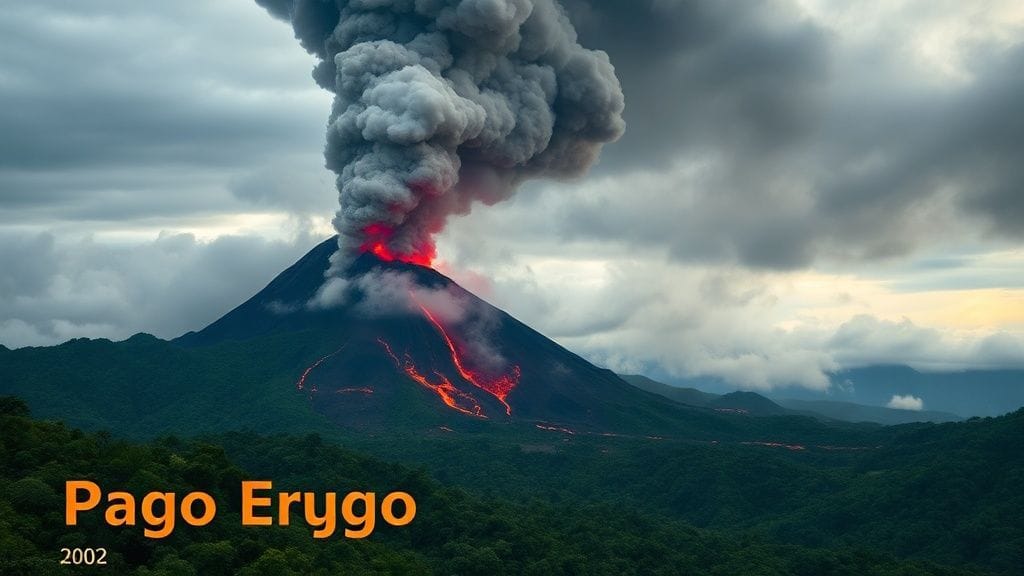
A towering plume of dark smoke burst forth from the caldera, risen like a spectral finger clawing the sky. Incandescent rock and ash exploded outward, showering the landscape with fiery fragments. The initial blast was a theatrical release of pent-up pent-up energy, shaking the island to its core.
Rivers of lava began weaving down Pago’s flanks; ash clouds billowed, engulfing the horizon and plunging villages into near-total darkness. The stench of sulfur mixed with the acrid taste of falling ash—a suffocating embrace from the volcano’s fury.
Ash Clouds and Lava Rivers: The Dramatic Unfolding
The eruption’s intensity defied expectations, with pyroclastic flows racing down Pago’s slopes, consuming everything in their relentless path. Ash fall fanned far beyond the immediate footprint, affecting air quality and agricultural lands. Flights were grounded, schools closed, and day turned to night as the ash veil thickened.
Scientific teams documented the event with awe and trepidation. The dynamic nature of the eruption, shifting between explosive bursts and flowing lava, challenged all prior models and forecasts.
Airborne Darkness: How the Eruption Shrouded the Island
Daytime became an eerie twilight. Ash particles dense enough to blot out the sun turned skies to an unnatural gray-black. Crops wilted under the ashen weight; respiratory ailments surged. Inside homes, families huddled, fearful yet connected by the shared uncertainty.
This airborne veil disrupted not only daily life but infrastructure. Roads clogged with debris, water sources became contaminated, and communication networks faltered.
Human Stories Amidst the Pyroclastic Fury
Behind every statistic was a human face: elders shielding children, farmers abandoning fields at a moment's notice, communities rallying around the afflicted. One woman, Maria Tavo, described running through ash-laden streets clutching her infant, her home succumbing to lava while the cries of neighbors scattered in the smoke echoed in the air.
Local leaders organized impromptu shelters, while youth volunteers braved the hazardous conditions to distribute food and water. These stories reveal resilience, fear, and the enduring spirit of a people caught in nature’s throes.
Emergency Response: Local and International Efforts Unite
Papua New Guinea’s government, faced with an escalating disaster, declared a state of emergency. International aid — from Australia, New Zealand, and NGOs — poured in with supplies, expertise, and manpower.
Efforts to evacuate affected populations often encountered logistical hurdles owing to terrain and communication gaps. Yet despite these challenges, the coordination grew, blending local knowledge with global resources. Mobile clinics were deployed and volcanic monitors enhanced.
Scientific Eyes: Monitoring the Volcano’s Fury
Volcanologists, seismologists, and atmospheric scientists converged on New Britain. Instruments measuring ground deformation, gas emissions, and ash dispersion became critical tools in understanding Pago’s behavior.
Continuous analysis underscored the importance of volcanic monitoring for the region — a living laboratory in which each tremor, plume, and lava flow extended broader knowledge about subduction zone volcanoes.
The Aftermath: Land and Lives Transformed
As the eruption subsided weeks later, the aftermath revealed a profoundly altered landscape. Forests lay buried under layers of ash; fertile farmlands converted to wastelands of hardened lava and pumice. Entire villages had been destroyed or severely damaged.
Yet, amid destruction, nature’s cycles persisted. New ecological niches began to form; pioneer plants slowly reclaimed the blackened earth. People, too, started to heal — rebuilding homes, memories, and livelihoods from the volcanic ruins.
Economic Quakes: The Cost Beyond the Ash
The eruption’s toll went far beyond physical damage. New Britain’s economy, primarily based on agriculture, fishing, and forestry, took a severe hit. Crops lost to ash fall meant months of food shortages; damaged roads disrupted trade; tourism — a budding sector — stalled.
For many families, the financial strain was compounded by loss of property and displacement. The government and aid agencies faced the daunting task of balancing immediate relief with long-term recovery.
Cultural Resilience: Traditions Tested by Nature’s Wrath
For the Tolai and other peoples, the eruption challenged traditions and beliefs. Rituals meant to appease volcano spirits gained renewed significance, while storytelling shifted to include firsthand accounts of the disaster.
Community ceremonies celebrated survival and collective endurance, blending sorrow for losses with hope. The event catalyzed dialogues on modernization, climate adaptation, and cultural vitality.
Lessons From Pago: Volcanic Awareness in Papua New Guinea
In the wake of the eruption, efforts surged to enhance preparedness. Early warning systems were improved, community education programs developed, and scientific collaboration ensured.
Pago became a poignant example of how vulnerable island nations can develop resilience — harnessing both indigenous knowledge and modern science to coexist with geological threats.
Pago’s Place in Global Volcanology: A Chapter in Earth’s Fiery Story
While the Pago eruption might be less famous than others globally, it attracted considerable scientific attention. It offered insights into andesite volcanoes’ behavior and ash dispersion patterns in tropical climates.
Reviews of the eruption contributed to international databases on volcanic hazards, helping shape risk management strategies worldwide.
The Long Shadow: Environmental Impact Over Time
Beyond immediate damage, Pago’s eruption influenced New Britain’s environment for years. Changes to soil chemistry, hydrology, and local climate altered ecosystems. Animal populations shifted in response to habitat disruption.
Researchers continue to study how volcanic activity shapes island biogeography, making Pago a living case study in ecological recovery.
Memory and Myth: How Pago’s Eruption Entered Local Lore
As time passed, the eruption wove itself into the cultural tapestry. Elders recounted the event in stories, songs, and carvings, imprinting lessons and legacies for future generations.
Many locals viewed the eruption as a manifestation of spiritual cycles — punishment, challenge, and renewal — reinforcing the interconnectedness of people, earth, and spirit.
Recovery and Rebuilding: The Road Back to Normalcy
Recovery was neither swift nor easy. Reconstructing infrastructure, restoring agriculture, and resettling displaced populations demanded years. Community solidarity was tested, yet local ingenuity shone.
Government programs, supported by international funds, prioritized resilient construction, disaster awareness, and sustainable development programs.
Volcanoes and Identity: Living With the Threat
For the people of New Britain, volcanoes are not just hazards but defining elements of cultural identity. Pago’s eruption deepened this understanding, highlighting the need for coexistence, respect, and vigilance.
Celebrations and remembrances now often include elements commemorating survival and the lessons learned from 2002.
Pago 2002 in Retrospect: What the World Learned
The Pago eruption underscored the complex challenges volcanic islands face — balancing growth with safety, indigenous traditions with scientific progress. It highlighted the importance of global support networks for disaster response.
Moreover, it offered a stark reminder of nature’s unpredictability, compelling renewed commitments to risk mitigation and community empowerment.
The Legacy of Pago: From Destruction to Renewal
Today, Pago stands as a symbol of both destruction and regeneration. The eruption forged a path of renewal — ecological, social, and scientific — that continues to shape New Britain.
With each new leaf sprouting from ashen soil, the story of Pago reminds us that even the fiercest tragedies can plant the seeds of hope.
Conclusion
Fire and fury are elemental forces that mankind cannot control, only endure and learn from. The 2002 eruption of Pago volcano in New Britain was more than a geological event; it was a profound human experience. It laid bare vulnerability, yet illuminated resilience forged in the crucible of crisis.
The island’s people, their traditions, and their lives intertwined with this fiery symphony, emerge not broken but emboldened. Pago’s story is a testament to the enduring spirit that embraces uncertainty, crafts meaning from calamity, and rebuilds—time and again—on the edge of destruction.
FAQs
Q1: What caused the Pago eruption in 2002?
A1: The Pago eruption was triggered by tectonic activity as the Pacific and Indo-Australian plates interact along the Ring of Fire. Rising magma beneath the volcano eventually found release, causing explosive activity.
Q2: How many people were affected by the eruption?
A2: Thousands of residents from nearby villages were impacted either through evacuation, loss of homes, or health after ashfall. Precise numbers vary, but the eruption forced widespread displacement and economic hardship.
Q3: Were there any casualties?
A3: Thanks to timely warning and evacuations, there were no confirmed direct fatalities, though the eruption caused significant trauma and disruption.
Q4: How did the local communities respond to the disaster?
A4: Local communities relied on traditional knowledge, mutual aid, and organized evacuations. Combined with governmental and international aid, these responses were pivotal in managing the crisis.
Q5: What environmental changes did the eruption cause?
A5: The eruption altered soils, vegetation, water sources, and ecosystems, creating new environmental conditions that evolved over years.
Q6: What scientific advancements came from studying the Pago eruption?
A6: Pago’s eruption contributed to understanding andesite volcano dynamics, ash plume modeling in tropical climates, and improving regional monitoring protocols.
Q7: How is Pago volcano monitored today?
A7: Enhanced seismic and gas monitoring systems, satellite imagery analysis, and local community reporting now help track volcanic activity more closely.
Q8: How is the eruption remembered culturally?
A8: The eruption is commemorated in folklore, community ceremonies, and educational programs that blend science and tradition, preserving its lessons for future generations.

