Table of Contents
- A Thunderclap in the Eternal City: The Emergence of the Dictatus Papae
- Rome in 1075: A City on the Brink of Transformation
- The Papacy and the Holy Roman Empire: A Power Struggle Unfolding
- Gregory VII: A Pope with a Vision for Reform and Authority
- The Seeds of Conflict: Lay Investiture and the Question of Church Authority
- The Compilation of the Dictatus Papae: Intentions and Audience
- The Core Assertions: Absolute Papal Supremacy and Its Revolutionary Claims
- Reactions from Rome and the Empire: Friends and Foes of the Dictatus
- The Dictatus Papae and the Investiture Controversy: A Catalyst for Conflict
- The Clash with Emperor Henry IV: From Political Manoeuvring to Excommunication
- The Walk to Canossa: Humiliation, Power, and Redemption
- The Long Shadow: How Dictatus Papae Redefined Papal and Secular Relations
- Implications for European Monarchies and the Making of Christendom
- The Cultural and Spiritual Repercussions of Papal Authority
- Historiographical Debates: Interpreting the Dictatus Papae’s Legacy
- The Enduring Symbolism of the Dictatus Papae in Church-State Relations
- Conclusion: Power, Faith, and the Making of Medieval Europe
- FAQs
- External Resource
- Internal Link
A Thunderclap in the Eternal City: The Emergence of the Dictatus Papae
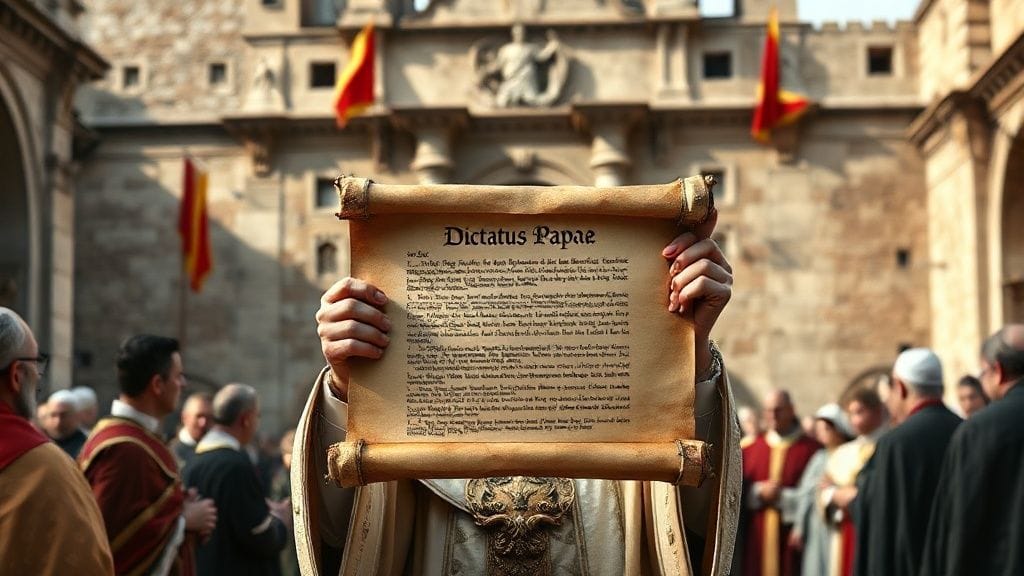
On a pale morning in the winter of 1075, within the hallowed halls of the Lateran Palace in Rome, a momentous declaration was etched into the annals of history. It was not a battle cry, nor a treaty inked to end a war, but a set of bold, concise assertions—twenty-seven propositions known collectively as the Dictatus Papae. These words, penned under the authority of Pope Gregory VII, were a thunderclap that shattered the medieval political landscape and heralded a new era of papal supremacy.
The Dictatus Papae did not merely speak of authority; it roared of absolutism, asserting the pope’s unique dignity and power above kings and emperors. It was a manifesto that would ripple through the fabric of Christendom, reshaping the relationships between church and state, faith and power, conscience and crown. This document foresaw the growing tensions that would explode into the fierce Investiture Controversy, defining yet again the delicate dance between spiritual authority and temporal power.
But to truly grasp the seismic import of the Dictatus Papae, one must step back into the Italy of the 11th century—a city alive with conflicting loyalties, ambitious leaders, and a church wrestling with its own identity…
Rome in 1075: A City on the Brink of Transformation
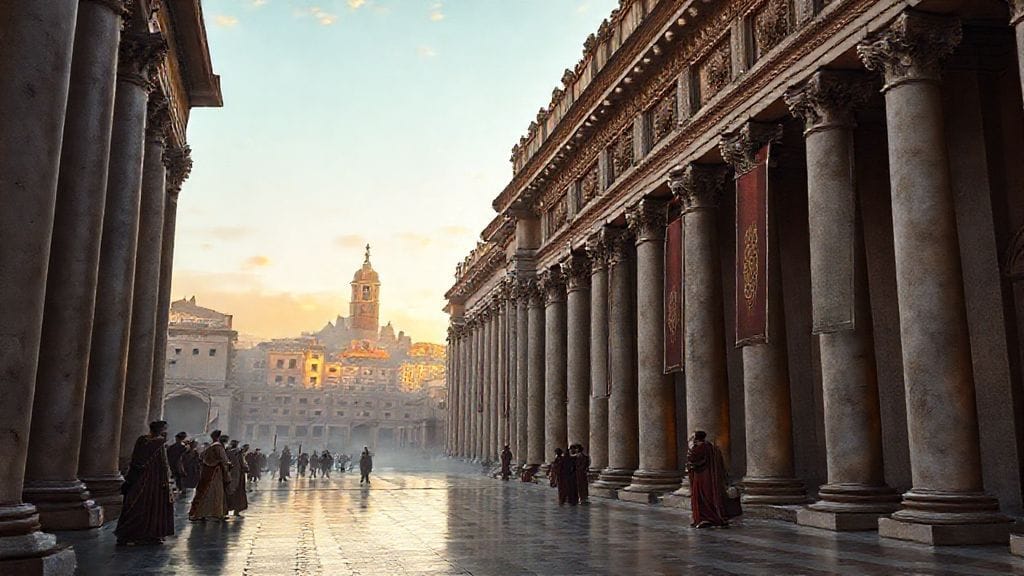
Rome—the seat of the papacy and the immortal city of empire—was no stranger to upheaval. By 1075, the city was a crucible where competing forces converged: the ancient grandeur of imperial tradition mingled uneasily with the rising tide of ecclesiastical reform. Factions vied for influence, and the boundaries between sacred and secular power were fluid and contested.
The papacy itself was emerging from a turbulent era. The previous decades had witnessed moral laxity in the clergy, the pervasive practice of simony (the buying and selling of church offices), and the interference of secular rulers in ecclesiastical appointments. Reform-minded clerics, rallied by a vision of a purified and autonomous church, sought to wrest control from corrupt rulers—both lay and clerical—and restore spiritual authority to the throne of St. Peter.
At the same time, the Holy Roman Empire, a sprawling polity that nominally encompassed much of Europe, exercised considerable influence in Rome. The emperors fancied themselves protectors of the church, but often leveraged their power to place loyal bishops and abbots in key posts, blurring the line between spiritual leadership and imperial politics.
Within this tense atmosphere rose Hildebrand, soon to be Pope Gregory VII, a man of keen intellect and unyielding conviction, whose ideas would challenge centuries of political custom and divine sanction.
The Papacy and the Holy Roman Empire: A Power Struggle Unfolding
During the Middle Ages, the relationship between the pope and the emperor was a complex dance of cooperation and rivalry. Each claimed a divine mandate: the emperor wielded power over the earthly realm, while the pope held spiritual authority conferred by St. Peter himself. Yet there was no clear division of jurisdiction, and both aspired to supremacy.
The Empire, especially under the Salian dynasty, saw itself as the rightful executor of order in Europe. The investiture of bishops—granting them their spiritual offices and with it great wealth and influence—was traditionally performed by the emperor, an act symbolizing imperial supremacy over the church’s temporal affairs.
However, reformists within the church argued that lay rulers had no right to interfere in sacred matters. Their contention would fundamentally challenge centuries-old customs and ignite the simmering embers of conflict.
Gregory VII: A Pope with a Vision for Reform and Authority
Born Hildebrand of Sovana, Gregory VII ascended to the papal throne in 1073 with a singular focus: to reform the church from within and to assert its universal sovereignty against secular domination. He was a fierce advocate of clerical celibacy, the eradication of simony, and most controversially, the elimination of lay investiture.
Gregory’s vision extended beyond mere cure of corruption; he viewed the papacy as a divine institution endowed with supreme moral and judicial authority that transcended kings and emperors. His pontificate proved to be a turning point—not only in ecclesiastical governance but also in the political tapestry of medieval Europe.
The Seeds of Conflict: Lay Investiture and the Question of Church Authority
The heart of the conflict lay in the practice known as lay investiture, by which kings and nobles appointed bishops and abbots, often for political loyalty or personal gain. This practice compromised the spiritual independence of the church and blurred the distinction between sacred and secular power.
Reform-minded clerics saw lay investiture as a form of corruption and a direct affront to the church’s divine mission. Their battle was not solely about governance—it was a fight for the soul of Christendom.
The tension mounted with increasing fury, setting the stage for a monumental confrontation between Pope Gregory VII and Emperor Henry IV of Germany.
The Compilation of the Dictatus Papae: Intentions and Audience
Amid this turbulent backdrop, the Dictatus Papae emerged as a bold declaration of principles that would underpin papal policy. While the exact authorship remains debated, it is widely attributed to Gregory VII or his close circle of reformers.
Written as part of the papal register (the Liber Diurnus), this document was less a public manifesto and more a statement of his spiritual and juridical claims aimed at bishops, secular rulers, and perhaps the wider world. It framed the pope as the supreme arbiter of all matters, spiritual and temporal, a role that had hitherto been implicitly contested.
It is remarkable that these 27 propositions were so concise and uncompromising—articulating new norms of allegiance, authority, and discipline in a moment of crisis.
The Core Assertions: Absolute Papal Supremacy and Its Revolutionary Claims
The Dictatus Papae contained 27 claims, each a testament to papal absolutism. Among the most striking were assertions that:
- The Roman church alone is rightly called universal.
- The pope alone may depose or reinstate bishops.
- The pope may depose emperors.
- The pope’s legate should be deemed to possess the full power of the pope himself.
- That his name alone should be spoken in the churches.
These claims were nothing short of radical, ignoring the established norm that emperors held sway over temporal matters and had a say in ecclesiastical appointments.
For contemporaries accustomed to a delicate balance of powers, these propositions were startling—and incensed emperors who saw their authority threatened.
Reactions from Rome and the Empire: Friends and Foes of the Dictatus
Within Rome, Gregory’s reformists hailed the Dictatus as a necessary affirmation of the church’s dignity. Many clergy who sought liberation from imperial interference welcomed these assertions of papal independence.
Yet secular rulers, nobles, and some bishops viewed these claims as provocative and dangerous. Emperor Henry IV, in particular, perceived the document as a direct challenge to his prerogatives—a prelude to open conflict.
The document sharpened fault lines between reformers and traditionalists, leaving little room for compromise.
The Dictatus Papae and the Investiture Controversy: A Catalyst for Conflict
Though the Dictatus Papae itself did not cause the Investiture Controversy, it crystallized the ideological battleground over authority. In 1075, when the German king Henry IV appointed his own candidate as Archbishop of Milan against Gregory’s wishes, the papacy responded with fierceness anchored in the Dictatus principles.
What followed was a long and bitter struggle, with excommunications, political isolations, and even civil war brewing within the empire.
The invoked spiritual authority of the pope was not merely symbolic; it was wielded as a weapon to reshape governance.
The Clash with Emperor Henry IV: From Political Manoeuvring to Excommunication
By 1076, the escalating tensions burst into full conflict. Henry IV convened a synod of German bishops which, in turn, declared Gregory deposed—a brazen political move to undermine papal authority.
Gregory, armed with his claims in the Dictatus Papae, struck back with the ultimate spiritual sanction: excommunication. This edict declared Henry’s subjects released from their oaths of loyalty, threatening the very foundation of imperial power.
This was a moment in history where spiritual penance wielded tangible political consequences, paralyzing the empire and forcing dramatic reckonings.
The Walk to Canossa: Humiliation, Power, and Redemption
The confrontation reached a dramatic climax in the winter of 1077 at Canossa Castle. Henry IV, shivering in the snow, humbled himself before the gates to seek absolution from Pope Gregory VII, who stood as the living embodiment of the Dictatus Papae principles.
This iconic episode of penance symbolizes the extraordinary reach of papal authority, juxtaposing spiritual supremacy over temporal kingship in a vivid, human tableau.
Yet this was not a final surrender but a pause in a prolonged and complex struggle—an interplay of faith, dignity, and power.
The Long Shadow: How Dictatus Papae Redefined Papal and Secular Relations
Though the conflict endured for decades, the legacy of the Dictatus Papae was clear: it established a theological and legal precedent that elevated papal claims to unprecedented heights.
The document marks a decisive moment in the medieval assertion of church autonomy and the concept of papal monarchy—a concept that resonated through centuries and across continents.
It laid foundational ideas that influenced canon law, political philosophy, and international relations, framing debates about sovereignty and divine right well into the modern era.
Implications for European Monarchies and the Making of Christendom
The ramifications of the Dictatus Papae echoed beyond Rome and the Empire, shaping the political development of European kingdoms. Monarchs wrestled with the notion that their legitimacy could be questioned or revoked by the pope.
This tension informed subsequent reforms, conflicts, and arrangements—such as the Concordat of Worms (1122)—that sought to find balance between spiritual and temporal authorities.
In this crucible, medieval Christendom was forged as a society where faith and politics remained entangled and contested.
The Cultural and Spiritual Repercussions of Papal Authority
The Dictatus Papae was more than political theology; it was a spiritual manifesto affirming the pope as Christ’s vicar and the ultimate shepherd of souls.
This empowered the church to renew moral authority, challenge secular corruption, and inspire reform, but it also introduced a political instrumentality into papal power that would produce both unity and conflict.
Its principles permeated art, literature, and religious consciousness, embedding the papacy as a unique and elevated symbol in medieval thought.
Historiographical Debates: Interpreting the Dictatus Papae’s Legacy
Scholars have long debated the origins, purpose, and impact of the Dictatus Papae. Was it a revolutionary charter or an assertion reaffirming existing practice? Some argue it was a strategic proclamation to bolster Gregory’s immediate political aims; others see it as marking a genuine transformation in medieval governance.
The ambiguity of the document—its exact date, authorship, and immediate dissemination—opens avenues for interpretation but also enriches the mystery of its lasting power.
The Enduring Symbolism of the Dictatus Papae in Church-State Relations
Across centuries, the Dictatus Papae endures as a touchstone in discussions of sovereignty, church authority, and the balance of power. It prefigured later tensions that would culminate in events like the Reformation, the Enlightenment, and modern notions of secularism.
Its dramatic claims remain a potent reminder of the interwoven nature of faith and governance and the complexities of authority in human history.
Conclusion: Power, Faith, and the Making of Medieval Europe
The Dictatus Papae of 1075 was not simply a list of papal claims; it was a declaration of a new world order grounded in divine authority. Within its terse lines lay the seeds of confrontation and reform that would shape the trajectory of European civilization.
By boldly proclaiming papal supremacy over kings and emperors, Gregory VII signaled a shift that redefined the medieval landscape—a testament to faith’s capacity not only to inspire but also to command power.
The drama surrounding the Dictatus reminds us that history is rarely a calm river; it is a turbulent sea where ideas, ambitions, and beliefs collide, shaping the world in ways still visible today.
FAQs
Q1: What was the main purpose of the Dictatus Papae?
A1: The Dictatus Papae aimed to assert the pope’s supreme authority over the church and secular rulers, particularly in matters like appointing bishops, excommunication, and deposition of rulers, thereby reinforcing papal sovereignty.
Q2: Who was Pope Gregory VII and why is he central to this document?
A2: Gregory VII, originally Hildebrand, was a reformist pope determined to purify the church and assert its independence from secular rulers. The Dictatus Papae reflects his vision and policies during his pontificate.
Q3: How did the Dictatus Papae affect the Investiture Controversy?
A3: The Dictatus Papae provided ideological justification for papal opposition to lay investiture, escalating the conflict that became the Investiture Controversy between Gregory VII and Emperor Henry IV.
Q4: Why was the claim that the pope could depose emperors so controversial?
A4: It challenged the existing political order by suggesting that spiritual authority could override imperial sovereignty, a radical idea that threatened the emperor’s legitimacy and power.
Q5: Did the Dictatus Papae immediately change church-state relations?
A5: Not immediately. It sparked further conflict and debate, but over time, it influenced laws and norms that gradually redefined the separation and interaction between church and state.
Q6: What was the significance of the Walk to Canossa in relation to the Dictatus Papae?
A6: The Walk to Canossa symbolized the power of the pope as outlined in the Dictatus—forcing an emperor to seek forgiveness and highlighting the supremacy of spiritual authority over temporal rulers.
Q7: Are the principles of the Dictatus Papae still relevant today?
A7: While the medieval context has changed, the document remains a landmark in the history of political theology, influencing ideas about sovereignty, authority, and church-state relations.
Q8: Where can I find more information about the Dictatus Papae?
A8: A comprehensive overview is available on the Wikipedia page dedicated to the Dictatus Papae and the Investiture Controversy.