Table of Contents
- The Dawn of an Alliance: Italy on the Brink
- The Papacy in Turmoil: Gregory VII’s Reformist Vision
- The Normans’ Rise: From Mercenaries to Kings
- Ceprano’s Strategic Importance: Crossroads of Power
- Preludes to Partnership: Years of Tension and Negotiation
- The Political Chessboard of 11th Century Italy
- Meeting at Ceprano: The Gathering of Giants
- The Reaffirmation Ceremony: A Pact Forged in Faith and Power
- The Symbolism of the Alliance: Papal Authority Meets Norman Might
- The Role of Matilda of Tuscany and Other Key Figures
- Immediate Aftermath: Consolidation of Power in Southern Italy
- The Alliance’s Impact on the Investiture Controversy
- Repercussions Across Europe: A Shift in Balance
- Cultural and Religious Dimensions of the Pact
- The Military Collaboration: From Defense to Campaigns
- Ceprano’s Alliance and the Road to the Crusades
- Norman Governance and Papal Legitimization
- Subsequent Strains and Renewals of the Alliance
- The Legacy of the 1080 Covenant in Italian History
- Reflections on Power, Faith, and Diplomacy
The Dawn of an Alliance: Italy on the Brink
The year 1080 was not quiet. In the rolling hills of the Italian countryside, the small town of Ceprano nestled between the Papal States and the expanding Norman territories, became the unlikely stage for a defining moment in medieval history. The thick air was charged with anticipation as two powerful forces prepared to reaffirm an alliance crucial not merely to their own survival but to the trajectory of Christian Europe itself. Here, at the intersection of faith and martial prowess, a pact was rekindled that would echo through the ages, shaping the fate of Italy and beyond.
The Papacy in Turmoil: Gregory VII’s Reformist Vision
At the heart of this meeting was Pope Gregory VII, a figure towering in his conviction and reformist zeal. His papacy was marked by an uncompromising campaign to assert spiritual authority over secular rulers—a stance crystallized in the fiercely contested Investiture Controversy. Gregory’s vision was not solely religious; it was profoundly political. He sought to purge the Church of corruption, enforce clerical celibacy, and wrest control of ecclesiastical appointments from kings and emperors. Against this backdrop, the alliance with the Normans was vital: they were both sword and shield in a turbulent Italy where the lines between sacred and temporal power blurred endlessly.
The Normans’ Rise: From Mercenaries to Kings
Meanwhile, the Normans, originally Northmen hailing from Norway and later settled in Normandy, France, had carved out a formidable presence in southern Italy and Sicily. What began as small bands of adventurers and mercenaries led by charismatic leaders such as Robert Guiscard and his brother Roger had evolved into nascent kingdoms. The Normans were not simply conquerors; they were astute politicians and quick to adopt local customs, blending Latin, Byzantine, and Arab influences. Their military prowess was undeniable, but so was their ambition—to legitimize and solidify their rule through formal recognition by the papacy.
Ceprano’s Strategic Importance: Crossroads of Power
Why Ceprano? This modest town was far from a random choice. Located approximately midway between Rome and Monte Cassino, Ceprano was a gateway to the southern territories and a key point on the Via Latina, the ancient Roman road linking the capital with the Mezzogiorno. Controlling this corridor meant not only securing military movements but also ensuring the flow of goods, communications, and political influence. In essence, Ceprano symbolized the fragile equilibrium between northern and southern Italy—a stage where the papacy and Normans could visibly demonstrate their renewed solidarity.
Preludes to Partnership: Years of Tension and Negotiation
The road to 1080 was paved with uncertainty, betrayals, and evolving mutual interests. Earlier decades had seen shifting alliances; at times, Normans and papacy clashed violently, as Norman mercenaries often disregarded papal authority in their conquests. The investiture conflict further strained relationships, as the papacy found itself opposed by the Holy Roman Emperor Henry IV, while Normans balanced pragmatism and loyalty. Yet the underlying necessity of cooperation remained clear: without papal backing, Norman claims risked being dismissed as illegitimate; without Norman military support, the papacy’s stature was vulnerable.
The Political Chessboard of 11th Century Italy
Italy in the late 11th century was a patchwork of competing powers—city-states, princely families, the Holy Roman Empire, the papacy, and emerging Norman duchies. This complex mosaic created opportunities and hazards. Pope Gregory VII’s reforms not only sought to purify the Church but implicitly challenged imperial authority. Henry IV’s insistence on appointing bishops clashed with papal decrees. Amid this turmoil, the Normans’ unwavering military advance southward was both a threat and an opportunity. It is within this high-stakes ideological and political contest that the reaffirmation at Ceprano took on outsized significance.
Meeting at Ceprano: The Gathering of Giants
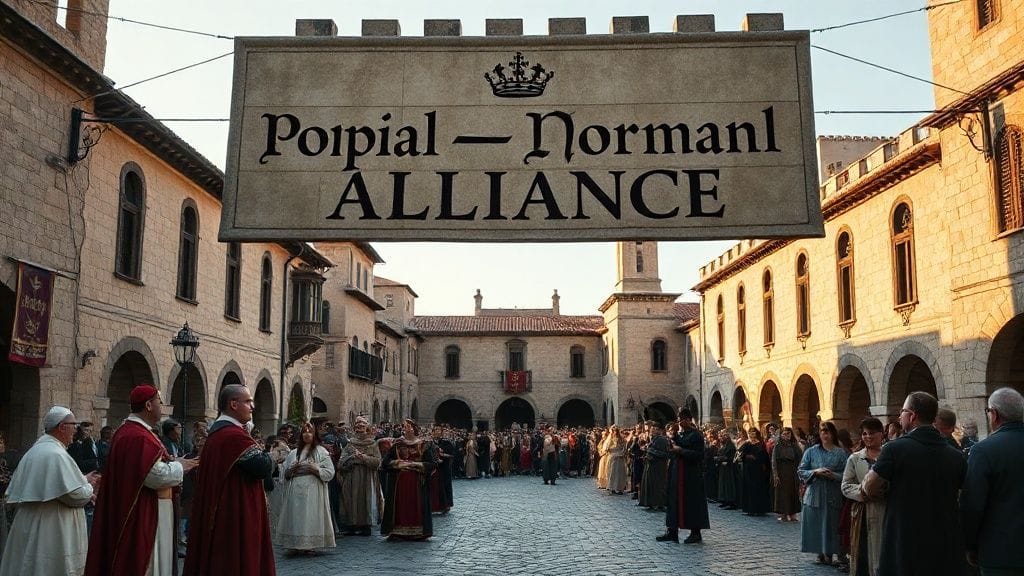
The day arrived when leaders and envoys converged on Ceprano. Accounts portray a scene both solemn and tense. On the papal side, Gregory VII stood firm, a man etched by pastoral care and political battles. Opposite, Robert Guiscard, tall and commanding, their bearing a testament to Norman resolve and experience. Surrounding them were courtiers, clerics, knights, and regional magnates—each aware that the decisions made here would ripple for decades. The nuances of the meeting—its speeches, gestures, and rituals—conveyed not just political calculation but a shared belief in a divinely ordained mission.
The Reaffirmation Ceremony: A Pact Forged in Faith and Power
The ceremony was rich with symbolism. Gregory VII, wearing the papal tiara, solemnly blessed Robert Guiscard and his followers, recognizing their right to rule lands in southern Italy in exchange for their loyalty to the Church. This acknowledgment was far more than a formal convention; it was a diplomatic masterstroke underscoring papal supremacy while harnessing Norman ambition. The investiture was accompanied by oaths of fealty, prayers, and blessings, symbolizing the fusion of ecclesiastical sanction and military force.
The Symbolism of the Alliance: Papal Authority Meets Norman Might
This partnership was, in essence, a marriage of two powerful yet vulnerable forces. Gregory controlled spiritual legitimacy but lacked a standing army. Robert’s Normans bore swords but sought legitimacy beyond mere conquest. Their alliance sent a clear message to rivals: Rome’s spiritual authority and Norman military power were united. In an era where the divine right to rule was paramount, this reaffirmation lent an unbeatable aura of legitimacy to Norman rule while bolstering Gregory’s reformist ambitions.
The Role of Matilda of Tuscany and Other Key Figures
Behind the scenes, influential nobles like Matilda of Tuscany played critical roles as mediators and patrons. Matilda, a staunch ally of Gregory VII and a formidable ruler in her own right, provided crucial support to the papacy against imperial interference. Her territories and influence helped create the conditions for the alliance’s success. Additionally, the bishops, monks, and knights present reflected a spectrum of power that wove together feudal politics, religious fervor, and military necessity.
Immediate Aftermath: Consolidation of Power in Southern Italy
Following Ceprano, Robert Guiscard swiftly consolidated his holdings, extending control over Apulia, Calabria, and parts of Sicily. The alliance with the papacy enabled him to crown himself with papal approval, sidestepping potential claims by rival nobles and legitimatizing his duchy’s expansion. For Gregory VII, the reaffirmation strengthened his hand in the Investiture Controversy and deepened his network of alliances, providing a practical bulwark against imperial pressures.
The Alliance’s Impact on the Investiture Controversy
The Investiture Controversy between Gregory VII and Henry IV was the dominant conflict of the era, a battle over whether secular rulers or the pope held authority to appoint bishops and abbots. The Norman alliance provided Gregory with a military ally capable of checking imperial ambitions in Italy. This was a crucial factor in the pope’s ability to resist Henry IV’s attempts to depose him. Yet, this alliance also drew the papacy into regional conflicts, making the struggle between sacred and secular powers even more complex.
Repercussions Across Europe: A Shift in Balance
The reaffirmation of the alliance was not merely an Italian affair; the ripples were felt throughout Europe. Monarchs and church leaders observed the rising nexus between papal power and Norman might with a mixture of apprehension and admiration. The Normans' success inspired other warrior societies, while the papacy’s increasing political assertiveness challenged imperial hegemony. The Ceprano pact thus represents a turning point in medieval geopolitics, laying groundwork for altered alliances and conflicts throughout Christendom.
Cultural and Religious Dimensions of the Pact
Beyond politics and warfare, the alliance had profound cultural repercussions. The Normans’ openness to local traditions and the papacy’s reformist ideals formed a symbiotic relationship that encouraged artistic and architectural innovation. Romanesque cathedrals, monastic reforms, and pilgrimages flourished under this umbrella. The fusion of Norman and papal identities also influenced the spiritual landscape, fostering a renewed sense of Christian unity and purpose amidst internal schisms.
The Military Collaboration: From Defense to Campaigns
The military dimension of the alliance cannot be overstated. Combined Norman-papal forces proved formidable not only in defense of the Papal States but also offensively, particularly in campaigns to subdue rebellious nobles and extend influence over southern Italy and Sicily. The alliance’s military successes demonstrated the efficacy of combining spiritual legitimacy with martial strength, a model that subsequent European powers would emulate.
Ceprano’s Alliance and the Road to the Crusades
It is no coincidence that the affirmation at Ceprano preceded the First Crusade by just over a decade. The alliance helped set the stage for broader Christian mobilization. The papacy’s capacity to call upon warrior elites like the Normans was instrumental in rallying forces for the holy war. The reciprocal relationship nurtured trust and operational coordination, which would prove vital when the call to arms extended beyond Italy to the Levant.
Norman Governance and Papal Legitimization
The norms of governance introduced by Norman rulers combined feudal administration with papal oversight, creating a hybrid system that stabilized southern Italy. The legitimacy granted at Ceprano eased tension between Norman lords and local populations, who saw the papal sanction as a guarantee of justice and order. This governance model set precedents that influenced later monarchies, underscoring the power of religious endorsement in political rule.
Subsequent Strains and Renewals of the Alliance
No alliance remains unchallenged. In the decades following 1080, periodic conflicts tested the Papal–Norman partnership. Disputes over territories, papal politics, and shifting loyalties brought moments of tension. Yet the fundamental bond, sealed at Ceprano, endured through renewals and reassertions, reflecting a mutual recognition of necessity transcending transient disagreements.
The Legacy of the 1080 Covenant in Italian History
Looking back, the reaffirmation at Ceprano stands as a pivotal moment—one that shaped medieval Italy’s political and religious contours. It symbolized a melding of power that facilitated the gradual emergence of modern European states. The alliance underscored the evolving relationship between church and state, and its legacy resonates in the complexities of authority, legitimacy, and identity that define European history.
Reflections on Power, Faith, and Diplomacy
The Papal–Norman alliance reaffirmed at Ceprano in 1080 offers enduring lessons on the interplay between spiritual ideals and worldly ambitions. It reveals how political actors harness faith to legitimise power, and how military strength can reinforce religious authority. This remarkable episode invites us to reflect on the multifaceted nature of human alliances—fraught, pragmatic, hopeful—and the ways in which moments of concord can illuminate centuries.
Conclusion
The reaffirmation of the Papal–Norman alliance at Ceprano in 1080 was more than a political arrangement; it was a profound encounter between conviction and pragmatism, faith and force. Against a backdrop of conflict and reform, two distinct powers—one spiritual, the other martial—found common cause that would reverberate across the medieval world. They forged a partnership at a crossroads, not only of geography but of history, setting the stage for crusades, conquests, and cultural flowering. The pact embodied the delicate dance of authority and allegiance, reminding us that history’s most enduring narratives emerge where ideals meet realpolitik, bound by shared purpose and often unexpected solidarity.
FAQs
Q1: Why was the Papal–Norman alliance important in 1080?
The alliance solidified the Normans’ legitimacy in southern Italy while bolstering Pope Gregory VII’s reforms and political authority. It was key to balancing power in Italy and resisting imperial interference during the Investiture Controversy.
Q2: Who were the main figures involved in the reaffirmation?
Pope Gregory VII and Robert Guiscard were the principal leaders. Influential nobles like Matilda of Tuscany and other church officials also played significant supporting roles.
Q3: How did the alliance affect the Investiture Controversy?
It strengthened the pope’s military and political position against Emperor Henry IV by providing loyal Norman forces to defend papal interests in Italy.
Q4: What role did Ceprano’s location play in this event?
Ceprano was a strategic town on the Via Latina, serving as a symbolic and tactical meeting point at the boundary between Papal and Norman territories.
Q5: Did the alliance influence the Crusades?
Yes. The alliance helped establish the cooperation necessary between religious authority and military leaders that would later facilitate the launching of the First Crusade.
Q6: Were there any conflicts between the Normans and the Papacy after 1080?
While the alliance generally endured, subsequent decades saw tensions and disputes over territory and authority. However, their mutual interests often led them back to cooperation.
Q7: What cultural impacts resulted from the Papal–Norman partnership?
The collaboration encouraged a fusion of Latin Christian and Norman traditions, influencing architecture, religious practice, and governance in southern Italy.
Q8: How did the Normans benefit from papal recognition?
Papal blessing granted the Normans political legitimacy and prestige, enabling them to consolidate their rule with less opposition from rivals and local populations.

