Table of Contents
- The Dawn of Ecclesiastical Upheaval: Rome in the Mid-11th Century
- The Papal Authority before Reform: A Church in Turmoil
- Seeds of Change: Early Calls for Reform and the Gregorian Vision
- The First Lateran Council (1059): Setting the Reform in Motion
- Defining Papal Election: The Papacy Breaks Free from Secular Control
- The Investiture Controversy Ignites: Power Struggles Beyond Rome
- The Second Lateran Council (1139) and the Continued Quest for Purity
- The Third Lateran Council (1179): Codifying Discipline and Combating Heresy
- Reform’s Human Faces: Key Figures and Fierce Critics
- The Clash with the Holy Roman Empire: Politics Meets Religion
- Reforming Clerical Life: Celibacy and Moral Rectitude
- The Wider Church and the Laity: Reactions and Resistance
- The Role of the Roman Curia: Centralizing Church Authority
- The Impact on Monastic Movements: Cluniacs and Cistercians
- Art and Architecture: Reform’s Visible Legacy in Rome
- Long-Term Consequences: The Papacy Rid of Feudal Entanglements
- The Reform and Its Echoes in European Politics
- How the Councils Shaped Medieval Canon Law
- Women, the Reform, and the Limits of Papal Authority
- The Spiritual Renewal Amid Political Upheaval
- The Legacy of the Lateran Reforms in the Age of the Crusades
- The Councils’ Role in Forging the Medieval Papal Image
- Reflection: Reform as Revolution – Church and Society Transformed
1. The Dawn of Ecclesiastical Upheaval: Rome in the Mid-11th Century
The air in Rome was thick with tension and expectation. Narrow streets thronged with citizens and pilgrims, but beneath the familiar daily bustle lay a profound unease. The Church, the heart and soul of medieval Christendom, was unraveling at its seams. Corruption, simony—the buying and selling of ecclesiastical offices—and the heavy hand of secular powers over the papacy were common scandals that stained the Vatican’s grandeur. By 1059, the Church was poised on the cusp of monumental change—what would come to be known as the Lateran Reforms, a decisive movement to reclaim spiritual purity and authority from the vortex of political chaos.
Imagine the scene: Pope Nicholas II, a man of austere conviction, standing before an assembly not only of bishops and abbots but also of the Roman nobility, determined to wrest back control of papal elections. Behind his determined gaze was the vision of a renewed Church, one freed from crowned monarchy’s manipulative grip. Rome was breathing a new purpose; the future of the papacy—and by extension all of Western Christendom—would pivot on the decisions taken in these fateful years.
2. The Papal Authority before Reform: A Church in Turmoil
Understanding the gravity of the Lateran Councils requires stepping back into a century riddled with conflict. For decades, the papacy had been hostage to feudal barons and kings, whose puppet-like interference turned pontiffs into mere political pawns. The infamous era of the Saeculum Obscurum — the “Dark Age” of the Papacy — saw corruption with palace intrigues rivaling any royal court drama.
Yet the problem was not simply moral decay; it was structural. The Church’s vast spiritual authority was compromised because its leadership was entangled with dynastic and territorial struggles. The privilege of electing popes had long been abused. Roman aristocrats and German emperors intervened, disenfranchising genuine ecclesiastical choice.
This decay bred calls for reform. Monastic communities, especially the Cluniac order, inspired a renewal of spiritual rigor and ecclesiastical discipline. The stage was set for a conflict between the old order and a new vision—one that would elevate the Church’s spiritual mission above worldly power politics.
3. Seeds of Change: Early Calls for Reform and the Gregorian Vision
Reform was no sudden wildfire but a slow-burning ember fanned by key figures who imagined a purified Church. Hildebrand, later Pope Gregory VII, emerged as the spearhead of this movement. His belief in plenitudo potestatis, the fullness of papal power, was both revolutionary and controversial. He argued that the Church must be free to govern itself without lay interference.
Hildebrand’s ideas took root among reform-minded clergy who longed to end the disgrace of simony and clerical marriage. Their vision was of a spiritually unassailable papacy, an institution whose moral and political authority would emanate from divine will alone.
Many viewed this as a challenge to kings and emperors, whose influence had been entwined with Church appointments. Yet the reformers marched on undeterred, gathering momentum as they positioned the papacy at the center of Christendom—not merely as a religious office, but as a formidable political force.
4. The First Lateran Council (1059): Setting the Reform in Motion
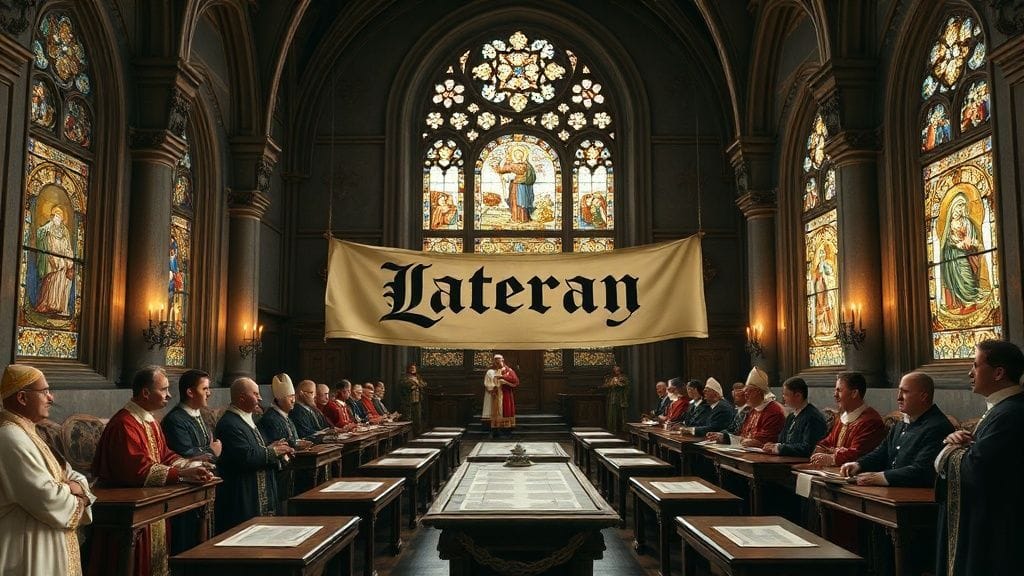
The defining moment arrived in April 1059 when Pope Nicholas II convened what would become known as the First Lateran Council. Against the backdrop of simmering factional conflict, the assembly issued groundbreaking decrees that would forever alter the papal succession.
Most famously, In nomine Domini declared that only the cardinals had the right to elect the pope, shutting out the Roman nobles and secular rulers. This was more than administrative reform; it was a radical assertion of ecclesiastical autonomy. The council codified the investiture rights that the Church would begin to claim as inalienable—a direct challenge to imperial claims.
These steps were the first visible foundation stones to challenge centuries of secular dominance. Yet, this bold step unleashed fierce reactions, especially from the Holy Roman Emperor Henry IV, whose role in choosing popes was about to be curtailed forever.
5. Defining Papal Election: The Papacy Breaks Free from Secular Control
To modern eyes, the idea that cardinals alone would choose the pope might seem a bureaucratic detail, but in the 11th century, it was revolutionary. The council’s decree effectively reclaimed the spiritual sovereignty of the Church.
Prior to this, emperors and kings had installed popes who served their political interests; the papacy was a prize exchanged in power games. Now, by limiting the electoral rights to the Roman clergy, the Lateran Council redefined the Church’s inner workings as a sanctified sanctum, shielded from worldly interference.
This redefinition sent shockwaves through Europe. It was not simply about procedure but about contesting who held ultimate authority in Christendom: temporal princes or spiritual shepherds.
6. The Investiture Controversy Ignites: Power Struggles Beyond Rome
The ripples of the Lateran Council soon expanded into the infamous Investiture Controversy—a bitter, decades-long power struggle over who would appoint bishops and abbots. Henry IV’s refusal to accept the diminishing of his rights culminated in a dramatic showdown with Pope Gregory VII, leading to the legendary episode of the emperor’s penitent journey to Canossa in 1077.
As the secular and ecclesiastical worlds collided with unprecedented force, the Lateran reforms had ignited a war for the soul and governance of medieval Europe. The stakes were nothing less than the balance between church and state, a question still echoing in political theology today.
7. The Second Lateran Council (1139) and the Continued Quest for Purity
Though after the initial push, the road to reform was not smooth, subsequent Lateran Councils kept the momentum alive. The Second Lateran Council, convened by Pope Innocent II, relentlessly attacked the scourges of simony and clerical irregularity.
Decrees emphasized priestly celibacy and excommunicated those engaging in illicit marriage or concubinage. The council sought to cleanse the clergy morally while reaffirming papal authority over bishops.
This ongoing battle was more than spiritual discipline; it was an effort to reforge a unified Church identity amid fractious political realities.
8. The Third Lateran Council (1179): Codifying Discipline and Combating Heresy
By the time Pope Alexander III convened the Third Lateran Council, the reform movement had matured into a comprehensive program. This council tackled the twin challenges of internal corruption and external threats—the latter notably addressing rampant heresies that threatened the Church’s doctrinal unity.
One of the council’s most enduring enactments was the two-thirds majority rule for papal elections, intended to prevent factionalism that had plagued earlier selections. It also moved to discipline clergy more strictly and impose penalties on violent acts against churchmen.
The Lateran reforms, thus, had not only reshaped governance but broadened their scope to defending orthodoxy itself.
9. Reform’s Human Faces: Key Figures and Fierce Critics
The Lateran reforms were not abstract edicts but the work of compelling personalities whose convictions reshaped history. From Pope Nicholas II’s bold declarations to Gregory VII’s dogged vision of papal supremacy, their actions echoed through the centuries.
Yet resistance was fierce. Emperors like Henry IV and later Frederick Barbarossa saw the reforms as threats to imperial prerogative. Archbishop Cadalus of Parma and other clergy often opposed the reformers, revealing the deep divisions even within the Church.
These human dramas—of conviction, conflict, and compromise—gave the reforms emotional and political texture, making ecclesiastical history as vivid as any royal chronicle.
10. The Clash with the Holy Roman Empire: Politics Meets Religion
Underlying the Lateran reforms was an unyielding confrontation between pope and emperor. The Investiture Controversy revealed how church reform was inseparable from medieval politics.
Henry IV’s multiple conflicts with Gregory VII culminated in mutual excommunications and civil wars within the empire. This violent standoff symbolized the struggle for supremacy between the spiritual and temporal power centers.
Ultimately, the Peace of Worms (1122) attempted a truce: the emperor renounced investiture of bishops with ring and staff, but retained influence in their temporal affairs. This uneasy compromise underscored the era’s complex negotiation between sacred and secular claims.
11. Reforming Clerical Life: Celibacy and Moral Rectitude
One of the more profound impacts of Lateran reforms was the insistence on priestly celibacy. The councils condemned marriage among clergy as a grievous offense against the Church’s spiritual purity.
This change was not simply about chastity but about severing clergy from worldly ties that compromised their dedication. The imposition of celibacy reverberated for centuries and remained a defining feature of the Latin Church.
Obedience, poverty, and humility became pillars of clerical morality, aligning the Church as a spiritual sanctuary amid secular tumult.
12. The Wider Church and the Laity: Reactions and Resistance
Not all embraced the reforms readily. Many local communities were entangled with lay patrons who saw ecclesiastical offices as family inheritances or political rewards.
Some clergy resisted celibacy, and simony remained stubbornly persistent in some regions. Laity reactions ranged from support—seeing a purer Church—to frustration at the papal impositions seen as centralized control.
These tensions illuminated the social fabric binding Church and society, revealing that reform was as much about negotiating community identities as it was about decrees.
13. The Role of the Roman Curia: Centralizing Church Authority
The Lateran councils strengthened not only the papal office but also the Roman Curia, the administrative apparatus of the Church. Episcopal appointments, canon law development, and enforcement mechanisms grew more centralized.
This professionalization allowed the papacy to project power effectively across Europe, turning Rome into a hub of religious and political command.
Yet it also sparked concerns over bureaucracy and distance from local spiritual realities, a tension that would shape Church politics for centuries.
14. The Impact on Monastic Movements: Cluniacs and Cistercians
Monastic reform and Lateran decrees ran parallel and intertwined. The Cluniac reforms had already energized the Church’s spiritual renewal, emphasizing liturgical splendor and independence from secular influence.
Later, the austerity of the Cistercians complemented these reforms, modeling the ideals of discipline and purity the Lateran Councils sought to institutionalize.
Monasteries became centers of both spiritual renewal and political influence, extending the reform vision beyond Rome’s walls.
15. Art and Architecture: Reform’s Visible Legacy in Rome
These reforms were not only textual or doctrinal but visibly etched into Rome’s stones. The Lateran Basilica and associated structures were renovated and expanded, symbolizing the papacy’s renewed vigor.
Artistic representations began reflecting themes of papal authority and spiritual righteousness. The Roman landscape itself became a testament to the reform’s triumph, a cityscape breathing ecclesiastical power.
Through frescoes, mosaics, and architecture, the Lateran reforms left a palpable imprint on medieval Christian imagination.
16. Long-Term Consequences: The Papacy Rid of Feudal Entanglements
By reclaiming the right of papal election and defining clerical discipline, the Lateran reforms broke the papacy’s chains to feudal lords and secular kings.
This newfound independence allowed popes to act as arbiters across Christendom, unencumbered by localized political allegiance.
Though tensions persisted, the Church emerged as a distinct supranational entity—an institution whose power transcended dynasties and kingdoms.
17. The Reform and Its Echoes in European Politics
The assertion of papal authority reconfigured Europe’s political map. Kings and emperors now had to contend with a spiritual authority capable of excommunication and interdict.
The Church’s moral power became a formidable political tool. England’s King Henry II and France’s Philip II navigated these new dynamics, often with fraught consequences.
Lateran reforms thus seeded the papal monarchy that would dominate medieval diplomacy and governance for centuries.
18. How the Councils Shaped Medieval Canon Law
The decrees and canons from the Lateran councils formed the backbone of medieval canon law, regulating everything from election procedures to clerical behavior.
These legal frameworks underpinned the Church’s self-governance and judicial authority, setting precedents that influenced both ecclesiastical and secular courts.
The Lateran reforms made law a central instrument for institutional reform and control.
19. Women, the Reform, and the Limits of Papal Authority
While the Lateran reforms aimed at clerical purity and Church autonomy, their impact on women was complex and sometimes contradictory.
The strictures against clerical marriage and the consolidation of power limited women’s roles in church hierarchy, except within monastic communities.
At the same time, female mystics and abbesses retained spiritual influence, highlighting the nuanced gender dynamics within reform-era Christendom.
20. The Spiritual Renewal Amid Political Upheaval
Above all, the reforms sought not simply power but spiritual renewal. The conviction that the Church must be morally pure underpinned all these changes.
This pursuit imbued the period with a paradoxical energy: a church struggling with worldly power yet reaching for holiness.
The Lateran councils stand as testimony to this tension—the quest to reconcile spiritual vocation with worldly realities.
21. The Legacy of the Lateran Reforms in the Age of the Crusades
The reforms paved the way for the papacy’s leadership in the Crusades. The strengthened papal office could now mobilize Christendom in unprecedented ways.
The sense of papal supremacy justified calls for holy war, linking reform and militant Christianity.
Thus, the Lateran reforms not only reshaped internal Church structure but also projected power outwardly in new historical endeavors.
22. The Councils’ Role in Forging the Medieval Papal Image
The Lateran reforms crafted the enduring image of the pope as the supreme spiritual and, to an extent, temporal authority.
This papal monarchy would dominate medieval political imagination, setting the stage for later conflicts with nation-states and reformers.
The councils’ decisions were as much about symbolism as practical governance, forging a powerful mythos of papal leadership.
23. Reflection: Reform as Revolution – Church and Society Transformed
Ultimately, the Lateran reforms were nothing less than a revolution cloaked in canons and council halls. They transformed the papacy from a beleaguered institution into a centralized authority with vast spiritual and political reach.
For the people of Rome and all Europe, these reforms altered the way they experienced religion, leadership, and power.
The Lateran councils stand as a compelling chapter of medieval history, a moment when the Church seized its destiny and reshaped the world around it.
Conclusion
The Lateran Councils, spanning from 1059 to 1179, were extraordinary milestones that forged the path of medieval Christendom. In the shadow of corruption, political strife, and spiritual decay, they rekindled the flame of a purified, autonomous Church. These reforms challenged centuries-old power dynamics, confronting emperors, nobles, and ingrained ecclesiastical customs. Their legacy endured through the establishment of papal independence, stricter clerical discipline, and an assertion of spiritual authority that would resonate throughout Europe and beyond.
But beyond institutional transformation, the Lateran reforms reverberate as a human story: of courage amidst adversity, of conviction wresting control from chaos, and of faith seeking renewal. They remind us that history’s grand shifts often emerge from the quiet insistence on principle—echoing through council chambers, cathedral walls, and the hearts of men and women who dared to imagine a Church of truth and justice.
FAQs
Q1: What was the main purpose of the Lateran Councils between 1059 and 1179?
The main purpose was to reform the Catholic Church by asserting papal authority over elections, combating corruption like simony, enforcing clerical celibacy, and codifying ecclesiastical discipline to restore spiritual integrity.
Q2: How did the Lateran reforms change the election of the pope?
They restricted the right to elect the pope to the College of Cardinals, excluding secular rulers and local Roman nobility, thus ensuring ecclesiastical autonomy in choosing the spiritual leader.
Q3: Who were the key figures behind these reforms?
Pope Nicholas II initiated the reforms, but Pope Gregory VII (Hildebrand) was the most influential advocate, promoting papal supremacy, clerical celibacy, and independence from secular interference.
Q4: What was the Investiture Controversy and how was it related to the Lateran reforms?
It was a conflict between the papacy and the Holy Roman Emperors over who had the right to appoint bishops. The Lateran reforms’ assertion of papal election rights challenged imperial privileges, sparking this prolonged political-religious struggle.
Q5: How did these reforms affect the daily lives of clergy and laity?
Clergy were required to maintain celibacy and moral discipline, while the laity had to navigate a Church increasingly centralized and assertive. Resistance and adaptation from both groups shaped medieval religious life.
Q6: Did the Lateran reforms have political consequences outside the Church?
Yes, they realigned power dynamics between popes and monarchs, influencing European politics by limiting imperial interference in Church affairs and establishing the papacy as a supranational power.
Q7: How did the Lateran reforms influence the Crusades?
By strengthening the papacy’s authority, the reforms enabled popes to call for and organize the Crusades, projecting religious power into military campaigns across the Mediterranean.
Q8: What is the lasting legacy of the Lateran Councils?
Their legacy lies in establishing papal primacy, shaping medieval canon law, enforcing clerical discipline, and formalizing a centralized Church that would dominate European spiritual and political life for centuries.