Table of Contents
- A Friday Night in Paris Before Everything Changed
- France in the Shadow of Terror: The Years Before 2015
- Radical Networks and the Road to November 13
- The City Glows Under Stadium Lights: The Stade de France
- Cafés, Terraces, and Sudden Gunfire in the East of Paris
- The Bataclan Under Siege: Music, Chaos, and Courage
- Inside the Control Rooms: How Authorities Discovered a War Had Begun
- Throughout the Night: Hospitals, Volunteers, and Ordinary Heroes
- A Nation Wakes to the Count of Its Dead
- From Shock to State of Emergency: The Political Response
- Europe Under Pressure: Borders, Security, and the Refugee Crisis
- Fear, Grief, and Resilience in Parisian Streets
- The Hunt for the Network: Brussels, Raids, and the Capture of Salah Abdeslam
- Intelligence Failures and Hard Lessons for Security Services
- Islam, Identity, and the Struggle Over Narratives
- Art, Memorials, and the Battle for Collective Memory
- The Long Road of Justice: Trials, Testimonies, and Accountability
- Global Reverberations: From Paris to Other Cities Under Attack
- How Paris Changed: Security Culture, Daily Life, and Public Space
- Conclusion
- FAQs
- External Resource
- Internal Link
Article Summary: On the night of 13 November 2015, coordinated attacks turned an ordinary Friday in Paris into one of the darkest episodes in recent European history. This article retraces the unfolding of the paris attacks 2015 minute by minute, from the first explosion at the Stade de France to the siege at the Bataclan concert hall. It explores how years of radicalization, geopolitical turmoil, and intelligence blind spots converged into a meticulously planned massacre. Beyond the chronology, it examines the profound political, social, and emotional consequences in France and across Europe. We listen to survivors, doctors, police officers, and ordinary Parisians as they tried to make sense of the chaos. The article also delves into the hunt for the attackers’ network, the subsequent trials, and the transformation of public life and security in France. In doing so, it shows how memory, mourning, and resilience reshaped the city and its people after that terrible night.
A Friday Night in Paris Before Everything Changed
For many Parisians, 13 November 2015 began like any other cool, autumnal Friday. The early evening air carried the usual blend of exhaust and roasted chestnuts, of cigarette smoke and laughter spilling out from café terraces. In the 10th and 11th arrondissements, young people were sliding into metal chairs outside bistros, their scarves looped casually around their necks, glasses of red wine catching the last glints of light. At the Stade de France, in the northern suburb of Saint-Denis, tens of thousands of spectators were taking their seats for an international football match between France and Germany, a friendly game that felt more like a celebration than a contest.
Only months earlier, the city had been shaken by the Charlie Hebdo shootings and the Hyper Cacher hostage crisis. Yet, by November, a fragile sense of normality had begun to return. The phrase “We are not afraid” had resounded through demonstrations and editorials, becoming something close to a national incantation. That evening, Paris was determined to live, to occupy terraces, to cheer in stadiums, to gather in concert halls. No one imagined that, in a matter of minutes, the city would be plunged into an unprecedented wave of coordinated violence that would be known around the world as the paris attacks 2015.
On Boulevard Voltaire, fans were queuing outside the Bataclan, an iconic concert venue with a history stretching back to the 19th century. The American band Eagles of Death Metal was playing, and the mood was festive, carefree, even a little mischievous, as concertgoers snapped photos and texted late-arriving friends. Across the city, in apartments lit by warm lamps, people laid out simple dinners, opened bottles, and switched on the television to watch the match. It was a night whose ordinariness would make the violence that followed all the more shattering. But this was only the beginning…
France in the Shadow of Terror: The Years Before 2015
To understand why the paris attacks 2015 happened the way they did, one has to step back into the years preceding that November night. France, long marked by its colonial past and complex relationship with the Muslim world, had become a central target in the propaganda of extremist organizations. French military interventions in Mali (2013) and the broader Sahel, as well as participation in the U.S.-led coalition against the so-called Islamic State (ISIS) in Iraq and Syria, positioned the country as an enemy in the narrative woven by jihadist movements.
Domestically, the country wrestled with social fractures: pockets of economic deprivation in the banlieues, debates over secularism and the place of religion in public life, and the alienation of some second- and third-generation immigrants who felt caught between cultures. In this terrain, radical preachers, online recruiters, and traveling emissaries of extremist networks found receptive ears among a small minority of disaffected youth. By 2015, French and Belgian services estimated that hundreds of young men and women had left Europe to join ISIS in Syria and Iraq, while others formed clandestine cells closer to home.
Earlier that same year, in January 2015, the Charlie Hebdo and Hyper Cacher attacks had already revealed the lethal potential of homegrown radicalization. The Kouachi brothers and Amedy Coulibaly were French citizens, familiar figures in the long dossier of France’s security services. Their actions, followed by a vast republican march, provoked a wave of soul-searching: could a liberal democracy defend itself against enemies raised within its own borders? Intelligence was stepped up, emergency laws sharpened, and a sense of a looming threat settled over the country. Yet behind the celebrations of solidarity, another, even deadlier plot was already incubating in the shadows of Raqqa and the suburbs of Brussels.
Radical Networks and the Road to November 13
The paris attacks 2015 did not emerge from nowhere; they were the culmination of months, even years, of organization. At their center stood a loose constellation of militants tied to the Islamic State in Syria and an operational hub in Belgium. The man most often identified as the mastermind, Abdelhamid Abaaoud, a Belgian of Moroccan origin, had traveled to Syria and reentered Europe using the chaotic migration routes through Greece and the Balkans. He was not alone. Several of the attackers, including the notorious Salah Abdeslam, crisscrossed the continent, shuttling between safe houses and false identities, using cheap rental cars and prepaid phones.
These men were often known, at least peripherally, to police and intelligence agencies. Some had petty criminal records; others had appeared in databases of radicalized individuals. Yet no agency fully grasped the scope of the network or the level of coordination it was about to unleash. ISIS, at its territorial height in 2014–2015, had announced its intention to strike in Western capitals, but intelligence assessments often struggled to move from general warnings to specific threats. As one security official later admitted anonymously, “We knew they hated us. We knew they were trying. But we did not know when, where, and how the blow would come.”
From apartments in Brussels districts like Molenbeek to hideouts around Paris, the cell mapped out a plan: simultaneous attacks designed to stretch security resources and maximize terror. Suicide belts were assembled with the grim precision of a production line. Automatic weapons, including AK-47s, were procured through criminal networks. The targets were carefully chosen: a stadium symbolizing national unity, cafés and restaurants representing the art of French living, and a concert hall—an emblem of youth, culture, and joyous noise. The message was clear: no place of everyday pleasure would be safe.
The City Glows Under Stadium Lights: The Stade de France
At 21:00 on 13 November, the Stade de France was a glowing bowl of light visible for kilometers. Inside, around 80,000 spectators, including President François Hollande, stood for the national anthems of France and Germany. Security was present but routine; the memory of January’s crimes lingered, but football was meant to be a respite. Children waved flags. Vendors shouted. The players jogged into position as the referee’s whistle signaled the start.
Outside the stadium, however, something was terribly wrong. At 21:20, a man wearing a suicide belt approached one of the entrance gates, identified in later reports as Gate D. Denied entry after a routine frisk reportedly raised suspicion, he moved away. Moments later, a blast tore through the cool night air. At first, many inside the stadium heard the explosion as a distant thump, like a backfiring truck or construction mishap. The match carried on. Television commentators paused briefly, then resumed.
Yet this was not an accident. It was the first detonation of the paris attacks 2015, and within minutes, two more explosions would follow near the stadium, all carried out by suicide bombers. Fragments of clothing and metal littered the streets outside. One passerby was killed, dozens wounded. Inside, high-ranking security officials huddled quickly, informing the president that an explosion had occurred and that it might be an attack. Hollande quietly left his seat and was ushered out, even as most of the crowd, still unaware of the scale of events unfolding across the city, continued to watch the game. It’s astonishing, isn’t it, how ignorance can briefly shield us from dread?
Cafés, Terraces, and Sudden Gunfire in the East of Paris
While the stadium crowds struggled to interpret the booms in the distance, a new horror unfurled in the 10th and 11th arrondissements. At 21:25, a black car—later identified as a rental vehicle—slowed near the intersection of Rue Bichat and Rue Alibert. Terraces at Le Carillon and the nearby Cambodian restaurant Le Petit Cambodge were full; diners leaned over plates, clinked glasses, and chatted in multiple languages. Without warning, men armed with automatic rifles opened fire from the car, sending chairs, bottles, and bodies scattering. Witnesses would later describe the sound as a “long crackle,” a noise that didn’t fit any familiar urban category.
Minutes later, at 21:32, another café, A La Bonne Bière, and a nearby pizzeria on Rue de la Fontaine-au-Roi came under attack. Again, gunmen sprayed the terraces with bullets before driving away. Sirens began to rise in the background, but the attackers kept moving, hunting for new crowds. At 21:36, La Belle Équipe, a popular spot on Rue de Charonne, was targeted. Friends who had gathered to celebrate a birthday were cut down mid-laughter. In a pattern repeated across these scenes, some victims threw themselves to the ground, others dragged wounded strangers inside. Neighbors opened their doors to the bleeding, improvising triage zones in hallways and stairwells.
It was here, on these streets lined with ordinary bars and restaurants, that the doctrine of “maximum casualties” became tangible. The attackers did not seek fortified military or governmental targets. They sought symbols of leisure and joy, turning simple Friday-night rituals into stages for mass murder. To later read the cold forensic maps—small red dots marking every bullet impact—is to see how methodical the violence was. Yet in those first minutes, none of the patrons knew they were part of a coordinated attack that stretched far beyond their neighborhood. They thought, many of them, that they were the victims of a lone gunman. The larger truth had not yet revealed itself.
The Bataclan Under Siege: Music, Chaos, and Courage
By around 21:40, while the shootings at the cafés were still underway, the night turned into a nightmare at the Bataclan. Inside the concert hall, Eagles of Death Metal were playing to a crowd of roughly 1,500 people. The music was loud, the atmosphere electric. Many in the audience had their phones raised, recording, texting, capturing fragments of joy. Then, in the span of a heartbeat, the soundscape shifted.
Three gunmen, dressed in dark clothing and armed with assault rifles, entered the hall. At first, some concertgoers thought the sharp cracking noise was part of the show, perhaps pyrotechnics. But the pattern was wrong. People began to fall. The band fled backstage. The attackers, later identified as members of the ISIS cell, fired indiscriminately into the crowd. Panic erupted. Those nearest to the exits ran, stumbling over collapsed bodies. Others threw themselves to the ground, trying to play dead as bullets tore above them or into the flesh of those huddled next to them.
The violence was not only mechanical; it was ideological. Witnesses later recalled hearing the attackers shout about Syria and Iraq, about the war France was waging against ISIS. The Bataclan had been chosen years earlier as a target by extremists, partly because of rumored ties to pro-Israel owners and partly because it embodied Western youth culture. In a grim echo of the 2004 Madrid and 2005 London bombings, the message sought to conflate everyday life with war zones, to make civilians feel as exposed as soldiers.
As minutes bled into an hour, the assault at the Bataclan evolved into a hostage situation. The attackers took survivors prisoner, gathering them on the stage and in the balcony, threatening mass executions if police intervened. Meanwhile, outside, elite French police units—the BRI (Brigade de Recherche et d’Intervention) and RAID—were converging on the theater. Families across Europe stared at breaking-news banners: “Shooting at Paris concert hall,” “Multiple attacks in French capital.” The name Bataclan, once associated with carefree nights, now joined a tragic lexicon of places like Beslan, Mumbai, and Nairobi.
Inside the Control Rooms: How Authorities Discovered a War Had Begun
In police and emergency coordination centers across Paris, the evening of 13 November unfolded as a succession of frantic calls and blinking red alerts. The first reports—an explosion near the Stade de France, gunfire in the 10th arrondissement—arrived fragmented and ambiguous. Operators tried to distinguish rumor from fact as terrified voices shouted over distant sirens and screaming. Within minutes, it became clear that this was not an isolated incident but a rapidly growing chain of attacks.
France’s Vigipirate security plan, already on heightened alert after January, was escalated. Tactical units were dispatched from different parts of the city, paramedics mobilized, hospitals put on emergency footing. President Hollande, having been evacuated from the Stade de France, was whisked to the Interior Ministry and then to the Élysée Palace. Advisors clustered around television screens and live police feeds, their faces lit by the cold glow of technology, trying to assemble a mental map of the crisis.
Yet coordination under such conditions is imperfect, even in a country practiced in crisis management. Information lagged. One official later described the experience in testimony to a parliamentary commission: “It was as if we were trying to catch a flood with our bare hands.” The word “war” spread quickly through internal conversations. Hollande himself would soon use it in a televised address, declaring that France was under attack, that a state of emergency would be proclaimed, and that borders would be tightened.
At the Bataclan, negotiators tried to contact the attackers, but communication was sporadic, and the sounds of sporadic gunfire and screams punctured any illusion that time was on their side. As the scale of the paris attacks 2015 became undeniable, France’s security machinery shifted into a mode unseen in decades, yet still seemingly insufficient in the face of unfolding horror.
Throughout the Night: Hospitals, Volunteers, and Ordinary Heroes
While special forces prepared to storm the Bataclan, another battle was being fought in the hospitals and streets of Paris. Ambulances raced through red lights, sometimes escorted by police motorcycles clearing the way. In emergency rooms at hospitals like Saint-Louis, Pitié-Salpêtrière, and Hôpital Lariboisière, staff were called back from home, surgeons roused from sleep, interns told to prepare every available operating theater.
The concept of “plan blanc”—a mass-casualty protocol—was activated. Hallways filled with gurneys. Nurses taped hastily printed signs to walls to direct incoming waves of the wounded: thoracic injuries, abdominal wounds, psychological trauma. Triaging under such conditions meant making heart-wrenching decisions in seconds. Who needed immediate surgery? Who could wait? Who, tragically, was beyond saving? One doctor, quoted later in the French daily Le Monde, recalled, “We were stitching up bullet wounds in corridors. There was no time to think. Only to act.”
Elsewhere, acts of spontaneous solidarity emerged, sometimes almost invisibly. Taxi drivers turned off their meters and ferried people home for free. Residents near the attacks opened their doors, offering water, blankets, phone chargers. On social media, the hashtag #PorteOuverte (“open door”) spread rapidly as Parisians invited stranded strangers to take shelter. Blood donation centers saw long lines form the next morning, as citizens stood in silence, waiting to offer what they could.
Not all heroes wore uniforms. At the Bataclan, some people shielded others with their bodies. In cafés, bystanders pressed napkins and tablecloths into wounds, whispering reassurances as they waited for help. In the chaos and fear that defined the paris attacks 2015, countless small gestures of courage and kindness pushed back, however modestly, against the logic of terror.
A Nation Wakes to the Count of Its Dead
By dawn on 14 November, the scale of the carnage had become clear. The coordinated attacks had left 130 people dead and more than 400 wounded, many of them gravely. The majority of the fatalities occurred at the Bataclan, where nearly 90 concertgoers were killed. At cafés and restaurants in the 10th and 11th arrondissements, sidewalks were still streaked with blood, glass crunched underfoot, and makeshift medical supplies lay abandoned. The Stade de France, which had quietly evacuated after the match concluded, was cordoned off, a heavy silence replacing the previous night’s cheers.
Across France, televisions and radios repeated the tally: 130 victims, 7 attackers killed. Names and faces began to appear—students, teachers, architects, waiters, music lovers, people from more than 20 different nationalities. Among the dead were visitors from the United States, Mexico, Tunisia, Chile, Morocco, and elsewhere. Terrorism, in this instance, had struck a global city at its most cosmopolitan points, making the grief international as well as national.
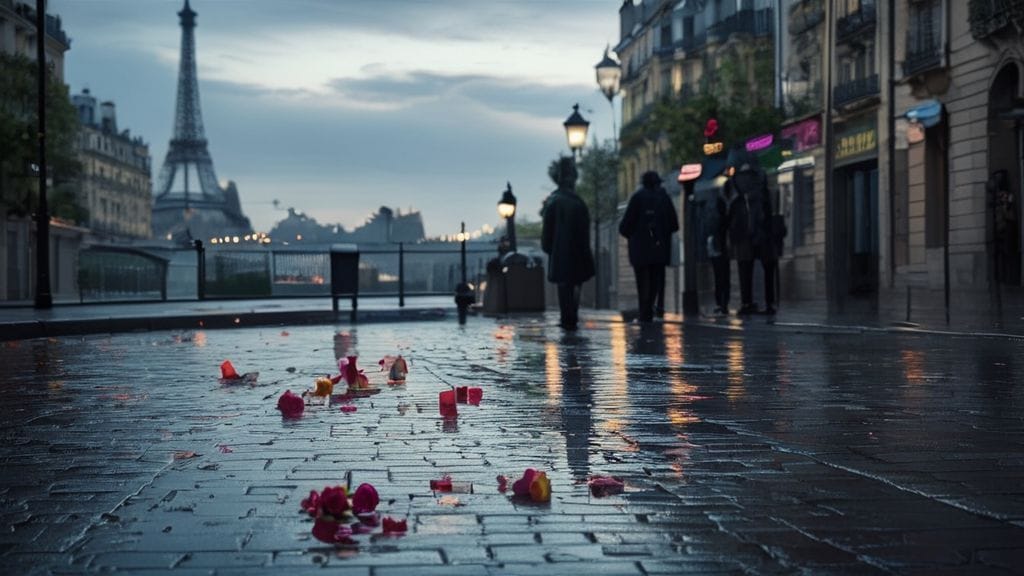
In Paris, people lined up outside schools and workplaces, hugging more tightly than usual, scanning their phones for messages. Lists of missing persons circulated on social networks. In front of the Bataclan and the café terraces, candles and flowers appeared almost immediately. Some left handwritten notes: “Even in the darkest night, we will keep singing.” Churches, mosques, and synagogues opened their doors for quiet prayer. The bells of Notre-Dame tolled in mournful solidarity with a city that had, overnight, become a symbol of vulnerability and defiance.
The numbers alone did not tell the full story, but they were stark: this was the deadliest attack on French soil since World War II and one of the worst in Western Europe in decades. The paris attacks 2015 carved a before and after into the national psyche. As one survivor put it in later testimony at the trial, “We left our homes that night in one country, and we returned—if we were lucky—to another.”
From Shock to State of Emergency: The Political Response
Political reactions to the attacks were swift and dramatic. In a televised address shortly after midnight, President François Hollande declared a nationwide state of emergency—état d’urgence—and announced that France’s borders would be temporarily closed. “What we are dealing with is an act of war,” he said, his voice heavy, “committed by a terrorist army, Daesh.” The language of war was not merely rhetorical; it signaled an intensification of France’s military campaign against ISIS abroad and a significant expansion of security powers at home.
The state of emergency granted the government broad authority: house arrests without judicial oversight, warrantless searches, bans on public gatherings, and the ability to dissolve organizations deemed a threat to public order. Parliament, in an atmosphere of near-unanimous indignation, voted to extend these measures for three months, and later for even longer. Supporters argued that extraordinary times required extraordinary tools, that the paris attacks 2015 proved the old frameworks were inadequate. Critics, including civil liberties organizations, warned that such powers risked becoming permanent, eroding democratic norms and disproportionately targeting Muslim communities.
Internationally, the attacks prompted expressions of solidarity and promises of cooperation. World leaders lit their landmarks in the blue, white, and red of the French flag. The European Union pledged deeper intelligence sharing. Within days, French warplanes intensified strikes against ISIS positions in Raqqa, Syria, hitting training camps and command centers. The narrative of reciprocity was explicit: those who had ordered the attacks in Paris would be hunted in their self-declared caliphate.
Still, beneath the formal speeches and emergency decrees lay deeper questions. Could a strategy focused on surveillance and repression alone prevent future attacks? To what extent did France’s foreign policy—its interventions in the Middle East and Africa—fuel the animosity that groups like ISIS exploited? The political debate that followed, sometimes dignified, sometimes acrimonious, would continue for years.
Europe Under Pressure: Borders, Security, and the Refugee Crisis
The paris attacks 2015 landed on a continent already strained by multiple crises. In 2015, Europe had seen the arrival of more than a million refugees and migrants, many fleeing wars in Syria, Iraq, and Afghanistan. Images of overcrowded boats in the Mediterranean and long marchers on Balkan highways dominated headlines. While some Europeans responded with empathy, others reacted with suspicion and hostility. The attacks in Paris intensified these existing tensions.
Early reports that at least one attacker may have entered Europe using forged Syrian documents via the refugee route through Greece sparked fierce political debates. Far-right parties seized on the news to argue that the refugee influx posed an existential security threat. Even when further investigations suggested that the core of the cell was composed of European citizens and residents, the association between refugees and terrorism stuck in the political imagination. Borders hardened; controls within the Schengen zone were reintroduced in several countries.
European Union institutions, already grappling with the aftermath of the eurozone crisis, now faced urgent pressure to enhance information sharing between national intelligence agencies, harmonize passenger-name records for airlines, and better track the movement of suspected radicals across borders. Yet mistrust between member states, concerns over privacy, and differing legal standards complicated these efforts. In the meantime, the route between Brussels and Paris—the path traveled by some of the attackers—became a symbol of both Europe’s openness and its vulnerability.
In a broader sense, the attacks contributed to a climate in which nationalist, anti-immigrant, and anti-Muslim rhetoric gained traction, not only in France but across the continent. Political leaders who had long campaigned on the promise of closing borders and restricting migration found new audiences for their messages. Terror, in this way, achieved one of its long-term objectives: to polarize societies and erode the liberal ideals they profess to defend.
Fear, Grief, and Resilience in Parisian Streets
In the weeks following the attacks, Paris moved through overlapping stages of mourning and defiance. Spontaneous memorials grew dense with candles, votive lights flickering in the wind, flowers wilting under the November drizzle. At the Place de la République, already a symbolic space after January’s marches, people gathered nightly, some in silence, others in hushed conversation. Graffiti appeared on walls and barricades: “Même pas peur” (“Not even afraid”), “Love is our weapon,” “You will not have our hate.”
Yet fear was palpable. Public events were canceled, concerts postponed, demonstrations banned under the state of emergency. Soldiers with automatic rifles patrolled train stations and tourist sites; bag checks became routine at museums, cinemas, even some supermarkets. Parents hesitated before sending children to school; commuters eyed unattended bags with a new suspicion. The city, always a blend of vigilance and nonchalance, tilted temporarily toward the former.
Within families and friendship circles, conversations about risk and fate multiplied. Why had one person decided, at the last minute, not to go to the Bataclan, while another died in the same seat they had occupied at dozens of previous concerts? This sense of near-miss, of randomness, haunted survivors and the bereaved. Psychologists spoke of a “collective trauma,” a wound that extended beyond direct victims to encompass a whole city, even a nation.
And yet, slowly, terraces refilled. Bars reopened. Theaters and cinemas resumed their programs. Many Parisians framed their decision to go out as an act of resistance, a small personal refusal to grant the attackers the satisfaction of a permanently cowed city. “We are here,” a café owner in the 11th arrondissement told a reporter, “not because we are not afraid, but because we refuse to live only in fear.” It was a nuanced form of courage, one that recognized fragility while insisting on continuity.
The Hunt for the Network: Brussels, Raids, and the Capture of Salah Abdeslam
As the immediate shock faded, security services across Europe turned to the painstaking work of dismantling the network behind the paris attacks 2015. Quickly, investigators traced key links to Belgium, particularly to the Brussels district of Molenbeek, which had already been associated with earlier plots. Continuities of family and friendship—brothers, cousins, childhood friends—emerged from the data, revealing how tight-knit social circles had been repurposed for clandestine violence.
One of the central figures in the manhunt was Salah Abdeslam, a French national raised in Belgium. He had rented cars used in the attacks, driven some of the attackers to Paris, and was believed to have abandoned a suicide belt in the south of the city before fleeing back to Brussels. For months, Europe’s most wanted man evaded capture, slipping through police dragnets, apparently assisted by a network of sympathizers and accomplices. His flight became a symbol of both the determination of the attackers and the limits of European policing.
In November 2015, only days after the attacks, French police tracked Abdelhamid Abaaoud to an apartment in Saint-Denis. A dramatic raid followed. He and an accomplice were killed after a prolonged firefight, during which a woman detonated an explosive device. Yet the network was not fully dismantled. Only in March 2016, after intensive surveillance and a tip-off, did Belgian police corner and arrest Abdeslam in the Molenbeek neighborhood. The operation came just days before coordinated bombings at Brussels Airport and a metro station, also linked to the same broader network.
The Abdeslam arrest and subsequent trials would reveal chilling details of the planning and mindset behind the attacks. It became clear that the paris attacks 2015 were part of a larger strategy to strike multiple European capitals, to turn the continent into a perpetual battlefield. Investigators uncovered safe houses, weapons caches, and forged documents that testified to both the sophistication and fallibility of the network. Each discovery answered some questions and raised new ones, particularly about how such a large operation could have gone undetected for so long.
Intelligence Failures and Hard Lessons for Security Services
In the inevitable postmortem that followed the attacks, intelligence and security services came under harsh scrutiny. Multiple parliamentary inquiries and journalistic investigations sought to understand how individuals already known to authorities—Abaaoud, the Abdeslam brothers, and others—could orchestrate such a devastating assault. The answers were complex, pointing to both structural constraints and missed opportunities.
France, like many democracies, had long struggled with the sheer volume of potential threats. By 2015, thousands of individuals were listed as fichés S, flagged for suspected radicalization or extremist sympathies. Monitoring even a fraction of them around the clock was logistically impossible. Intelligence agencies prioritized those deemed most dangerous, but ranking that danger was more art than science. In some cases, information about travel to Syria or Iraq had been noted but not fully exploited. In others, coordination between foreign and domestic services faltered, leaving gaps that the attackers slipped through.
European cooperation suffered from similar problems. Databases existed, but not all member states contributed equally or updated them consistently. Legal barriers around data sharing, privacy concerns, and professional rivalries between agencies hindered the free flow of information. The paris attacks 2015 starkly exposed these shortcomings. As one official told a commission, “We were prepared for the attacks we feared; we were not perfectly prepared for the attacks they planned.”
In response, France invested heavily in intelligence, hiring new analysts, upgrading surveillance technologies, and expanding legal frameworks for digital monitoring. Critics warned of the risk of creating a security apparatus too powerful, with insufficient oversight. Supporters countered that another 13 November had to be prevented at all costs. The tension between security and liberty, always present, now shaped a new generation of laws and norms.
Islam, Identity, and the Struggle Over Narratives
Beyond the technical realm of intelligence and policing, the attacks ignited intense debates about religion, identity, and the meaning of being French in the 21st century. The attackers claimed to act in the name of Islam, invoking grievances over Western interventions in Muslim-majority countries and the marginalization of Muslims in Europe. Yet Muslim leaders and organizations across France and the world swiftly condemned the violence, insisting that such acts bore no resemblance to the faith they lived daily.
Imams in Paris neighborhoods delivered sermons denouncing the attackers as criminals and betrayers of Islam. Some mosques organized open days, inviting non-Muslim neighbors to visit, to ask questions, to share tea. At the same time, anti-Muslim incidents spiked: graffiti on mosques, verbal harassment of hijab-wearing women, arson attacks on prayer rooms. The attackers, in their perverse logic, had sought precisely this escalation, hoping to drive a wedge between Muslims and non-Muslims, to foster the alienation that could feed future recruitment.
Public discourse turned to questions of integration, secularism, and “communitarianism.” Were certain neighborhoods, particularly in the banlieues, incubators of radicalism due to unemployment and discrimination? Or did the problem lie primarily in extremist ideology imported from conflict zones? Different political factions emphasized different explanations, often aligned with their preexisting views. Sociologists and historians urged nuance, pointing out that the vast majority of French Muslims rejected violence and that the path to radicalization typically involved a complex mix of personal crisis, social networks, and ideological framing.
In this contested field of narratives, the memory of the paris attacks 2015 became a symbolic resource, invoked to justify policies ranging from expanded counterterrorism powers to stricter rules on religious expression. The struggle over who gets to speak for the victims, and in whose name, continues to this day.
Art, Memorials, and the Battle for Collective Memory
As months turned into years, the city’s visible scars began to heal. Broken windows were replaced, bullet holes patched, crime-scene tape removed. But another process, more subtle and profound, was underway: the construction of memory. How would Paris, and France, remember 13 November 2015? Which images, words, and rituals would anchor that memory in public consciousness?
Artists responded quickly. Murals appeared on walls near the sites of the attacks, some depicting doves or intertwined hands, others abstract evocations of shattered but resilient hearts. Concerts were organized in tribute to the victims; musicians who had survived the Bataclan returned, trembling but determined, to perform again. Writers, too, tried to capture the experience. Novels, essays, and graphic narratives explored the subjective dimensions of fear and survival. In one widely cited reflection, a French novelist wrote, “It was as if the city had inhaled a dark breath, and we were all learning to exhale again.”
Official memorials developed more slowly. Temporary plaques at the Bataclan and the cafés were eventually replaced with permanent markers, listing the names of those who died. Annual commemorations on 13 November brought together families of victims, politicians, and ordinary citizens. The act of reading the names aloud—one by one, in the chill of mid-November—became a ritual of recognition, a way to resist the erasure that time threatens.
Yet memory is never purely consensual. Some activists argued that the focus on victimhood risked overshadowing necessary debates about foreign policy and social injustice. Others worried that the attacks were being instrumentalized by political actors seeking to advance agendas unrelated to the victims’ lives. In response, many families of the dead insisted on nuanced remembrance: honoring those lost without simplifying the complexity of the world that produced their killers. The paris attacks 2015 thus entered the long, contested history of how societies encode trauma into narrative.
The Long Road of Justice: Trials, Testimonies, and Accountability
Justice, after such a vast crime, can never fully compensate for the loss, but it can offer a framework for truth-telling and accountability. In France, the investigation into the paris attacks 2015 culminated in one of the largest and most complex criminal trials in the country’s history. Held in a specially constructed courtroom in Paris, the trial began in September 2021 and lasted many months, involving hundreds of plaintiffs, dozens of lawyers, and a thick dossier of evidence.
The defendants included Salah Abdeslam, the only surviving direct participant in the attacks, and several others accused of logistical support: providing weapons, vehicles, false documents, or safe houses. Over the course of the proceedings, survivors and relatives of victims were invited to testify. Their accounts were harrowing: descriptions of hiding under bodies in the Bataclan, of calling loved ones from café floors, of the long-term physical and psychological wounds they carried. One survivor told the court, “I am alive, but the person I was before is dead.”
The trial also examined broader questions: who gave orders, how the network was structured, which opportunities authorities had missed. Intelligence officials, police officers, and experts were called to the stand. Some answers were precise; others remained frustratingly vague. In June 2022, the court delivered its verdicts, handing down life sentences and long prison terms to the main defendants. For some families, the outcome brought a measure of closure. For others, it felt like an administrative endpoint to something that would never truly end.
In a sense, the trial functioned as both a legal and a historical forum, assembling an official record of what happened and why. As the historian and political scientist Gilles Kepel observed during the proceedings, “Here, law meets memory. It is where individual stories become part of the collective history of our time.”
Global Reverberations: From Paris to Other Cities Under Attack
The paris attacks 2015 did not occur in isolation; they were part of a grim sequence of terrorist assaults that spanned continents. In the years surrounding November 2015, cities such as Ankara, Beirut, Brussels, Nice, Berlin, London, and Manchester were likewise targeted. Each had its own particular context, its own list of victims, but together they formed a pattern: public spaces turned into sites of indiscriminate slaughter, attackers claiming allegiance to or inspiration from ISIS or similar groups.
Paris, however, occupied a special place in the global imagination. The city’s symbolic weight—as a capital of art, romance, and enlightenment—meant that an attack there resonated far beyond its borders. Vigils were held in New York, Sydney, Rio de Janeiro, and countless other cities. The Eiffel Tower, darkened in mourning and later illuminated again, became an instantly recognizable emblem of solidarity. For many, the attacks reinforced the sense that there was a shared global struggle against violent extremism, even if its precise contours and causes remained disputed.
At the same time, the global response exposed divisions over strategy. Some argued for intensified military campaigns against ISIS and similar groups, more robust intelligence sharing, and tougher domestic security laws. Others insisted that without addressing underlying grievances—political repression, economic inequality, sectarian conflict—new movements would inevitably emerge to replace those defeated on the battlefield. The memory of Paris thus fed into larger debates about how the 21st century world should confront non-state violence and ideological fanaticism.
How Paris Changed: Security Culture, Daily Life, and Public Space
Years after the sirens faded, the legacy of the paris attacks 2015 could still be read in the city’s fabric and routines. Security measures born of emergency gradually became part of the background. Bag inspections at major museums, pat-downs at concerts, and visible police or military patrols in busy squares became normalized. Many venues installed metal detectors; some redesigned entrance areas to better control flows of visitors. Architects and urban planners began to integrate “hostile vehicle mitigation” features—bollards, planters, reinforced barriers—into the landscape, often discreetly, to protect pedestrian zones from potential car or truck attacks, like the one later seen in Nice in 2016.
For ordinary Parisians, these changes created a new mental map of risk. Crowded events, once attractive for their festive energy, now carried a faint overlay of anxiety. Parents rehearsed with their children what to do in case of an attack: where to hide, how to remain calm, how to contact family. Schools conducted drills not only for fires but for “intrusion” scenarios, a chilling lexical shift. Some people chose to avoid large gatherings; others, conversely, sought them out as a way to reclaim space.
At the same time, the city’s spirit of everyday sociability persisted. Terraces bustled on summer evenings, the banks of the Seine filled with picnickers, metro trains jammed at rush hour. The balance between vigilance and normality remained delicate but real. Paris had changed, undeniably, but it had not surrendered the fundamental rhythms of its life. In this, perhaps, lies the city’s quiet answer to those who sought to terrorize it: not a denial of vulnerability, but a sustained commitment to living publicly, together, despite the risks.
Conclusion
The attacks of 13 November 2015 were more than a sequence of explosions and gunfire; they were a profound rupture in the lived experience of a city, a country, and, in many ways, a continent. The paris attacks 2015 crystallized a series of tensions that had been building for years: between security and liberty, openness and protection, memory and forgetting. They exposed the reach and ruthlessness of a transnational extremist network while also revealing the limits of our institutions, from intelligence services to political leadership.
Yet alongside the horror, the night and its aftermath also revealed something else: the extraordinary capacity of ordinary people to care for one another under unimaginable pressure. From the café patron who pressed her hands into a stranger’s wound to the doctor who worked through the night without rest, from the neighbor who opened their door to those fleeing the streets to the survivors who later stood in court to speak the truth—the response to the attacks contained countless acts of quiet heroism.
The story of the paris attacks 2015, then, is not only a story of perpetrators and victims, of policies and trials. It is also a story about how societies absorb trauma, argue over its causes, and attempt to shape its legacy. In the plaques on walls, the annual ceremonies, the continuing debates over security and integration, the attacks live on in collective memory. History cannot undo what was done that night, but it can help us understand, and in understanding, perhaps help us to imagine paths that reduce the likelihood of such nights in the future.
FAQs
- What happened during the Paris attacks on 13 November 2015?
The paris attacks 2015 were a series of coordinated terrorist assaults carried out by militants linked to the Islamic State (ISIS). They targeted the Stade de France, several cafés and restaurants in the 10th and 11th arrondissements, and the Bataclan concert hall. Suicide bombers detonated explosives near the stadium while gunmen opened fire on crowded terraces and inside the Bataclan, where a concert was underway. - How many people were killed and injured in the attacks?
A total of 130 people were killed in the attacks, making them the deadliest on French soil since World War II. More than 400 others were injured, many with life-altering physical and psychological wounds. The highest number of fatalities occurred at the Bataclan concert hall. - Who was responsible for organizing the attacks?
The attacks were claimed by the Islamic State, which at the time controlled territory in Syria and Iraq. Investigations identified Abdelhamid Abaaoud, a Belgian national who had fought in Syria, as a key coordinator, working with a network based largely in Belgium and France. Several of the attackers were European citizens, including French and Belgian nationals, some of whom had previously been on intelligence watch lists. - How did the French government respond?
The French government declared a nationwide state of emergency on the night of the attacks, expanding police powers for searches, house arrests, and bans on public gatherings. President François Hollande described the events as an “act of war” and ordered intensified airstrikes against ISIS positions in Syria. Parliament later extended the state of emergency, and France introduced a range of new counterterrorism measures. - What was the impact on everyday life in Paris?
In the immediate aftermath, public events were canceled, and visible security presence increased dramatically, with soldiers and armed police patrolling key sites. Over time, bag checks, metal detectors, and other security protocols became routine at many venues. While fear and anxiety left a deep mark, Parisians gradually returned to their terraces, concerts, and public spaces, often framing this return as a conscious act of resilience. - Were there any major trials related to the attacks?
Yes. A large criminal trial began in Paris in 2021, focusing on Salah Abdeslam, the only surviving direct participant, and several accomplices accused of logistical support. The proceedings included extensive victim testimony and expert analysis. In 2022, the court handed down life sentences and long prison terms to the main defendants, establishing an official judicial record of the events and responsibilities. - How did the attacks affect European security policy?
The paris attacks 2015 accelerated efforts within the European Union to enhance intelligence sharing, tighten border controls, and implement passenger-name record systems for air travel. They also fueled political debates about migration, integration, and the balance between security and civil liberties. Many member states expanded their counterterrorism laws in the years that followed. - How are the victims and events commemorated today?
Each year on 13 November, ceremonies are held at the sites of the attacks, where officials, survivors, and families of victims gather to read the names of those who died and lay wreaths. Permanent plaques mark the locations, and memorial artworks and performances contribute to an evolving culture of remembrance. These commemorations aim both to honor the victims and to affirm the values—life, freedom, shared public space—that the attackers sought to undermine.
External Resource
Internal Link
Other Resources
- Encyclopaedia Britannica – general search for the exact subject
- Google Scholar – academic search for the exact subject
- Internet Archive – digital library search for the exact subject