Table of Contents
- Dawn over Paris: The Birth of a Commune
- The Decline of the Second Empire: Seeds of Revolt
- The Franco-Prussian War and the Siege of Paris
- The Fall of Napoleon III: A Nation in Turmoil
- The Rise of the National Guard: Defenders or Revolutionaries?
- March 18, 1871: The Spark that Ignited the Commune
- The Proclamation of the Paris Commune: A New World in the Making
- Governing Paris: The Commune’s Radical Vision
- Social Reform and Revolutionary Ideals: From Worker's Rights to Secular Education
- Women in the Commune: A Silent Revolution
- The Internal Struggles: An Uneasy Alliance of Radicals and Moderates
- The National Government and the Commune: Two Frances at War
- The Bloody Week: The Tragedy of May 1871
- Aftermath and Retribution: A City Scorched and a People Bruised
- The Legacy of the Paris Commune: Revolution, Memory, and Myth
- The Commune’s Echo in Future Movements: From Marx to Modern Socialism
- Paris Commune in Art and Literature: The Revolution Immortalized
- Revisiting the Commune: Historical Debates and New Perspectives
- Why the Commune Still Inspires: Lessons in Courage and Despair
Dawn over Paris: The Birth of a Commune
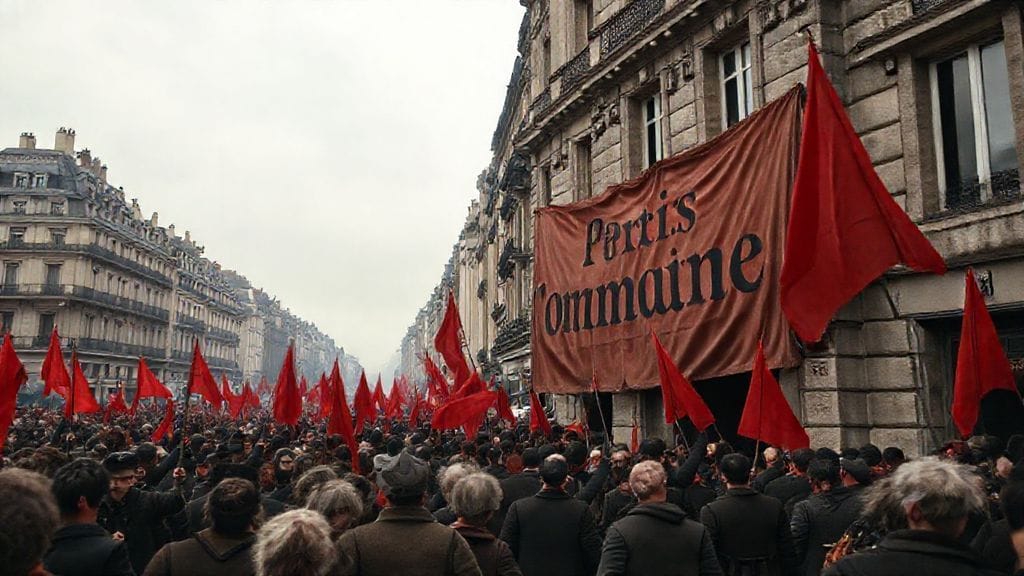
The chill of early spring hung thick in the air of Paris on March 18, 1871, mist weaving through the narrow alleys and wide boulevards alike. Amid the smoky breath of war, and the lingering tension of defeat, an electric murmur pulsed beneath the cobbled stones. The people of Paris were on the precipice—of revolt, of hope, and of tragedy. As dawn broke over the city that had for centuries been a beacon of culture and power, the streets Below the spires of Notre-Dame and the arches of the Place de la Concorde, a new chapter was about to be written: the birth of the Paris Commune.
It was not merely an uprising, nor a fleeting insurrection—it was a bold, nascent attempt to reinvent society itself in the ashes of empire. The Commune was proclamation, experiment, crucible: a city seizing control of its fate and daring to envision democracy through the eyes of workers, soldiers, and citizens long held at the margins of power.
But how did this startling upheaval come to pass? What fire forged the Commune from the embers of France’s defeat? This story is, above all, a human story—a saga of desperation and hope, of bitter conflict and soaring idealism.
The Decline of the Second Empire: Seeds of Revolt
To understand the Paris Commune, one must first peer back into the fracturing world of the Second French Empire under Napoleon III. Once a symbol of grandeur, ambition, and order, the empire had grown brittle amid wars abroad and unrest at home.
The 1860s were a decade of contradictions: economic modernization and widening inequality, authoritarian rule and rising demands for liberty. Napoleon III navigated a precarious line—liberalizing somewhat, but refusing true democracy. His regime alienated republicans, socialists, and workers alike.
Growing hunger for political reform simmered beneath Paris’s elegant facades while the working class struggled with low wages, poor living conditions, and little political voice. Tensions clung to the city’s air like smog—waiting.
The Franco-Prussian War and the Siege of Paris
The rupture came with the disastrous Franco-Prussian War of 1870-1871. France, confident yet ill-prepared, faced a rapid and humiliating defeat at the hands of the Prussians and their German allies.
After the capture of Napoleon III at Sedan in September 1870, the French government collapsed, replaced by the hastily formed Third Republic. But the new regime was weak, overwhelmed by the shock of defeat.
Paris endured a cruel siege lasting four brutal months. Food shortages, cold, and constant bombardment forged city-wide suffering. Yet it also nurtured a growing solidarity among its people—workers, soldiers, and citizens bound together by hardship.
The Fall of Napoleon III: A Nation in Turmoil
Napoleon III’s capture marked not just a military loss but a spiritual one for many Parisians. The figure who had once promised order and stability was now a prisoner, and the empire’s days were numbered.
In this vacuum, political factions vied for power. The new republican government, led from Versailles outside Paris, was cautious, conservative, and distrustful of the revolutionary temper rising among Parisians.
The division between the capital and the provinces widened dangerously. Paris, proud and defiant, became a city unto itself—its citizens skeptical of Versailles’s authority and hungry for change.
The Rise of the National Guard: Defenders or Revolutionaries?
Made up largely of working-class citizens, the National Guard was a powerful force in Paris. Initially intended as a militia to defend the city from Prussian forces, by 1871 the Guard had become politicized.
Its ranks swelled with socialists, radicals, and ordinary citizens who saw in it the means to defend their rights and achieve political reform. Loyal to the people rather than the government in Versailles, the National Guard stood poised between order and revolution.
The Guard’s control of the city’s armories and fortifications meant that Paris held formidable leverage—something few expected it would wield with such determination.
March 18, 1871: The Spark that Ignited the Commune
On the morning of March 18, events moved quickly and dramatically.
The government, fearful of losing the cannons stored on Montmartre and other forts, ordered troops to seize them. But the National Guard and Parisians would not comply.
When government troops attempted to take the cannons, they were met with fierce resistance and ultimately retreated. In the turmoil, two generals were arrested and later executed by angry crowds.
This defiance was a turning point: the government’s authority evaporated in the capital; the Commune was born amidst cheers, shouts, and a city alive with possibility and peril.
The Proclamation of the Paris Commune: A New World in the Making
Within days, the Paris Commune was formally declared. On March 26, citizens elected a revolutionary municipal council—composed largely of socialists, anarchists, and radical republicans.
The Commune was characterized by its bold vision: a government “for the people, by the people,” grounded in direct democracy, social equality, and workers’ control.
No longer subjects of distant rulers, Parisians embraced self-government with fervor. The Commune sought to abolish oppressive institutions: it proposed free education, workers’ cooperatives, abolition of conscription, and more.
But it was not a utopia—challenges and contradictions quickly emerged.
Governing Paris: The Commune’s Radical Vision
The Commune established a series of innovative policies unprecedented in European political history.
It implemented measures like the remission of rents during the siege, separation of church and state, and the abolition of night work in bakeries. It invited workers to manage their workplaces, promoted gender equality, and sought to democratize public services.
This was a government that rejected hierarchy, promoted accountability, and attempted to bridge social divides through communal effort.
Yet, governing a city still vulnerable and divided was fraught with difficulty. The Commune balanced between radical measures and pragmatic governance, often wrestling with ideological disputes.
Social Reform and Revolutionary Ideals: From Worker's Rights to Secular Education
The Commune’s social agenda was daring. It championed the rights of workers like never before: scrap the miserly wages, create democratic workplaces, and ensure basic welfare.
Education, seen as key to liberation, became secular and free—challenging the long dominance of the Catholic Church in French society.
For many Parisians, this was a breath of fresh air amid decades of inequality. For others, especially conservatives, it was a frightening step toward chaos.
Women in the Commune: A Silent Revolution
Though often overshadowed by male leaders, women played crucial roles in the Commune.
Figures like Louise Michel emerged as fierce defenders of the revolution, leading protests, organizing medical aid, and advocating for women’s rights.
The Commune’s recognition of women’s petitions, inclusion in commune activities, and their active participation in the National Guard was revolutionary in itself.
Yet, traditional gender norms remained strong, and women’s full political inclusion was limited—a testament to the contradictions within the revolution.
The Internal Struggles: An Uneasy Alliance of Radicals and Moderates
Despite their united front, the Commune’s leadership was divided.
More radical factions pushed for swift socialization of property and deeper reforms, while moderates advocated caution, fearing alienation or provoking harsh reprisals.
Debates over justice for the executed generals, the role of religion, and military tactics revealed fault lines.
These tensions weakened the Commune’s capacity to act decisively just when unity was most desperately needed.
The National Government and the Commune: Two Frances at War
The government in Versailles refused to accept the Commune’s authority.
Determined to crush the uprising, Versailles mobilized an army, supported by rural France and conservative elites alarmed by the Commune’s experiment.
From March to May 1871, France was therefore split—not just geographically, but ideologically and socially—between two conflicting visions of governance: authoritarian centralism versus grassroots democracy.
The Bloody Week: The Tragedy of May 1871
The final chapter of the Commune was a week of unprecedented violence and tragedy known as “La Semaine Sanglante” or The Bloody Week.
Versailles troops entered Paris, street by street, meeting fierce resistance from Commune fighters.
The city became a battlefield: barricades, sniper fire, arson, and brutal combat marked these days.
By May 28, the Commune was crushed. Thousands were killed in battle, many more executed in summary trials or imprisoned. The city was scarred, both physically and emotionally.
Aftermath and Retribution: A City Scorched and a People Bruised
The defeat of the Commune was not just military defeat; it was social and cultural trauma.
Paris underwent harsh purges, trials, and repression. The memory of the Commune was suppressed, labeled as anarchist chaos by conservative historians for decades.
Yet among workers, socialists, and radicals, it became a symbol of courage, resistance, and a vision unfulfilled.
The Legacy of the Paris Commune: Revolution, Memory, and Myth
Though fleeting, the Commune left an indelible mark on political history.
It inspired Marx and Engels, informed socialist and anarchist doctrine, and became a rallying cry for future revolutionaries.
Over time, it transformed into a powerful myth of the city of the people—a testament to both the possibilities and dangers of radical self-government.
The Commune’s Echo in Future Movements: From Marx to Modern Socialism
Karl Marx famously described the Commune as “the dictatorship of the proletariat” — both a warning and an inspiration.
Throughout 20th century revolutions, labor movements, and civil rights struggles, echoes of the Commune’s ideals resounded.
Its lessons on the challenges of revolution, democracy, and social justice continue to fuel debates.
Paris Commune in Art and Literature: The Revolution Immortalized
The Commune’s dramatic story fascinated artists, poets, and writers.
From Émile Zola’s novels to Picasso’s paintings, the revolution was immortalized as both tragedy and heroic struggle.
Songs, pamphlets, and monuments celebrated its martyrs and ideals, ensuring the Commune’s place in cultural memory.
Revisiting the Commune: Historical Debates and New Perspectives
Modern historians continue to debate the Commune’s successes and failures.
Was it a noble experiment or a reckless insurrection? Could it have survived or was it doomed by circumstance?
New archival discoveries and fresh interpretations invite us to rethink the Commune beyond mythology or condemnation.
Why the Commune Still Inspires: Lessons in Courage and Despair
More than 150 years later, the Paris Commune remains a powerful symbol.
It reminds us of the human capacity for courage in the face of oppression, but also the fragility of revolutionary hope.
Its story invites reflection on justice, democracy, and the perennial struggle for a fairer world.
Conclusion
The Paris Commune of 1871 stands as one of history’s most remarkable episodes—a brief, fiery moment when ordinary people dared to seize power and imagine a different society. Amid the ruins of war and empire, Parisians embraced radical democracy, social justice, and equality, creating a government of the people for the people.
Though crushed with ruthless violence, the Commune left a legacy that transcends its tragic end. It challenges us to remember that history is not only shaped by kings and generals, but also by workers, women, and citizens who dare to dream.
In the end, the Commune is a mirror held to every generation: a reminder that the quest for freedom is both noble and perilous, and that the flame of revolution, once lit, continues to inspire and warn across time.
FAQs
What caused the Paris Commune to be proclaimed in March 1871?
The Commune emerged from the deep social, political, and military crises following France’s defeat in the Franco-Prussian War, the collapse of Napoleon III’s empire, and escalating tensions between Paris’s working classes and the conservative government in Versailles.
Who were the main leaders of the Paris Commune?
Leaders included figures like Louis Auguste Blanqui (though largely imprisoned), Jules Vallès, Raoul Rigault, and Louise Michel, a passionate advocate for workers and women.
What social reforms did the Paris Commune implement?
It introduced secular education, worker control of workplaces, abolition of night work in bakeries, remission of rents, separation of church and state, and promoted gender equality, among others.
How did the Paris Commune end?
After two months of revolutionary government, Versailles troops violently reclaimed Paris during the Bloody Week (May 21–28, 1871), executing thousands and imprisoning many more.
What is the historical significance of the Commune?
The Commune inspired socialist, anarchist, and labor movements worldwide, serving both as a model for radical democracy and a cautionary tale about revolution’s challenges.
How did women participate in the Paris Commune?
Women played active roles as combatants, nurses, propagandists, and organizers, symbolized by figures like Louise Michel, although full political rights were not granted.
Why is the Commune often considered a ‘myth’?
Because of its brief duration, violent suppression, and polarized portrayals, the Commune has been idealized by some as a heroic struggle and dismissed by others as chaos, creating a complex legendary status.
Where can I learn more about the Paris Commune?
The Wikipedia page on the Paris Commune offers a detailed overview and bibliography for deeper study.