Table of Contents
- The Dawn of Bloodshed: May 28, 1871, and the Fall of the Paris Commune
- From Utopia to Tragedy: The Origins of the Paris Commune
- The Franco-Prussian War and the Siege of Paris: A City Under Siege
- The Spark of Revolution: The Commune Declared
- Ideals and Turmoil: The Commune’s Vision for a New Society
- The Internal Struggles: Divisions Within the Commune
- Versailles on the March: Government Forces Prepare to Retake Paris
- The Bloody Week Begins: May 21 to May 28, 1871
- Street Fighting and Urban Carnage: Paris in Flames
- The Execution of Hostages: A City Haunted by Revenge
- The Role of Women in the Commune and the Bloody Week
- The Massacre’s Toll: Death, Destruction, and Despair
- The Aftermath: Repression, Trials, and Exile
- The Commune in Memory: Martyrs and Myths
- The Political Ripples: France and Europe After the Commune
- Legacy of the Commune: Inspiration for Future Revolutions
- How the Semaine Sanglante Shaped Modern Paris
- Voices from the Ashes: Eyewitnesses and Personal Stories
- The Commune in Art and Literature: Echoes Through Time
- Historical Debate: Heroism or Tragedy?
- Conclusion: The End of the Commune and the Eternal Fight for Justice
- FAQs: Understanding the Paris Commune and Bloody Week
- External Resource: Link to Wikipedia Article
- Internal Link: Visit History Sphere
The Dawn of Bloodshed: May 28, 1871, and the Fall of the Paris Commune
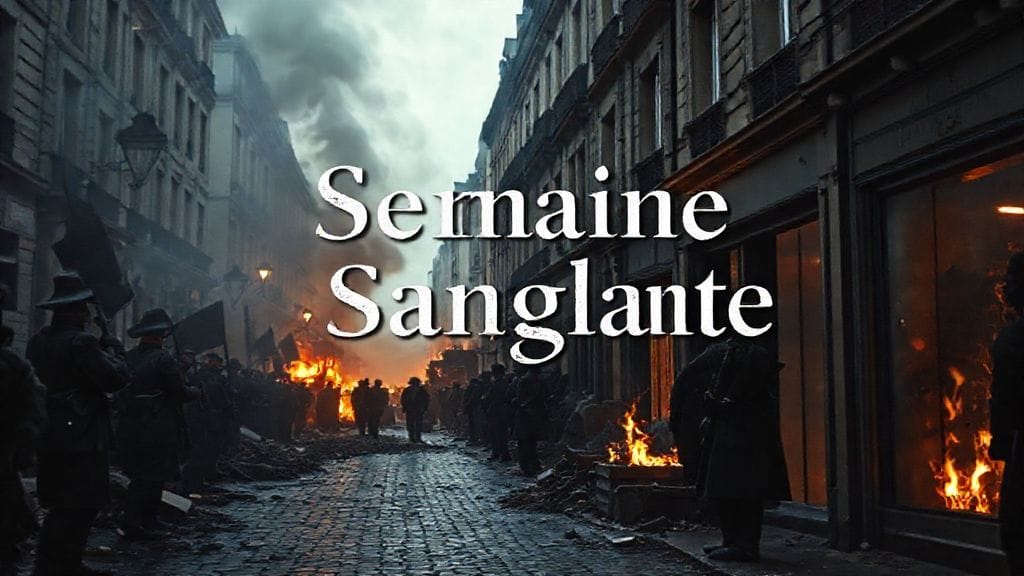
On a cold and misty morning in late May 1871, the once vibrant streets of Paris turned into a labyrinth of smoke, rubble, and despair. The final chokehold of what would become known as the Semaine Sanglante—the Bloody Week—was tightening. As the sun rose over the rooftops steeped in the red hue of burning barricades, thousands of Parisians found themselves caught between hope and horror. This was not merely a military assault; it was the tragic collapse of a daring experiment in radical self-governance, a final chapter drenched in blood.
Paris, for days, had been a city devastated by conflict, its boulevards transformed into battlefields, its walls etched with the scars of gunfire. Behind the smoke, citizens—workers, artisans, soldiers, and revolutionaries—wrestled between desperate determination and the all-consuming chaos of urban warfare. And then, on May 28, the inevitable happened: the Commune’s last stands crumbled, its leaders captured or dead, and its dream smothered beneath the boots of government troops from Versailles.
But this ending was more than just military defeat. It was the violent suppression of voices clamoring for justice, equality, and dignity. It was a brutal reckoning with the price of revolution, the human cost of hope turned to ashes.
From Utopia to Tragedy: The Origins of the Paris Commune
The Paris Commune was born out of crisis—a crucible of military defeat, political betrayal, and social upheaval. To understand the carnage of Bloody Week, one must journey back to the spring of 1871, when France was shattered by the catastrophic defeat in the Franco-Prussian War. The humiliation of defeat, the fall of Napoleon III’s Second Empire, and the Siege of Paris created fertile ground for the radical ideas that blossomed into the Commune.
Paris was a city divided. Beneath its elegant facades lay the simmering anger of the working classes, crushed by poverty, harsh labor conditions, and political exclusion. Meanwhile, conservative forces, monarchists, and the emerging bourgeoisie eyed the capital warily, fearful of revolutionary contagion. It was a volatile mix of resentments and aspirations—a tinderbox waiting for a spark.
The Franco-Prussian War and the Siege of Paris: A City Under Siege
In July 1870, war erupted between France and the rising power of Prussia. The conflict was swift and brutal. By September, the French army was decisively crushed at Sedan, and Emperor Napoleon III was captured. Paris, encircled and starved, endured months of siege and hardship. The desperate hunger and relentless bombardment forged a resilience—and a radicalization—among its citizens.
The siege deepened class tensions: the government, stationed in Versailles, seemed distant and disconnected from the suffering within Paris’s walls. The city’s working population, faced with starvation and privation, grew restless, fueling revolutionary sentiment.
The Spark of Revolution: The Commune Declared
On March 18, 1871, as the government attempted to disarm the Paris National Guard—a militia primarily composed of working-class Parisians—hostilities erupted. The soldiers refused to surrender their guns, and violent clashes led to the arrest of the government’s representatives. In an electrifying moment of defiance, Parisians declared the establishment of the Commune, a self-governing body rooted in socialist and anarchist principles.
The Commune represented a radical break with the past: it promised workers’ control, communal governance, secular education, and an egalitarian society. It was a bold experiment, challenging the authority of the French state and the entrenched social order.
Ideals and Turmoil: The Commune’s Vision for a New Society
The Commune sought to reimagine society from the ground up. It abolished conscription, reduced working hours, and allowed workers to reclaim factories abandoned by owners fleeing the turmoil. It championed women's rights, secularism, and direct democracy. It was an unprecedented assertion of popular sovereignty.
Yet beneath the noble ideals lurked contradictions and conflicts. The Commune was a coalition of socialists, anarchists, Blanquists, and radicals—united against a common enemy but divided on methods and goals. Time was short, and internal disputes often hampered decisive action.
The Internal Struggles: Divisions Within the Commune
In the heat of revolution, the Commune’s internal fissures widened. Leaders like Louis Auguste Blanqui advocated for centralized control and military discipline, while more anarchic factions pushed for decentralized power. These disagreements manifested in paralysis at critical moments, undermining the Commune’s ability to coordinate defense.
Moreover, the Commune’s leaders faced external pressures from Versailles, public opinion, and the omnipresent shadow of defeat. The disparity between revolutionary zeal and pragmatic governance created bitter tensions that would haunt their final days.
Versailles on the March: Government Forces Prepare to Retake Paris
Meanwhile, in Versailles, the French government, led by Adolphe Thiers, prepared its counteroffensive with grim determination. Thiers, wary of revolutionary contagion, mobilized regular army forces—retreating Prussian allies tacitly permitting the suppression—to reclaim Paris and crush the insurgency.
The government forces were better armed, trained, and commanded. Their strategy was methodical: isolate, bombard, and methodically regain control of Paris’s arrondissements. The fate of the Commune was sealed as Versailles’ troops advanced.
The Bloody Week Begins: May 21 to May 28, 1871
The Semaine Sanglante commenced on May 21, with government troops entering Paris and starting house-to-house combat. The city turned into a nightmarish battlefield, where every street corner held the potential for death. The fighting was brutal, intimate, and merciless.
Barricades rose again, echoes of 1848 and 1832, but this time the outcome was starkly different. The rebels were fewer in number and poorly supplied. The government’s troops, many veterans seeking revenge for defeat and humiliation, showed no mercy.
Street Fighting and Urban Carnage: Paris in Flames
“Paris is on fire,” an eyewitness reported—an understatement. The battle scars were writ large in the burnt-out shells of buildings, the twisted debris of collapsed walls, and the acrid stench of gunpowder mingled with smoke. The Commune’s defenders fought fiercely, turning streets into mazes of death.
The destruction was both physical and symbolic. The Commune set fire to important landmarks, including the Tuileries Palace and the Hôtel de Ville, a desperate act of defiance but also one that wrought devastation on the city’s heritage.
The Execution of Hostages: A City Haunted by Revenge
As government forces closed in, the Commune took retaliatory measures, executing hostages including prominent figures like Archbishop Darboy. This grim cycle of violence intensified the brutality of the conflict. The executions, while horrific, reflected the desperation and radicalism permeating the Commune’s final hours.
Yet, the government’s subsequent massacre of thousands of Communards far eclipsed these acts, turning the suppression into one of modern history’s bloodiest urban confrontations.
The Role of Women in the Commune and the Bloody Week
Women played a vital and often overlooked role in the Commune—both in governance and on the barricades. Figures like Louise Michel emerged as legendary warriors, educators, and organizers. The Commune embraced women’s emancipation in a way unprecedented for the time.
During Bloody Week, women fought alongside men, tended to the wounded, and resisted arrest. Their courage stood as a testament to the inclusive spirit of the Commune and the broad social aspirations that fueled the uprising.
The Massacre’s Toll: Death, Destruction, and Despair
By May 28, the bloodbath was nearly over. Estimates of the death toll vary, but historians agree that upwards of 20,000 Communards were killed during the fighting and its aftermath. Thousands more were arrested, tortured, or sentenced to exile.
The physical destruction was immense. Neighborhoods lay in ruins, families torn apart. Paris bore the scars of civil war, and the trauma seeped deep into the city’s collective memory.
The Aftermath: Repression, Trials, and Exile
The Versailles government unleashed a campaign of repression unparalleled in French history. Courts-martial, executions, imprisonments, and deportations to New Caledonia decimated the Commune’s ranks. Survivors scattered across Europe and the world, carrying the Commune’s ideals into exile.
Politically, the government reasserted control but at the cost of deep societal divisions. The Commune’s defeat did not quell revolutionary fervor; instead, it transformed it into a martyrdom that inspired generations.
The Commune in Memory: Martyrs and Myths
From the ashes arose a potent mythology. The Commune became a symbol of proletarian resistance, immortalized by Marxist and socialist movements worldwide. Streets and memorials bear the names of heroes who perished.
Yet, the Commune was also demonized by conservatives as anarchy incarnate. Its legacy remains contested, a prism through which ideals of liberty, equality, and violence are endlessly debated.
The Political Ripples: France and Europe After the Commune
The crushing of the Commune reverberated across Europe. Monarchies and republics alike watched and learned—some fearful of similar uprisings, others inspired. The Commune influenced revolutionary theory deeply, contributing to Marx’s writings and later communist movements.
In France, the trauma complicated national politics, feeding into the polarization that weighed down the Third Republic for decades.
Legacy of the Commune: Inspiration for Future Revolutions
Despite its violent end, the Commune seeded ideas of workers’ control, social justice, and radical democracy. It inspired the Russian Revolution a half-century later, anarchist uprisings, and leftist movements worldwide.
Its message—that ordinary people could seize power and reshape society—continued to resonate, long after the smoke cleared.
How the Semaine Sanglante Shaped Modern Paris
Modern Paris still bears subtle marks of the Commune’s violent end. Urban planning, political culture, and social movements all reflect the complex interplay of memory and history left by 1871. The city’s revolutionary past injects vitality into its modern identity.
Voices from the Ashes: Eyewitnesses and Personal Stories
Amidst the grand narratives lie countless personal tragedies and acts of heroism. Letters, memoirs, and diaries recount the terror, hope, and heartbreak experienced by Communards and civilians alike. These human stories add depth and poignancy to the historical record.
The Commune in Art and Literature: Echoes Through Time
The Commune’s dramatic rise and fall captured artists’ imaginations—from Édouard Manet’s paintings to Victor Hugo’s poetry and later films. It became a symbol of resistance and sacrifice, inspiring countless works that keep the memory alive.
Historical Debate: Heroism or Tragedy?
Historians continue to grapple with the Commune’s meaning. Was it a noble but doomed experiment? A reckless insurrection? A necessary step toward social justice? The debate reflects the complexity of a moment when ideals collided with harsh realities.
Conclusion: The End of the Commune and the Eternal Fight for Justice
The suppression of the Paris Commune during the Bloody Week was a cataclysmic event that left scars on a city and a nation. It was the violent death of a bold dream, but also the birth of a symbol for all who seek justice in the face of overwhelming power. The Commune shows us the price of revolution, the limits of idealism, and the resilience of human hope. As smoke clears over the barricades—now gone—it beckons future generations to remember, to reflect, and to strive.
FAQs
1. What caused the Paris Commune to be established in 1871?
The Commune emerged in the aftermath of the Franco-Prussian War and the siege of Paris, fueled by working-class anger at economic hardship, political betrayal by the government in Versailles, and radical socialist and anarchist ideologies seeking a new social order.
2. Why was the Paris Commune suppressed so brutally during the Semaine Sanglante?
The French government saw the Commune as a direct threat to state authority and social order. Its radical reforms and control over Paris made it intolerable for conservative powers, who responded with overwhelming military force and ruthless repression to dismantle it.
3. Who were some key figures of the Paris Commune?
Notable figures include Louise Michel, a fiery revolutionary and educator; Adolphe Thiers, head of the government in Versailles; and leaders like Louis Blanc and Gustave Courbet who influenced the Commune’s political direction.
4. How many people died during the Bloody Week?
Estimates suggest that around 20,000 Communards were killed during combat and executions. Thousands more were arrested or exiled afterward.
5. What role did women play in the Paris Commune?
Women were actively involved in the Commune as fighters, nurses, and political activists. Louise Michel is a celebrated example of their courage and leadership during the uprising.
6. How did the Paris Commune influence future revolutions?
The Commune inspired socialist and communist movements worldwide, including the Russian Revolution. It became a symbol of proletarian struggle and workers’ self-government.
7. How is the Paris Commune remembered today?
The Commune is commemorated as both a heroic struggle for justice and a tragic failure. It remains a powerful symbol in leftist politics, art, and historical debates.
8. What was the political impact of the Commune on France?
Its suppression led to political polarization and conservative consolidation in the French Third Republic, but also energized socialist and workers’ movements in the long term.