Table of Contents
- The Dawn of a New Era: Paris, January 18, 1919
- From War to Peace: The Turbulent Road to the Conference
- The Gathering of Titans: A Confluence of Global Powers
- Wilson’s Fourteen Points: A Vision for Lasting Peace
- Clemenceau’s France: Revenge, Security, and Reparation
- Lloyd George’s Balancing Act: Between Empire and Stability
- The Excluded Voices: Defeated Powers and Colonized Nations
- The Redrawing of Maps: National Self-Determination and Its Discontents
- Negotiating the Treaty of Versailles: The Art of Compromise and Conflict
- War Guilt and Reparations: The Weight of Blame
- The League of Nations: Idealism Meets Realpolitik
- The Shadows of Resentment: Seeds of Future Conflicts
- Women and Minorities at the Conference: Silent Observers and Emerging Actors
- The Cultural Reverberations: Art, Memory, and Trauma after the War
- The Conference’s Economic Footprint: Reconstruction and Debt
- The Aftermath: Immediate Reactions in Europe and Beyond
- Historians’ Debate: Was the Paris Peace Conference a Success or Failure?
- Lessons Learned and Forgotten: The Legacy of 1919 in Global Diplomacy
- The Road to World War II: How 1919 Shaped the Twentieth Century
- Echoes in Modern Peace Efforts: The Conference as a Precursor
- Conclusion: The Fragile Promise of Peace
- FAQs about the Paris Peace Conference
- External Resource
- Internal Link
The Dawn of a New Era: Paris, January 18, 1919
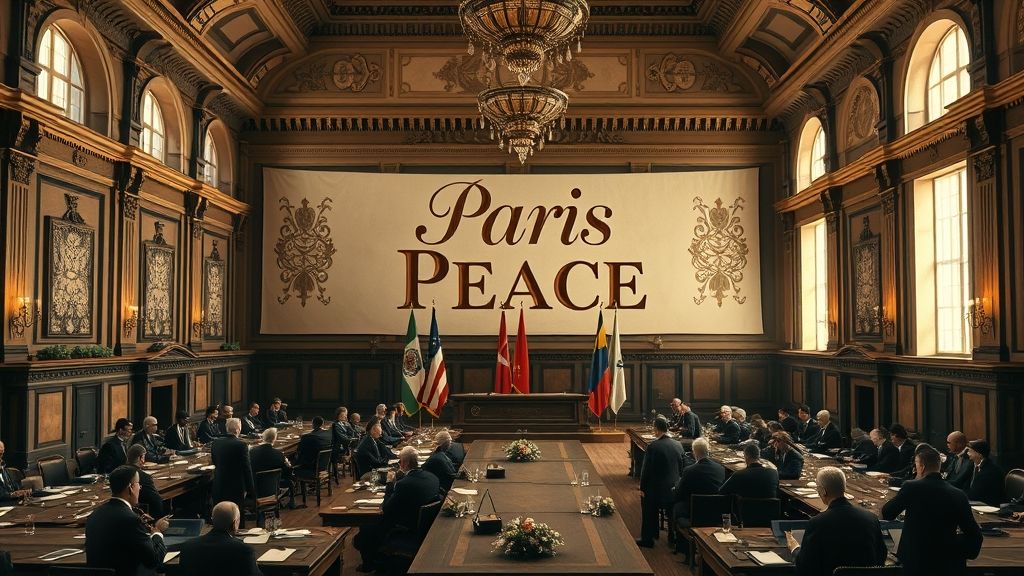
It was a winter morning thick with anticipation and exhaustion. Despite the biting cold that gripped Paris, the city’s grand halls buzzed with a restless energy—one that carried the hopes and fears of a war-weary world. Delegates, diplomats, and politicians arrived in grand carriages, their faces etched with the indelible marks of four years of unprecedented carnage. The Paris Peace Conference had just opened, a colossal gathering that promised to reshape the world. Flags bearing the colors of the Allied Powers fluttered proudly, while beneath the pomp and ceremony, an uneasy tension simmered. Here, in the heart of France, was a chance to turn the nightmare of World War I into a lasting peace—but nothing about 1919 would be simple.
From War to Peace: The Turbulent Road to the Conference
The First World War had ended in November 1918, leaving over 37 million casualties and entire empires shattered. The conflict’s devastation exposed not just rivalries between nations but deep ideological, political, and social fissures. Europe’s political landscape was in ruins, and the victors faced the monumental task of rebuilding. Yet, the contrast between immense loss and the desire to prevent future wars was stark. The Paris Peace Conference was born out of this paradox—an attempt to stitch together a fractured world while managing competing interests and bitter grievances.
The Allied forces—the victors—had their own competing visions. The French, Britain, and the United States, along with smaller powers, came together to decide not only how to deal with Germany but how to reorder global relations. Meanwhile, defeated nations like Germany and Austria-Hungary were excluded, their futures decided behind closed doors. Colonized peoples and minority nations also found themselves ignored or offered hollow promises of independence.
The Gathering of Titans: A Confluence of Global Powers
From the vast corridors of the Quai d’Orsay to the ornate halls of the Palace of Versailles, the most powerful figures of their day assembled. Four main leaders dominated the scene: Woodrow Wilson of the United States, Georges Clemenceau of France, David Lloyd George of Britain, and Vittorio Orlando of Italy. Each came carrying their nation’s scars, ambitions, and principles.
Woodrow Wilson arrived with his idealistic vision of “making the world safe for democracy,” proposing a new order designed around justice and international cooperation. Clemenceau, haunted by years of German invasion and destruction, demanded security and retribution. Lloyd George navigated between the harsh realities of empire and a desire for European stability. Orlando, meanwhile, sought to secure Italy’s war gains, though his influence would soon wane.
The conference drew less heralded participants as well—from Japan’s ambitions in the Pacific to the emerging voices of new nations born from the empire’s ruins—and yet the loudest were those closest to the battlefield.
Wilson’s Fourteen Points: A Vision for Lasting Peace
Just months before the war’s end, President Wilson had delivered his famous “Fourteen Points,” a blueprint for peace grounded in transparency, self-determination, and the formation of an international body to prevent future conflict. These points captured the hopes of many war-weary people: open diplomacy, freedom of the seas, removal of economic barriers, and most importantly, the principle that peoples should have the right to govern themselves.
Yet, as the Conference progressed, Wilson’s idealism clashed with the harsher demands of European allies. While his vision of a League of Nations would survive, many of his 14 points, especially those concerning territorial rearrangements, were compromised or abandoned. Still, Wilson remained a pivotal figure in a historic attempt to build a new world order.
Clemenceau’s France: Revenge, Security, and Reparation
For Clemenceau, the wounds inflicted by the German army during the 1914-1918 conflict were personal and national. The devastation of northern France left deep scars—both human and economic. Clemenceau’s primary agenda was to ensure that Germany would never again pose a threat. His demands were uncompromising: harsh reparations, demilitarization, and territorial concessions.
The French leader’s relentless pursuit of security often put him at odds with Wilson’s more conciliatory approach. Clemenceau’s famous declaration, "Germany must be crushed," encapsulated the mood of a nation battered yet defiant. His influence ensured that the Treaty of Versailles contained punitive measures designed to constrain Germany—an act of justice for France, yet paradoxically a cause of future tensions.
Lloyd George’s Balancing Act: Between Empire and Stability
British Prime Minister David Lloyd George faced a delicate task. Britain had emerged victorious but weary, its empire vast yet increasingly strained. Lloyd George sought to balance domestic pressures for a harsh peace with concerns about European stability and the economic consequences of punishing Germany too severely.
His approach was pragmatic and nuanced, often acting as a mediator between Clemenceau’s hardline stance and Wilson’s idealism. He understood that a treaty that fostered resentment rather than reconciliation would sow the seeds of future conflict. Lloyd George’s role highlighted the complex interplay between nationalism, empire politics, and the quest for peace.
The Excluded Voices: Defeated Powers and Colonized Nations
While the victors negotiated the new world order, defeated Germany, Austria-Hungary, Bulgaria, and the Ottoman Empire were conspicuously absent and powerless to influence their fate. Their exclusion foreshadowed the bitterness that would fester for years to come.
Moreover, the peoples of Asia, Africa, and the Middle East—many of whom had fought alongside the Allies—found themselves marginalized. Promises of self-determination were inconsistently applied; colonial territories were reshaped into mandates governed by the victors, perpetuating systems of control. This hypocrisy sowed the seeds of anti-colonial movements and future struggles for independence.
The Redrawing of Maps: National Self-Determination and Its Discontents
One of the Conference’s most ambitious and complicated tasks was redrawing borders. The principle of national self-determination, championed by Wilson, inspired new states to emerge from the dissolved Austro-Hungarian and Ottoman empires: Poland, Czechoslovakia, Yugoslavia, and others.
Yet the application of this principle was often selective and fraught. Ethnic minorities were left stranded within new or existing states, territorial claims overlapped, and historic grievances endured. The new map of Europe was an imperfect patchwork—a fragile mosaic that at times functioned, but often fractured.
Negotiating the Treaty of Versailles: The Art of Compromise and Conflict
The Treaty of Versailles, signed on June 28, 1919, was the culmination of months of intense negotiation, debate, and deadlock. It was a document heavy with contradictions: a mix of punitive clauses against Germany, attempts at international cooperation, and economic provisions to rebuild.
Negotiations were fraught with strategic maneuvers, personal rivalries, and ideological battles. Each clause reflected compromises—some bitterly contested, others quietly accepted. The treaty was less a clean solution than a political truce; a fragile agreement that bore the marks of its creators’ conflicting visions.
War Guilt and Reparations: The Weight of Blame
A particularly contentious element was Article 231, the so-called “war guilt clause,” which assigned sole responsibility for the war to Germany and its allies. This legal formulation was both a justification for reparations and a deep humiliation for Germany.
The reparations demanded were vast—straining an already crippled economy and fueling resentment across German society. For many Germans, the clause represented an injustice: a narrative that ignored the war’s complex causes but would dominate political discourse, feeding nationalist fervor and revanchism.
The League of Nations: Idealism Meets Realpolitik
One of Wilson’s proudest achievements was the establishment of the League of Nations, conceived as a forum to resolve conflicts peacefully and prevent future wars. The League embodied hope for a new diplomatic order rooted in cooperation rather than confrontation.
Yet, the League faced immediate challenges. The absence of major powers such as the United States (which ultimately refused to join) and the Soviet Union weakened its authority. This idealistic institution struggled to assert itself in a world still dominated by power politics.
The Shadows of Resentment: Seeds of Future Conflicts
The treaties and agreements that emerged from Paris satisfied no one completely. While aiming to ensure peace, they also bred bitterness. Germany’s economic woes, territorial losses, and political humiliation would fuel radicalism and the rise of extremist movements.
Similarly, in the colonies and newly created states, discontent simmered under the surface. The unresolved ethnic tensions, economic instability, and political upheavals transformed the quest for peace into a complex dynamic of fragility and unrest.
Women and Minorities at the Conference: Silent Observers and Emerging Actors
The Paris Peace Conference opened a new chapter in global diplomacy, yet women and many minority groups were largely excluded from the official delegations and negotiations. However, their presence was felt through advocacy groups and parallel assemblies.
Women’s organizations pushed for suffrage and peace initiatives, planting the seeds for later social and political movements. Minority groups’ petitions and delegations, though often ignored, highlighted the limits of self-determination and the ongoing struggles for recognition and rights.
The Cultural Reverberations: Art, Memory, and Trauma after the War
The conference’s aftermath reverberated beyond politics. The cultural trauma of the Great War permeated literature, art, and memory. Writers like Erich Maria Remarque and poets such as Wilfred Owen captured the futility and horror of the conflict.
In Paris and beyond, monuments and commemorations sought to enshrine sacrifices, even as societies wrestled with grief and the challenge of moving forward. The 1919 conference set the stage for how nations would remember—and reinterpret—the war.
The Conference’s Economic Footprint: Reconstruction and Debt
Economically, the world faced staggering challenges: devastated infrastructure, colossal debts, and disrupted trade. The reparations imposed on Germany and economic arrangements crafted at Paris shaped interwar financial relations.
Efforts to stabilize currencies and restore commerce were uneven, contributing to crises such as hyperinflation in Germany and ultimately the Great Depression. The economic legacy of the conference was a tangled mixture of goodwill and hardship.
The Aftermath: Immediate Reactions in Europe and Beyond
News of the treaty’s terms sparked a spectrum of reactions. In Allied countries, relief mixed with unease; in Germany, outrage and disbelief bred political chaos. Across the colonial world, the disappointment over mandates took hold.
The fragile peace settled uneasily. In a continent still littered with battlefields, political accidents and social upheavals would soon test the limits of Versailles and the fragile new order established at Paris.
Historians’ Debate: Was the Paris Peace Conference a Success or Failure?
A century of scholarship has grappled with the Conference’s mixed legacy. Was it a noble effort betrayed by harsh realities? Or a flawed compromise baked with the seeds of future war?
Some historians emphasize Wilson’s visionary ideas; others point to Clemenceau’s unforgiving approach or to the selfish interests of empire politics. Increasingly, scholars highlight the voices excluded from decisions and the global impact beyond Europe.
Lessons Learned and Forgotten: The Legacy of 1919 in Global Diplomacy
The Paris Peace Conference stands as a powerful lesson in diplomacy’s possibilities and limits. It underlined the difficulty of aligning divergent national interests and ideals in the pursuit of peace.
Yet it also pioneered institutions like the League of Nations and principles that resonate today. The mixed outcomes underscore the need for inclusivity, fairness, and foresight in peacebuilding—a message still relevant.
The Road to World War II: How 1919 Shaped the Twentieth Century
Far from ending conflict, the Versailles settlement helped set the stage for the cataclysm of 1939. The unresolved grievances in Germany, the instability of new states, and the weakness of international mechanisms contributed to a fragile peace.
Understanding 1919 offers critical insight into how peace treaties can both heal and wound; how diplomacy must grapple with history’s shadows as much as its promises.
Echoes in Modern Peace Efforts: The Conference as a Precursor
Contemporary peace processes—from the United Nations to regional accords—echo the lessons and limitations of Paris. The importance of building inclusive frameworks, addressing root causes, and fostering dialogue reflect the ongoing relevance of the 1919 experience.
Paris reminds us that peace is not a moment, but a process—complex, contested, and essential.
Conclusion: The Fragile Promise of Peace
The opening of the Paris Peace Conference on January 18, 1919, was a moment brimming with hope, tension, and profound uncertainty. Delegates arrived burdened by the devastation of the Great War but determined to build a new world order. Their efforts reflected the best and worst of human nature: idealism mingled with realpolitik, justice shadowed by revenge, ambition tempered by compromise.
This gathering produced treaties that ended one chapter of violence but unwittingly sowed the seeds of future struggles. It revealed the challenges of balancing national sovereignty, justice, and global cooperation—a balancing act that continues to define international relations. Above all, Paris in 1919 reminds us that peace is fragile, precious, and must be nurtured with vigilance and goodwill, lest history repeat its darkest pages.
FAQs about the Paris Peace Conference
Q1: What were the main objectives of the Paris Peace Conference?
The Conference aimed to negotiate peace terms to end World War I, redraw national boundaries, impose reparations on the defeated Central Powers, and establish mechanisms like the League of Nations to prevent future conflicts.
Q2: Who were the key figures at the Conference?
The four principal leaders were Woodrow Wilson (United States), Georges Clemenceau (France), David Lloyd George (United Kingdom), and Vittorio Orlando (Italy). Each had distinct priorities shaping the negotiations.
Q3: Why was Germany excluded from the peace talks?
Germany and other defeated powers were not allowed to participate as they were considered defeated enemies, bound to accept the terms laid out by the victors without negotiation, fostering resentment.
Q4: What was the significance of Wilson’s Fourteen Points?
Wilson’s Fourteen Points outlined principles like open diplomacy, self-determination, and the creation of a League of Nations. While influential, many points were compromised during the negotiations.
Q5: What impact did the Treaty of Versailles have on Germany?
The treaty imposed heavy reparations, reduced territory, and military restrictions on Germany. The “war guilt clause” was deeply humiliating, contributing to political instability and the rise of extremist movements.
Q6: How did the Conference affect colonized peoples?
Colonized nations were largely excluded, with many territories placed under mandates controlled by Allied powers, delaying independence movements and fueling anti-colonial sentiment.
Q7: Was the League of Nations effective?
While the League embodied hope for peace, it suffered from the absence of key powers (including the US), lacked enforcement mechanisms, and ultimately failed to prevent future global conflict.
Q8: How is the Paris Peace Conference viewed by historians today?
Historians see it as a complex event with mixed outcomes—both groundbreaking in vision and flawed in execution, offering enduring lessons on the challenges of achieving lasting peace.