Table of Contents
- The Dawn of a Turbulent Journey: The People’s Crusade Takes Flight
- The Medieval World on Edge: Political and Religious Tensions in 11th Century Europe
- Urban Unrest and Religious Zeal: The Social Fires Igniting the People’s Crusade
- The Calling of the Crusade: Pope Urban II’s Speech at Clermont and Its Aftermath
- From Piety to Movement: The Rise of Pied Piper Preachers
- Cologne: A City Poised at the Crossroads of Faith and Fury
- Marching Through Hungary: Trials, Tribulations, and Hostilities
- Negotiations and Skirmishes: Hungarian Reactions to the Unruly Crusaders
- Crossing into Byzantine Territory: Suspicion and Uneasy Alliances
- Anatolia Awaits: The Land of Promise and Peril
- The Arrival at Nicaea: Hope Clashes with Harsh Reality
- The Disintegration of the People’s Crusade: Chaos and Collapse
- The Massacres and Misfortunes: Violence Against Jews En Route
- The Role of Key Figures: Peter the Hermit and Walter Sans Avoir
- Legacy of the People’s Crusade: Seeds of the Greater Crusades
- The Impact on European Society and Jewish Communities
- Chronicles and Eyewitness Narratives: Peering into the Past
- The People’s Crusade in Historical Memory: Myth, Legend, and Lessons
- Conclusion
- FAQs
- External Resource
- Internal Link
The Dawn of a Turbulent Journey: The People’s Crusade Takes Flight
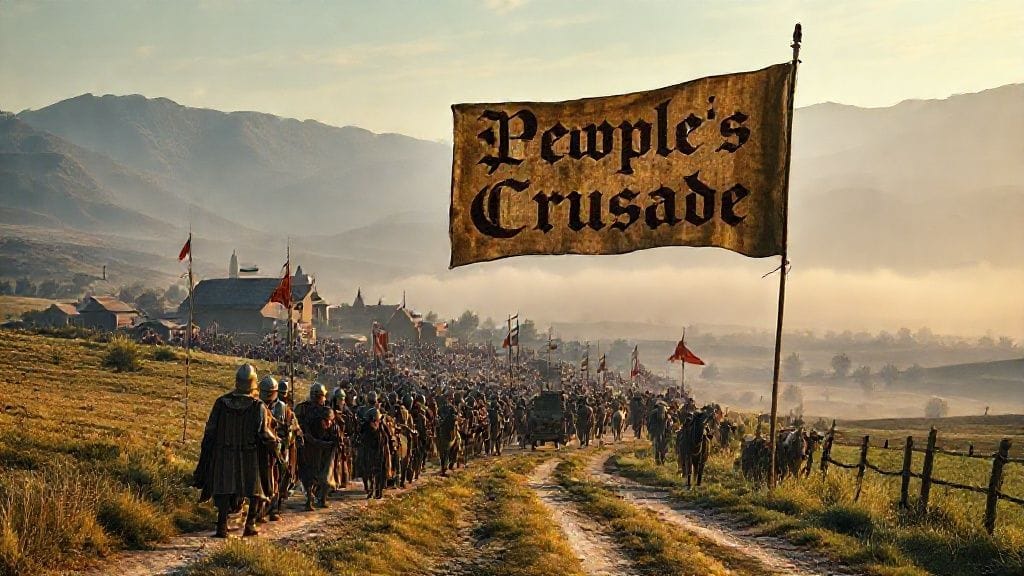
The spring of 1096 dawned with an electric buzz. Streets, towns, and villages throughout Europe bristled with anticipation and fervor as thousands of men, women, and sometimes children—farmers, tradesmen, minor nobles, and wanderers—girded themselves for what they believed was a holy mission: to reclaim Jerusalem from Muslim rule. This was no well-planned campaign of nobles and knights, but a spontaneous, chaotic, impassioned surge of the common folk. Known as the People’s Crusade, this movement surged forth from places like Cologne, crossing Hungary and moving toward the Byzantine Empire en route to Anatolia.
As the crusaders set out, the air was thick with hope, religious zeal, and a primal thirst for adventure. Yet, lurking beneath that hopeful spirit was a simmering current of fear, desperation, and ignorance—a deadly combination that would soon explode into violence, confusion, and tragedy. The journey was about to become a crucible, testing faith, endurance, and the fragile fabric of medieval society itself.
The Medieval World on Edge: Political and Religious Tensions in 11th Century Europe
To truly understand the People’s Crusade, one must first grasp the volatile backdrop of 11th-century Europe—a continent fractured by political rivalries, religious fervor, and social upheaval. The East-West schism of 1054 had formally split Western Latin Christianity from Eastern Orthodoxy, while newly emboldened kingdoms and duchies jostled for power. The Byzantine Empire, long a bastion in the East, was squeezed from all sides by emerging Muslim powers, Seljuk Turks especially, who had seized Jerusalem in 1071 after their victory at Manzikert.
At the same time, much of Western Europe was grappling with internal strife. Overpopulation strained resources, and the gap between the wealthy elite and impoverished peasantry widened. The Church, led by reformist pope Urban II, sought to unify Christendom by calling for a sacred war—a campaign to reclaim the Holy Land, and to reassert Christian dominance over sacred sites and ancient cities.
Urban Unrest and Religious Zeal: The Social Fires Igniting the People’s Crusade
The seeds of the People’s Crusade were sown in the tinderbox of social and economic hardships. Peasantry burdened by tithes and taxes, displaced by warfare or famine, were drawn to the promise of redemption, land, and relief. The people’s crusade was not a movement of armies but a wave of untrained, unarmed pilgrims, often led by charismatic preachers who stirred religious devotion into a potent call for action.
The horn of opportunity sounded loudly among the marginalized. The lure was irresistible: a chance to cleanse sins, gain eternal salvation, and perhaps carve a new life. For the common folk, the crusade was a beacon amid the twilight of stagnation and suffering.
The Calling of the Crusade: Pope Urban II’s Speech at Clermont and Its Aftermath
November 1095: Pope Urban II unleashed a clarion call at the Council of Clermont, a moment etched into history. With fervent words, he urged Christendom to mobilize and aid their Eastern brethren by liberating Jerusalem from “infidel” Muslim control. His speech blended spiritual urgency with political ambition, promising indulgences and forgiveness of sins for those who joined.
But beyond the noble intent, the message was often distorted and magnified by local preachers. The peasantry, hungry for hope and action, imbibed it as a divine mandate. Urban II's call thus sparked an unprecedented popular movement, one that engulfed all social strata, and launched the People’s Crusade well before the official military expeditions started.
From Piety to Movement: The Rise of Pied Piper Preachers
Figures such as Peter the Hermit and the lesser-known Walter Sans Avoir were more than just charismatic leaders; they were the engines that transmuted religious enthusiasm into a mass movement. Peter, a poor cleric from Amiens, preached tirelessly about visions, miracles, and the imminent fulfillment of divine will. Walter, noble but penniless, harnessed clan loyalty and restless youth.
These men marshaled tens of thousands—peasants, artisans, and even some minor knights—into a migrating tide, all convinced that the path to God lay through armed pilgrimage. But lacking the discipline or resources that later Crusades would possess, this mass was vulnerable, a tinderbox of zeal drifting toward chaos.
Cologne: A City Poised at the Crossroads of Faith and Fury
Cologne, a major city in the Holy Roman Empire, became one of the crucibles where the People’s Crusade took tangible form. The city bristled with tension and anticipation as streams of crusaders converged. Here, supply shortages, disputes over authority, and clashing motivations quickly surfaced. Local clerics and officials often viewed the unruly masses with suspicion and fear.
Yet, for the crusaders, Cologne was a gateway—crossing the Rhine meant one step closer to the sacred East. The city’s gates saw waving crosses, worn-out travelers, and the occasional outbreak of violence, setting a tone of uneasy resolve.
Marching Through Hungary: Trials, Tribulations, and Hostilities
The journey into Hungary marked the beginning of the People’s Crusade’s descent into disorder. Hungrily relying on local goodwill, the crusaders quickly overburdened the region. Supplies dwindled, tempers flared, and the behavior of the advancing mob caused alarm among Hungarian nobles and clergy.
According to medieval chronicles, some crusaders raided villages, exacting tribute or outright plunder. The Hungarians, caught between hospitality and self-defense, negotiated passage but remained wary. Skirmishes erupted sporadically, foreshadowing the breakdown of military discipline that would doom the crusade.
Negotiations and Skirmishes: Hungarian Reactions to the Unruly Crusaders
Hungarian leaders sought to contain the damage by engaging with crusader leaders to enforce order. Peacemaking efforts were undertaken, with the intent to protect local populations and ensure safe passage.
Yet clashes persisted. Miscommunication, language barriers, and conflicting expectations escalated tensions. The People’s Crusade, led more by religious fervor than military strategy, was ill-prepared for the intricacies of diplomacy—a failure that would prove costly not only for their relations with Hungary but for the entirety of their expedition.
Crossing into Byzantine Territory: Suspicion and Uneasy Alliances
Upon entering the Byzantine Empire, the crusaders faced a complex political landscape. Emperor Alexios I Komnenos welcomed the crusaders reluctantly, viewing them as a potential liability as much as an asset. His priorities centered on maintaining order in Anatolia, where Seljuk Turks challenged the empire’s eastern borders.
The Byzantine strategy was cautious: allow passage but limit interference. The People’s Crusade, undisciplined and unarmed, aroused suspicion and fear among Byzantine officials. The lack of coordination with the imperial forces deepened the chaotic nature of the campaign.
Anatolia Awaits: The Land of Promise and Peril
The early summer of 1096 saw the ragtag masses approach Anatolia—the gateway to the Holy Land and the theater of destiny for the Crusade. For these mostly untrained pilgrims, Anatolia’s rugged terrain, harsh climate, and hostile inhabitants posed monumental challenges.
They faced starvation, disease, desertion, and Turks skilled in guerrilla warfare. The romantic notion of a victorious pilgrimage clashed violently with the cold facts of military logistics and geographical hardship.
The Arrival at Nicaea: Hope Clashes with Harsh Reality
Nicaea, a strategically crucial city near the Byzantine border, became the crucible where the illusion of invincibility shattered. The crusaders hoped to find Byzantine support and a secure staging ground, but reality was unforgiving.
The Seljuk Turks, forewarned and battle-hardened, harassed the incoming crusaders. Poorly armed and innumerable, the People’s Crusade could not mount a successful defense. Confusion reigned, discipline dissolved, and morale crashed.
The Disintegration of the People’s Crusade: Chaos and Collapse
The final acts of the People’s Crusade were marked by fragmentation and massacre. Leadership was weak and often disputed, while the rank-and-file were ill-equipped for combat. Turkish attacks, Byzantine mistrust, and internal dissension culminated in the near-annihilation of these early crusaders.
Many perished in skirmishes or from the elements; others were captured or scattered. The dream of a popular pilgrimage to the Holy Land died in the dust and blood of Anatolia.
The Massacres and Misfortunes: Violence Against Jews En Route
Tragically, the People’s Crusade also unleashed waves of antisemitic violence. In cities like Mainz and along the Rhine, crusader bands massacred Jewish communities, falsely blaming them for the “crucifixion” and casting them as enemies within.
These pogroms laid bare the ferocity of popular fervor turned deadly, revealing the darkness that can accompany religious zealotry. The Jewish communities bore a staggering human toll, a somber reminder of the crusade’s cost beyond military failure.
The Role of Key Figures: Peter the Hermit and Walter Sans Avoir
Peter the Hermit epitomized the mixture of zeal, charisma, and tragic naivety that defined the People’s Crusade. His impassioned preaching ignited millions’ imagination, though his own command of the crusade’s forces was limited.
Walter Sans Avoir, contrastingly, was a more pragmatic nobleman with military experience, yet insufficient to impose order. Both men became symbols of the crusade’s hopeful beginning and disastrous end.
Legacy of the People’s Crusade: Seeds of the Greater Crusades
Despite its catastrophic outcome, the People’s Crusade sowed the seeds for future campaigns. It demonstrated the immense power of popular religious movements, shaped papal and noble strategies, and intensified Christian-Muslim conflict for centuries to come.
Lessons learned from the failures propelled subsequent, more organized crusading efforts, culminating in the First Crusade’s military successes a year later.
The Impact on European Society and Jewish Communities
The crusade altered medieval Europe socially and culturally. It intensified Christian identity and solidarity but also inflamed antisemitism and xenophobia, leading to lasting divisions.
Socially, the movement disrupted trade, triggered migrations, and shifted power relations. The trauma endured by Jewish communities echoed through generations, a dark stain on the narrative of sacred war.
Chronicles and Eyewitness Narratives: Peering into the Past
The People’s Crusade is illuminated by chronicles from chroniclers like Ekkehard of Aura, Albert of Aix, and Muslim historians such as Ibn al-Qalanisi. Their accounts, fragmented and biased, offer invaluable glimpses into the chaotic human drama, blending heroism, fanaticism, and despair.
Through their words, the distant past becomes vivid—smells, sounds, and hopes come alive, creating a textured mosaic of history.
The People’s Crusade in Historical Memory: Myth, Legend, and Lessons
Over centuries, the People’s Crusade has been alternately romanticized as the purest expression of piety or condemned as naïve folly. Its memory informs modern debates over faith, violence, and popular movements.
It stands as a cautionary tale of idealism unchecked by discipline, and a testament to the profound human yearning for meaning and purpose, even at great peril.
Conclusion
The People’s Crusade of 1096 was, above all, a profoundly human story—one of hope and desperation intertwined, of unity and fracture, of faith that could both inspire and destroy. It was a raw, unfiltered surge of the medieval soul toward the sacred, a pilgrimage that began as a dream and ended as a tragedy.
Yet from its ashes rose the structured military campaigns that would reshape the medieval world, forge new political realities, and leave an indelible imprint on history’s canvas. In the People’s Crusade, we glimpse the enduring complexities of humanity—our capacity for devotion and destruction, our dreams and our nightmares.
History remembers not just what was lost, but the passions that kindled a movement and changed the world forever.
FAQs
Q1: What sparked the People’s Crusade in 1096?
The People’s Crusade was ignited by Pope Urban II’s call at Clermont in 1095 and driven by widespread social unrest, religious fervor, and economic hardships among common people seeking redemption and opportunity.
Q2: Who were the main leaders of the People’s Crusade?
Peter the Hermit, a charismatic preacher, and Walter Sans Avoir, a minor noble, were the principal figures leading the unruly mass of crusaders.
Q3: Why did the People’s Crusade end in disaster?
Lack of military discipline, inadequate supplies, poor leadership, hostile encounters, and attacks from Muslim forces all contributed to the collapse of the crusade.
Q4: How did the People’s Crusade affect Jewish communities in Europe?
Tragically, the crusade triggered violent pogroms against Jewish communities, causing massacres and long-lasting trauma.
Q5: What was the relationship between the People’s Crusade and the Byzantine Empire?
The Byzantine Empire viewed the crusaders suspiciously, fearing the disorder they brought and trying to manage their passage cautiously while defending against Turkish threats.
Q6: Did the People’s Crusade achieve any of its goals?
No—the People’s Crusade failed militarily and was annihilated in Anatolia, but it set the groundwork for the more organized First Crusade that followed.
Q7: How has the People’s Crusade been remembered historically?
It has been remembered both as a tragic display of popular piety and as a chaotic movement emblematic of medieval religious zeal.
Q8: What lessons did later crusades learn from the People’s Crusade?
Later crusades emphasized military planning, noble leadership, and better coordination with Byzantine and other allies to avoid the failures of the People’s Crusade.

