Table of Contents
- Dawn of Change: Tehran Awakens to a New Era
- Persia at the Turn of the Century: Cracks in an Ancient Empire
- The Qajar Dynasty's Waning Grip on Power
- Seeds of Dissent: Economic Hardship and Foreign Intrigue
- The Clash of Tradition and Modernity
- The Tobacco Protest: First Sparks of Revolution
- The Constitutional Movement Ignites
- Leading Figures of the Persian Constitutional Revolution
- The Siege of Tehran: Tensions Reach Boiling Point
- December 30, 1906: The Constitution is Signed
- The Document That Changed Persia’s Destiny
- Immediate Aftermath: Hope, Resistance, and Counterattacks
- The Role of Clergy and Intellectuals in the New Order
- Reactions from Foreign Powers: Russia and Britain in the Crossfire
- Women and the Constitution: Emerging Voices
- From Paper to Practice: The Struggle to Establish Constitutional Rule
- The 1908 Coup: The Constitution Under Threat
- Legacy of the Persian Constitution: National Identity and Sovereignty
- Influence on Middle Eastern Constitutional Movements
- Remembering the Revolution in Contemporary Iran
- The Persian Constitution in Global Historical Context
- Reflections on Democracy, Sovereignty, and Revolution
- Conclusion: A Nation's Leap into Modernity
- FAQs
- External Resource
- Internal Link
Tehran’s cool winter air on December 30, 1906, was pierced by the murmur of voices rising from a crowd that had gathered in the heart of Persia’s capital. Outside the royal palace, hopeful yet anxious citizens held their breath as a document, fraught with the promise of profound change, was about to be signed—the first Persian Constitution. The echoes of this moment would resound far beyond the walls of Tehran, forever altering the nation’s trajectory and inspiring movements across the region. This was not just a legal text; it was a beacon of hope, signaling the dawn of a new era in a land long dominated by royal absolutism and foreign interests.
Dawn of Change: Tehran Awakens to a New Era
In the waning days of 1906, Tehran was a city on edge. The streets, dusted with a light snow, were thrumming with unrest and anticipation. The air was thick with whisperings of reform, revolution, and the unknown future of Persia. From the alleys of the bazaar to the halls of the aristocracy, talk of constitutional government was both a source of inspiration and trepidation. To understand the magnitude of the day’s events, one must travel back through the tumultuous years that led this ancient empire, known today as Iran, to its crossroads.
Persia at the Turn of the Century: Cracks in an Ancient Empire
By the early 20th century, Persia was a land struggling to reconcile its rich history with the forces of modernity and foreign domination. The Qajar dynasty, which had ruled since the late 18th century, found itself increasingly powerless. Persia’s sovereignty was increasingly compromised by the British and Russian Empires, whose spheres of influence carved up Persian territory like pieces of a grand chessboard. Internally, the country faced economic stagnation, military weakness, and a bureaucracy riddled with corruption.
This was a society deeply rooted in tradition, with power concentrated in the hands of the Shah and his court, the religious clergy playing a pivotal role, and a vibrant merchant class that yearned for participation in governance. The convergence of these pressures set the stage for a seismic political shift.
The Qajar Dynasty's Waning Grip on Power
Muzaffar al-Din Shah Qajar, ruler until his death in 1907, was a man with limited capacity to stem the dissension swelling within his realm. His reign was marked by extravagant spending that drained the treasury, and concession agreements with foreign powers that enraged his subjects. Persia’s autonomy was steadily eroding. The concessions, most notoriously the tobacco monopoly awarded to a British company, sparked outrage and ignited nationalist fervor among merchants, clergy, and intellectuals alike.
Seeds of Dissent: Economic Hardship and Foreign Intrigue
By the early 1900s, economic instability intensified grievances. Heavy taxation bore down on peasants and merchants, while foreign controls on customs and resources seemed an affront to national pride. The Persia of these years was a powder keg—economic despair blended with political impotence and growing awareness among the population that change was inevitable.
Foreign powers watched cautiously but with vested interests in Persia’s sparsely governed territories. The British controlled trade routes, while the Russians exerted influence in the north. This geopolitical tension magnified internal discord and fractured Persian society.
The Clash of Tradition and Modernity
Persian society was caught between two worlds: the centuries-old traditions of monarchy and clerical authority, and the modern ideas of constitutionalism, legal reform, and popular representation imported from Europe and neighboring reform movements.
The emergence of a literate, politically conscious middle class began to challenge the old order. Local newspapers, journals, and salons served as incubators for debate about rights, justice, and sovereignty. This ideological clash would soon reveal itself in the streets and palaces of Tehran.
The Tobacco Protest: First Sparks of Revolution
The 1891–92 Tobacco Protest foreshadowed the constitutional upheaval by demonstrating the power of public resistance against foreign exploitation. When the Shah granted a British company a tobacco monopoly, merchants and clerics rallied the populace in boycott, successfully forcing a royal retraction. This was a critical early example of collective action and political awakening that underlined Persia's potential for organized dissent.
The Constitutional Movement Ignites
By 1905, the conditions were ripe for a broader challenge to royal absolutism. Merchants, lawyers, clerics, and disaffected aristocrats coalesced into a constitutional movement demanding an elected assembly—the Majles—and the establishment of laws limiting the Shah’s authority.
Their demands were clear: rule of law, popular representation, and the end to secretive agreements with foreign powers. Protests, petitions, and political agitation swept through the cities, with Tehran becoming the epicenter of this transformative struggle.
Leading Figures of the Persian Constitutional Revolution
At the forefront of this movement were influential personalities like Sattar Khan, the fiery national hero who led armed resistance; Mirza Nasrullah Khan, Persian statesman advocating reform; and clerical figures such as Ayatollah Behbahani, who lent religious legitimacy to the cause.
These leaders embodied a delicate balance—modernizing Persia while respecting its religious and cultural traditions, a challenge that defined the revolution’s unique character.
The Siege of Tehran: Tensions Reach Boiling Point
As pressure mounted, the Shah vacillated between concession and repression. In 1906, a mass mobilization of constitutionalists surrounded the royal palace, demanding the establishment of the Majles and the signing of the constitution. Months of negotiations, threats, and unrest rattled the city.
The siege was not merely military but symbolic—the old world besieged by the insurgent force of political modernity. Finally, bowing to mounting pressure, Muzaffar al-Din Shah agreed to the historic document that would limit his powers and establish Persia’s first constitution.
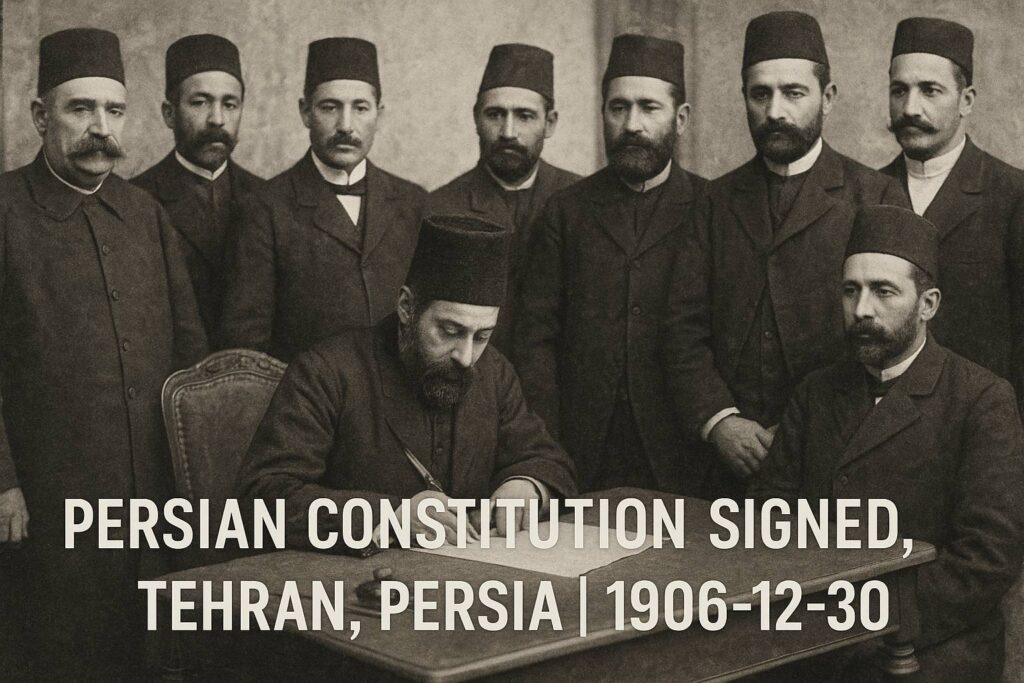
December 30, 1906: The Constitution is Signed
On a frigid December day, the historic signing took place. The Constitutional Charter carried the weight of collective aspiration, a legal codex articulating civil rights, separation of powers, and parliamentary governance. Witnesses speak of a palpable tension mingled with hope—as the ink dried, a new chapter began for Persia.
The Document That Changed Persia’s Destiny
The Persian Constitution was a pioneering text in the Muslim world—one of the earliest attempts to reconcile Islamic tradition with modern constitutional governance. It laid out rights for citizens, established the Majles with legislative authority, and sought to limit royal despotism.
Though imperfect and incomplete, it symbolized a radical break from autocracy, placing Persia on the path to modern nationhood.
Immediate Aftermath: Hope, Resistance, and Counterattacks
The jubilation was short-lived. Reactionary forces clung to power; factionalism and foreign interference swiftly complicated the experiment. The struggle for the soul of Persia continued, punctuated by violent clashes and political intrigues.
Yet, the momentum of constitutionalism had been unleashed. The Majles convened, laws were debated, and the idea of Persian sovereignty regained traction.
The Role of Clergy and Intellectuals in the New Order
Religious leaders, initially supportive, soon expressed divergent views about the constitution’s secularizing tendencies. The clash between reformist clergy and traditionalists deepened. Intellectuals, poets, and journalists championed the cause of freedom and justice, wielding pen and pulpit alike.
The revolution was as much a cultural transformation as a political one, questioning the place of religion, law, and power in society.
Reactions from Foreign Powers: Russia and Britain in the Crossfire
The British and Russians viewed constitutionalism with suspicion, each wary of losing influence. Both sought to manipulate Persia’s politics to safeguard their imperial interests, often supporting reactionary forces or fomenting discord to maintain control.
Their rivalry often hindered Persia’s progress, illustrating the fragile sovereignty the country was fighting to build.
Women and the Constitution: Emerging Voices
Though not enfranchised, women began to find a voice during the constitutional movement. Emerging women’s groups and writers challenged traditional roles and advocated education and participation in public life.
This era planted the seeds of Iran’s later feminist struggles, inspiring generations to come.
From Paper to Practice: The Struggle to Establish Constitutional Rule
Implementing the constitution proved daunting. Administrative reform faltered amid entrenched interests. Corruption persisted, and the civil war of ideas played out in streets and parliament alike.
Yet the legacy of the constitution endured, representing a constant demand for accountability and rule of law.
The 1908 Coup: The Constitution Under Threat
In June 1908, Mohammad Ali Shah, successor to Muzaffar al-Din Shah, launched a coup with Russian support, bombarding the Majles and dissolving the parliament. This brutal crackdown was a stark reminder that constitutionalism was not guaranteed. The ensuing civil war fragmented the country but also galvanized further resistance.
Legacy of the Persian Constitution: National Identity and Sovereignty
Despite setbacks, the constitutional movement solidified a burgeoning sense of national identity centered on sovereignty, law, and political participation. It challenged autocracy and foreign domination in ways that reverberated far beyond Persia’s borders.
Influence on Middle Eastern Constitutional Movements
Persia’s experiment was a powerful example to neighboring states. It helped inspire constitutional and nationalist movements across the Middle East and beyond, sowing ideas of democracy and resistance to imperialism.
Remembering the Revolution in Contemporary Iran
Today, the 1906 Persian Constitution is commemorated as a foundational moment of Iranian modern history. It is studied, debated, and remembered as a courageous leap toward democracy, even as the struggle for political freedom continues in various forms.
The Persian Constitution in Global Historical Context
Viewed globally, the Persian Constitutional Revolution was among the first in a non-Western Islamic society to challenge monarchy and foreign domination through constitutionalism, positioning Iran within a worldwide wave of political modernization.
Reflections on Democracy, Sovereignty, and Revolution
The 1906 constitution invites reflection on the complexities of implementing democratic ideas in culturally and historically unique societies, the tensions between tradition and innovation, and the enduring quest for sovereignty.
Conclusion: A Nation's Leap into Modernity
The signing of Persia's first constitution was both a triumph and a trial—a beacon signaling a nation’s determination to shape its own destiny amid internal rivalries and imperial interference. It was the embodiment of a people’s yearning for justice and a better future, setting Iran on a path that, despite many struggles, continues to inspire.
Conclusion
The Persian Constitution signed on December 30, 1906, was far more than ink on paper. It was a symphony of hope resonating through a land yearning for freedom, a courageous assertion of national will against the forces of autocracy and empire. It marked the commencement of Iran’s modern political journey—a complex saga of aspiration, turmoil, resilience, and identity.
As we look back over a century later, the constitution stands as a testament to the human spirit’s capacity to dream of justice, to fight for representation, and to assert that sovereignty belongs to the people. It reminds us that revolutions are not merely events but ongoing processes—conversations between past and future, tradition and innovation, that shape nations and inspire generations.
FAQs
Q1: What factors led to the Persian Constitutional Revolution of 1906?
Economic hardship, foreign intervention, dissatisfaction with autocratic Qajar rule, and the rise of a politically conscious middle class stimulated demands for constitutional government.
Q2: Who were the main leaders of the Persian constitutional movement?
Key figures included Sattar Khan, Mirza Nasrullah Khan, and Ayatollah Behbahani, representing various social and political factions united for reform.
Q3: How did foreign powers react to the Persian Constitution?
Russia and Britain were wary and often hostile, seeking to maintain influence by supporting reactionary forces and undermining constitutionalists.
Q4: What were the immediate consequences of the Constitution’s signing?
It led to the creation of the Majles (parliament), new laws, but also fierce resistance from royalists, culminating in a coup in 1908.
Q5: Did the Constitution grant rights to women?
While it did not enfranchise women, the constitutional movement inspired early feminist voices advocating education and political participation.
Q6: How is the Persian Constitutional Revolution remembered today?
It is celebrated as a foundational moment in Iran's struggle for democracy and sovereignty, studied as a milestone in Middle Eastern political history.
Q7: What impact did the Persian Constitution have on the Middle East?
It inspired constitutional and nationalist movements by demonstrating the possibility of challenging monarchy and foreign domination through legal frameworks.
Q8: Why is the Persian Constitutional Revolution significant in global history?
It was among the first to merge Islamic culture with modern constitutional ideas, marking an important chapter in non-Western political modernization.