Table of Contents
- A Dream in the Andes: The Birth of a Confederation Idea
- The Tumultuous Era of 1820s South America
- Chuquisaca, 1826: The Congress That Could Change History
- Antonio José de Sucre: The Liberator’s Vision for Unity
- Bolivia on the Brink: Post-Independence Fragility
- Peru’s Fragmentation and Political Chaos
- The Idea of Confederation: Political Innovation or Imperial Overreach?
- The Players: Leaders, Delegates, and Stakeholders
- The Congress Debates: Ideological Clashes and Diplomatic Maneuvers
- Indigenous and Mestizo Voices: The Silenced Majority?
- Economic Incentives Behind Confederation
- Regional Rivalries and International Reactions
- The Role of Chile and Argentina: Watching and Waiting
- The Competing Visions: Centralism versus Federalism
- Failures and Successes of the Chuquisaca Congress
- The Aftermath: Seeds Sown for Later Confederation Attempts
- The Confederation Idea in Bolivian Political Thought
- Myths and Realities: Legacy of the 1826 Congress
- Conflicts Reignited: Prelude to Future War and Instability
- The Confederation’s Place in the Pan-American Dream
- Conclusion: An Unfinished Symphony of Unity in the Andes
- FAQs: Understanding the Peruvian–Bolivian Confederation Idea
- External Resource
- Internal Link
1. A Dream in the Andes: The Birth of a Confederation Idea
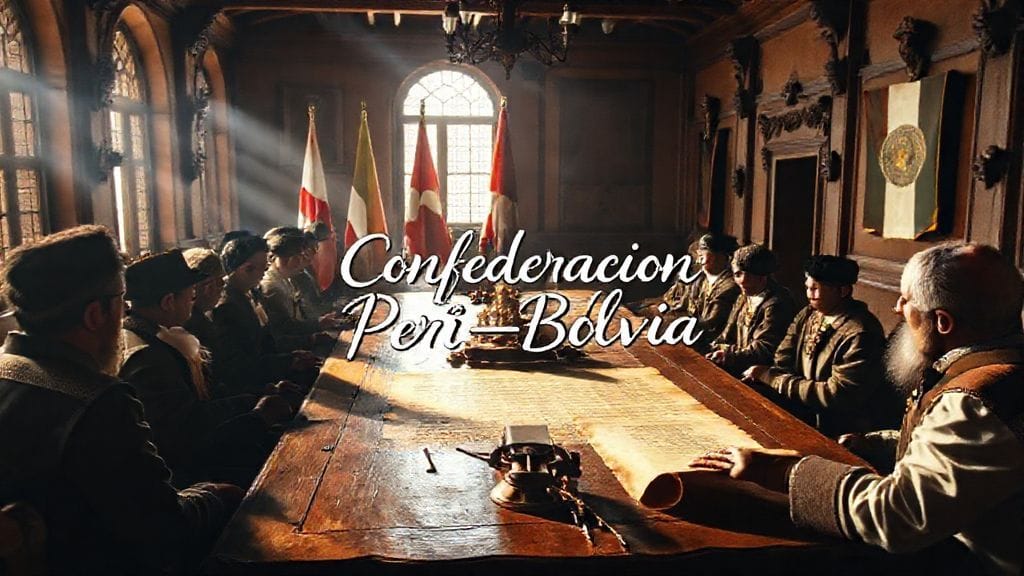
In the late afternoon sun of May 1826, in the stately, ancient city of Chuquisaca—nestled high amid the Andes’ shadowed peaks—a fragile but electrifying hope rippled through the stone corridors of its Congress hall. Delegates, their faces weathered from the long, grueling wars of independence, sat hunched over documents and maps, speaking in earnest voices that echoed with the weight of destiny. Their mission was audacious: to sculpt a confederation of two young nations—Bolivia and Peru—seeking unity amid chaos, stability amid fragmentation.
The idea of a Peruvian-Bolivian Confederation, as debated earnestly in Chuquisaca, was more than a political project. It was a bold dream of forging strength from the shared history, culture, and struggles of people born under the crushing yoke of colonial Spain. More than a century later, this embryonic political experiment remains a testament to the turbulent birth pangs of South American sovereignty.
2. The Tumultuous Era of 1820s South America
The continent had barely emerged from the flames of revolution. The Spanish empire in the Americas had largely crumbled by the mid-1820s, leaving behind a patchwork of fragile new states, many riven by internal dissent, economic instability, and the shadow of colonial institutions difficult to uproot. Bolivia, having tossed off the yoke as Alto Peru, was newly independent, named in honor of Simón Bolívar, and Peru was grappling extensively with its own political identity after years of struggle.
South America stood at a crossroads. The big question was whether these newborn countries would settle into isolated nationalisms or strive for confederations that echoed the federalist ideals flowering elsewhere in the Americas—particularly inspired by the United States, but colored with local nuances. The 1820s were a period of feverish debate over sovereignty, governance, and identity.
3. Chuquisaca, 1826: The Congress That Could Change History
Chuquisaca, then the administrative heart of Bolivia and a symbolic site of revolutionary fervor, was chosen for a congress that convened with hopes as high as the Andean peaks surrounding it. Leaders, diplomats, and intellectuals came together under the auspices of General Antonio José de Sucre, the Liberator and Bolivia’s first president, whose charisma and military prowess had forged nations.
The goal was simple but Herculean: to formally unite Bolivia and Peru under a single confederation that respected local governance but pooled military and economic strength. The Congress worked long hours; voices grew heated, alliances shifted; maps were laid upon rough wooden tables, and every clause was weighed with care.
4. Antonio José de Sucre: The Liberator’s Vision for Unity
Sucre, a man described by contemporaries as “noble and visionary,” carried the burden of war and hope in equal measure. Having played a pivotal role in major battles of independence alongside Bolívar, he envisioned a region united not only by geography but by a shared destiny nurtured through cooperation and mutual defense.
He argued passionately that Peru and Bolivia, geographically intertwined and culturally linked, could form a confederation that would elevate their collective voice on the international stage. For Sucre, this was not just about politics—it was about survival. Fragmentation risked vulnerability to foreign intervention and renewed colonial ambition.
5. Bolivia on the Brink: Post-Independence Fragility
Bolivia was a nation politicized by uncertainty. After ousting Spanish forces, it had to grapple with indigenous unrest, factionalism, and an economy heavily dependent on silver mines vulnerable to fluctuations in global markets. The nation’s institutional framework was embryonic, and rifts between different political factions threatened to dissolve unity.
The need for a larger alliance was undeniably held out as a solution—the idea that merging with Peru could bring economic expansion and political stability seemed to many wise, if not urgent. Still, fears of losing sovereignty haunted the proceedings.
6. Peru’s Fragmentation and Political Chaos
Peru was, in its own right, a patchwork of contrasting forces. Lima and the coastal regions leaned toward powerful centralized government heavily influenced by creole elites. Meanwhile, the Andes and highlands, areas culturally intertwined with Bolivia, were more fragmented and restless.
The Peruvian government was unstable, with competing factions, some favoring confederation proposals and others deeply suspicious. Concerns about national identity loomed large, exacerbated by the scars of war and the difficulty of governing vast, diverse territories.
7. The Idea of Confederation: Political Innovation or Imperial Overreach?
Was the confederation a pragmatic solution, or was it an undemocratic imposition? The proposal raised fundamental questions about authority, representation, and the balance of power between regions.
Critics argued that confederation might simply replace one form of centralized dominance with another, potentially repeating colonial patterns of imposed control. Supporters retorted that fusion offered security in an unstable world, enabling infrastructure development, coordinated defense, and integrated markets.
8. The Players: Leaders, Delegates, and Stakeholders
The Congress brought together a kaleidoscope of figures—from seasoned generals and political heavyweights to young idealists and local chieftains. Among them were men who would define Bolivian history, like Andrés de Santa Cruz, a visionary military leader whose later role in a confederation would become pivotal.
Debates were intense, allies shifted, and the personal ambitions of some participants colored their stances. Yet despite disagreements, many shared a profound hope that through unity the region might finally secure lasting peace and prosperity.
9. The Congress Debates: Ideological Clashes and Diplomatic Maneuvers
Sessions extended for weeks, with speeches invoking the language of liberty, republicanism, and progress. Yet behind closed doors, diplomacy was as cutthroat as the battlefields they had left.
Arguments ranged from the practical—how to harmonize laws, currencies, and military command—to the philosophical—what the very nature of sovereignty meant. Some cautioned against rushing into political mixtures without popular consent, while others emphasized the existential threat of fragmentation.
10. Indigenous and Mestizo Voices: The Silenced Majority?
Though the Congress focused heavily on elite politics, the inclusion (or exclusion) of indigenous and mestizo populations was a silent yet vital undercurrent. These groups comprised the majority in both Peru and Bolivia, yet their direct influence in decision-making remained minimal.
Yet their presence was felt—not only through their numbers but through the land, customs, and unresolved demands for rights and recognition. Some delegates recognized that any confederation ignoring these populations risked inherent fragility.
11. Economic Incentives Behind Confederation
The Andean economies of Peru and Bolivia were intertwined, relying heavily on mining, agriculture, and trade routes traversing treacherous mountain terrain. Conflicting currencies, tariffs, and competing provincial interests hampered economic growth.
The confederation idea promised economic integration, increased bargaining power, and an ability to attract foreign investment. Yet it also threatened entrenched economic elites wary of changing the status quo.
12. Regional Rivalries and International Reactions
Beyond the Andes, Chile watched with caution, worried about a strong confederation upsetting their influence along the Pacific. Argentina, itself grappling with federation and centralism issues, had its own stake in regional stability but remained ambivalent.
European powers, exhausted by revolutions, viewed the emergent nations through a prism of skepticism, some considering reasserting influence. The confederation proposal sent ripples through international diplomacy.
13. The Role of Chile and Argentina: Watching and Waiting
Chile, having recently secured independence, was regional competitor but also potential ally. Its elites feared that a Peruvian-Bolivian confederation might threaten their trade routes and maritime dominance.
Argentina’s internal conflicts distracted it, but the prospect of a stronger northern neighbor was complex. Diplomats from both countries engaged in quiet negotiations, evaluating whether to support or undermine confederation efforts.
14. The Competing Visions: Centralism versus Federalism
Underlying many debates was the old divide between centralist models—favoring strong executive control from a capital—and federalist ideas, calling for decentralized governance respecting local autonomy.
This ideological tension permeated the Congress and the broader political cultures of Peru and Bolivia. The confederation formula sought a middle path, but balancing power was an enduring challenge.
15. Failures and Successes of the Chuquisaca Congress
Ultimately, the 1826 Chuquisaca Congress was inconclusive—while significant ground was made in defining frameworks and ambitions, many roadblocks remained. The confederation as envisioned would not crystalize immediately, facing resistance from entrenched interests and logistical challenges.
Yet the Congress planted seeds—intellectual, political, and practical—that would germinate in later years, notably under the leadership of Andrés de Santa Cruz in the 1830s.
16. The Aftermath: Seeds Sown for Later Confederation Attempts
In the years following the Congress, Bolivia and Peru experienced further turbulence, but the idea of confederation did not vanish. It resurfaced more concretely with Santa Cruz's rise, culminating in the creation of the Peru-Bolivian Confederation (1836-1839).
The Chuquisaca debates provided foundational thinking that informed the later political experiment, although its ultimate failure also underscored persistent challenges.
17. The Confederation Idea in Bolivian Political Thought
For Bolivia, the confederation concept became entwined with national identity debates—an expression of regional solidarity but also a symbol of foreign influence and ambition.
Political factions clashed over its merits for decades, but it remained a recurrent theme in discourse about Bolivia’s place in South America, highlighting the tension between sovereignty and integration.
18. Myths and Realities: Legacy of the 1826 Congress
History remembers the Chuquisaca Congress sometimes as a moment of lost opportunity, other times as a pioneering attempt at regional cooperation. Mythologized in nationalist narratives, its complexity is often simplified.
Yet careful study reveals it as a nuanced, human story—full of idealism, contradictions, and the struggles inherent in forging new nations from the embers of empire.
19. Conflicts Reignited: Prelude to Future War and Instability
The confederation idea did not bring immediate peace. Instead, competing ambitions and external pressures fed renewed conflicts, including the devastating War of the Confederation (1836-1839) and subsequent border disputes.
These conflicts underscored the difficulty of unifying diverse groups with competing interests, but they also demonstrated the enduring potency of the idea.
20. The Confederation’s Place in the Pan-American Dream
The Peruvian-Bolivian Confederation is part of a broader narrative of Pan-Americanism—the vision of interconnectedness and cooperation across the Americas. It foreshadowed later regional integration efforts, albeit with different contexts and structures.
Its legacy, though troubled, inspired thinkers who believed that South America’s vastness and complexity could be bridged through political union.
21. Conclusion: An Unfinished Symphony of Unity in the Andes
The 1826 Chuquisaca Congress may not have sealed the union it sought, but its significance endures as a symbol of hope, ambition, and the complexities of state-building in post-colonial South America. These debates, fraught with passionate convictions, reveal how history is shaped not just by outcomes but by the human spirit striving to forge common destiny amid division.
The confederation idea remains a poignant reminder of the Andean peoples' quest for identity and strength—unfinished, courageous, and deeply human.
Conclusion
The story of the Peruvian-Bolivian Confederation idea, crystallized in the Congress of Chuquisaca in May 1826, offers a vivid lens through which to explore the turbulent birth of nations in South America. It reflects the aspirations and anxieties of a region caught between the lingering shadows of empire and the daunting promise of independence.
This congress embodied the dreams of leaders like Antonio José de Sucre and Andrés de Santa Cruz, who envisaged a united front capable of withstanding internal fractures and external threats. Yet it also laid bare the fragility of newly minted states, the complexities of integrating diverse populations, and the stubborn persistence of regional rivalries.
The event reminds us that history is seldom a simple tale of success or failure. Instead, it is a tapestry woven from ambitions, fears, negotiations, and human will—a story still echoing in the mountains of the Andes today.
FAQs
Q1: What prompted the idea of a Peruvian-Bolivian Confederation in 1826?
A1: The Confederation was proposed to strengthen two young nations in the face of political instability, economic challenges, and potential foreign threats. A shared history, cultural ties, and geographic proximity made unity seem a practical solution for survival and growth.
Q2: Who was Antonio José de Sucre and what was his role?
A2: Sucre was a key leader in South America’s independence wars and the first president of Bolivia. He was a principal advocate for the Confederation, seeing it as a way to secure regional stability and promote mutual cooperation.
Q3: Why did the confederation idea face resistance?
A3: Many feared loss of sovereignty or dominance by one party, while others doubted the feasibility of uniting disparate regions with distinct political cultures. Additionally, international actors and regional rivals viewed the confederation warily.
Q4: Did the Chuquisaca Congress successfully create the Confederation?
A4: No, the Congress failed to finalize the confederation but laid important groundwork for later attempts, notably the Peru-Bolivian Confederation that existed briefly in the 1830s.
Q5: How did indigenous populations fit into these political plans?
A5: Indigenous and mestizo groups were major demographics but largely excluded from formal power. Their social and political demands were often sidelined, creating unresolved tensions within the emerging states.
Q6: What was the role of neighboring countries in the confederation discussions?
A6: Chile and Argentina were cautious observers, each with regional interests that sometimes conflicted with the confederation’s goals. Their political positions influenced the viability and security of such a union.
Q7: How does this historical episode influence modern South American politics?
A7: It foreshadowed ongoing debates about regional integration, sovereignty, and collaboration. The confederation efforts remain a reference point for understanding challenges of unity in diverse political landscapes.
Q8: Where can I learn more about the Peruvian-Bolivian Confederation and the Chuquisaca Congress?
A8: Detailed information can be found on historical encyclopedias and archives, including the Wikipedia page dedicated to the Peru-Bolivian Confederation.