Table of Contents
- The Silent Shadows of Rome: Setting the Stage
- Peter the Apostle: The Man Behind the Legend
- Christianity in Its Infancy: Seeds of a New Faith
- Nero’s Rome: Fire, Furies, and Fear
- The Great Fire of Rome, 64 AD: Chaos Ignites Persecution
- The Apostolic Mission: Peter’s Journey in the Eternal City
- A Cross Beside the Circus: The Imminent Martyrdom
- The Crucifixion of Peter: Tradition and Testimony
- Historical Debates: Myth, Memory, and Meaning
- The Symbol of the Inverted Cross
- The Christian Underground: Surviving the Storm
- Nero’s Shadow over Christianity
- From Martyrdom to Legend: The Making of a Saint
- The Vatican and the Tomb of St. Peter
- The Legacy of Peter’s Crucifixion on Christian Thought
- The Crucified Apostle in Art and Culture
- The Political Significance of Peter’s Death
- Christianity’s Transformation after Peter
- Martyrdom and Authority: The Rise of the Papacy
- The Enduring Power of a Sacred Story
- Conclusion: Crucifixion, Courage, and the Birth of a Faith
- FAQs: Understanding Peter the Apostle's Martyrdom
- External Resource: Wikipedia Entry
- Internal Link: Discover More at History Sphere
The Silent Shadows of Rome: Setting the Stage
Rome in the mid-first century was a city boiling with unspoken tensions. The air was thick with smoke from the distant fires that would soon engulf the capital. The streets echoed with whispers of rebellion, fear, and the simmering discontent of an empire stretching its grasp a little too far. Among the labyrinthine alleys walked a humble fisherman, Simon Peter—a man far from the grandeur of emperors and senators, yet destined to change the world. In those turbulent years, as political upheaval and religious ferment intertwined like the smoke and flames above, a new chapter was being etched into history—a chapter marked by suffering, unwavering faith, and a crucifixion that would echo for millennia.
Peter the Apostle: The Man Behind the Legend
Simon Peter’s story is one of profound transformation. Born in Bethsaida, near the Sea of Galilee, he was a fisherman by trade—a rugged man of practical skills and emotional intensity. His life changed forever when he encountered Jesus of Nazareth. Peter emerged as a leading figure among the twelve apostles, known for his passion, doubts, and moments of profound insight. He was a man adorned with imperfections and immense faith, a charismatic yet relatable figure whose life and death would become the cornerstone for a burgeoning religion. His journey from fisherman to apostle to martyr is more than biography; it is a human saga of conviction against all odds.
Christianity in Its Infancy: Seeds of a New Faith
By the 60s AD, Christianity was a fragile but growing sect within the vast Roman Empire. Mostly comprised of Jews and Gentiles converted by the apostles, this fledgling faith was hostile to imperial order due to its exclusive monotheism and refusal to participate in emperor worship. It was a community viewed with suspicion and disdain, often misunderstood, sometimes persecuted. The apostles spread the message of Christ’s resurrection and salvation, igniting hope for an eternal kingdom amidst earthly oppression. Yet, the path ahead was shadowed by dangers born of political paranoia and cultural misunderstanding.
Nero’s Rome: Fire, Furies, and Fear
Emperor Nero ruled Rome from 54 to 68 AD, a figure as infamous for his excesses as for his paranoia. His reign was marked by a mix of catastrophic mismanagement and violent purges. The urban and social fabric of Rome was brittle; factions jockeyed for power, and public unrest simmered beneath the surface. When the Great Fire of 64 AD reduced large parts of the city to embers, Nero’s reputation suffered immeasurably. Allegations would swirl that he had “fiddled” while Rome burned—a claim driven more by rumor and distrust than historical certainty.
The Great Fire of Rome, 64 AD: Chaos Ignites Persecution
The fire ravaged Rome for six days, destroying homes, temples, and iconic public buildings. Panic spread as thousands were left homeless and destitute. Against this backdrop of devastation, Nero sought a scapegoat to divert blame from himself. Early Christians, still a minority and unpopular sect, were the perfect targets. Tacitus records the cruel reprisals—Christians arrested, tortured, and executed with horrifying creativity. It was the first state-sponsored persecution of Christians in Rome, a dark turning point in Christian history.
The Apostolic Mission: Peter’s Journey in the Eternal City
Peter’s arrival in Rome represents a pivotal juncture. Tradition holds that he came to the imperial capital to shepherd the Christian community, providing leadership and moral guidance amid growing adversity. The city was a crucible of cultures, religions, and political tensions where the Christian message found both obstacles and followers. Peter’s work was not merely evangelical; it was a struggle to establish a faith that challenged the authority of Rome itself while nurturing hope among the oppressed.
A Cross Beside the Circus: The Imminent Martyrdom
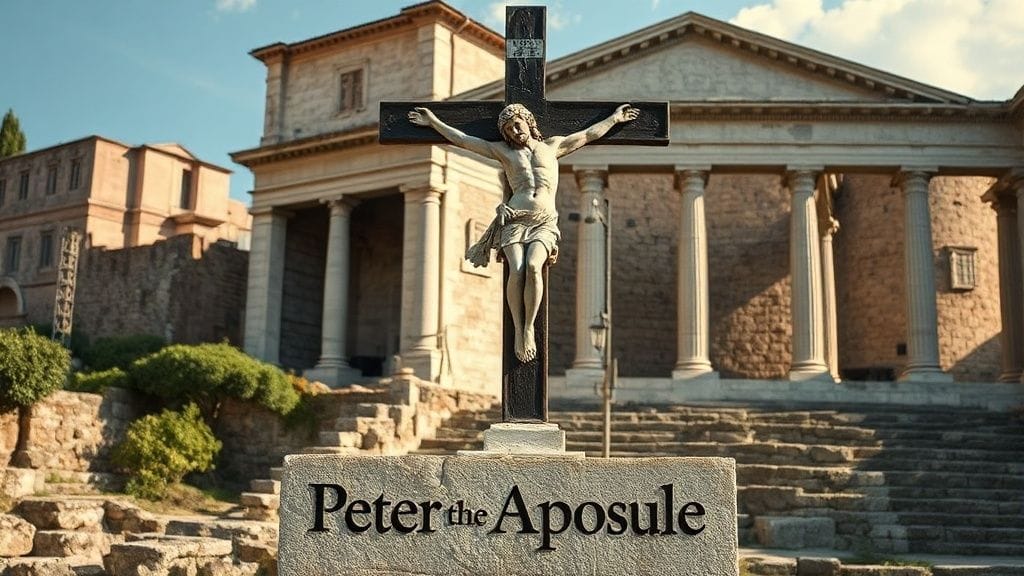
Peter’s fate in Rome is shrouded in tradition but narrated with heartbreaking clarity in early Christian writings. Arrested during Nero’s persecution, he was condemned to death, reportedly for the crime of preaching Christ as King. The appalling symbolism of his execution is compounded by the tradition that Peter was crucified upside down—out of humility, refusing to die in the same manner as Jesus. This act of self-effacement transformed an execution into a profound statement of faith and defiance.
The Crucifixion of Peter: Tradition and Testimony
Though no firsthand historical eyewitness accounts survive, the collective memory of Peter’s martyrdom has endured through writings such as the apocryphal Acts of Peter and the testimonies of early Church Fathers like Clement of Rome and Tertullian. These sources paint a picture of a brutal execution imbued with spiritual significance. Peter’s upside-down crucifixion became a potent symbol of Christian humility and sacrifice, forever linked to the narrative of salvation and suffering.
Historical Debates: Myth, Memory, and Meaning
Scholars have long debated the details of Peter’s martyrdom. Was he indeed crucified? Did he choose the inverted position? How reliable are the second-century reports? The questions reveal the challenges of separating fact from faith—historical reconstruction from devotional tradition. Yet, whether myth or reality, the story serves a powerful function: to inspire conviction, fortify communities, and embody the paradox of power through suffering. It encapsulates a moment when personal belief met imperial oppression, leaving a legacy beyond the bounds of certainty.
The Symbol of the Inverted Cross
Peter’s upside-down crucifixion gave rise to the inverted cross, a symbol layered with paradoxical significance. For centuries, it stood as a Christian emblem of humility, martyrdom, and the reversal of worldly values. In modern culture, it has sometimes been misconstrued or co-opted, but its origins remain rooted in Peter’s final act of faith. This inversion signifies the radical nature of Christian discipleship—bearing witness by turning the world’s expectations upside down.
The Christian Underground: Surviving the Storm
Despite Nero’s brutal crackdown, the Christian community in Rome did not vanish. It adapted, went underground, and even grew. The martyrdoms became rallying points, turning fear into a source of strength. Secret meetings, catacombs, and coded symbols preserved the faith under the empire’s watchful eyes. Peter’s death was both a tragedy and a turning point—the crucified apostle became a beacon for resilience amidst persecution.
Nero’s Shadow over Christianity
Nero’s persecution inaugurated a pattern of imperial hostility toward Christianity that would wax and wane for centuries. His actions marked a defining moment in Christian history—the movement was no longer merely a sect but a perceived threat to imperial unity and religious conformity. The shadow of Nero’s reign darkened the lives of countless believers, but also forged a faith that thrived against the odds.
From Martyrdom to Legend: The Making of a Saint
Martyrs like Peter transcended their deaths to become saints—their stories told and retold, embellished and hallowed. Peter’s martyrdom was the foundation stone of Christian hagiography, blending history with piety to forge a narrative of holy witness. The process of saint-making was both communal and political, rooting Christianity firmly in Rome and imbuing it with an enduring authority.
The Vatican and the Tomb of St. Peter
Tradition holds that Peter was buried where St. Peter’s Basilica now stands—a site of immense religious significance. Excavations beneath the Vatican reveal ancient tombs believed to be Peter’s, anchoring physical history to spiritual memory. The basilica itself, a masterpiece of faith and architecture, stands as a monument to the apostle’s legacy and the triumph of Christianity over persecution.
The Legacy of Peter’s Crucifixion on Christian Thought
Peter’s martyrdom embodies key themes of Christian theology: sacrifice, humility, and the paradox of strength in weakness. It shaped doctrines of leadership, apostolic succession, and ecclesiastical authority. The image of the crucified apostle encapsulates the pathway of discipleship and the enduring power of grace amid suffering. It is a legacy carried in liturgy, doctrine, and personal faith.
The Crucified Apostle in Art and Culture
Peter’s death inspired countless works of art, from early Christian catacomb paintings to Renaissance masterpieces and modern sculptures. Artists grappled with the tension between pain and sanctity, mortality and transcendence. The inverted cross appears in stained glass, iconography, and sculpture, a visual testament to the enduring power of Peter’s story. Culture, religion, and history converge in these depictions, keeping the apostle’s memory alive through the centuries.
The Political Significance of Peter’s Death
Peter’s martyrdom was not only a religious event but a deeply political one. It symbolized the challenge Christianity posed to Roman authority and ideology. The death of a prominent Christian leader signaled Rome’s attempt to assert dominance, yet it also highlighted the limits of imperial power. Peter’s crucifixion became a symbol of resistance, inspiring later generations to challenge tyranny in the name of conscience and faith.
Christianity’s Transformation after Peter
The church that grew after Peter’s death became more organized, confident, and influential. His martyrdom galvanized the Christian community, contributing to the faith’s spread throughout the empire. The hope of resurrection and triumph over death transformed struggles into narratives of victory. Christianity began its journey from persecuted sect to imperial religion, with Peter’s legacy serving as a guiding star.
Martyrdom and Authority: The Rise of the Papacy
Peter’s role as the "rock" upon which the church was built was a foundational claim of papal authority. His death in Rome lent symbolic weight to the bishop of Rome, establishing a lineage of spiritual leadership that claims direct descent from the apostle himself. This idea shaped the structure of the Catholic Church and influenced Christian ecclesiology throughout history.
The Enduring Power of a Sacred Story
Through centuries of turmoil, reform, and renewal, the story of Peter’s crucifixion has retained its emotional and spiritual power. It reminds believers of the cost of discipleship, the meaning of sacrifice, and the possibility of redemption. The narrative speaks across cultures and epochs, a testament to the human search for meaning amid suffering.
Conclusion: Crucifixion, Courage, and the Birth of a Faith
The crucifixion of Peter the Apostle is a story woven from threads of history, faith, and legend. It opens a window onto a world fraught with danger but full of hope—a world where a humble fisherman faced imperial power not with weapons, but with conviction. His martyrdom embodies the paradox of strength through weakness and offers a profound lesson on the courage to stand for one’s beliefs. This pivotal event shaped not only early Christianity but the very contours of Western civilization, making Peter’s story an enduring beacon of faith and resilience. In the shadow of his cross, a new world began to take shape—one where the power of love and sacrifice transcends even death.
FAQs: Understanding Peter the Apostle's Martyrdom
Q1: Why was Peter crucified upside down?
Tradition holds that Peter requested this form of crucifixion because he felt unworthy to die in the same manner as Jesus. The inverted cross symbolizes humility and a radical inversion of worldly values.
Q2: What evidence supports Peter’s martyrdom in Rome?
While no contemporary eyewitness accounts exist, early Church Fathers such as Clement of Rome and Tertullian refer to Peter’s death under Nero’s persecution. Archaeological findings under the Vatican also support the tradition of Peter’s burial site.
Q3: How did Nero’s persecution impact early Christianity?
Nero’s crackdown marked the first state-sponsored persecution of Christians in Rome, intensifying fear but also solidifying the identity and cohesion of the Christian community.
Q4: What is the significance of Peter’s martyrdom for the papacy?
Peter’s role and death in Rome underpin the doctrine of apostolic succession, legitimizing the bishop of Rome’s authority as the Pope, the spiritual leader of the Catholic Church.
Q5: How has the story of Peter’s crucifixion influenced Christian art?
Artists have used the image of the inverted cross and Peter’s martyrdom to depict themes of sacrifice, humility, and divine grace, making it a powerful symbol throughout Christian history.
Q6: Was Peter’s martyrdom unique among early Christians?
While many early Christians faced persecution, Peter’s status as an apostle and his death in Rome gave his martyrdom exceptional symbolic and institutional importance.
Q7: How does Peter’s crucifixion reflect the tensions between Christianity and Rome?
Peter’s death illustrates the clash between a new, exclusive faith that refused emperor worship and a Roman Empire that maintained power partly through religious conformity.
Q8: Why is Peter considered the ‘rock’ of the church?
According to the New Testament, Jesus gave Peter the nickname “rock,” symbolizing his foundational role in establishing the church and functioning as its leader.