Table of Contents
- The Final Sunset of an Empire: Philip II’s Last Days
- A Monarch’s Twilight: The Burden of the Spanish Crown
- The Rise and Reign of Philip II: Setting the Stage for an Ending
- El Escorial: The Royal Mausoleum and Symbol of Power
- September 13, 1598: The Day Spain Lost Its King
- The Physical Decline of the Lion of Castile
- Political Undercurrents in the Shadow of Death
- The Legacy of Empire: Challenges Awaiting Philip III
- Religious Zeal and the End of an Era
- The Funeral Rites at El Escorial: A Monument to Majesty
- The Mourning of a Realm: Spain’s Collective Grief
- Chroniclers and Poets Reflect on the Passing of the King
- The Transition: From the Habsburg’s Iron Grip to a Fragile Stability
- The European Stage in Flux: Power Shifts Post-1598
- Philip II’s Death and the Decline of Spanish Supremacy
- Castile’s Role in the Monarch’s Final Hours
- Anecdotes from the Court: Personal Observations of Philip II’s Death
- The Monumental Architecture of Grief and Memory
- From History to Myth: Philip II’s Image Through Time
- The Long Shadow of a Great King: Spain After 1598
The Final Sunset of an Empire: Philip II’s Last Days
In the fraught silence of a warm September morning, the air outside El Escorial hung heavy with anticipation. Within the austere walls of the sprawling monastery-palace, the last breath of Philip II—the monarch who had ruled Spain’s golden age—waned amid whispered prayers and the flickering of candlelight. His life, marked by conquest, religious fervor, and relentless governance, was drawing to an end on September 13, 1598, and with it, an epoch in European history. The kingdom seemed to hold its collective breath, as if aware that the passing of this formidable king would mark not just the death of a man, but the fragile turning of an empire’s tide.
Philip II, often called the “Prudent King,” had borne the weight of an empire upon his shoulders for over four decades—an empire spanning continents and oceans. Yet in these somber last moments, confined to a deathbed frail and diminished, he was no longer the indisputable ruler of Europe’s mightiest nation. Instead, he was a man confronting the inevitable limits of mortality, in a world that already teetered on the edge of profound transformation.
The day of Philip's death was more than a mere date—it was a defining passage. It closed the chapter on the zenith of Spanish glory and heralded an uncertain dawn for one of the most powerful states the world had ever known.
A Monarch’s Twilight: The Burden of the Spanish Crown
Philip II's health had been failing for years, yet no one dared truly believe the lion of Castile might soon fall. The king was the very image of imperial determination, his imposing figure often seen pacing through El Escorial’s corridors, absorbed in documents or religious meditations. But by September 1598, infirmities—both physical and spiritual—had taken their toll.
As the ruler of Spain, the Netherlands, parts of Italy, the expansive Spanish Americas, and the Far East possessions, Philip was a man whose mere will had altered the course of history. But even kings must surrender to the ravages of time. Lying on his deathbed, encircled by his confessor, courtiers, and family, Philip II was confronted with a past filled with victories and failures, conquests and wars, crafted into a personal reckoning.
The epitome of Catholic kingship, his reign was suffused with obsession for religious unity, which drove him to intervene in the wars of religion ravaging Europe and to order the construction of El Escorial—the monumental testament to his earthly and divine mission. Yet this same fervor fueled conflicts that strained the Spanish state’s coffers and manpower.
The burden of empire, it seemed, had finally caught up with the monarch.
The Rise and Reign of Philip II: Setting the Stage for an Ending
To understand the gravity of Philip II’s death, it is essential to revisit the path that had led the “Prudent King” to the pinnacle of European power. Born in 1527, Philip was the son of Charles V, the Holy Roman Emperor and King of Spain, one of history’s greatest rulers. When Charles abdicated, Philip inherited not only the vast Spanish territories but also the mantle of Europe’s defender of Catholicism during the Reformation.
His reign—spanning from 1556 to 1598—was characterized by relentless warfare and an unyielding vision of a Catholic world order. From the crushing of the Dutch Revolt to attempts at curbing Ottoman expansion in the Mediterranean, and the fateful Armada expedition against England in 1588, Philip II’s policies unfolded as an intense drama played out on the world’s stage.
Underneath these external conflicts, however, the internal strains of a sprawling empire grew apparent: financial crises, revolts, and the slow erosion of centralized power hinted at mounting challenges. All these factors set the ominous stage for his final days.
El Escorial: The Royal Mausoleum and Symbol of Power
Perched under the gaze of the Madrid mountains, the monastery-palace of El Escorial is more than mere stone and shadow—it embodies the spirit and ambitions of Philip II himself. A vast complex of Renaissance austerity, religious devotion, and political symbolism, it served simultaneously as royal residence, monastery, and, crucially, royal tomb.
It was within these walls that Philip chose to spend his final years, and ultimately to meet death. El Escorial was his vision of a perfect Christian realm, a bastion against the chaotic tides of the age. The somber solemnity of the mausoleum—its granite sarcophagi, its painted chapels, its ordered symmetry—reflected both the king’s piety and the weight of his legacy.
On that fateful September day, the corridors echoed with muted voices; the air smelled of incense and wax; the king’s breathing was shallow beneath the vaulted ceilings that seemed to watch over his passing.
September 13, 1598: The Day Spain Lost Its King
As dawn broke on September 13, 1598, Philip’s condition had deteriorated dramatically. Small courtiers guarded his chamber, and his closest advisors prepared for the inevitable. The king’s final hours were marked by moments of lucidity interspersed with weakness. At last, his spirit departed, almost quietly, leaving behind a realm suspended between mourning and uncertainty.
Philip’s death was no mere personal event; it rippled through the fabric of European politics. News traveled swiftly, carried by couriers across seas and mountains. From Madrid to Antwerp, from Manila to Naples, the great powers revised their strategies, aware that a new era was dawning.
Spain had lost more than a monarch; it had lost an era-defining figure whose absence created a vacuum of power that would soon be felt worldwide.
The Physical Decline of the Lion of Castile
In his final months, Philip was a far cry from the vigorous ruler who once towered over his council chambers. Chroniclers described the grim reality: a king gaunt from illness, his once piercing gaze dulled by arthritis and dropsy, confined to his bed in El Escorial.
Pain wracked his body, yet there was resolute calm in his demeanor. His physicians did all they could, but medicine at the time was powerless against the illnesses ravaging him. It is said that even in pain, he maintained his dignity—an emblem of the stoicism that had defined his reign.
His deathbed became a theater of conflicting emotions: grief mingled with relief, fear tempered by faith.
Political Undercurrents in the Shadow of Death
Behind the scenes, the machinery of monarchy did not halt for death. Spain’s governing elites observed keenly as the transition loomed. Philip’s chosen heir, his son Philip III, faced huge expectations—both to preserve his father’s legacy and to steer Spain through turbulent waters.
At court, factions mobilized and diplomats speculated on future alliances. The Habsburg grip on Europe seemed unshaken but vulnerable. Questions arose: Would Philip III embody his father’s iron will or chart a new, more pragmatic course? The tension was palpable.
Spain’s enemies and allies alike watched anxiously, sensing that the death of Philip II might signal the beginning of shifting powers across the continent.
The Legacy of Empire: Challenges Awaiting Philip III
The empire Philip II left behind was unparalleled in its reach and complexity. Yet the very scale of this empire sowed the seeds of future difficulties. Financial exhaustion, restless provinces, religious conflicts, and military overextension posed serious problems.
Philip III inherited a vast but fragile dominion, on which the "sun never set" but whose foundations were increasingly shaky. The challenges facing him would test his leadership abilities far beyond his father’s already immense trials.
Historians view this moment as the pivot point where Spain’s Golden Age began its slow descent, though its global influence persisted for decades after.
Religious Zeal and the End of an Era
One cannot fully grasp Philip II’s death without understanding how deeply religion permeated his reign and identity. A champion of Catholicism, he saw his mission intertwined with the spiritual salvation of his subjects and the defense against Protestant heresies.
His policies led to the Spanish Inquisition’s height, the suppression of dissent, and the promotion of cultural orthodoxy. Yet this religious zeal, so central to his kingship, also fuelled internecine wars and alienated many.
At his death, the question lingered: would his successors continue this fierce religious orthodoxy or move toward moderation?
The Funeral Rites at El Escorial: A Monument to Majesty
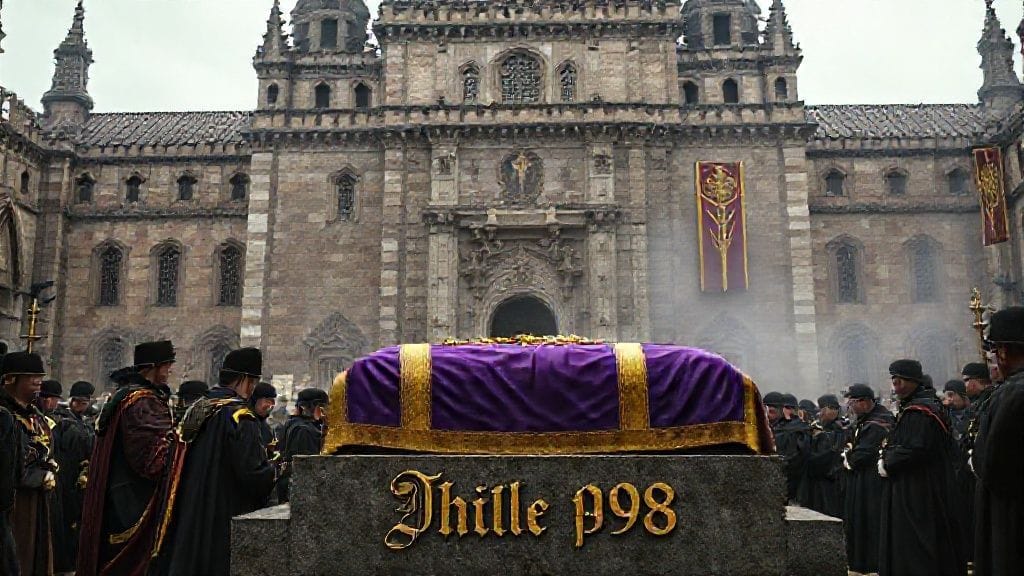
Philip II’s funeral was inseparable from the grandeur of El Escorial itself. The procession was solemn and elaborate, a display of medieval ritual blended with Renaissance dignity. Nobles, clergy, and representatives from across the empire assembled to pay homage.
The royal sarcophagus, carved in granite and bronze, was lowered into the Pantheon of the Kings—a crypt reserved for sovereigns and their kin. The ceremony echoed Philip’s own complex legacy: devout, authoritative, and enduring.
For the people of Spain, the funeral was a moment of shared mourning that transcended class and region.
The Mourning of a Realm: Spain’s Collective Grief
In cities and villages alike, news of Philip’s death elicited profound sorrow. To many Spaniards, he was not only a king but a living symbol of national identity and divine order. The collective response mixed piety, nostalgia, and apprehension.
Church bells tolled, masses were said, and poets composed elegies lamenting the fallen monarch. Yet beneath this public grief, there was awareness of the challenges to come—questions about Spain’s future and its path forward.
This moment of mourning was a fragile bridge between past glories and the uncertain promise of the future.
Chroniclers and Poets Reflect on the Passing of the King
Contemporary writers seized upon Philip II’s death to reflect on his life and reign. The court chronicler Antonio de Herrera y Tordesillas penned somber accounts emphasizing the king’s piety and dedication. Poets like Luis de Góngora captured the pathos of an age ending in elegiac verse.
In these testimonies, Philip’s image was immortalized as a complex figure—both a mighty ruler and a deeply human presence, wrestling with the divine will and earthly power.
They ensured that the king’s passing would not fade into mere footnotes but would resonate through Spanish culture for centuries.
The Transition: From the Habsburg’s Iron Grip to a Fragile Stability
Philip II’s death marked the transition from a monarch known for meticulous control to a son often perceived as more compliant and less rigorous. The era of absolute, hands-on governance gave way to a more delegated authority, with powerful ministers increasingly shaping policy.
This change mattered, for it signaled the beginning of structural shifts in Spain’s monarchy and its imperial administration, foreshadowing transformations in governance and the state’s eventual decline.
Yet the foundations laid by Philip II’s reign would continue to influence Spain’s direction well into the 17th century.
The European Stage in Flux: Power Shifts Post-1598
Philip’s death was not just a Spanish affair—it was a seismic event in European geopolitics. Rivals like France, England, and the Dutch Republic noted the potential for changes in alliances and strategies.
The fragile peace in the Low Countries, the ongoing wars with England, and relations with the Papacy would all be recalibrated in the newborn king’s shadow.
In many ways, September 1598 was a portal from the 16th century’s religious wars into the more complex, multi-polar struggles of the 17th century.
Philip II’s Death and the Decline of Spanish Supremacy
Though still a dominant force, Spain’s monarchic authority began to wane after Philip’s death. Fiscal troubles deepened, military defeats accumulated, and internal divisions sharpened.
Historians often mark his passing as the beginning of the Spanish Empire’s gradual decline, a slow fading from the status of world hegemon to a power struggling to maintain its vast territories.
But it was also an end tinged with nostalgia and respect for the era Philip II had forged through sheer will and unyielding faith.
Castile’s Role in the Monarch’s Final Hours
Castile, the heartland of Spanish monarchy and Philip’s favored domain, played a special role in the king’s last moments. The loyalty of the Castilian nobility, the religious fervor of the populace, and the administrative infrastructure converged at El Escorial during those final days.
More than a backdrop, Castile was active in shaping the ceremonial and political responses to the king’s death. Its centrality underscored the enduring importance of this region to Spanish identity and monarchical power.
Anecdotes from the Court: Personal Observations of Philip II’s Death
Eyewitness accounts offer intimate glimpses into the king’s passing. Some spoke of his calm acceptance, others recalled small gestures—a grasp of a hand, a whispered prayer. One courtier noted, “Though frail, the king’s eyes still held the steel of command.”
These anecdotes humanize a figure often seen as remote or austere, revealing the man behind the crown in his final human moments.
Stories of loyal attendants and devoted clergy attending his bedside further enrich this poignant chapter.
The Monumental Architecture of Grief and Memory
El Escorial itself became not just a resting place but a symbol of mourning, power, and memory. Designed as a monument to Philip’s ideals, it also embodied collective grief.
For centuries, pilgrims and dignitaries have visited his tomb, contemplating the vast sweep of the king’s life and its historical ramifications.
The architecture stands as a silent witness to the passage of time and the enduring drama of empire.
From History to Myth: Philip II’s Image Through Time
Over the centuries, Philip II’s image has been sculpted by historians, politicians, and artists into myth and legend. The “Prudent King” alternates between a symbol of majesty and a cautionary tale of imperial overreach.
Literature, cinema, and scholarship revisit his reign and death, each generation reshaping his memory to fit its own questions about power, religion, and leadership.
His death remains a profound moment where history and myth intersect.
The Long Shadow of a Great King: Spain After 1598
Though Philip II’s mortal journey ended in 1598, his influence cast a long shadow over Spain’s destiny. The monarchs who followed, the wars that raged on, and the slow transformations of empire all unfolded within the framework he had built.
His death was a hinge in Spain’s history—a moment of both loss and transition that continues to teach us about the fragility of power and the enduring pursuit of divine and earthly order.
Conclusion
The death of Philip II on September 13, 1598, resonates far beyond the quiet chambers of El Escorial where a mighty king drew his last breath. It marked the close of an extraordinary reign—a reign characterized by ambition, devotion, and the tireless forging of a global empire.
Yet, it also heralded the passing of an era, as Spain faced the formidable challenges of continuity, religious fervor, political transition, and imperial management. The physical decline of the monarch mirrored the subtle shifts underway in the European order, where old certainties gave way to new realities.
Philip II’s death was not merely a historical event; it was a profound human story of authority meeting mortality, piety confronting fate, and the weight of history pressing upon a solitary man. In understanding his final hours, we grasp a larger narrative about the cycles of power, the fragile longevity of empire, and the indelible legacy one man can leave behind.
His passing invites us to reflect on leadership, faith, and the tenuous nature of greatness—reminding us always that history’s grandest tales are lived, breathed, and finally ended by human hearts.
FAQs
Q1: What were the main causes of Philip II’s declining health leading to his death?
A1: Philip II suffered from multiple ailments in his later years, including arthritis, gout, and dropsy (fluid retention). The cumulative strain of years of physical and mental stress, combined with the limited medical knowledge of the time, contributed to his gradual physical decline culminating in his death in 1598.
Q2: Why was El Escorial significant in Philip II’s life and death?
A2: El Escorial was both a royal residence and a religious monument constructed by Philip II as a symbol of his Catholic faith and imperial authority. It served as his retreat during his later years and was chosen as his final resting place, reflecting his desire for a lasting spiritual and dynastic legacy.
Q3: How did Philip II’s death affect Spain’s political landscape?
A3: His death led to the ascension of Philip III, whose reign saw less personal involvement in governance and more delegation to ministers, initiating shifts in the administration of Spain. This transition also raised uncertainties among Spain’s enemies and allies, impacting European diplomacy and power balance.
Q4: What was the international reaction to the death of Philip II?
A4: European powers reacted with a mixture of apprehension and opportunity. Rivals like England and France anticipated possible changes in Spanish policies, while allies prepared to support the new king. The death marked a potential inflection point in ongoing conflicts such as the Dutch Revolt and tensions in the Mediterranean.
Q5: In what ways did Philip II’s religious policies influence his reign and death?
A5: Philip II’s intense Catholicism defined much of his reign, leading to staunch opposition to Protestantism and the enforcement of the Spanish Inquisition. His faith influenced his decisions and his last rites, highlighting the inseparability of religion and monarchy in his life and legacy.
Q6: How is Philip II remembered in Spanish history and culture?
A6: Philip II is remembered as a complex figure—both revered as a wise and devout monarch and criticized for his authoritarianism and the burdens his wars imposed on Spain. His image is deeply embedded in Spain’s cultural memory through art, literature, and national identity.
Q7: Did Philip II’s death immediately change the course of the Spanish Empire?
A7: While his death did not instantaneously transform the empire, it marked the beginning of gradual political and economic challenges. His son Philip III’s less hands-on approach and evolving geopolitical circumstances contributed to the empire’s slow decline.
Q8: Why is Philip II often called “The Prudent King”?
A8: He earned this epithet due to his cautious, deliberate governance style, emphasis on planning, and disciplined administration. His prudence was seen in his attempts to consolidate power and carefully manage Spain’s vast territories, though opinions differ on the effectiveness of his methods.