Table of Contents
- The Twilight of a Monarch: Philip III of Spain’s Final Days
- The Royal Court in Madrid: A Stage Set for Transition
- The Habsburg Legacy and the Burden of Empire
- Spain on the Brink: Political and Social Underpinnings
- The Life and Reign of Philip III: From Promise to Decline
- The Influence of the Duke of Lerma: Power Behind the Throne
- March 1621: The Deathbed Scene in the Royal Chambers
- Public Reaction in Madrid: Mourning a Monarch
- Succession and Uncertainty: The Future of the Spanish Crown
- Spain’s International Standing at the Time of Philip III’s Death
- The Economic Struggles and Their Toll on the Empire
- Religion and Politics: Catholicism’s Role in Philip’s Spain
- Cultural Flourishing Amidst Imperial Decay
- The Death of a King and the Rise of Philip IV: A Changing Era
- Historical Perspectives on Philip III: Judgements and Reassessments
- Legacy in Stone and Spirit: Philip III’s Monumental Imprint on Madrid
- The Rituals and Ceremonies of Royal Death in Early 17th Century Spain
- The Lasting Shadows: How Philip III’s Reign Shaped Spanish and European History
- Conclusion: The End of an Era, The Dawn of Another
- Frequently Asked Questions about Philip III’s Death and Reign
- External Resource: Wikipedia Entry on Philip III of Spain
- Internal Link: Visit History Sphere → https://historysphere.com/
1. The Twilight of a Monarch: Philip III of Spain’s Final Days
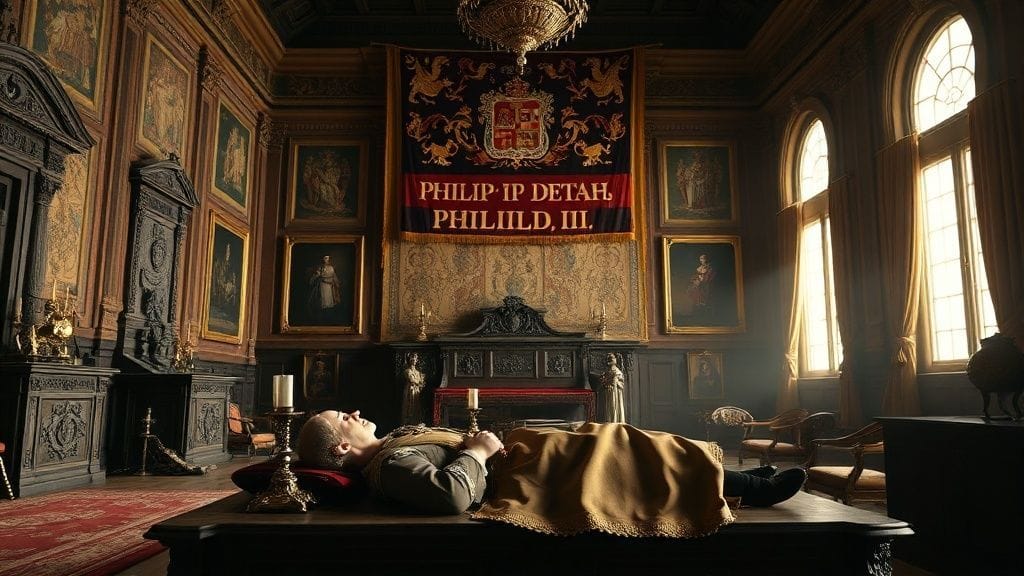
On a chilly March morning in 1621, deep within the stone walls of Madrid’s Royal Alcázar, Philip III lay pale and weakened. The vast empire he had inherited was fracturing like a brittle shell beneath his fragile form. His breath, once an emblem of the might of the Spanish crown, now came in shallow whispers, as courtiers and priests gathered silently in the dimly lit chamber. The echo of his heavy footsteps walking the corridors of power had faded; whispers of Spain’s decline began to pour through the capital's streets. The death of Philip III was not merely a king’s passing—it was the closing of a chapter that would dramatically reshape Europe’s future.
2. The Royal Court in Madrid: A Stage Set for Transition
The Royal Alcázar, a fortress-palace that once echoed with the flourishing power of the Habsburg dynasty, was an epicenter of tension and murmurs in those final days. The courtiers were restless yet subdued, each grappling with the knowledge that the reign of their monarch was coming to an end. The transition ahead was veiled in uncertainty, especially given the period's fragile alliances and the empire’s mounting challenges. Despite the sumptuous tapestries and ornate gold fixtures, the atmosphere was heavy—an empire's heart was about to stop beating.
3. The Habsburg Legacy and the Burden of Empire
Philip III ascended the Spanish throne in 1598, inheriting a sprawling empire stretching across Europe, the Americas, and parts of Asia. The Habsburg legacy he carried was immense, but so was the burden. Spain was the foremost superpower of its day, yet the costs of maintaining such dominion were growing prohibitive. Wars, religious conflicts, and political intrigues sapped the kingdom’s vitality. Philip III’s reign became synonymous with peace overtures and abdications to his powerful prime minister rather than direct rule, a trend which would influence the empire’s trajectory long after his death.
4. Spain on the Brink: Political and Social Underpinnings
The Spain of 1621 was a kingdom on edge. The costly Eighty Years’ War against the Dutch and the religious wars sweeping through the Holy Roman Empire reflected a continent rife with conflict. Within Spanish borders, economic difficulties gripped daily life, while noble factions vied for influence. The monarchy struggled to maintain authority amid rising public discontent and the slow erosion of Spain’s once overwhelming prestige. These tensions set the stage for a fraught succession at the end of March.
5. The Life and Reign of Philip III: From Promise to Decline
Born in 1578, Philip was groomed from an early age to be a ruler, receiving education steeped in counter-Reformation Catholicism and dynastic pride. His marriage to Margaret of Austria symbolized dynastic alliances. Yet, his 23-year reign was marked by a cautious, sometimes indecisive style of governance. Reliant on royal favorites and ministers, particularly the Duke of Lerma, Philip delegated much of his power—a decision both criticized and understood in light of the empire's complexities.
6. The Influence of the Duke of Lerma: Power Behind the Throne
Francisco Gómez de Sandoval y Rojas, the Duke of Lerma, was arguably the most significant figure during Philip III’s rule. Acting as valido—royal favorite and chief minister—Lerma wielded extraordinary influence. His tenure saw the consolidation of power but also corruption and political stagnation. Lerma’s policies of peace with certain European states and internal patronage may have extended Philip's reign peacefully, but also arguably accelerated the erosion of Spain’s dominance.
7. March 1621: The Deathbed Scene in the Royal Chambers
As the last day of March 1621 arrived, Philip’s condition had deteriorated markedly. Chronic health issues, including gout and possibly tuberculosis, had confined him increasingly to bed. Witness accounts describe a king calm yet resigned—a man aware of his impending fate. Priests administered the last rites as courtiers solemnly awaited the monarch’s final breath. The death of Philip III was not a private affair; it punctuated the anxiety of a nation on the cusp of transformation.
8. Public Reaction in Madrid: Mourning a Monarch
News of the king’s passing rippled swiftly through Madrid. Shops closed early; commoners and nobles alike poured into cathedrals to pray for the soul of their sovereign. The city was draped in black, a somber procession marking the end of an era. Yet beneath grief was a palpable apprehension—what would the future hold for Spain without the careful, if flawed, hand of Philip III?
9. Succession and Uncertainty: The Future of the Spanish Crown
With Philip III’s death, his son Philip IV ascended the throne as a young, untested ruler. The transition was anything but simple. The new king would inherit an empire shadowed by debt, internal discord, and external threats. Although Philip IV promised a vibrant renaissance, he faced the enormous task of reversing an empire in decline. The delicate balance of power in Europe hinged on the decisions made in the following months.
10. Spain’s International Standing at the Time of Philip III’s Death
By 1621, Spain’s aura as an unchallenged global force was fading. While still formidable, the empire faced rising competitors: England, France, and the Dutch Republic. The Thirty Years’ War was reshaping Europe’s political map, demanding deft diplomacy. The balance between maintaining colonial holdings and managing European conflicts strained Spain’s resources, flagging its dominance on the world stage.
11. The Economic Struggles and Their Toll on the Empire
The Spanish empire’s vast wealth, largely derived from New World silver, was under siege by inflation, piracy, and interminable warfare. The crown declared multiple bankruptcies in the early 1600s, and levies burdened the peasantry and burgeoning middle classes. Philip III’s tenure saw pragmatism in halting aggressive expansion, yet the economic foundations of power were visibly crumbling with profound consequences.
12. Religion and Politics: Catholicism’s Role in Philip’s Spain
Catholicism was not merely a religion but a pillar of Spanish identity under Philip III. His reign amplified the Counter-Reformation ethos, enforcing religious conformity and persecution of heretics. Yet this religious zeal coexisted with political pragmatism, as peace treaties and alliances sometimes required diplomacy across confessional lines. The king’s death left questions about how fervently his successor would wield faith in governance.
13. Cultural Flourishing Amidst Imperial Decay
Interestingly, despite political and economic difficulties, Philip III’s era witnessed cultural brilliance. The Spanish Golden Age flourished with literary giants like Lope de Vega and Diego Velázquez taking form. Royal patronage of the arts infused the capital with a radiant but bittersweet glow, a testament that creative vigor can thrive even as empires falter.
14. The Death of a King and the Rise of Philip IV: A Changing Era
Philip IV’s assumption of the crown was imbued with hope and anxiety. At just 16, he promised vigor and modernity, eventually delving deeply into arts and statecraft. Yet the legacy of his father’s cautious reign coupled with an increasingly volatile Europe meant that Spain’s trajectory would be tested—sometimes painfully—in decades to come.
15. Historical Perspectives on Philip III: Judgements and Reassessments
Historians have often painted Philip III as a weak ruler overshadowed by his ministers. Yet modern scholarship has nuanced this view, recognizing the complexity of ruling a vast, overstretched empire beset by global transformations. Philip’s reign illustrates the intrinsic challenges of monarchy amid rising nationalism, economic change, and religious upheaval.
16. Legacy in Stone and Spirit: Philip III’s Monumental Imprint on Madrid
Beyond politics, Philip III’s name endures in Madrid’s urban landscape. The Plaza Mayor, completed under his reign, remains a central emblem of Spanish civic life and architecture. His reign left both tangible monuments and intangible legacies that continue to define Spain’s historical identity.
17. The Rituals and Ceremonies of Royal Death in Early 17th Century Spain
The passing of Philip III unfolded within a rich tapestry of ritual. From the last rites to the elaborate funeral procession, every act was imbued with symbolism, reinforcing monarchy’s sanctity and continuity. These ceremonies served to unify a grieving populace and reaffirm dynastic permanence amid uncertainty.
18. The Lasting Shadows: How Philip III’s Reign Shaped Spanish and European History
Philip III’s death signaled more than a dynastic handover. It encapsulated the end of a certain Spain—one marked by hesitant retreat and the first tremors of decline. His reign’s legacies—political, cultural, and social—resonated across Spain and Europe, marking a watershed between grandeur and transformation.
Conclusion
Philip III’s death on that somber March day in 1621 was not simply the fall of a monarch but the closing of a pivotal chapter in European history. His reign, an intricate mosaic of deferred power, imperial overreach, cultural brilliance, and cautious diplomacy, epitomizes the paradox of Spain’s Golden Age—radiant yet receding. From the royal chambers of the Alcázar to the bustling streets of Madrid, the death of Philip III whispered of endings and beginnings, of an empire poised precariously between its glorious past and an uncertain future. The Spanish crown would survive, but the world around it was irreversibly changing.
FAQs
Q1: What were the main causes of Philip III’s death?
A1: Philip III suffered from chronic health issues, including gout and possible tuberculosis, which debilitated him in his final years, culminating in his death on March 31, 1621.
Q2: How did Philip III’s reign influence Spain’s political landscape?
A2: His reign was characterized by delegation of power to favorites like the Duke of Lerma, leading to political stagnation but also relative peace, influencing Spain’s gradual loss of dominance.
Q3: Who succeeded Philip III and what challenges did he face?
A3: Philip IV, his son, succeeded him. At only 16, he faced an empire burdened by debts, wars, and declining influence amidst a shifting European balance of power.
Q4: How did the Spanish people react to the death of Philip III?
A4: The death was met with widespread mourning in Madrid, with public displays of grief mingled with anxiety about the uncertain future.
Q5: What role did religion play in Philip III’s reign?
A5: Catholicism was central, reinforcing the monarchy’s authority and identity during the Counter-Reformation, often manifesting in stringent religious policies.
Q6: What cultural achievements occurred during Philip III’s reign?
A6: Despite political challenges, the Spanish Golden Age flourished, with prominent figures in literature and the arts emerging under royal patronage.
Q7: How is Philip III viewed by modern historians?
A7: While traditionally seen as a weak ruler overshadowed by favorites, modern perspectives recognize the complexities he faced managing a sprawling, troubled empire.
Q8: How did Philip III’s death impact Spain’s international standing?
A8: His death marked a definitive turn toward imperial decline, with rising rivals challenging Spain’s hegemonic status in Europe and overseas.