Table of Contents
- The Calm Before the Storm: Paris in Early 1906
- Pierre Curie: The Quiet Genius at the Heart of Science
- A Life Devoted to Discovery and Collaboration
- April 19, 1906: A Tragic Turn on the Streets of Paris
- The Accident: Details of That Fateful Day
- Witnesses and Immediate Reactions on the Scene
- The Shockwaves Through the Scientific Community
- Marie Curie’s Unbroken Resolve Amid Tragedy
- The Funeral and Public Mourning: Paris Bids Goodbye
- The Effects on Radiation Research and Scientific Progress
- The Personal and Professional Legacy of Pierre Curie
- How Pierre’s Death Shaped the Role of Marie Curie
- Public Memory and Commemoration in France and Beyond
- Revisiting the Street of the Accident: A Historical Site
- The Death of Pierre Curie: Reflection on Chance and Fate
- The Evolution of Safety for Scientists After Early Radium Studies
- From Tragedy to Enduring Inspiration: Pierre Curie’s Place in History
1. The Calm Before the Storm: Paris in Early 1906
In the spring of 1906, Paris brimmed with a mix of optimism and modern vitality. The city of lights had long since established itself as a bastion of art, intellect, and cutting-edge science. Horse-drawn carriages clattered alongside new motorcars; cafés buzzed with philosophers, poets, and physicists debating the mysteries of the universe. It was within this vibrant context that Pierre Curie moved quietly but resolutely, a figure profoundly respected yet modest, committed to unraveling the invisible forces shaping the natural world.
Yet beneath this atmosphere of progress loomed the fragility of human existence. Scientists like Pierre had long wrestled with unpredictable elements, from the intangible power of radium to the precarious circumstances of daily life in a bustling metropolis. On April 19, 1906, that tension between human mastery and fate revealed itself with heartbreaking force.
2. Pierre Curie: The Quiet Genius at the Heart of Science
Pierre Curie’s name may not resonate with the same immediate fame as his wife Marie’s, but in the early 20th century, among scientific circles, he was revered as a brilliant mind whose discoveries were foundational. Born in 1859 in Paris, Pierre’s intellectual gifts were evident from a young age. His early studies into magnetism and crystallography set the stage for paradigm-shifting breakthroughs in physics.
Together with Marie Curie, he pioneered the emerging field of radioactivity, coining terms and developing methods that were as revolutionary as they were dangerous. This was a man who worked with materials that emitted invisible rays, unaware yet of the long-term consequences for health.
His humility and dedication were defining traits. Though his contributions were immense, Pierre remained far from the limelight, preferring the quiet intensity of laboratory work to public acclaim.
3. A Life Devoted to Discovery and Collaboration
Pierre and Marie Curie's partnership was more than matrimonial—it was an intellectual symbiosis. Their shared curiosity fueled work that led to the discovery of two new elements: polonium and radium. From the modest basement laboratory at the University of Paris, their experiments illuminated the nature of atomic matter and radioactivity.
Despite the excitement of discovery, their lives were filled with arduous labor and modest means. Pierre often lectured while Marie continued experimental research. Their endeavors pushed the boundaries of physics but also brought them face to face with unknown risks.
It was this shared journey that defined Pierre’s life up until that tragic day, illustrating the sacrifices and unpredictability wrapped in the pursuit of knowledge.
4. April 19, 1906: A Tragic Turn on the Streets of Paris
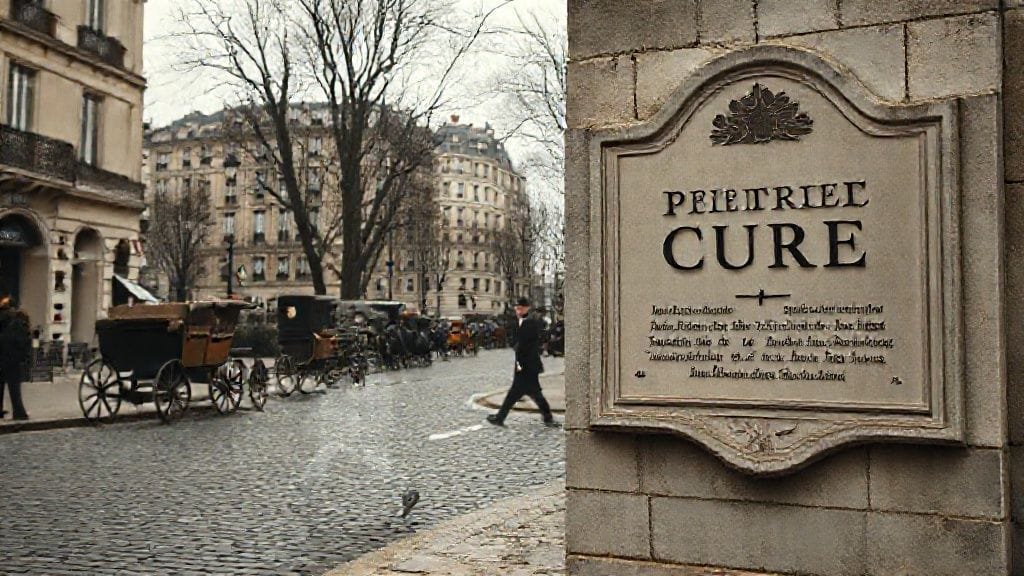
Spring’s warmth beckoned Parisians outdoors on the morning of April 19, 1906. Pierre Curie was crossing the Rue Dauphine near Pont Neuf, a bustling area framed by centuries-old buildings and vibrant street life. It was an ordinary day, blinked and passed by thousands, but for Pierre, it became a moment etched forever in tragedy.
A heavy horse-drawn cart, maneuvering clumsily on the cobblestones, descended upon him with awful suddenness. Witnesses later recalled the helplessness of a respected elder caught unaware, crushed beneath the wheels and pulled beneath the vehicle’s belly.
This was no simple accident; it was a sudden rupture of order, a stark reminder of how fragile life is—even for those shaping human understanding of the universe.
5. The Accident: Details of That Fateful Day
At around 3 p.m., Pierre Curie was reportedly in a hurry to return home from his laboratory. Accounts describe him stepping off the curb, perhaps distracted by thoughts or a slip on the uneven stone. The cart’s driver, struggling to control the animal, could not halt in time.
Pierre was pinned under the wheel; the severity of his injuries was immediate and fatal. He succumbed to a fractured skull and severe internal trauma before medical aid arrived.
This violent incident shocked the city. A man so dedicated to science killed by a commonplace urban hazard: a reminder that genius cannot shield one from the randomness of fate.
6. Witnesses and Immediate Reactions on the Scene
Eyewitnesses, including street vendors and passersby, rushed to assist, but the damage was irrevocable. One man later described the scene: “There was terror and confusion, a collective grief in the air… We all knew who he was.”
Within hours, news spread amongst Parisian scientific circles. The Sorbonne professors and students felt the loss like a personal wound. Telegrams conveyed condolences globally.
For a man who had spent his life discovering unseen forces, his death was brutally visible and immediate—a jarring inversion of his usual world of quiet scientific revelation.
7. The Shockwaves Through the Scientific Community
Pierre Curie’s death was felt far beyond French borders. Scientific communities, from London to Berlin, mourned a pioneer who had advanced the understanding of matter itself.
J.J. Thomson, the Nobel physicist, remarked, “Europe has lost one of its brightest scientific lights.” Colleagues recognized not only a brilliant physicist but a man whose kindness and humility were as rare as his intellect.
Newspapers published detailed obituaries, elevating Pierre posthumously while raising awareness of their groundbreaking research on radioactivity.
8. Marie Curie’s Unbroken Resolve Amid Tragedy
Amidst immense personal grief, Marie Curie’s resilience shone with extraordinary clarity. While mourning the loss of her beloved husband and partner, she resolved to carry forward their work.
Contrary to expectations of withdrawal, she stepped into public scientific roles with unprecedented strength, eventually becoming the first woman to teach at the University of Paris.
Marie’s determination turned Pierre’s tragic death into a moment of impetus, ensuring their shared dreams would not fade but blossom anew.
9. The Funeral and Public Mourning: Paris Bids Goodbye
The funeral cortege winding through Paris’s streets reflected the city’s deep respect. Scientists, political figures, students, and ordinary citizens lined the roads.
At the cemetery, speeches eulogized Pierre Curie not only as a scientist but as a model of modesty, dedication, and sacrifice.
The public participation underscored the man’s significance beyond science—the communal loss of someone embodying human curiosity and commitment.
10. The Effects on Radiation Research and Scientific Progress
Pierre's untimely death posed profound questions about the future of radiation research. Was the field too dangerous without proper safety knowledge?
In the years following, precautions increased amid revelations about radiation’s invisible hazards. Marie herself suffered health consequences, suggesting a harsh silent toll.
Yet the momentum for discovery accelerated; Pierre’s foundational work became the launchpad for pioneers like Irène Joliot-Curie and Ernest Rutherford.
11. The Personal and Professional Legacy of Pierre Curie
Though his life ended abruptly, Pierre’s legacy was cemented in multiple domains. In science, his laws of piezoelectricity remain fundamental. His elegant experiments set templates for precision and rigor.
Humanly, he is remembered for his gentle nature, his collaborative spirit, and a devotion to truth above acclaim.
His narrative invites reflection on the balance between curiosity and vulnerability in the scientific quest.
12. How Pierre’s Death Shaped the Role of Marie Curie
Widowed suddenly, Marie Curie’s career took decisive new paths. She assumed leadership of their radium research, became the first female Nobel laureate alone, and transformed science’s gender dynamics.
Pierre’s death, while devastating, catalyzed a remarkable chapter of female empowerment in science—a theme resonant a century later.
13. Public Memory and Commemoration in France and Beyond
Paris, the city that witnessed both Pierre’s life and death, honors him through plaques and monuments near Rue Dauphine. Annual commemorations occur in scientific institutions.
Globally, his name is inscribed alongside Marie’s in histories of physics, inspiring generations fascinated by the marvels and dangers of the atom.
14. Revisiting the Street of the Accident: A Historical Site
The Rue Dauphine intersection remains a quiet portal to memory. Modern Paris flits by, oblivious to the gravity of that spot, yet for historians and pilgrims, it is sacred ground.
The contrast between bustling urban life and this site of sudden tragedy encapsulates the unpredictability that defines human existence.
15. The Death of Pierre Curie: Reflection on Chance and Fate
The irony of a man who studied invisible forces falling victim to a visible, mechanical accident provokes deep reflection. Was it chance, fate, or the cruelty of circumstance?
Pierre’s death underscores life’s fragile unpredictability, even amidst progress.
16. The Evolution of Safety for Scientists After Early Radium Studies
Following Pierre’s era, scientific methodologies transformed. Awareness of radiation’s dangers led to safety protocols, equipment redesigns, and protective legislation.
His legacy thus extends to safer laboratories, where future discoveries could unfold with reduced risk.
17. From Tragedy to Enduring Inspiration: Pierre Curie’s Place in History
Over a century later, Pierre Curie remains a symbol of quiet genius and scientific purity. His story, marked by both brilliance and heartbreak, continues to inspire.
He stands not only as a pioneer of physics but as a testament to the human spirit confronting the mysteries of the cosmos and mortality itself.
Conclusion
The sudden death of Pierre Curie on April 19, 1906, is more than a historical footnote—it is a profound narrative of brilliance interrupted, resilience awakened, and legacy forged in the crucible of tragedy. Paris that spring witnessed the tearing away of a man who had devoted his life to unveiling the invisible energies shaping the world. Yet from this rupture rose a renewed commitment in his widow Marie and the wider scientific community, transforming grief into progress and personal loss into universal gain.
Pierre Curie’s story reminds us that the pursuit of knowledge carries risks known and unknown, and that humanity’s greatest advancements often emerge from moments of deep sorrow. His legacy is not only in the equations and elements he helped discover but also in the enduring testament to perseverance and the ceaseless human quest to understand the universe. It is a story of light and shadow, discovery and death, chance and fate—a story that resonates as powerfully today as it did those many years ago on the cobblestones of Paris.
FAQs
Q1: Who was Pierre Curie, and what were his major scientific contributions?
Pierre Curie was a French physicist known for his pioneering work on crystallography, magnetism, and radioactivity. Alongside Marie Curie, he co-discovered polonium and radium, laying the groundwork for modern atomic physics.
Q2: How did Pierre Curie die?
Pierre Curie died on April 19, 1906, after being accidentally crushed by a horse-drawn cart in Paris. The collision caused fatal head injuries.
Q3: How did Pierre Curie’s death affect Marie Curie and their research?
Marie Curie, devastated, chose to carry on their shared research alone, eventually winning a solo Nobel Prize and breaking significant gender barriers in science.
Q4: What was the immediate reaction of the scientific community to his death?
The scientific world mourned deeply, recognizing the loss of a brilliant mind whose work was foundational to emerging nuclear science.
Q5: How is Pierre Curie commemorated today?
He is commemorated through monuments, plaques, and annual remembrances in France, and is celebrated within the international scientific community.
Q6: Did Pierre Curie’s death prompt changes in laboratory safety?
While his death was accidental and unrelated to radiation exposure, the broader Curie research era led to increased awareness and improved safety practices around radioactive materials.
Q7: What does Pierre Curie’s story teach us about the risks in scientific discovery?
His story highlights that the path of discovery can be precarious, filled with unforeseen dangers both mundane and extraordinary, and requires courage and resilience.
Q8: How did Pierre Curie’s death influence public perceptions of science in the early 20th century?
The tragedy humanized the image of scientists, illustrating their vulnerability and sacrifice, and underscored the urgency of understanding and managing scientific risks.

