Table of Contents
- Setting Sail into the Medieval Maelstrom: The Pisa-Genoa Alliance Emerges
- The Iberian Peninsula in the Late 11th Century: A Land Divided
- Maritime Powers of the Western Mediterranean: Pisa and Genoa’s Rise
- The Political Calculus: Why Pisa and Genoa Supported the Reconquista
- Shipyards and Sails: The Naval Technology Behind the Expeditions
- The First Forays: Early Military Campaigns in the Balearic Islands
- Valencia in the Crosshairs: A Strategic Jewel in the Western Mediterranean
- The Role of Religion: Crusading Zeal and the Iberian Holy War
- Alliance and Rivalry: Cooperation and Competition Between Pisa and Genoa
- The Balearics Campaigns: A Mixture of Conquest and Commerce
- Valencia’s Fall: Turning Tides and the Shift of Power
- Naval Innovations and Tactical Maneuvers on the Mediterranean Seas
- The Impact on Muslim Taifa Kingdoms: Fragmentation and Resistance
- Trade Winds and Treasure: Economic Impacts of the Expeditions
- Cultural Exchanges: The Mediterranean as a Melting Pot
- The Human Cost: Soldiers, Sailors, and Civilians in the Crossfire
- Legacy of the Pisa-Genoa Ventures: From Maritime Rivalries to Mediterranean Dominance
- The Western Mediterranean’s Geopolitical Transformation Post-1090s
- Myth and Memory: How Chroniclers Told the Story
- Conclusion: The Enduring Echoes of 11th-Century Mediterranean Crusades
- FAQs: Unraveling the Pisa-Genoa Expeditions
- External Resource
- Internal Link
Setting Sail into the Medieval Maelstrom: The Pisa-Genoa Alliance Emerges
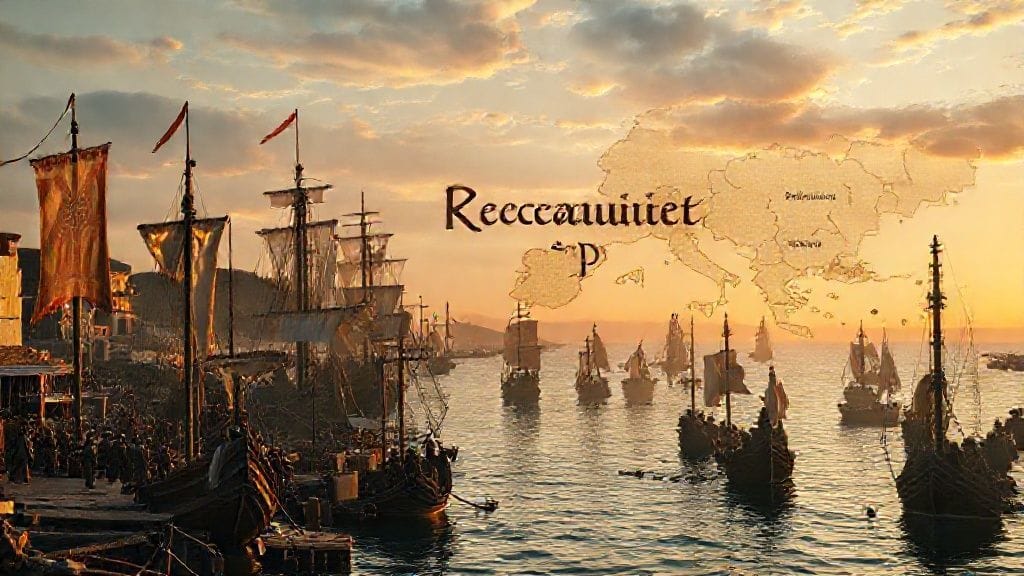
The early morning sun shimmered on the restless waters of the Western Mediterranean, casting a golden sheen over the decks of towering galleys manned by men from the thriving maritime republics of Pisa and Genoa. The 1090s—an age when the call of faith mingled with the lust for wealth and power—saw these fierce rivals set aside hostilities momentarily, casting their collective ambitions toward one of medieval Europe’s most tantalizing frontiers: the Iberian Peninsula and the Balearic Islands. This was no mere naval expedition but the burgeoning of a strategic power play that would not only reshape the political contours of the Western Mediterranean but echo through the annals of Mediterranean history.
A salty mist laced the air as sailors prepared for departure, the sound of wooden oars dipping rhythmically into the sea punctuating urgent prayers and the clashing of mail armor. Cities like Pisa and Genoa, woven intricately into the tapestry of medieval commerce and crusading fervor, were on the cusp of a pivotal engagement in the Iberian Reconquista—a centuries-long Christian effort to reclaim land from Muslim rule. Yet, the story of these expeditions is far richer than a mere military campaign. It’s a tale of shifting alliances, technological prowess, ideological zeal, and the clashing currents of trade and culture.
The Iberian Peninsula in the Late 11th Century: A Land Divided
The Iberian Peninsula of the 11th century was a mosaic of shifting powers and fractured sovereignties. The Christian kingdoms—Castile, León, Aragon, Navarre—watched warily as Muslim taifa kingdoms, born from the collapse of the once-mighty Caliphate of Córdoba, jockeyed for survival and influence. Many of these taifas thrived on internal disputes, yet they retained control over fertile lands, bustling cities, and crucial Mediterranean ports.
The Reconquista was far from a uniform crusade; rather, it was a patchwork of shifting alliances, opportunistic conquests, and religious motivations tangled with pragmatic considerations. Into this volatile landscape sailed the maritime republics—Pisa and Genoa—whose fleets, ambitions, and resources would tip scales far beyond purely Iberian interests. The stakes were high: control of coastal strongholds meant dominance over trade routes, strategic naval bases, and influence in a lucrative Mediterranean economy where Africa, Europe, and Asia met.
Maritime Powers of the Western Mediterranean: Pisa and Genoa’s Rise
By the 1090s, Pisa and Genoa had emerged as titans of the Mediterranean seas. These city-states, born of northern Italy’s Ligurian and Tuscan coasts, had built formidable navies that defended growing mercantile empires. Their ships—sleek, fast, and laden with the weaponry of the age—were instruments of both war and commerce.
More than mere rivals, Pisa and Genoa shared a complicated relationship defined by economic competition and occasional cooperation. Both cities desired to curtail Muslim piracy in the Western Mediterranean, gain access to new markets, and establish naval dominance. The Reconquista offered a perfect pretext. Lending support to Christian kings in Iberia promised religious validation, political alliances, and commercial privileges—all crucial for their continued ascent.
The Political Calculus: Why Pisa and Genoa Supported the Reconquista
Religion and commerce wove tightly together in the motivations propelling Pisa and Genoa towards the Iberian Crusades. Pope Urban II’s call for the First Crusade in 1095 invigorated Christian militancy across Europe, and the Iberian Peninsula was regarded as a natural theater for holy war against the Islamic powers.
Yet economic and political calculations underpinned this zeal. Both maritime republics believed that by aiding Christian monarchs, they could secure trading concessions, establish naval bases, and weaken Muslim control over key ports and islands—especially the Balearics, which had long been centers of piracy threatening Mediterranean commerce.
Their intervention was also an expression of burgeoning naval power projection. By projecting fleets hundreds of miles away from home shores, Pisa and Genoa signaled their maritime ambitions. Supporting the Reconquista was as much about faith as about forging empires on the waves.
Shipyards and Sails: The Naval Technology Behind the Expeditions
The successes of the Pisa-Genoa expeditions rested on a secret: their mastery of maritime technology. The 11th-century Mediterranean was a risky highway where speed, maneuverability, and firepower decided the fate of fleets.
Ships like the galley, with its combination of oars and sails, allowed swift passage regardless of winds. Innovations in hull design improved durability and seaworthiness. Siege engines and archers aboard ships brought a new dimension to naval warfare, ensuring that attacks on coastal fortifications were deadly and effective.
Behind the ships were bustling shipyards—Pisa’s port thrived with timber workers, sailmakers, and shipwrights whose expertise formed the backbone of the expeditions. Genoa, too, was no slouch, its arsenals humming with preparation for naval campaigns. This technological edge gave these republics confidence to venture far beyond their shores.
The First Forays: Early Military Campaigns in the Balearic Islands
The Balearic Islands—Majorca, Minorca, Ibiza, and Formentera—were not just jewels of the Mediterranean but strategic hubs of piracy and Muslim naval power. Their geographical position between the Iberian Peninsula and North Africa made them perfect bases for raids on Christian shipping lanes.
By the early 1090s, Pisa and Genoa spearheaded expeditions to challenge Muslim control of these islands. The campaigns were brutal and fiercely contested. Siege warfare, amphibious assaults, and naval blockades characterized the fights. Some chroniclers spoke vividly of the horror and heroism—burning villages, desperate battles on rocky shores, and acts of sheer valor.
Despite difficulties, these forays gradually chipped away at Muslim dominance and established a Christian foothold in the Balearics. But this military victory was not simply an act of war; it reconfigured economic and political maps, bringing an influx of Christian settlers and reshaping trade routes.
Valencia in the Crosshairs: A Strategic Jewel in the Western Mediterranean
Valencia was a prize unlike any other. Founded centuries earlier and flourishing under Muslim rule, its fertile hinterlands and port attracted merchants and warriors alike. The city was a bastion of Islamic culture and commerce, but also a revered target for Christian monarchs bent on expansion.
With naval support from Pisa and Genoa, the Kingdom of Aragon and allied forces launched sustained efforts to capture Valencia. The expeditions of the 1090s laid groundwork that would culminate in later monumental campaigns. The presence of formidable fleets prevented reinforcements from Africa and restricted Muslim resupply by sea.
Controlling Valencia meant not just acquiring territory but dominating a key node in the Mediterranean trade network. The city’s eventual fall would symbolize a shift in power and faith, altering the Mediterranean balance forever.
The Role of Religion: Crusading Zeal and the Iberian Holy War
The religiosity fueling these expeditions cannot be overstated. The papal endorsement of the Reconquista as a crusade gave these campaigns a halo of sanctity rarely found in medieval warfare. Clerics preached the divine imperative to reclaim Christian lands and to defend Christendom’s southern borders.
Soldiers from Pisa and Genoa often saw their actions as acts of piety, binding their enterprises into larger narratives of salvation and sacrifice. Chroniclers recorded sermons, prayers, and processions that accompanied the fleets, painting the expeditions as holy missions.
Yet beneath this spiritual veneer lay political calculus and pragmatic concerns. Religion became a language of legitimacy, a tool for rallying men and securing support at home.
Alliance and Rivalry: Cooperation and Competition Between Pisa and Genoa
The cooperation between Pisa and Genoa, while pivotal, was strained by underlying rivalries. Their shared Christian identity and strategic goals did not completely overcome centuries of trade disputes and naval clashes.
Temporary alliances formed when mutual interests aligned, such as joint assaults on Muslim-held ports or coordinated efforts to control piracy. But mistrust simmered beneath the surface, occasionally igniting into outright confrontation.
The 1090s represented a delicate balance, a moment when the lure of the Reconquista temporarily bridged one of the Mediterranean’s fiercest rivalries. Yet, the seeds of future conflict were sown in this crucible of cooperation.
The Balearics Campaigns: A Mixture of Conquest and Commerce
The expulsion of Muslim rulers from the Balearic Islands in the 1090s was both a military triumph and an economic masterstroke. Once the islands fell under Christian control, Pisa and Genoa moved swiftly to establish trade networks and impose tribute systems.
Settlers arrived, markets burgeoned, and the islands became critical stopover points for ships sailing between Italy, Iberia, and North Africa. Control of the Balearics diminished piracy, creating safer seas for Christian merchants but also expanding the republics’ mercantile reach.
This dual nature of conquest and commerce underscored the era’s complexity: it was not just about swords and faith but also about markets and money.
Valencia’s Fall: Turning Tides and the Shift of Power
Though the final conquest of Valencia would come decades later, the expeditions of the 1090s were instrumental in weakening Muslim hold over the city. Naval blockades choked supply lines; Christian raids ravaged the surrounding countryside; psychological pressure mounted.
These military pressures catalyzed the fragmentation of Muslim control and emboldened Christian kings. They set the stage for the great sieges and eventual Christian triumphs that redefined the region.
Valencia’s fall symbolized the triumph of the Reconquista and the expansion of Christian influence across the Western Mediterranean—a geopolitical pivot that resonated far beyond Iberian shores.
Naval Innovations and Tactical Maneuvers on the Mediterranean Seas
The tactical ingenuity displayed by Pisa and Genoa deserves particular note. Utilizing swift galleys for surprise attacks, employing archers and siege engineers on ships, and implementing blockades demonstrated a level of naval sophistication ahead of their time.
Commanders orchestrated amphibious assaults with precision, combining land and sea forces to overwhelm fortifications. Intelligence networks, including maritime espionage, played roles in planning.
These innovations marked a turning point in medieval naval warfare, influencing Mediterranean engagements for generations to come.
The Impact on Muslim Taifa Kingdoms: Fragmentation and Resistance
The pressure exerted by Pisa-Genoa backed Christian campaigns exacerbated the already fragile state of the taifa kingdoms. Divided and often distrustful, Muslim rulers struggled to coordinate effective responses.
Some sought uneasy truces; others mounted desperate defenses. The shockwaves of these campaigns rippled through Islamic political structures, accelerating internal conflicts and weakening regional cohesion.
This fragmentation facilitated the Christian advances, illustrating how external military pressure can speed internal dissolution.
Trade Winds and Treasure: Economic Impacts of the Expeditions
Beyond the clash of arms lay the less visible but equally transformative economic shifts. Control over pivotal trade routes around the Balearics and Valencia granted Pisa and Genoa unprecedented commercial advantages.
Merchants enjoyed reduced piracy, newly accessible markets, and enhanced security. The flow of goods—silks, spices, metals—accelerated, enriching the Italian republics and fueling their urban growth.
But these gains also displaced Muslim traders and altered centuries-old economic networks, remapping Mediterranean commerce in the process.
Cultural Exchanges: The Mediterranean as a Melting Pot
Despite the violence of conflict, the Mediterranean remained a space of vibrant cultural interaction. The Pisa-Genoa expeditions unwittingly facilitated exchanges of ideas, technologies, and artistic influences between Christian and Muslim worlds.
Architectural styles, navigation techniques, and even culinary tastes crossed religious divides, leaving enduring legacies in the region’s diverse societies.
This dynamic interplay reveals the multifaceted nature of medieval Mediterranean history: war and peace, conflict and cultural fusion intertwined.
The Human Cost: Soldiers, Sailors, and Civilians in the Crossfire
War is a tapestry of human experience—brave victories shadowed by suffering and loss. The Pisa-Genoa campaigns displaced populations, conscripted sailors, and exposed civilians to sieges and pillaging.
Chroniclers detail harrowing tales of hardship, from starving towns to drowned sailors. Families were scattered; communities destroyed. The human dimension often gets lost in grand narratives, but here, it pulses vividly.
Remembering this human cost deepens our understanding of history beyond dates and battles.
Legacy of the Pisa-Genoa Ventures: From Maritime Rivalries to Mediterranean Dominance
The 1090s expeditions marked the dawn of a new chapter for Pisa and Genoa. Their involvement in the Iberian Reconquista strengthened their naval capabilities, expanded their trade empires, and enhanced their prestige.
These campaigns laid foundations for centuries of maritime rivalry and conquest, eventually leading these republics to play central roles in Mediterranean politics, commerce, and crusading ventures.
Their legacy is woven into the broader story of medieval European ascendancy and Mediterranean transformation.
The Western Mediterranean’s Geopolitical Transformation Post-1090s
The successful campaigns against Muslim strongholds in the Balearics and Valencia reshaped the geopolitical map. Christian kingdoms consolidated territories; Muslim control receded.
New alliances emerged, borders shifted, and the Western Mediterranean grew increasingly integrated under Christian influence. Pisa and Genoa were no longer mere city-states—they had become key players on the international stage.
This transformation set the stage for the High Middle Ages’ shifting balance of power.
Myth and Memory: How Chroniclers Told the Story
The deeds of the Pisa-Genoa expeditions were enshrined in medieval chronicles, illuminated manuscripts, and oral traditions. These narratives often blended fact and myth, casting leaders as heroic champions of Christendom.
Religious fervor colored descriptions of battles; accounts emphasized divine favor and moral righteousness, shaping collective memory.
Understanding these perspectives helps us decode medieval mindsets and the power of storytelling in history.
Conclusion
The Pisa-Genoa expeditions in the 1090s were more than mere maritime raids or military campaigns—they were a fulcrum upon which the Western Mediterranean’s destiny pivoted. Sailing under banners of faith and fortune, these maritime republics wove together the complex threads of religion, commerce, technology, and politics to reshape lands and seas alike.
The campaigns launched during this decade foreshadowed a new era of Mediterranean history marked by Christian expansion, heightened naval warfare, and the relentless interplay of rivalry and cooperation. Yet, amid the clashing steel and roaring waves, lie stories of human ambition, suffering, and resilience that remind us the past is never distant pageantry, but the living echoes shaping our present.
In reflecting on these expeditions, one witnesses the birth of a Mediterranean world that was at once fragmented and interconnected, violent and vibrant—a world where the sails of Pisa and Genoa caught not only the winds of the sea but also the tides of history itself.
FAQs
1. What motivated Pisa and Genoa to support the Iberian Reconquista?
Pisa and Genoa were driven by a mix of religious zeal inspired by the papal Crusades and pragmatic economic interests. Supporting Christian kingdoms against Muslim taifas promised trade privileges, naval bases, and a reduction in piracy threatening their merchant fleets.
2. How significant were the Balearic Islands in the Western Mediterranean?
The Balearic Islands were strategic hubs for controlling sea routes and combating piracy. Their conquest allowed Christian powers to secure safer maritime commerce and established key naval bases for further campaigns.
3. What role did technology play in these expeditions?
Advanced naval technologies, including fast galleys, siege engines adapted for amphibious assaults, and improved shipbuilding, enabled Pisa and Genoa to conduct complex naval operations far from home ports.
4. How did these expeditions affect Muslim kingdoms in Iberia?
The military pressure from these campaigns exacerbated internal divisions among Muslim taifas, weakening their ability to resist Christian advances and accelerating territorial losses.
5. Were Pisa and Genoa always allies during these campaigns?
While they cooperated against common enemies, Pisa and Genoa remained competitors and occasionally clashed over trade and territorial disputes, revealing a fragile alliance built on convenience.
6. What were the economic consequences of the expeditions?
Christian control over key Mediterranean ports and islands opened new trade routes and markets for Pisa and Genoa, enriching these republics and shifting Mediterranean commerce away from Muslim traders.
7. How are these expeditions remembered in historical sources?
Medieval chronicles often depict the expeditions as divinely sanctioned crusades, blending fact with religious propaganda to celebrate military victories and frame them as holy missions.
8. Did the expeditions leave any lasting cultural impact?
Yes, besides military and economic impacts, the expeditions facilitated cultural exchanges across religious and ethnic lines, influencing art, architecture, navigation, and daily life throughout the Mediterranean.

