Table of Contents
- The Fall Then Rise: Rome in Upheaval, 1849
- Pope Pius IX: From Reformer to Exile
- The Roman Republic: A Republic Born of Revolution
- Garibaldi’s Brave Defense: The Sword of Republican Rome
- French Intervention: From Protector to Invader
- The Siege of Rome: Guns, Faith, and Ideals
- The Moment of Restoration: Pius IX Returns
- The Streets of Rome: Jubilation and Resentment
- The Aftermath: Political Repression and Papal Authority
- The Hidden Costs: French Ambitions and Italian Nationalism
- Pius IX’s Legacy: The Seeds of Vatican Ultramontanism
- The Italian Question: Rome as a Symbol of Unity
- European Powers and the Papal State: A Fragile Balance
- The Romanticism of Rome’s Republic: Myth and Memory
- The Long Shadow: How 1849 Shaped Modern Italy
- Conclusion: Faith, Force, and the Future of Rome
- FAQs: Understanding the Restoration of Pius IX
- External Resource: Wikipedia on the Restoration of Pius IX
- Internal Link: Visit History Sphere
1. The Fall Then Rise: Rome in Upheaval, 1849
The summer of 1849 was one of fever, fear, and fervent hope. In the narrow, cobbled streets of Rome, tension crackled in the humid air as two fierce visions of the Eternal City — the ancient Papal rule and the revolutionary republic — collided with brutal finality. And then, unexpectedly, amid the roar of cannon fire and the cries of civilians, came a moment of seismic change: the restoration of Pope Pius IX, returned to his throne by the marching battalions of France.
This was not just a political event. It was the reweaving of Rome’s fragile social fabric torn by the contradictions of liberal reform, revolutionary zeal, and foreign ambition. The dramatic return of the pontiff marked the end of the revolutionary Roman Republic but signified the start of decades of struggle between tradition and modernity, faith and nationalism.
2. Pope Pius IX: From Reformer to Exile
Giovanni Maria Mastai-Ferretti ascended the papal throne in 1846 as Pope Pius IX, at first hailed as a progressive voice in the Church. His early gestures raised hopes among liberals and reformers — he granted amnesty to political prisoners and hinted at constitutional reform. Rome, draped in its layers of history and papal power, seemed poised for a new era.
Yet the idealism shattered quickly. The revolutionary waves of 1848–1849 overwhelmed the Papal States. Faced with growing republican agitation and nationalism spreading through the Italian peninsula, Pius IX found himself forced from Rome in November 1848, fleeing to the fortress of Gaeta. His exile left a vacuum swiftly filled by radical revolutionaries who declared the Roman Republic in February 1849.
3. The Roman Republic: A Republic Born of Revolution
The Roman Republic, led by figures such as Giuseppe Mazzini and Carlo Armellini, was the bold experiment of Italian republicanism writ large. Inspired by the sweeping ideals of liberty, fraternity, and national unity, it aimed to dismantle the centuries-old temporal power of the papacy and establish Rome as a beacon of modern democracy.
Yet the Republic was born amid chaos — economic hardship, factionalism, and looming external threats. It was a fragile thing, vibrant and inspirational but vulnerable. Mazzini’s vision clashed with Garibaldi’s pragmatic militancy, and internal divisions hampered effective governance. Still, its very existence struck a nerve across Europe, embodying the hopes of many for a unified and free Italy.
4. Garibaldi’s Brave Defense: The Sword of Republican Rome
Few figures loom larger in the story of the Republic’s defense than Giuseppe Garibaldi, the legendary soldier of Italian unification. In the spring and early summer of 1849, Garibaldi’s volunteer army fought valiantly against overwhelming French forces sent to restore papal authority.
These battles, marked by desperate courage and strategic genius, were more than military contests; they were clashes over Rome’s soul. Garibaldi’s forces held out in the Janiculum hills, defending barricades and inspiring citizens with the fight for a secular, nationalist future. But despite their fierce resolve, their cause was doomed by the sheer weight of French determination and superior weaponry.
5. French Intervention: From Protector to Invader
France’s decision to intervene was wrapped in complex motivations. Louis-Napoléon Bonaparte, newly elected President of the French Republic, balanced domestic politics and international Catholic allegiances. The possibility of alienating French Catholics by allowing the papal authority to fall was too great a risk. Moreover, the restoration of Pius IX would consolidate a key ally in Italy.
French troops landed outside Rome in April 1849 under General Oudinot, initially expecting a swift victory. What followed was a grueling siege that lasted months, a bloody and costly campaign that revealed the contradictions between republican idealism and imperial pragmatism — France had become the very force suppressing democracy it claimed to protect.
6. The Siege of Rome: Guns, Faith, and Ideals
For nearly four months, Rome was engulfed in a brutal siege. The French bombardment shattered neighborhoods, and the city’s skyline — punctuated by domes and spires — was scarred by artillery fire. Civilians huddled in basements; soldiers alternated between brutal combat and moments of grim camaraderie.
This siege was as much spiritual as military. The defenders, many of them volunteers raised in Garibaldi’s diverse ranks, fought not just against French soldiers but against an old order they saw as oppressive and backward. The air was thick with the prayers of the faithful and the cries of revolutionaries. Rome was a city torn by loyalty, hope, and despair.
7. The Moment of Restoration: Pius IX Returns
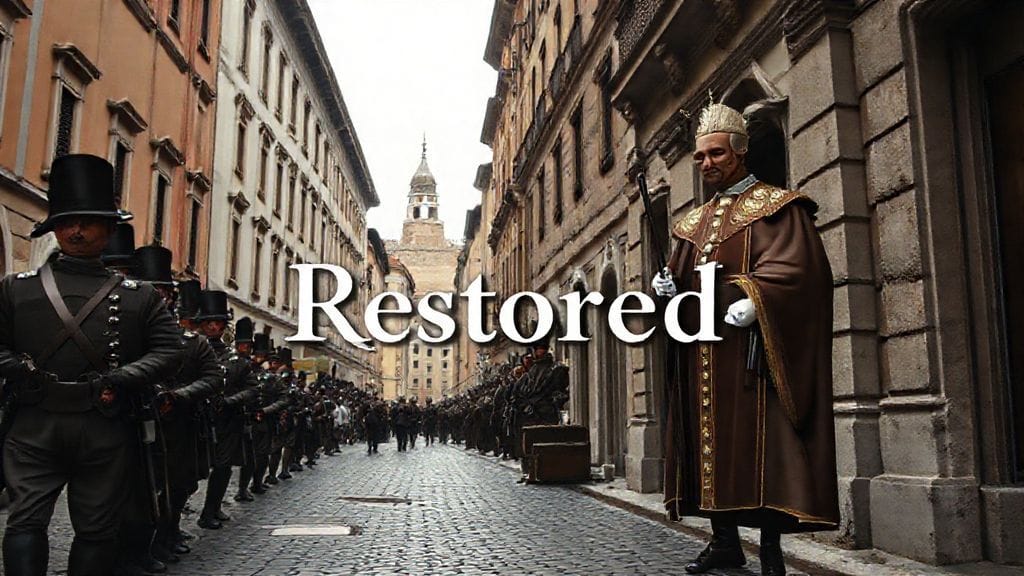
On July 3rd, 1849, following the fall of the last bastions of resistance and the exodus of Republican leaders, French troops marched triumphantly into Rome. The streets filled with a mix of jubilation and shadowed apprehension as Pope Pius IX made his solemn return to the Quirinal Palace.
Clad in his pontifical robes, the pontiff’s restored presence symbolized not just ecclesiastical authority but the reassertion of conservative order in Italy. Bells pealed from every church, crowds knelt in tears of relief and longing. Yet behind the public spectacle, a repressed city bristled with silent questions about the price paid for peace.
8. The Streets of Rome: Jubilation and Resentment
Celebrations accompanied the pontiff’s return, but beneath the surface simmered a city divided. For many Roman Catholics, the pope’s restoration was a divine vindication. For republicans, liberals, and growing nationalist factions, it was the bitter end of a dream.
Street murals and pamphlets circulated in defiance; secret societies whispered of revolution to come. The French presence, once welcomed as a protector, now felt like occupation. Rome had been liberated — for whom? The question haunted both the squares and the palaces.
9. The Aftermath: Political Repression and Papal Authority
With power consolidated, Pope Pius IX initiated a reign marked by reaction and repression. The fledgling constitutional reforms he had once hinted at were abandoned. Republicans and liberals faced arrests, imprisonment, and exile. The papal states reverted to a conservative theocracy, closed off from the burgeoning tide of Italian nationalism.
Yet, even as Pius IX tightened control, he paradoxically set the stage for his own opposition. His opposition to Italian unification made him a symbol both revered and reviled, a figure whose restored throne was both a fortress and a gilded cage.
10. The Hidden Costs: French Ambitions and Italian Nationalism
France had won the day, but it was a costly victory. The intervention alienated many Italian nationalists, who saw in French troops an unwelcome foreign occupation. The delicate dance of European powers in Italy resulted not in peace but in deepening animosities.
Moreover, France’s involvement strengthened the resolve of Italian patriots to unite and liberate their land from foreign and papal control. The restoration of Pius IX pushed the cause of Italian unification into sharper focus — a struggle that would come to define the following decades.
11. Pius IX’s Legacy: The Seeds of Vatican Ultramontanism
The Pope’s long papacy (1846–1878) after his restoration became synonymous with Ultramontanism — the assertion of papal supremacy and central authority. The trauma of his exile and restoration hardened his views against modern liberalism and nationalism.
In 1870, after the Italian armies captured Rome, Pius IX refused to recognize the Kingdom of Italy’s sovereignty over the city, proclaiming himself a “prisoner” of the Vatican. His stance shaped the Vatican’s role in global Catholicism for generations.
12. The Italian Question: Rome as a Symbol of Unity
The restoration of the pope was but a chapter in Italy’s fractured path to unification. Rome remained the spiritual and political prize coveted by all factions. For the Kingdom of Sardinia and later the Kingdom of Italy, incorporation of Rome meant the realization of Risorgimento aspirations.
Until 1870, Rome would remain a city of contradictions: papal capital and nationalist symbol, fortress and stage, reverence and revolution.
13. European Powers and the Papal State: A Fragile Balance
The 1849 episode exemplified the delicate balance of power in Europe, where politics, religion, and nationalism intertwined. Britain watched with wary distance; Austria eyed Italy’s republican stirrings with alarm; France balanced religion with politics.
The restoration underscored how Rome and the papacy were key chess pieces in continental diplomacy — their fate a mirror of shifting alliances and ideologies.
14. The Romanticism of Rome’s Republic: Myth and Memory
Though short-lived and militarily defeated, the Roman Republic infused Italian consciousness with a powerful myth of resistance and renewal. Garibaldi emerged as a national hero, and Mazzini’s dream of a united republic lived on in the hearts of many.
This romantic image would inspire artists, writers, and patriots, painting 1849 as a tragic but noble moment in the saga of Italy’s birth.
15. The Long Shadow: How 1849 Shaped Modern Italy
The events surrounding Pius IX’s restoration cast long shadows over Italy’s political evolution. They revealed the profound challenges of reconciling faith and modernity, foreign influence and national identity.
The failure of the Republic and the pope’s return delayed unification but could not stop it. The clash of ideologies born in 1849 continued to echo in Italian politics and society well into the 20th century.
Conclusion
The restoration of Pius IX to Rome in July 1849 was more than a simple military victory or papal reinstatement. It was a moment when the tides of history seemed to ebb against the currents of revolution, faith contended with freedom, and the old world confronted the new. The pope’s return under the banner of French guns marked both an end and a beginning — the collapse of the Roman Republic’s dream but the ignition of Italy’s fiery path to unification.
Rome, timeless and turbulent, remained a city caught between past and future. The echoes of 1849 still resonate, reminding us that history is rarely settled with ease; it is lived in the hopes and heartbreaks of those who dare to imagine a better world. Above all, this episode reveals the enduring power of symbols — the papal tiara, the tricolor flag, the barricade — each narrating Rome’s eternal story of faith, force, and freedom.
FAQs
Q1: Why was Pope Pius IX forced to flee Rome in 1848?
A1: Pius IX fled in the face of growing republican and nationalist uprisings during the 1848 revolutions. His conservative papal authority was increasingly challenged, forcing him to seek refuge in Gaeta as Rome declared itself a republic.
Q2: What role did Giuseppe Garibaldi play during the Roman Republic?
A2: Garibaldi was the military defender of the Republic, leading volunteer forces against the French siege. His bravery and tactics prolonged the defense of Rome, making him a heroic figure in Italian unification.
Q3: Why did France intervene to restore the pope?
A3: France, under Louis-Napoléon Bonaparte, sought to maintain Catholic support at home and preserve influence in Italy. The restoration of Pius IX aligned with both domestic political needs and conservative European strategic interests.
Q4: What were the lasting political consequences of the restoration?
A4: The restoration reinforced papal conservatism, intensified repression of liberals and republicans, and heightened tensions with the Italian unification movement, which eventually succeeded in 1870.
Q5: How is the Roman Republic of 1849 remembered today?
A5: It is celebrated as a symbol of democratic and nationalist aspirations, epitomized by figures like Mazzini and Garibaldi, inspiring future generations despite its military defeat.
Q6: Did the restoration of Pius IX affect European diplomacy?
A6: Absolutely. It underscored the religious and political sensitivities surrounding the Papal States and foreshadowed the complicated dance of European powers over Italian affairs.
Q7: How did Pius IX’s policies change after his restoration?
A7: After returning, Pius IX abandoned earlier liberal reforms, adopted Ultramontanism, and opposed Italian unification, defining the papacy’s stance for decades.
Q8: When did Rome finally become part of unified Italy?
A8: Rome was annexed to the Kingdom of Italy in 1870 following the withdrawal of French troops during the Franco-Prussian War and the capture by Italian forces.