Table of Contents
- The Dawn of Revolution: October 5, 1910, San Antonio Awakens
- Francisco I. Madero: The Reluctant Revolutionary
- Mexico on the Brink: The Porfiriato and Its Discontents
- The Catalyst: Why San Luis Potosí?
- Drafting the Call to Arms: The Making of the Plan
- A Voice from Exile: Demand for Democracy Across Borders
- The Plan’s Core: Overthrow, Justice, and Free Elections
- The Spread of the Plan: From Print to Guerrilla Warfare
- The Impossible Spark: Early Responses in Mexico
- The Role of Women and Indigenous Peoples in the Growing Revolt
- Porfirio Díaz’s Empire Shakes: Repression and Underestimation
- Francisco Villa and Emiliano Zapata: Icons Born from the Plan
- The United States’ Ambiguous Stance: Shelter and Suspicion
- The First Shots: Start of the Mexican Revolution’s Armed Conflict
- The Plan’s Ideological Legacy: Democracy, Justice, and Nationalism
- The Fall of Díaz: How the Plan Reshaped Mexico
- Unintended Consequences: Violence and Fragmentation
- From Revolution to Constitution: The Plan’s Long Shadow
- The Human Toll: Families, Lives, and Dreams Interrupted
- Remembering the Plan of San Luis Potosí in Mexican Memory
- Conclusion: The Endurance of a Revolutionary Call
- FAQs: Unraveling the Mysteries of the 1910 Plan
- External Resource
- Internal Link
On the crisp autumn day of October 5, 1910, in a modest office far from the turmoil enveloping Mexico, a document was published that would ignite flames of one of the most transformative revolutions in Latin American history. In San Antonio, Texas, Francisco I. Madero, a hopeful yet determined voice of change, crafted what would become the Plan of San Luis Potosí. This manifesto was no mere political statement—it was a rallying cry, a blueprint for upheaval, and a beacon of hope to millions shackled under decades of authoritarian rule.
The air was thick with anticipation and tension, as word of the plan spread quietly at first, but with volcanic potential. Madero’s words resonated far beyond the printed page, transcending borders, social classes, and entrenched powers. Yet, behind the optimism lurked uncertainty—would this call for justice and democracy be heard? Could it awaken a nation seemingly numb from years of repression?
1. The Dawn of Revolution: October 5, 1910, San Antonio Awakens
As the sun rose on October 5, 1910, San Antonio pulsed quietly with the routines of a busy American border city. Meanwhile, in a small office nestled near the river, Francisco I. Madero completed a document that was poised to rattle the very foundations of Mexican politics. This plan wasn’t just paper; it was a seismic declaration rejecting the legitimacy of President Porfirio Díaz’s continuous grip on power.
Madero’s act was both timely and risky. Exiled from Mexico and operating under constant threat, he issued a direct challenge—calling Mexicans to arms for a revolution against tyranny. The timing was no accident; elections slated for that November were set to formalize Díaz’s unchallenged dictatorship, and Madero sought to stop that fate.
2. Francisco I. Madero: The Reluctant Revolutionary
To understand the Plan of San Luis Potosí, one must grasp the man behind it. Francisco I. Madero was not a typical insurgent; he was a wealthy landowner’s son educated in the United States and France, steeped in ideas of liberalism and democracy but untrained for warfare. His initial goal was simple—peaceful democratic reform.
Yet, the crushing political machinery of Díaz’s regime left him no choice but to embrace revolution as a necessary evil. Madero’s vision was earnest: Mexico needed elections, justice, the rule of law, and respect for the constitution. Above all, he sought to replace autocracy with democracy, a radical notion for a country habituated to dictatorship for over thirty years.
3. Mexico on the Brink: The Porfiriato and Its Discontents
Porfirio Díaz’s regime, known as the Porfiriato, had ruled Mexico since 1876 with an iron fist masked by rhetoric of modernization and economic growth. Beneath the facade of prosperity, vast inequalities festered: poor peasants faced exploitation, indigenous lands were usurped, and political opposition was crushed.
The seemingly stable era had created deep tensions—urban elites thrived, railroads and foreign investments expanded, but the rural majority remained impoverished and disenfranchised. Underneath the gleam of progress, resentment simmered quietly, waiting for a spark.
4. The Catalyst: Why San Luis Potosí?
Why call this manifesto the Plan of San Luis Potosí, when it was written in San Antonio? The title was symbolic and strategic. San Luis Potosí was Madero’s home state and a historic hub of political upheaval. Naming the plan after this city invoked legitimacy and loyalty among Mexicans familiar with regional struggles.
San Antonio represented exile, safety, and logistical support. From its border vantage point, Madero could evade immediate repression, print the document, and disseminate it back into Mexico. The cross-border dynamic embodied the tension between exile and homeland, urgency and preparation.
5. Drafting the Call to Arms: The Making of the Plan
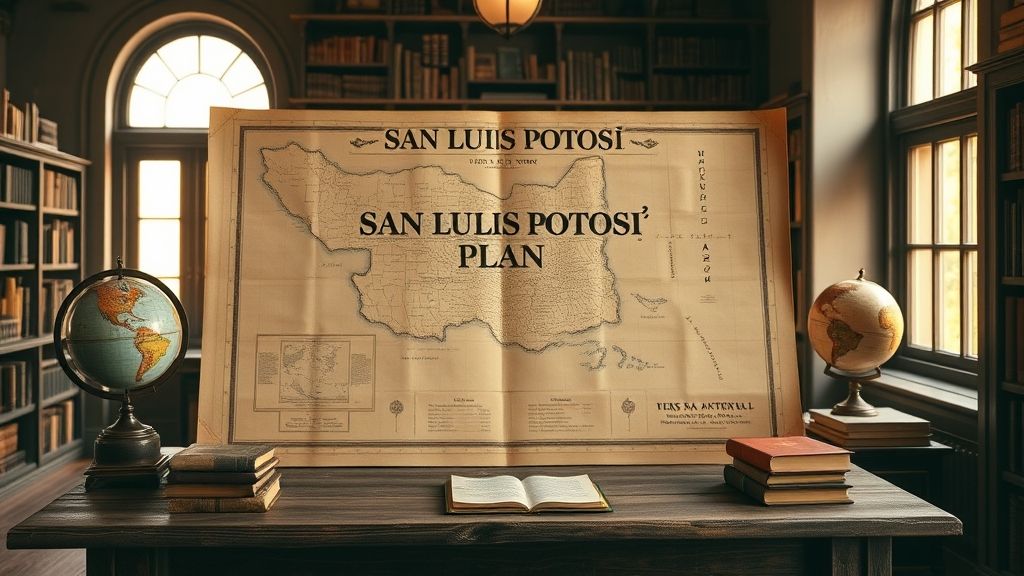
Crafting the Plan of San Luis Potosí was more than political rhetoric; it was a careful manifesto designed to unite disparate voices. The document declared Díaz’s 1910 election null and void, called for armed rebellion beginning November 20, and promised justice for political prisoners and agrarian reforms.
It was both legalistic—invoking Mexican constitutional traditions—and revolutionary, advocating armed struggle. The plan struck a tone of moral urgency, painting Díaz as a usurper and offering Madero as a legitimate leader committed to restoring the nation’s honor.
6. A Voice from Exile: Demand for Democracy Across Borders
From its sanctuary in Texas, Madero’s plan became a vivid symbol of resistance. It energized exiled communities, intellectuals, peasants, and workers disillusioned with the stale political order. Copies slipped back across the US-Mexico border, read aloud in villages and towns, passed hand-to-hand.
For many Mexicans, this was the first clear call to abandon passive endurance and engage in active struggle for freedom. Madero’s eloquence breathed new life into a tired and fearful nation.
7. The Plan’s Core: Overthrow, Justice, and Free Elections
At its heart, the Plan of San Luis Potosí was a promise of rebirth. It declared the invalidity of Díaz’s fraudulent re-election and proclaimed Madero provisional president until free elections could be held.
It condemned the repression of political opponents, called for release of prisoners, and emphasized respect for land rights—a direct appeal to peasants suffering under land dispossession. Essentially, it was a document that envisioned a Mexico reborn through justice and democracy.
8. The Spread of the Plan: From Print to Guerrilla Warfare
Once printed, the plan flowed into Mexico’s veins like igniting oil. Revolutionary cells, maverick leaders, and restive peasants embraced it. Though communication was slow and inconsistent, the call galvanized disparate forces scattered across northern and southern Mexico.
Word of the plan reached Francisco “Pancho” Villa in the north and Emiliano Zapata in the south—two figures whose subsequent roles in the revolution became legendary. The plan transformed from words on paper into a living mandate for rebellion.
9. The Impossible Spark: Early Responses in Mexico
The initial response to the plan was a mixture of cautious optimism and brutal crackdown. Díaz’s government dismissed it as a fad, underestimating its power. Yet, in the weeks following November 20, uprisings flared in Chihuahua, Coahuila, and Morelos.
Despite limited resources, rebels seized towns, and the government resorted to harsh repression. The revolution was messy and unpredictable, but the plan’s call to arms had undeniably struck the match.
10. The Role of Women and Indigenous Peoples in the Growing Revolt
The revolution wasn’t just a male-led military effort; women and indigenous communities played vital roles. From spies to frontline combatants, from nursing wounded to organizing support networks, they defied traditional roles.
Indigenous peoples, long marginalized and dispossessed, saw in the plan’s promises a chance to reclaim their lands and dignity. Their participation added depth and complexity to the revolution’s character.
11. Porfirio Díaz’s Empire Shakes: Repression and Underestimation
Facing open rebellion, Díaz deployed troops to crush insurgencies. Initially confident, he ordered mass arrests and military offensives. But the rebellion’s persistence and growing popular support revealed cracks in the regime’s armor.
Díaz’s miscalculations would cost him dearly. His underestimation of Madero and the rebels made the regime increasingly brittle. The iron grip showed signs of loosening for the first time in decades.
12. Francisco Villa and Emiliano Zapata: Icons Born from the Plan
Among the revolution’s many leaders, Pancho Villa and Emiliano Zapata rose to iconic status. Both were galvanized by the Plan of San Luis Potosí’s ideals, yet their own struggles and goals diverged later on.
Villa embodied northern bandit-turned-revolutionary energy; Zapata, the southern idealist desperate for land reform. Their legacies came to symbolize different facets of the Mexican Revolution’s complexity.
13. The United States’ Ambiguous Stance: Shelter and Suspicion
The US found itself in a complicated position. On one hand, San Antonio and other border cities provided refuge to revolutionaries. On the other, American officials worried about instability spilling across the border.
The US government walked a diplomatic tightrope—officially neutral, yet often covertly supporting Díaz or later factions depending on shifting interests. This ambivalence colored the revolution’s international dimension.
14. The First Shots: Start of the Mexican Revolution’s Armed Conflict
With the plan’s call to arms ringing loud, the first military confrontations erupted across Mexico on November 20, 1910. Militias formed hastily, often with minimal training, confronting federal forces.
Though disorganized, these early battles proved the regime vulnerable and ignited widespread commitment to armed struggle. The revolution had truly begun—and nothing would be the same.
15. The Plan’s Ideological Legacy: Democracy, Justice, and Nationalism
Beyond immediate military objectives, the Plan of San Luis Potosí planted ideological seeds that echoed beyond the battlefield. It championed democracy in a region dominated by autocrats; it called for social justice in a deeply unequal society; it awakened nationalist pride in self-determination.
This ideology would shape not only the Mexican Revolution’s course but also 20th-century Latin American political thought.
16. The Fall of Díaz: How the Plan Reshaped Mexico
The culmination of the plan’s promise came in 1911 when Díaz resigned and fled. This moment was a direct consequence of the nationwide upheaval the plan had set into motion.
Madero was elected president, symbolizing a victory for democracy—at least temporarily. Mexico had been transformed; the old order had crumbled, and a new political age beckoned.
17. Unintended Consequences: Violence and Fragmentation
Yet, the revolution did not end with Madero’s victory. Instead, power struggles, regional rebellions, and violent confrontations escalated. The plan, while unifying in purpose, could not contain the diverse, often conflicting ambitions unleashed.
The ensuing years would see further bloodshed, betrayal, and fracturing—a reminder that revolutions are unpredictable and often tragic.
18. From Revolution to Constitution: The Plan’s Long Shadow
Though its authorship was brief, the Plan of San Luis Potosí’s influence extended far beyond 1910. It laid ideological groundwork for the 1917 Constitution, which enshrined many revolutionary ideals such as land reform and labor rights.
This legal legacy endures, continuously shaping Mexican politics and society.
19. The Human Toll: Families, Lives, and Dreams Interrupted
The revolution’s human toll was staggering: millions displaced, countless lives lost, and profound societal disruptions. The Plan of San Luis Potosí sparked hope but also unleashed a torrent of violence and suffering.
Families were torn apart; entire communities vanished. The revolution would remake Mexico’s people as much as its politics.
20. Remembering the Plan of San Luis Potosí in Mexican Memory
Today, the Plan of San Luis Potosí occupies a revered place in Mexican collective memory—an emblem of hope and resistance. Its anniversaries are commemorated; its principles debated.
Yet, it also serves as a cautionary tale of the complexities of revolutionary change. Mexicans remember both the promise and the pain it embodied.
Conclusion
The Plan of San Luis Potosí was more than a political document; it was a beacon for a nation starved of justice and democracy. Emerging from exile, Francisco I. Madero carved a manifesto that would ignite the Mexican Revolution—a movement that reshaped the nation’s identity and future.
Despite its contradictions and the violent chaos it unleashed, the plan’s core ideals of freedom, fairness, and popular sovereignty continue to resonate. It reminds us that the struggle for democracy is often perilous but indispensable—a human story of courage, sacrifice, and enduring hope.
FAQs
Q1: What prompted Francisco I. Madero to write the Plan of San Luis Potosí?
Madero wrote the plan after repeated failures to reform Mexico’s corrupt electoral politics under Porfirio Díaz. The fraudulent 1910 election process motivated him to call for armed rebellion as a last resort for democracy and justice.
Q2: Why was the plan published in the United States rather than Mexico?
Due to persecution and surveillance in Mexico, Madero used the relative safety of San Antonio, Texas, to publish and disseminate the plan without immediate threat of arrest.
Q3: What were the main demands of the Plan of San Luis Potosí?
The plan declared Díaz’s re-election void, called for armed revolt, demanded political prisoners’ release, promised land reform, and proposed free elections under Madero’s provisional leadership.
Q4: How did the Plan of San Luis Potosí influence Mexican revolutionary leaders like Villa and Zapata?
Both leaders took inspiration from the plan’s call for justice and social reform but pursued their own regional agendas, contributing to the revolution’s diversity and complexity.
Q5: What role did the United States play in the Mexican Revolution following the plan’s publication?
The US played a dual role—providing sanctuary to revolutionaries while also diplomatically supporting different factions at times, reflecting its strategic and economic interests in Mexico.
Q6: What were the long-term impacts of the Plan of San Luis Potosí?
It catalyzed the revolution leading to Díaz’s fall, shaped Mexico’s 1917 Constitution, and left a lasting legacy of democratic aspirations and social justice in Mexican political culture.
Q7: How is the Plan of San Luis Potosí remembered in modern Mexico?
It is commemorated as a seminal moment of resistance and hope, representing a pivotal point in the nation’s path toward democracy, though recognized also for the ensuing turmoil it unleashed.
Q8: Did the Plan lead to immediate success?
No. While it successfully ignited the revolution, the ensuing years were marked by intense violence, factional splits, and a prolonged struggle before many of its democratic goals were partially realized.