Table of Contents
- The Day the Sky Turned Dark: August 24, 79 AD
- The Man Behind the Legend: Pliny the Elder’s Life and Legacy
- Mount Vesuvius: A Sleeping Giant Awakened
- The Early Signs: Unusual Earthquakes and Foreshadows
- Morning Alarm: The First Horrors Unfold
- The Command to Escape: Pliny’s Decision to Sail to Stabiae
- The Voyage through Ash and Smoke: A Journey into the Inferno
- Arrival at Stabiae: The Final Moments of a Naturalist
- The Death of Pliny the Elder: Heroism and Tragedy Entwined
- Floods of Ash and Rivers of Fire: The Cataclysm’s Broader Impact
- The Aftermath: Rescue, Destruction, and Despair
- Pliny’s Nephew and the Letters that Immortalized a Tragedy
- Pompeii and Herculaneum: Cities Frozen in Time
- The Roman World’s Shock and the Historical Significance of the Eruption
- Vesuvius in Scientific Memory: Understanding Volcanic Fury through the Ages
- Human Stories beneath the Ash: Victims, Survivors, and Myth
- The Story’s Legacy: How Pliny’s Death Shaped Volcanology
- Archaeological Revelations: Unearthing the Past Beneath the Ash
- The Enduring Mystery of Vesuvius
- Conclusion: Witnessing Awe and Fragility in the Face of Nature’s Power
- FAQs about Pliny the Elder and the Eruption of Vesuvius
- External Resource: Wikipedia on the Eruption of Mount Vesuvius (79 AD)
- Internal Link: 🏠 Visit History Sphere → https://historysphere.com/
1. The Day the Sky Turned Dark: August 24, 79 AD
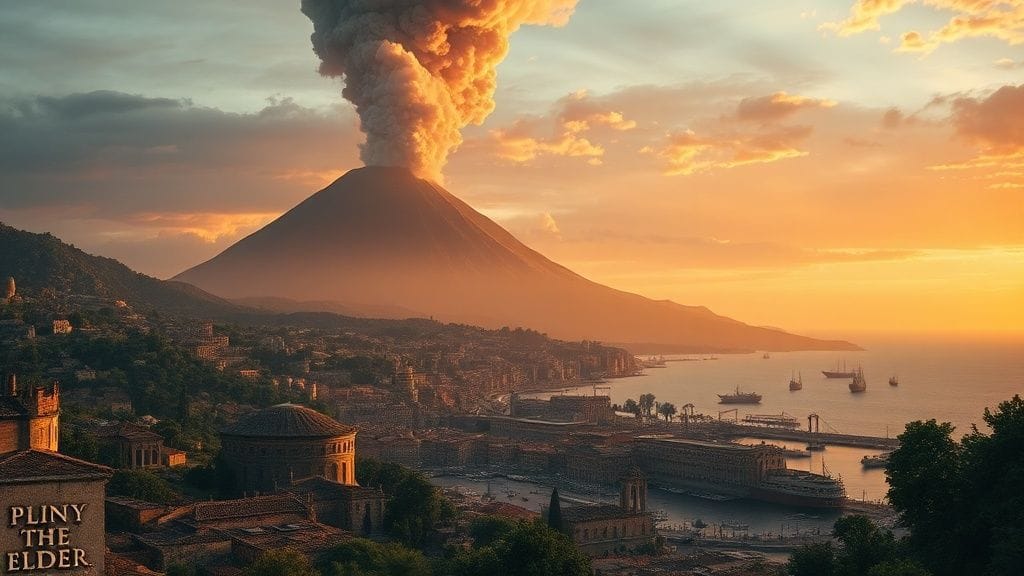
It began like any other day in late summer, with the sun looming heavily over the Bay of Naples. But soon, the sky darkened — an eerie, unnatural shadow swallowed the landscape. Ash and pumice filled the air, birds vanished in chaotic flight; a boiling mountain roared with fury. Few could grasp the enormity of what was unfolding just beyond the horizon. Among the brave, keen-eyed watchers was Pliny the Elder, a Roman scholar and admiral, whose curiosity and courage would lead him to his death.
It was August 24, 79 AD, an ordinary morning turned apocalyptic. The eruption of Mount Vesuvius would raze cities, silence thousands, and carve an indelible scar into human history. But above all, it would define a man—Pliny the Elder—whose final journey into the ash cloud remains one of the most vivid and human stories of ancient tragedy.
2. The Man Behind the Legend: Pliny the Elder’s Life and Legacy
Pliny the Elder was no ordinary Roman. Born Gaius Plinius Secundus in 23 AD, he carved a name for himself as a polymath: a naturalist, historian, naval commander, and author. His magnum opus, Naturalis Historia, sought to encapsulate all human knowledge—a bold and sprawling encyclopedia covering topics from botany and zoology to astronomy and mineralogy. His insatiable curiosity and meticulous observation made him one of antiquity’s brightest minds.
With a robust military career, including commanding roles in the Roman fleet, Pliny was at once a scholar and a man of action. The eruption of Vesuvius would reveal the strength and tragedy of both sides of his nature: the quest for knowledge and the impulse to protect. His life was defined by a restless pursuit of understanding the world, a trait that would lead him to the belly of the inferno.
3. Mount Vesuvius: A Sleeping Giant Awakened
Before the eruption of 79 AD, Mount Vesuvius had been largely silent for centuries, a dormant volcano guarding its destructive power beneath layers of soil and history. Its last known eruption dated back around 400 years, which to the Roman world seemed a distant memory. Yet volcanoes, by their nature, wait patiently for the right moment to rage.
Vesuvius dominates the landscape today, but in Roman times it was already an imposing presence—looming over thriving towns like Pompeii, Herculaneum, and Stabiae. The fertile soils around it had attracted agriculture, villages, and a rich tapestry of Roman life. The mountain’s sudden awakening would be catastrophic for all.
4. The Early Signs: Unusual Earthquakes and Foreshadows
In the days preceding the eruption, unusual tremors had shaken the region. Residents awoke to the unsettling rumble of the earth—a harbinger few fully appreciated. Earthquakes, sudden gusts of hot wind, and strange emissions of gas went largely ignored or dismissed as minor disturbances in the bustling Roman Empire.
But Pliny the Elder, with an eye for natural phenomena, noted these disturbances in letters to friends and family. His nephew, Pliny the Younger, would later describe these moments in vivid detail—telling us about the increasing tension in the air and the gathering panic that few in the ancient world understood.
5. Morning Alarm: The First Horrors Unfold
On the morning of August 24, a towering column of smoke and ash erupted from Vesuvius, blotting out the sun. This massive plume, resembling a pine tree in shape (later called a “Plinian” eruption in honor of Pliny), spewed volcanic gases, ash, and pumice into the sky. Stones and hot ash rained down on the towns, setting fires and sending terrified inhabitants fleeing.
The air quickly became choked with poisonous gases. Visibility dropped to near zero, heat scorched everything in its path, and the ground shook with relentless force. It was clear that the mountain was not merely rumbling but unleashing apocalyptic destruction.
6. The Command to Escape: Pliny’s Decision to Sail to Stabiae
From his command post at Misenum, commanding the Roman fleet, Pliny witnessed the spectacle with a mixture of awe and concern. As a naval officer, he was duty-bound to aid those in peril. Despite warnings from his friends, Pliny made the fateful decision to sail across the bay toward Stabiae, where his friend Pomponianus was trapped by advancing ash and lava.
We can almost sense the heavy air of urgency and uncertainty—the captain of the fleet turning his vessel into the heart of the disaster. For Pliny, it was both a mission of rescue and a voyage of scientific curiosity: he wanted to observe this great natural event firsthand.
7. The Voyage through Ash and Smoke: A Journey into the Inferno
Navigating the bay under a sky swirling with ash and smoke was no small feat. Pliny’s ships slowly made their way across turbulent waters, buffeted by sudden storms of ash fall. The sailors, terrified but loyal, obeyed as their commander steered toward the nightmare unfolding on land.
The sensory overload was immense: harsh flying debris, choking dust, the oppressive heat of the superheated air. Many nearby fled by sea, desperate for safety. For Pliny and his men, placing the mission above personal safety was a testament to Roman discipline and courage.
8. Arrival at Stabiae: The Final Moments of a Naturalist
Reaching the shores near Stabiae, Pliny and his crew found the villa of Pomponianus surrounded by ash but still standing. The men hastened to help their friend, shielding themselves as best they could from the volcanic fallout.
In the darkened sky punctuated by fire and gas, Pliny's final acts embodied his nature—brave, scientific, human. But exhaustion, the toxic air, and his failing health conspired against him. His death would come not in battle, but transformed by nature’s fury.
9. The Death of Pliny the Elder: Heroism and Tragedy Entwined
Ancient sources, especially Pliny the Younger’s eyewitness letters, suggest Pliny the Elder succumbed to the noxious gases or a heart attack brought on by the stress and exertion. The exact circumstances remain debated, but the image of a great naturalist, leader, and man dying amid volcanic fire is poignant and dramatic.
This death became emblematic: a mortal confrontation with the primal power of nature. Pliny’s legacy was sealed not only through his vast writings but through his tragic end, eternally intertwined with Vesuvius.
10. Floods of Ash and Rivers of Fire: The Cataclysm’s Broader Impact
The eruption unleashed torrents of pyroclastic flows—dense, scalding avalanches of ash, gas, and rock—that buried entire towns in minutes. Pompeii and Herculaneum, once thriving centers of Roman life, vanished beneath layers of stone and ash, frozen in time for centuries.
Lava flows, ash falls, and toxic fumes reshaped the landscape. Agriculture was destroyed; populations decimated. The Roman Empire was forced to confront the fragility of civilization against geological fury.
11. The Aftermath: Rescue, Destruction, and Despair
Survivors struggled through the chaos, many permanently displaced. The death toll remains unknown but is estimated in the thousands. Rescue efforts were hampered by the continuing eruption and devastation.
Roman officials launched aid and rebuilding efforts, but the scars ran deep. The tragedy became a somber chapter in Roman history, reminding that beneath imperial grandeur lay vulnerability.
12. Pliny’s Nephew and the Letters that Immortalized a Tragedy
Pliny the Younger’s letters to Tacitus serve as a crucial historical source on the eruption. His vivid, personal descriptions provide a window into the catastrophe and the character of his uncle.
These letters preserved not only an eyewitness account but also the spirit of a man dedicated to learning and leadership, turning a personal loss into a lasting narrative.
13. Pompeii and Herculaneum: Cities Frozen in Time
The sudden burial preserved the cities with astonishing detail: frescoes, mosaics, buildings, and even human forms petrified by ash. These ruins offer a rare glimpse into Roman daily life, urban planning, and society.
Archaeological discoveries have made Pompeii and Herculaneum emblematic of the eruption’s horror—and its strange gift to history.
14. The Roman World’s Shock and the Historical Significance of the Eruption
News of Vesuvius’s eruption spread across the empire, provoking fear and fascination. The disaster challenged Rome’s perceived dominion over nature and fate.
It became a symbol of nature’s unpredictability, featuring in Roman literature and collective memory as a cautionary tale.
15. Vesuvius in Scientific Memory: Understanding Volcanic Fury through the Ages
The term “Plinian eruption” coined centuries later acknowledges the scientific importance of this event. Volcanologists study Vesuvius as a textbook example of explosive volcanic activity.
Pliny’s death inspired early volcanology attempts, laying groundwork for understanding volcanic ash clouds, pyroclastic flows, and eruption dynamics.
16. Human Stories beneath the Ash: Victims, Survivors, and Myth
Amidst the geological narrative are countless human stories: families lost, desperate escapes, acts of bravery and despair. The petrified bodies in Pompeii are silent witnesses to the final moments of their owners.
Legends and myths emerged, intertwining heroism with horror, fueling the imagination for millennia.
17. The Story’s Legacy: How Pliny’s Death Shaped Volcanology
Pliny the Elder’s methodological observations and his nephew’s letters created the foundation for the science of volcanology. The eruption was studied as the first documented instance of a volcanic event with detailed eyewitness testimony.
His death marked the transition between ancient curiosity and systematic scientific inquiry.
18. Archaeological Revelations: Unearthing the Past Beneath the Ash
More than a millennium later, excavations revealed intact houses, artifacts, and human remains. Each discovery enriches our understanding of Roman life and the eruption’s catastrophic force.
Archaeology continues to unravel new mysteries, deepening the tragedy’s human dimension.
19. The Enduring Mystery of Vesuvius
Despite centuries of study, Vesuvius remains a potent threat, still erupting in later centuries, reminding us that volcanic power endures.
Modern cities cling to its slopes, living shadowed by the past, embodying hope and peril.
20. Conclusion: Witnessing Awe and Fragility in the Face of Nature’s Power
The eruption of Vesuvius in 79 AD was more than a natural disaster; it was a moment when human curiosity, courage, and vulnerability converged dramatically. Pliny the Elder’s death encapsulates this tension—his final act as a leader and scientist facing overwhelming nature.
This event reminds us that beneath the ashes of history lie stories of human endurance, death, and the eternal quest to understand the world around us.
Conclusion
The tragedy of Pliny the Elder’s death amid the Vesuvius eruption remains one of history’s most compelling fusions of human bravery and natural catastrophe. It serves as a mirror reflecting the paradox of human knowledge: our incessant drive to comprehend the unknown, even when it leads us into danger.
Pliny’s fatal journey across the churning Bay of Naples is more than a historic fact—it is a stirring narrative of intellectual passion under fire, a testament to the indomitable spirit that seeks truth in the shadow of disaster. Eruptions may bury cities, but through memory, scholarship, and archaeology, stories—especially those of heroes like Pliny—survive, inspiring awe and caution alike.
FAQs
Q1: Who was Pliny the Elder, and why is his death significant?
A1: Pliny the Elder was a Roman naturalist, naval commander, and author of Naturalis Historia. His death during the Vesuvius eruption symbolizes the blending of scientific curiosity and human bravery faced with disaster, immortalizing him in the history of volcanology.
Q2: What caused the eruption of Mount Vesuvius in 79 AD?
A2: The eruption was caused by the sudden release of pressure in Vesuvius’s magma chamber, leading to a massive explosive eruption marked by ash clouds, pyroclastic flows, and lava. It was a classic Plinian eruption typified by violent explosive activity.
Q3: How did Pliny the Younger contribute to our understanding of the eruption?
A3: Pliny the Younger, nephew of Pliny the Elder, wrote detailed eyewitness letters describing the eruption’s events and his uncle’s heroic death. These letters are primary historical sources that shape modern knowledge of the disaster.
Q4: What was the impact of the eruption on Roman cities?
A4: Pompeii, Herculaneum, and Stabiae were buried under meters of ash and debris, killing thousands and destroying homes, infrastructure, and lives. The archaeological preservation offers unparalleled insight into Roman urban life.
Q5: How has the eruption influenced modern volcanology?
A5: The eruption serves as the archetype of Plinian eruptions in volcanology. Pliny’s observations and the historical accounts underpin the early scientific study of volcanic processes.
Q6: Are there still risks associated with Mount Vesuvius today?
A6: Yes, Vesuvius remains an active volcano and poses serious risks to the densely populated areas around Naples. It is closely monitored for signs of activity to prevent future disasters.
Q7: What makes the archaeological sites of Pompeii and Herculaneum unique?
A7: Their rapid burial preserved buildings, art, and human remains in extraordinary detail, offering a snapshot of daily Roman life frozen in time.
Q8: How is Pliny the Elder remembered in history and science?
A8: As a pioneering naturalist and courageous figure, Pliny is commemorated through his writings and the “Plinian” eruption term, acknowledging his intertwined legacy with one of history’s greatest natural disasters.