Table of Contents
- A Governor at the Edge of Empire
- The Roman World That Birthed a Letter
- Who Was Pliny the Younger?
- A New and Troubling Name: “Christianus”
- Interrogations in the Governor’s Court
- Inside the Meetings of the Christians
- The Pliny the Younger Christians Letter Takes Shape
- Trajan Replies: Law, Mercy, and Control
- Religion, Power, and the Roman State
- Fear, Rumor, and Daily Life in Bithynia
- The Human Cost Behind Legal Phrases
- From Local Problem to Imperial Precedent
- How Later Christians Read Pliny’s Words
- Historians Rediscover an Ancient Crisis
- Echoes Across Centuries: Law, Conscience, and the State
- The Letter’s Place in the Wider Story of Persecution
- Conclusion
- FAQs
- External Resource
- Internal Link
Article Summary: In the early second century, a Roman governor in a far-flung province wrote a careful, uneasy report to his emperor about a baffling new sect, giving us what is now known as the pliny the younger christians letter. This article traces the world that shaped that correspondence: the structures of Roman law, the cult of the emperor, and the fragile rhythms of life in Bithynia-Pontus around the year 112. It follows Pliny as he investigates Christians with both severity and hesitation, interrogating men and women of different ages and social statuses. We then enter the imperial palace to watch Trajan’s measured reply, which quietly sets a precedent for how the empire will handle this stubborn faith. Along the way, the article explores the fears, rumors, and everyday anxieties that surrounded Christians, and the political calculations behind seemingly technical legal decisions. It also shows how later Christian writers seized on the pliny the younger christians letter as proof of their antiquity and moral reputation, and how modern historians mine it for vivid detail. Ultimately, the narrative reflects on the enduring tension between conscience and authority that pulses beneath this ancient exchange, making the pliny the younger christians letter far more than a dry bureaucratic note—it becomes a window into an empire wrestling with a movement it could not easily control.
A Governor at the Edge of Empire
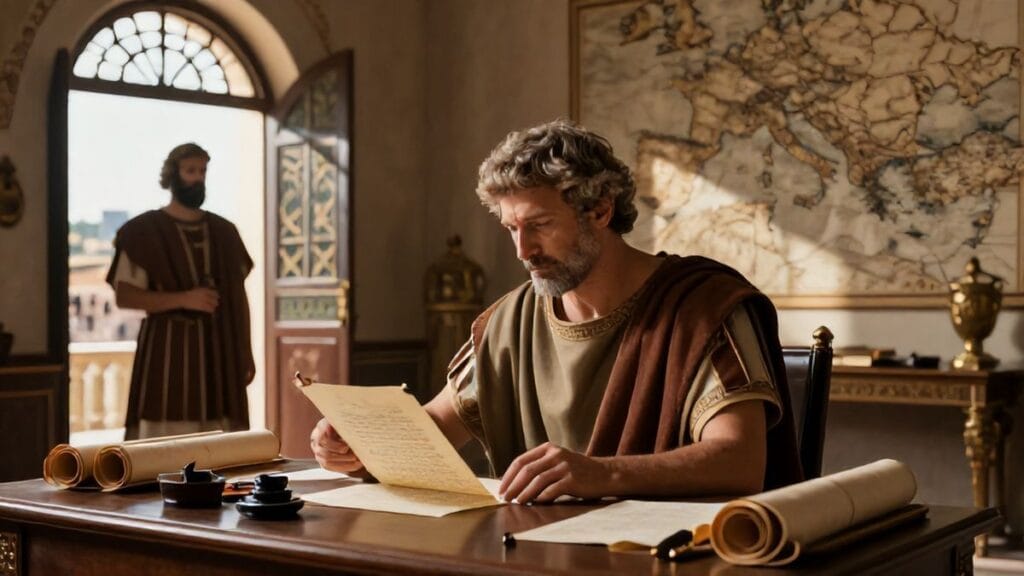
The winter air in Bithynia was sharp enough to sting the lungs, and the sea beyond Nicomedia’s harbor was streaked with pale light when the governor sat down to write. His name was Gaius Plinius Caecilius Secundus—Pliny the Younger to us—and he had been entrusted by Emperor Trajan with a delicate assignment: to restore order, justice, and financial health to a troubled province on the empire’s Black Sea frontier. His pens, neat and carefully trimmed, lay beside wax tablets and papyrus sheets. Around him, the hum of clerks, lictors, and petitioners filled the air like the low murmur of a restless city.
On that day, however, one problem seemed to rise above the tangle of lawsuits and municipal debts—a problem new enough that even a seasoned senator hesitated. People in Bithynia were whispering about a strange group, stubborn in their loyalty, refusing to offer sacrifices to the gods or to the image of the emperor. They called themselves “Christians.” Pliny, citizen of Rome and heir to a long tradition of law and reason, found himself standing before this unknown element, tasked with responding not merely as a judge, but as a representative of imperial power.
So he did what careful Roman officials had done for generations when confronted with something unprecedented: he consulted the emperor. The pliny the younger christians letter that resulted—a dispatch sent around 112 CE to Trajan and preserved in Pliny’s collected correspondence—would become one of the most revealing documents we possess about early Christianity and the mechanisms of Roman authority. Yet, for Pliny, it was not a milestone of religious history. It was a practical question: how should a governor handle these people whose crime, as far as he could see, was their stubbornness?
As he began to write, he did not know that his words would echo across two millennia. For him, the letter was one more stone in the vast, unseen foundation of imperial administration: precise, cautious, and tinged with the anxiety of a loyal servant who wants to get things exactly right. But this was only the beginning of the story, not just of a document, but of an uneasy dialogue between empire and conscience.
The Roman World That Birthed a Letter
To understand why Pliny felt compelled to write to Trajan about Christians, we need to inhabit the world in which both men lived. Around 112 CE, the Roman Empire stretched from the windswept moors of Britain to the scorching deserts of Arabia. It was a world patched together by roads, garrisons, tax collectors, and the rituals of loyalty that bound distant subjects to an unseen emperor. Trajan’s reign was remembered as a time of vigor and expansion; he was the “Optimus Princeps,” the best of princes, conquering Dacia and pushing Rome’s frontier further east than ever before.
Yet behind the celebrations, beneath the triumphal arches and official eulogies, the empire was a fragile web. Its unity depended as much on obedience as on military force, on the daily gestures of respect shown to Roman institutions and Roman gods. Religion, in this world, was not a matter of private belief but public practice. City life pulsed with sacrifices, processions, and festivals paid for by local elites seeking honor and favor. To burn incense before the image of the emperor was less about theology than about loyalty—it was saying, in visible and fragrant form, “We belong to this order; we accept Rome’s rule.”
Bithynia-Pontus, where Pliny now governed, was a complicated corner of this world. Once part of the Hellenistic kingdoms, it was dotted with Greek cities—Nicomedia, Nicaea, Amisus—each with its own traditions, rivalries, and civic pride. Here, temples to Zeus and Apollo stood alongside imperial cult shrines where citizens honored the living emperor as the guarantor of peace. Pliny had been sent there, partly at his own request and partly due to Trajan’s trust, to straighten out corrupt finances, tame factional rivalry, and impose Roman standards on cities that had grown lax or extravagant.
In this context, a group that refused to participate in basic civic ritual was more than a curiosity. It was a hairline crack in the stone that held society together. Romans had always prided themselves on their tolerance of foreign cults, so long as those cults did not threaten public order or undermine loyalty to the state. But a sect that refused to sacrifice at all, that gathered in private before daybreak, that spoke of another “Lord”—this invited suspicion. It is astonishing, isn’t it, how quickly a tiny religious minority can become, in the mind of a governor, a test case for imperial policy?
Who Was Pliny the Younger?
Pliny was not a provincial brute swinging the sword of Rome without thought. He was, in many ways, the ideal Roman aristocrat of his generation—cultured, conscientious, anxious to be remembered well. Born around 61 or 62 CE in northern Italy, he had grown up in the shadow of Mount Vesuvius and, as he would later immortalize in his letters, had watched as the volcano annihilated Pompeii and Herculaneum. It was from his eyewitness accounts of that disaster that we know more than from almost any other ancient observer. Already, in his youth, he was a man who turned events into letters, letters into literary monuments.
Adopted by his famous uncle, Pliny the Elder, he inherited not only a name but also a tradition of scholarship and public service. Educated in rhetoric and law, Pliny rose through the traditional political ranks: quaestor, tribune, praetor, and eventually consul. His life unfolded under emperors like Domitian, whose paranoid tyranny left scars on Rome’s senatorial class. When Trajan, more cooperative and dignified, took power, many senators felt a kind of moral restoration. Pliny was one of them, and his surviving letters often praise Trajan as a model of rational, humane autocracy.
By the time he went to Bithynia as legate with extraordinary powers, Pliny was perhaps in his early fifties. He had served as a lawyer, an advocate for friends in trouble, an inspector of public finances in Italy. He understood both the letter and the spirit of Roman law. His collected letters—carefully edited and published during his lifetime—reveal a man devoted to reputation, to dignitas, to the idea that one’s deeds should be worthy of remembrance. The pliny the younger christians letter that modern readers pore over was, in his mind, both an official dispatch and a chapter in the story of his public life.
His temperament mattered. He was no Nero, relishing cruelty, but neither was he a modern liberal. He believed firmly in hierarchy, tradition, and the importance of obedience. He could be moved by the plight of slaves, yet still accept their torture as a legitimate investigative tool in certain circumstances. When confronted with Christians, he did not see martyrs for conscience, but subjects whose strange obstinacy might threaten the fabric of civic religion. His personal instinct was to seek guidance rather than improvise a policy. Thus, he reached for his pen.
A New and Troubling Name: “Christianus”
By 112 CE, Christianity was not entirely unknown in the eastern Mediterranean, but it was far from the dominant force it would later become. Its followers were scattered across cities and villages, meeting in private houses, sometimes in catacomb-like burial spaces, sometimes in open, borrowed rooms. They were Jews and non-Jews, slaves and freedmen, merchants and artisans, a few wealthy patrons and many of modest means. They worshiped a crucified man called Christ, whom they proclaimed as risen and exalted.
To a Roman, the most jarring thing about this movement was not necessarily its doctrines, but its exclusive loyalty. Traditional pagans could worship many gods; adding one more deity to the mix was usually not a problem. Christians, however, refused to honor any other god or to participate in sacrifices that underpinned civic identity. They were not atheists in our sense, but many contemporaries accused them of atheism because they spurned the gods everyone else revered.
By Pliny’s time, Christians had already faced sporadic tensions with Roman authorities. The emperor Nero, half a century earlier, had scapegoated them after Rome’s great fire, and the historian Tacitus later wrote that “an immense multitude” of Christians suffered hideous tortures in Nero’s gardens. But there was no uniform policy across the empire. Much depended on local conditions and the temperament of individual governors. In Bithynia-Pontus, the Christian presence seems to have been substantial enough that allegations against them reached the governor’s court.
Pliny reports in his letter that “many of every age, of every rank, of both sexes” were being accused. He notes, almost in surprise, that the contagion of this superstition had spread not only through the cities but also through villages and the countryside. The term he uses—superstitio—was not neutral: it suggested an excessive, irrational, or dangerous form of religion, the opposite of what Romans saw as calm, traditional religio. Already, then, the name “Christianus” carried suspicion.
The governor’s dilemma lay in the ambiguity of their alleged crime. Christians were not accused of theft or murder, but of belonging to a name—of adhering stubbornly to an identity. Was mere identity punishable? Was the very label “Christian” criminal, or only if attached to seditious acts? This was the question that gave the pliny the younger christians letter its urgency, and it was why he did not dare to decide alone.
Interrogations in the Governor’s Court
In the austere audience hall where Pliny dispensed justice, the cases of Christians unfolded according to a grimly familiar script. Accusers—sometimes anonymous, sometimes not—brought names to the governor’s attention. The accused were summoned, and Roman procedure, with its blend of formalism and brutality, took over. Pliny tells us that he asked each person if they were a Christian. If they confessed, he repeated the question a second and third time, threatening punishment. Those who persisted, he ordered to be executed—unless they were Roman citizens, in which case he sent them to Rome for the emperor’s judgment.
What was this stubbornness that pushed some to death rather than compliance? For Pliny, it was precisely their obstinacy and inflexible resolve that warranted punishment, apart from any specific crime. He saw in their refusal to sacrifice or to curse Christ a defiance of legitimate authority. The Romans valued flexibility and compromise; to stand rigidly against the commands of a magistrate seemed perversely willful, almost a form of madness. The early Christian theologian Tertullian would later paraphrase Pliny’s logic with bitter irony: “They are condemned not so much for crimes as for the name.”
Not all broke under questioning in the same way. Some, Pliny notes, claimed that they had once been Christians but had abandoned the faith years earlier. These people, eager to prove their loyalty to Rome, were instructed to worship the gods, to offer wine and incense before the emperor’s image, and to curse Christ. If they complied, Pliny released them. Others hesitated, faltered, and then recanted. A few, perhaps visibly trembling, stood firm, and the sentence of death fell upon them with the weight of law.
In one of the most chilling parts of his report, Pliny describes how he ordered two slave women, whom Christians called “deaconesses,” to be tortured so that he might learn the truth about their gatherings. It was standard Roman investigative practice to use torture on slaves, whose testimony was otherwise considered unreliable. Here, it becomes a window into the real human suffering behind bureaucratic phrases. The screams of these women, the crack of whips, the questions shouted by interrogators—none of this appears vividly in Pliny’s polished prose, but it lurks just beyond the edges of his dignified sentences. He concludes that he found “nothing but a depraved and immoderate superstition”—but those words rest on bodies subjected to agony.
Inside the Meetings of the Christians
Yet Pliny also tells us, almost in passing, what these Christians actually did when they met. From his interrogations, he learned that they gathered on a fixed day “before dawn” and sang a hymn to Christ as to a god. They bound themselves, not to commit crimes, but to avoid theft, robbery, adultery, and breach of trust. Later, they would assemble again to share a common meal—although, under pressure, some had ceased this practice.
From the Christian side, this description is both familiar and moving. The early morning gathering evokes the first day of the week, the day of Christ’s resurrection, when believers met to pray and sing before their workday began. The hymn to Christ suggests a form of worship that elevated him to divine status, contrary to any notion that earliest Christians saw Jesus as merely human. Their oath, too, sounds more like a moral covenant than a conspiracy.
But to suspicious neighbors, such meetings could easily be misunderstood. In a world where many associations were banned for fear of political unrest, any private, recurring gathering was potentially subversive. Rumors about Christians circulated: that they engaged in “Thyestean feasts” (cannibalism) and “Oedipean intercourse” (incest), accusations rooted in deep misunderstanding of the Eucharist—eating the “body and blood” of Christ—and the Christians’ habit of calling one another “brother” and “sister.” Pliny’s inquiry, then, was an attempt to cut through rumor and discover whether crimes lurked beneath the name.
He found none that matched the lurid tales. Their gatherings seemed, if anything, more austere and more morally restrained than those of many ordinary cults. Yet this did not automatically absolve them, in his eyes. Even a harmless superstition could be dangerous if it led people away from the common religious life of the city, or undermined participation in sacrifices vital to the empire’s unity. In one poignant twist, the pliny the younger christians letter reveals that their very moral innocence made their execution more troubling—yet did not prevent it.
The Pliny the Younger Christians Letter Takes Shape
When Pliny finally sat to compose his report to Trajan, he crafted it with the precision of an advocate and the deference of a loyal subordinate. Today we label it Epistle 10.96, and in it, he lays out the procedure he has followed, the punishments he has imposed, and the doubts that still nag at him. The pliny the younger christians letter, read carefully, is as much about the psychology of governance as it is about Christians themselves.
He begins by acknowledging his uncertainty: “I have never been present at any trials of Christians,” he writes, “and therefore I do not know what is the usual subject of either punishment or investigation, or what limits are observed.” These are not rhetorical flourishes. They mark a real gap in imperial policy. There was no standing law that Christians must be hunted down; there was no imperial edict that simply outlawed the faith. Instead, the empire functioned through precedents, letters, and the decisions of emperors in particular cases. Pliny, in effect, was asking Trajan to make such a precedent.
He outlines three principal questions: Should any distinction be made between ages (in other words, should children and adults be treated differently)? Should those who recant be pardoned? And is the mere name “Christian,” even without crimes attached, enough to warrant punishment, or only the crimes associated with that name? It is a series of finely calibrated legal queries, but also an ethical plea. Pliny, shaped by Stoic-inflected ideals of justice, does not want to punish without clear cause. At the same time, he cannot allow obstinate defiance to go unaddressed.
His answer so far had been a kind of middle path. He has punished the steadfast, released the repentant, and ignored anonymous accusations as contrary to the “spirit of our age.” Yet he feels the weight of his decisions. To execute on the basis of his own improvised rule is dangerous; to do nothing might embolden what he regards as a disruptive cult. By putting his methods before the emperor, he seeks both confirmation and correction. And so the pliny the younger christians letter becomes a bridge, carrying provincial uncertainty to imperial authority.
Trajan Replies: Law, Mercy, and Control
In Rome, in the palace from which distances shrank into a stack of dispatches, Trajan received Pliny’s letter and drafted a response. His reply, preserved as Epistle 10.97, is brief, measured, and quietly momentous. If Pliny’s letter is a portrait of doubt, Trajan’s is a statement of policy—the emperor’s attempt to balance firmness with restraint.
Trajan commends Pliny for his course so far, reassuring him that his actions have been appropriate. Then he lays down several principles. Christians are not to be hunted out: there is to be no systematic search for them. But if they are accused and convicted, they must be punished. Those who deny being Christians and prove it by sacrificing to the gods are to be pardoned, no matter how suspicious their past behavior. Anonymous accusations, Trajan insists, are to be rejected as a vicious and untrustworthy practice.
At first glance, this might sound almost lenient. The empire will not send out squads to ferret out Christians; it will not accept nameless denunciations. Yet, beneath the veneer of moderation lies an unbending stance: to be a Christian, to bear that name and refuse to sacrifice, is punishable by death. Trajan does not ask whether the Christians have committed any particular crimes beyond their refusal to conform. Loyalty is the crime and the test.
The policy thus enshrined—no hunt, but no tolerance for open defiance—would shape the empire’s dealings with Christians for decades. It is a kind of passive intolerance: Christians could survive if no one accused them; yet any outbreak of hostility, any wave of denunciations, could quickly lead to trials and executions. The scholar Sherwin-White once described this policy as “pragmatic conservatism”: the emperor avoids extremes but refuses to admit the possibility that this new sect might be a legitimate form of piety.
In the interplay between these two letters, the pliny the younger christians letter and Trajan’s response, we see an empire choosing its stance toward a faith it barely understands. It will not yet unleash empire-wide persecution, but it will not protect those who stand openly apart. The fault line between private belief and public loyalty is drawn with a legal stylus, and countless lives will, in time, be written along that line.
Religion, Power, and the Roman State
What emerges from this correspondence is a picture of how utterly entwined religion and politics were in the Roman world. To offer incense to the emperor’s image was not an optional act of private devotion; it was a civic performance of allegiance. Temples to the imperial cult served as administrative and social centers. Priests of these cults were often leading local politicians. Altars bore not only the names of gods, but of emperors and their families. To abstain from these rituals was to opt out of civic life.
Christians, by their nature, did just that. To them, worship belonged to the one God revealed in Christ. They understood Jesus as “Lord,” a title that put him in implicit rivalry with the emperor’s own claims. When they refused to sacrifice, it was not because they wished to undermine Rome, but because they believed that to burn incense to the emperor as a god was idolatry. Rome, however, heard in their “no” an echo of sedition. A religion that would not bend to the state seemed, in principle, a danger.
Pliny’s report that the temples had been long deserted, that sacrificial animals found few buyers before his crackdown, hints at another layer. The spread of Christianity, even if slight in absolute numbers, may have been enough in certain cities to weaken traditional religious economies. Animal sellers, temple staff, local elites who derived status from religious offices—all had a stake in preserving the old ways. Complaints about Christians, then, were not purely doctrinal. They were shaped by fears about social and economic disruption.
This fusion of motives—piety, politics, money—helps explain why the pliny the younger christians letter is so charged. It is not a detached theological critique, but an intervention in a complex web of interests. When Pliny describes sacrifices flourishing again after his actions, he is reporting not only religious revival but the restoration of a whole system of civic order and prestige. For Rome, religious uniformity was not an end in itself; it was a tool for holding a vast, diverse empire together.
Fear, Rumor, and Daily Life in Bithynia
While emperors and governors traded letters, the people of Bithynia lived out the consequences in crowded streets, smoky workshops, and cramped houses. Imagine, for a moment, a craftsman in Nicomedia who has quietly joined the Christian community. At dawn, he slips from his home to meet fellow believers, perhaps in the courtyard of a modest house near the city wall. There, by lamplight, they sing hymns, share readings from sacred texts, and pray for one another—and, paradoxically, for the emperor who might one day order their deaths.
Around them, rumors swirl. A neighbor’s child is ill and doesn’t recover—the mother mutters that the gods are angry because some have abandoned them. A festival procession is thinner than usual—the priest complains that certain citizens no longer bring their offerings. A local animal seller, noticing a downturn in business, joins those who blame the Christians, this strange people who will not sacrifice. Fear thickens the air, and in times of fear, minorities often become convenient targets.
Pliny’s arrival in the province likely intensified these currents. Here was a high-ranking Roman magistrate, conducting audits, inspecting public works, trying to enforce order where laxity and mismanagement had flourished. For those already inclined to resent Christians, he became an opportunity: present their complaints not as petty grudges, but as concerns for the common good. “These people,” they could say, “refuse to honor the gods who protect our city. Is it any wonder misfortunes are multiplying?”
At the same time, Christians themselves must have felt the ground shifting under their feet. Accusations meant that any neighbor, any co-worker, any estranged relative could haul them before the governor. Those who had once worshiped Christ in relative obscurity now found themselves at the center of an imperial inquiry. Some, perhaps, struggled with terror, wondering whether to stand firm or to recant and save their families from ruin. Others, fired by a zeal we can only guess at, prepared inwardly for a painful witness. The pliny the younger christians letter does not name them, but it hints at their presence—men and women for whom a bureaucratic decision carried the weight of life and death.
The Human Cost Behind Legal Phrases
Roman legal documents have a way of flattening human experience into formulae—“they confessed,” “they were executed,” “they were tortured.” Yet each of these phrases is a doorway to particular faces, particular stories. Behind every “Christian” in Pliny’s account stands a life: a young woman perhaps, whose parents beg her to comply; an old man who had been part of the movement from its earliest days in the city; a slave whose conversion exposed her to double peril, both as a believer and as property.
When Pliny remarks that he executed those who persisted in calling themselves Christians, he does not describe the method, but we know typical procedures. In many provinces, executions could take the form of beheading for citizens, or more brutal deaths—like crucifixion or exposure to wild beasts—for others, especially if the aim was deterrence. In Pliny’s case, the executions were likely less spectacular than Nero’s theatrical horrors, but no less final. The fear in the eyes of the condemned, the grief of those left behind, the hush that fell over Christian gatherings afterward—all this exists in the silence between his lines.
Even the act of recantation, which Trajan’s policy explicitly allowed, carried deep psychological cost. To curse Christ publicly, to pour incense before an idol one had long rejected—this was not a simple civic gesture for believers. It was, to many, a betrayal of the deepest truths they held. Some who complied might later be tormented by guilt; others might rationalize their actions as necessary prudence. Later Christian literature, particularly in the wake of more systematic persecutions under Decius and Diocletian, would be haunted by the problem of the “lapsed”—those who had denied their faith under duress. The seeds of that anguish are already present in the world of Pliny’s Bithynia.
It is here that the historian’s cool analysis must coexist with a more empathetic imagination. The pliny the younger christians letter is one of the earliest pagan sources to mention Christians by name, but its importance lies not only in what it tells us about procedures. It is also, indirectly, a record of courage and fear, of the collision between conscience and coercion. To read it only as a legal document is to miss the lives it quietly erases.
From Local Problem to Imperial Precedent
Despite its provincial setting, the exchange between Pliny and Trajan radiated influence far beyond Bithynia. In a system where so much rested on imperial example, a single rescript could be cited by future governors facing similar dilemmas. The practice of not seeking out Christians, but punishing them when publicly accused, would become a kind of unwritten rule. In later centuries, Christian apologists like Tertullian and Origen would refer back to Trajan’s policy, sometimes to criticize, sometimes to highlight its limited scope.
One of the subtler consequences of this correspondence was to define Christianity more sharply as a problem of identity. By focusing on the name “Christian,” and on the stubborn refusal to renounce that name, both Pliny and Trajan helped solidify what it meant to belong to this movement in the eyes of the state. Christians were not just people who behaved in certain ways; they were bearers of a label that had legal consequences. The pliny the younger christians letter thus participates in turning a fluid, loosely organized sect into a recognized “other” against which laws could be applied.
Moreover, the policy implicitly encouraged a certain kind of coexistence. As long as Christians kept a low profile, as long as neighbors did not accuse them, they might live for years without interference. This uneasy tolerance depended on local circumstances: a city with strong anti-Christian sentiment could see waves of accusations and trials, while another might remain largely peaceful. Imperial power set the boundaries; within them, human passions and prejudices determined how fully they were enforced.
Modern scholars cite this correspondence frequently. Henry Bettenson’s classic anthology Documents of the Christian Church includes the Pliny-Trajan letters as foundational texts, alongside New Testament passages and early creeds. Their inclusion there is itself telling: what began as a pragmatic Roman administrative exchange has, in hindsight, become part of the Christian story. The empires of this world rarely imagine, in their own day, that their paperwork will someday be read as the chronicle of saints and martyrs.
How Later Christians Read Pliny’s Words
For centuries after Trajan and Pliny died, Christian writers preserved and commented on their correspondence. They did so not because they admired Roman policy, but because these letters provided rare, external testimony to the existence and character of Christians in the early second century. Apologists, tasked with explaining and defending the faith to skeptics, found in Pliny’s description unexpected ammunition.
Look, they could say, even a pagan governor admits that Christians bind themselves to moral behavior, that they refrain from theft, adultery, and deceit. He finds no crimes in their meetings, no orgies or cannibalism, but only prayer, hymn-singing, and shared meals. The accusation that Christianity was a breeding ground for immorality collapses under the testimony of an enemy. In this sense, the pliny the younger christians letter became a witness for the defense, rhetorically co-opted by those it once helped to condemn.
At the same time, the very fact that Christians were executed simply for bearing the name fueled a theology of martyrdom. Writers like Ignatius of Antioch, who himself may have been executed under Trajan or his successor, spoke of martyrdom as imitation of Christ, as the highest form of discipleship. Pliny’s victims in Bithynia, anonymous as they are to us, joined that cloud of witnesses. Their refusal to renounce Christ when pressed three times by a Roman governor prefigured countless later scenes in which believers were offered life in exchange for sacrifice to the emperor.
Later Christian historians, such as Eusebius of Caesarea in the fourth century, compiled narratives of persecutions, quoting imperial edicts and provincial accounts. While Eusebius does not preserve Pliny’s letter directly (our copy comes through the manuscript tradition of Pliny’s own works), the general pattern that the letter reveals—the unpredictable, locally-driven persecutions moderated by imperial policy—fits readily into his broader story. It is a story in which Christians move from despised minority to imperial religion, and in which the pliny the younger christians letter stands as a snapshot of the faith in its vulnerable youth.
Historians Rediscover an Ancient Crisis
When Renaissance humanists in the fifteenth and sixteenth centuries began to recover and study ancient manuscripts with renewed zeal, the letters of Pliny the Younger were among the treasures they embraced. Copyists had preserved them in monasteries and libraries, often without fully appreciating their value as windows into early Christianity. Scholars, once they recognized their significance, began to place the correspondence with Trajan alongside the New Testament and patristic sources in reconstructing the history of the church.
Modern historians are particularly struck by the ordinariness of it all. The pliny the younger christians letter is not polemical; it is not an ideological manifesto. It is routine provincial administration grappling with something unprecedented. That very ordinariness lends it weight. In contrast to the sometimes stylized martyrdom narratives produced within Christian circles, Pliny’s report offers a blunt external perspective on how Roman officials perceived and handled Christians.
Scholars analyze its Latin carefully. Terms like superstitio, contagio (contagion), and the repeated emphasis on the “name” (nomen ipsum) reveal an underlying conceptual framework. Christianity is not viewed as a competing philosophy, but as an unhealthy obsession, a contagion that threatens to spread if not checked. Yet, as the classicist A. N. Sherwin-White observed, the procedure Pliny adopted is relatively restrained compared to what might have been. He does not use Christians as public spectacles, nor does he engage in mass roundups. For him, they are a distasteful but manageable problem.
Historians also debate chronology. The letter is usually dated to 112 CE, during Pliny’s governorship in Bithynia, and thus sits between the composition of some New Testament texts and the more structured persecutions of the third century. It becomes, therefore, a keystone in understanding how Roman policy evolved: from ad hoc provincial responses to more systematic imperial campaigns. In citing it, historians often juxtapose Pliny’s account with that of the historian Tacitus, who, writing around the same time, described Nero’s persecution. Two non-Christian authors, each in different genres, converge in attesting to the stubborn presence of this new people.
Echoes Across Centuries: Law, Conscience, and the State
If the story ended with the death of a handful of Bithynian Christians and the filing of a few letters in Rome’s chanceries, it might be a footnote at best. But it does not end there. The themes that pulse beneath the pliny the younger christians letter—the conflict between inner conviction and external authority, the question of whether a mere name can be criminal, the balance between public order and individual conscience—have echoed across centuries in different guises.
Later empires and states would grapple with similar dilemmas. In early modern Europe, rulers confronted religious minorities—Protestants in Catholic realms, Catholics in Protestant realms, Jews almost everywhere—and had to decide: Should we hunt them out, tolerate them privately, or incorporate them publicly? The mechanisms of interrogation, recantation, and punishment, though dressed in different legal clothing, bear an eerie resemblance to those described by Pliny. One can almost hear his voice, in another age, asking: “Is the mere name enough?”
In the twentieth and twenty-first centuries, debates over freedom of religion and belief often turn, implicitly, on the same issue: what happens when a person’s deepest conviction leads them to resist a law, a symbol, or a ritual the state deems essential? The particular symbols have changed—no one is asked today to burn incense before Trajan’s image—but the underlying problem has not. How far should a state go in demanding visible gestures of loyalty? When does refusal become treason, and when is it protected dissent?
The enduring relevance of this ancient correspondence is not accidental. It taps into a foundational tension of political life: the desire of rulers for uniform, tangible expressions of allegiance, and the capacity of individuals and communities to say no, even at great cost. The Christians of Bithynia, in their dawn gatherings and their hesitant or resolute answers before Pliny, became early participants in an ongoing human drama. The historian’s task is not to flatten that drama into an abstract lesson, but to see how it unfolded in one specific time and place, under the rule of one emperor and in the hand of one governor with a quill.
The Letter’s Place in the Wider Story of Persecution
Standing alone, the pliny the younger christians letter and Trajan’s answer might suggest a world in which Christians faced only sporadic, localized pressure. In part, that is true. There was no empire-wide, constant persecution from Nero to Constantine. Rather, there were waves of hostility—some intense, some relatively mild—triggered by local tensions, imperial edicts, or popular unrest. Pliny’s Bithynia episode is one such wave, modest in scale but immense in documentary clarity.
Decades later, under emperors like Marcus Aurelius and Septimius Severus, Christians faced new crises in other regions, often linked to military defeats, plagues, or natural disasters. Each time misfortune struck, many pagans sought someone to blame, and the Christians, with their refusal to join in public sacrifices meant to appease the gods, were obvious candidates. Imperial policy oscillated, sometimes harsh, sometimes indifferent. In the mid-third century, Decius and later Valerian tried to enforce empire-wide sacrifices, leading to much fuller-scale persecutions than anything Pliny had overseen.
Yet, when imperial scribes and governors sought precedents, they looked back to earlier rescripts and practices. Trajan’s policy—no search, but punishment upon public accusation—remained a reference point. In that sense, Pliny’s inquiry had helped lay down a path that later rulers walked, whether or not they acknowledged its specific origins. Only with Constantine and his successors in the fourth century did the empire officially tilt, first toward toleration and then toward Christian favor, reversing the dynamic entirely.
By then, the memory of earlier persecutions had hardened into a central strand of Christian identity. Martyrdom accounts, whether sober or embellished, bore witness to men and women who, like Pliny’s Christians, chose death over sacrifice. Reading those accounts alongside the more prosaic pliny the younger christians letter allows us to see how a single bureaucratic exchange fits into a vast tapestry—one in which state power, religious conviction, fear, courage, and ordinary life interweave to shape history.
Conclusion
In a provincial governor’s study in Bithynia, sometime around 112 CE, a man trained in rhetoric and law faced a puzzle he could not solve alone. The Christians brought before Pliny the Younger were at once disturbingly obstinate and disarmingly harmless. They gathered before dawn to sing hymns; they pledged themselves to moral behavior; they refused to sacrifice to the gods or to curse Christ, even when threatened with death. Unsure how to proceed, Pliny did what a conscientious Roman official should: he wrote to the emperor. The pliny the younger christians letter that emerged from his ink became, in time, one of the most illuminating windows into the early encounter between Rome and the church.
Trajan’s reply, calm and concise, set a tone that would reverberate for generations. Christians were not to be hunted down, yet if accused and found steadfast, they were to be punished. The mere name, coupled with refusal to conform, was enough. Beneath this pragmatic arrangement lay a profound tension between the demands of the state and the claims of conscience. For Pliny, the issue was order and obedience; for the Christians, it was fidelity to a Lord they deemed higher than Caesar.
Looking back, we can trace the ripples outward: the human cost in Bithynia’s courts and streets, the gradual crystallization of imperial policy, the way later Christian writers turned a hostile document into supporting testimony, and the way modern historians have mined it for insight into both Roman governance and Christian self-understanding. The correspondence stands at a crossroads where law, fear, faith, and power intersect. Its phrases are dry, but its implications are not.
We read these letters now in a world very different from Trajan’s, yet still grappling with questions they foreshadowed. How far may a state go in demanding outward conformity? When does a name become a crime? What is the price of loyalty—to rulers, to gods, to conscience? The story of Pliny, Trajan, and the Christians of Bithynia does not offer easy answers, but it reminds us that these questions are as old as empire itself. In the end, what began as a governor’s cautious memorandum has become a timeless case study in the fraught relationship between authority and belief.
FAQs
- What is the pliny the younger christians letter?
The pliny the younger christians letter is a dispatch (Epistle 10.96) written around 112 CE by the Roman governor Pliny the Younger to Emperor Trajan, in which he describes how he has been investigating, interrogating, and punishing Christians in the province of Bithynia-Pontus and asks for guidance on the proper legal procedure. - Why is Pliny’s letter important for understanding early Christianity?
It is one of the earliest non-Christian sources to mention Christians by name and to describe their practices from an outsider’s perspective, including their dawn meetings, hymns to Christ “as to a god,” and moral commitments, thus confirming and complementing what we learn from Christian texts. - How did Emperor Trajan respond to Pliny about the Christians?
Trajan replied that Christians should not be systematically hunted out, but if they were accused, refused to recant, and would not sacrifice to the Roman gods and the emperor’s image, they should be punished; he also rejected anonymous accusations as unacceptable. - Did Pliny accuse Christians of specific crimes?
No, after questioning them and even torturing two deaconess-slaves, Pliny reported that he found no evidence of the lurid crimes rumored about them and judged their gatherings to involve mainly hymn-singing, oaths to moral behavior, and shared meals, but he still viewed their “superstition” and obstinacy as dangerous. - Were Christians actively sought out under Trajan’s policy?
Trajan explicitly ordered that Christians not be sought out; however, if they were denounced and brought before a magistrate, they could be required to sacrifice to the gods and, if they refused, face execution, making persecution dependent on local hostility and accusations. - How does Pliny’s letter show the Roman view of religion?
It shows that Romans saw religion as a public duty tied to loyalty and civic order; Christians, by refusing to join in sacrifices and honoring the emperor’s image, appeared as people who threatened that order, even if they were personally moral. - What does the letter reveal about Christian worship at that time?
The letter reveals that Christians met on a fixed day before dawn, sang hymns to Christ as to a god, bound themselves to ethical behavior, and later shared a meal, providing a concise summary of early Christian worship and community life in the provinces. - How have later Christians used the pliny the younger christians letter?
Later Christian writers and modern scholars have used it as external confirmation of the antiquity and moral character of Christian practice, and as evidence of how Roman officials misunderstood and sometimes persecuted Christians primarily for their identity and stubbornness rather than for actual crimes.
External Resource
Internal Link
Other Resources
- Encyclopaedia Britannica – general search for the exact subject
- Google Scholar – academic search for the exact subject
- Internet Archive – digital library search for the exact subject