Table of Contents
- A Wedding in a Frontier Town: Setting the Scene in Jamestown, 1614
- From Matoaka to “Pocahontas”: Childhood Along the Powhatan Rivers
- Powhatan’s Dominion and the Coming of the English
- Famine, Fear, and Fragile Peace: The Early Jamestown Years
- Capture on the Patawomeck River: Pocahontas Becomes a Political Pawn
- Faith, Language, and Transformation: The Baptism of Rebecca
- A Tobacco Planter and a Prisoner-Guest: John Rolfe Meets Pocahontas
- When Worlds Converge: Negotiations Before the Marriage
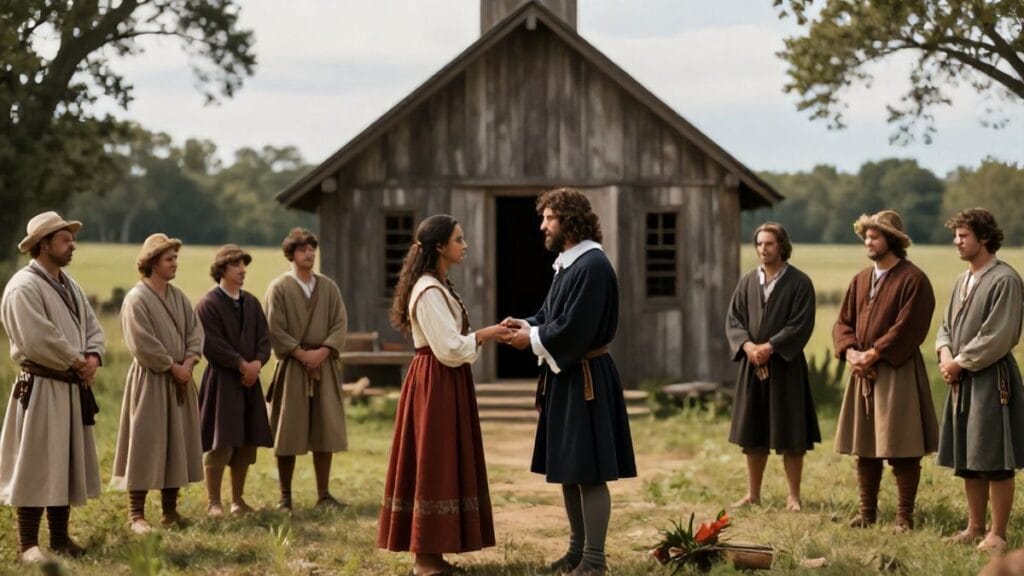
- “Pocahontas Marries John Rolfe”: The Wedding Day in Jamestown
- “Peace of Pocahontas”: How a Marriage Paused a War
- Domestic Life in a Borderland Household: Rebecca, John, and Little Thomas
- Across the Ocean: Pocahontas in London as a Symbol of Empire
- Between Illness and Intrigue: The Final Journey and Death at Gravesend
- After the Peace Broke: The 1622 Uprising and Shifting Memories
- Myth, Romance, and Empire: How the Story Was Rewritten
- Women, Power, and the Crossroads of Two Civilizations
- Reading the Sources: What We Know and What We Don’t
- Legacies in Virginia and Beyond: Family, Land, and Memory
- Conclusion
- FAQs
- External Resource
- Internal Link
Article Summary: On April 5, 1614, in the struggling English outpost of Jamestown, the event now known as “pocahontas marries john rolfe” unfolded as both a personal union and a calculated political experiment. This article traces the life of Pocahontas from her Powhatan childhood through captivity, conversion, and marriage to a tobacco planter whose ambitions were woven into the fate of the Virginia Colony. It explores how the wedding temporarily calmed a brutal frontier conflict, creating a fragile peace that enabled Jamestown to survive and grow rich on tobacco. Yet behind the celebrations lay deep inequalities, cultural pressures, and the stark reality that this alliance rested on coercion and colonial expansion. The narrative follows Pocahontas to London, where she was displayed as proof that “savages” could be “civilized,” and then to her early death far from home. It then examines how later generations romanticized the moment when pocahontas marries john rolfe, turning it into a legend of interracial harmony that concealed the violence of colonization. Drawing on period letters, colonial reports, and modern scholarship, the article unpacks the political, social, and human consequences of that 1614 wedding. In doing so, it shows how a single marriage became a powerful symbol—claimed, contested, and reimagined across four centuries.
A Wedding in a Frontier Town: Setting the Scene in Jamestown, 1614
On a cool April morning in 1614, Jamestown was still more a desperate experiment than a settled town. The wooden palisade that ringed the colony, weathered and leaning in places, spoke more of fear than permanence. Within its walls, rough-hewn houses crowded together around the church, a building of timber and mud daub, with a bell that sounded faintly over the marshes and the tidal James River. It was there, according to colonial accounts, that pocahontas marries john rolfe—an event that, at least for a moment, made this precarious outpost appear orderly, hopeful, almost civilized in the eyes of the English. The colony’s leaders understood that this was no ordinary union: it was theatre, diplomacy, and salvation rolled into one.
By 1614, Jamestown had nearly died more than once. The so-called “Starving Time” of 1609–1610 had left piles of dead and grim stories that would later horrify readers in England: colonists gnawing on leather, boiling roots and rats, and worse. Survivors remembered only a third of the roughly 300 settlers still alive when spring came. Outside the palisade lived thousands of Algonquian-speaking people under the loose dominion of Wahunsenacawh, known to the English as Powhatan, the paramount chief and father of the young woman the English called Pocahontas. Jamestown was perched on land claimed by Powhatan’s alliance, intruding into a complex political world that had functioned long before an English ship sighted these shores.
Yet on that April day the leaders tried to set aside the memory of famine and war. In the church, roughly built but adorned for the occasion, English settlers gathered in their best clothes—worn doublets brushed clean, stockings patched, boots scuffed but shined. Near the front stood John Rolfe, an earnest tobacco planter whose experiments with Caribbean tobacco had just begun to show promise. Close by was the young Native woman they called Pocahontas, though by then she carried a different name: Rebecca, chosen at her recent baptism. Around them, armed sentries glanced uneasily toward the surrounding woods; the palisade might keep out arrows, but it could not keep out doubt.
The decision that pocahontas marries john rolfe was meant to signal an end to open conflict between Powhatan’s people and the English. Only four years earlier, Jamestown and nearby Indian towns had exchanged raids, hostages, and blood. The colonists had taken Pocahontas captive in 1613, holding her as leverage in negotiations with her father. Over months, captivity blurred into cultural transformation. She learned more English, received Christian teaching, and underwent baptism in the church where she would later marry. Her father’s emissaries came and went, bringing gifts, arguments, and perhaps hidden resentments. By the time she and Rolfe stood before the minister, their marriage represented a negotiated pause in war, a fragile contract written on human bodies instead of paper.
It’s astonishing, isn’t it, to imagine how much rested on that intimate moment at the front of a crude frontier chapel? The colony’s very survival, the crown’s hopes for a profitable new dominion, the dreams of merchants who had invested in Virginia Company shares, the calculations of Powhatan’s councilors who saw both danger and opportunity in this alliance—all coalesced into the simple formula: pocahontas marries john rolfe. The human story, however, was much more complicated. Behind the solemn vows lay a young woman separated from her homeland and relatives, and a man whose piety and ambition would tether his life to the success of New World tobacco. Their union was both deeply personal and unmistakably public, both a marriage and a treaty, both a promise and a prophecy of what the future of Virginia might become.
From Matoaka to “Pocahontas”: Childhood Along the Powhatan Rivers
Before she ever set foot in Jamestown’s church, Pocahontas was a child of rivers and forests, born around 1596 into a world with its own rhythms, laws, and histories. Her given name, historians believe, was Matoaka, though the name “Pocahontas” — meaning something like “playful one” or “she who is mischievous” — became the affectionate nickname that survived in English memory. She grew up among the Powhatan people, whose villages lined the tidal waterways of what the English would call Virginia, sustained by cornfields, fishing grounds, and intricate trade networks.
As a daughter of Wahunsenacawh, the paramount chief, she did not live in a palace—for the Powhatan world did not divide royalty from commoners with massive walls and thrones. Yet her position mattered. She moved among the chiefly households, learning rituals, stories, and etiquette. In the spring, she would have watched women plant corn, beans, and squash in mounded fields; in the fall, she might have joined harvest dances, accompanied by the rattling of shells and the beat of drums. Children learned by watching and doing, not by sitting in rows. She would have absorbed the geography of her homeland not from crude maps but from canoe journeys, hunting paths, and the whispered advice of elders.
The English who later wrote about her often cast her as both child and curiosity, but in Powhatan terms she was also a political asset. Daughters of chiefs could form marriage alliances, carry messages, and serve as visible reminders of the web of kinship that bound a scattered collection of towns into something resembling a confederacy. In this sense, the idea that “pocahontas marries john rolfe” was prefigured, in a different cultural code, long before any Englishman ever imagined such a thing. Her body, like those of other elite women in her society, already carried diplomatic weight, though the form that diplomacy would take with the English was new and unsettling.
To understand the magnitude of the transformation she would endure, it matters to picture her earliest years in detail. The Powhatan calendar followed the seasons: fish runs, planting, hunting, winter storytelling. Winters could be harsh, but the people were accustomed to the cycles, and their food stores usually carried them through. Children learned to swim in rivers, to gather wild plants, to pick up the cues of weather and animal behavior. The world did not feel endangered or temporary; it felt ordered, governed by spirits and ancestral wisdom. Europeans were unknown ghosts beyond the ocean, spoken of perhaps in rumor from coastal traders but hardly central to daily life.
This was the world that would be cracked open in 1607, when three English ships anchored off Jamestown Island, bringing with them men who would soon speak Pocahontas’s nickname to one another, clumsily, as they tried to map her significance. To Powhatan, the arrival of these strangers was first a problem of protocol: who were they, under whose authority did they come, and how might they be fit into existing systems of tribute and alliance? To a child like Matoaka, they might have been frightening, fascinating, or largely out of sight at first, their wooden palisade just one more feature in a landscape she already knew intimately.
Later stories — especially the famous rescue tale in which Pocahontas supposedly saved the life of Captain John Smith — would elevate her to a near-mythic plane. But stripped of romantic gloss, she was initially a girl watching her world rearrange itself. The distances between villages began to fill with rumors of muskets, iron tools, unfamiliar diseases, and unpredictable demands. As the English dug their wells and built their fort, they also dug into the political soil of Tsenacommacah, the Powhatan homeland, altering relationships and expectations. The child who once raced along riverbanks would, within a few short years, be recast as a mediator between civilizations she had never imagined would collide so violently.
Powhatan’s Dominion and the Coming of the English
Long before English chroniclers wrote of “Virginia,” Powhatan’s world had its own name: Tsenacommacah, often translated as “densely inhabited land.” It stretched across tidewater rivers—the James, York, Rappahannock, and Potomac—binding some 30-odd tribes and perhaps 15,000 people into a loose political network. Wahunsenacawh, Pocahontas’s father, exerted influence through tribute, arranged marriages, warfare, and ritual. He was no absolute monarch; village chiefs (werowances) had autonomy, yet they answered to him in matters of war and regional diplomacy. Goods flowed toward his storehouses: corn, copper, exotic shells, furs. In turn he redistributed these, affirming bonds of loyalty and obligation.
Into this system sailed the Susan Constant, the Godspeed, and the Discovery in the spring of 1607, carrying about 100 English settlers backed by the Virginia Company of London. Many were gentlemen unused to manual labor, others artisans, a few soldiers. They arrived not as supplicants but as representatives of a royal charter that claimed this land for King James I. Their goals were conflicting: some sought gold, others a passage to the Pacific, still others hoped simply to survive. Their presence presented Powhatan with a challenge: were these people a minor nuisance to be incorporated and controlled, or a potential ally against his enemies, or a cancer that had to be cut out?
The first encounters fluctuated between tentative trade and sudden violence. The English, scrambling to feed themselves, leaned quickly on Powhatan’s stores, offering metal tools, beads, and copper in exchange for corn and fish. They admired the grace of Powhatan’s people, their skill in agriculture and hunting, their canoes that skimmed the waterways with effortless speed. Yet they also described them as “savages,” suitable for conversion and exploitation. Disease began to move silently through Tsenacommacah, preying on immune systems unacquainted with European pathogens. Within a few years, population declines would begin to alter demographic balances in ways no one fully understood at the time.
Smith’s famous account of his capture and presentation before Powhatan—in which he later claimed that Pocahontas intervened and saved him—has divided historians. Some see it as largely invented, an Englishman’s self-aggrandizing misreading of a ritual of adoption or symbolic execution. Others grant that some dramatic moment likely occurred but insist that its meaning was embedded in Powhatan cosmology, not in an impromptu romantic rescue. What matters for our story is that Pocahontas entered the English historical record as an intermediary figure very early, even if the details were filtered through Smith’s embellished prose.
Powhatan and his counselors weighed the English presence pragmatically. At times, they cut off food supplies, hoping to compel the fort’s abandonment. At other times, they sent envoys and gifts, perhaps aiming to turn these odd newcomers into dependent clients. For the English, the equations were equally stark: without Indian corn, Jamestown would die. Without some form of peace, English muskets and armor were not enough to guarantee survival against thousands of bowmen who knew the land intimately. The delicate dance of diplomacy, raids, hostage-taking, and trade drew Pocahontas gradually into its center. When later, in a Jamestown church, pocahontas marries john rolfe, that moment will sit atop years of such entanglements, failed understandings, and half-kept promises.
Famine, Fear, and Fragile Peace: The Early Jamestown Years
The settlement that Pocahontas first visited as a girl was a rough outpost teetering between survival and oblivion. Disease struck quickly—malaria, dysentery, strange fevers spread by polluted water and cramped living conditions. Over the first six months, about half the original colonists died. More arrivals came from England: new men, limited supplies, renewed optimism, and fresh resentments. The Virginia Company’s pamphlets bragged about endless opportunities, but no gold appeared, and the search for mythical riches wasted precious energy that might have gone into farming.
In this bleak landscape, relations with Powhatan’s people were rarely simple. The story of Pocahontas bringing food to the fort—recorded by Smith and echoed in later retellings—fits into a pattern where children, women, and specific envoys crossed boundaries more easily than warriors could. She appeared at the edge of the palisade with companions, delivering corn, perhaps dancing, perhaps mimicking English speech, weaving herself into the colonists’ imaginations as a friendly, almost magical presence. Yet even then, peace was never guaranteed. Raiding parties from both sides struck when negotiations soured. English soldiers attacked Indian villages, seizing grain and sometimes killing indiscriminately. Powhatan warriors ambushed isolated English parties in the woods, vanishing back into the trees.
The winter of 1609–1610, seared into memory as the Starving Time, revealed how thin the thread of coexistence really was. After leadership disputes, shipwrecks, and failed crops, the colony faced collapse. Powhatan, weary of English demands, tightened his control on food and restricted trade. Surrounding woods became hostile territory; colonists huddled behind their walls as hunger and disease ripped through them. Contemporary accounts speak of desperate measures, including cannibalism—the disinterment and consumption of the dead. Out of roughly 300 colonists at the start of the winter, only about 60 survived to see spring.
This is the crucible that forged the later decision that pocahontas marries john rolfe. The English emerged from the Starving Time with a hardened resolve: they would not abandon Virginia, and they would not remain at the mercy of Powhatan’s goodwill. Under Lord De La Warr and later Sir Thomas Dale, the colony adopted harsher military discipline and waged more aggressive campaigns against surrounding Indian towns. Yet total war was not sustainable; neither side had the resources to annihilate the other. The Virginia Company, furious at the high mortality rates threatening its investment, demanded some path toward stability. Meanwhile, Powhatan’s network showed signs of strain under disease, food pressure, and ongoing conflict.
Into this spiral of violence and necessity, Pocahontas disappeared from English view for several years. She matured into womanhood in a world that knew of the English but did not revolve around them. Then, in 1613, fate—or rather calculation—would drag her across the boundary once again, setting her on a course that led, irrevocably, toward that small church in Jamestown and the marriage that would reshape her life and reputation.
Capture on the Patawomeck River: Pocahontas Becomes a Political Pawn
In 1613, while Powhatan and the English were locked in a grinding stalemate, an English sea captain named Samuel Argall saw an opportunity. Pocahontas was living among the Patawomeck, a people related to but politically distinct from Powhatan’s core dominions. Argall learned that she was nearby and understood at once the value of such a captive. With the help of local leaders eager to curry favor with the powerful newcomers or to weaken Powhatan’s hand, he lured Pocahontas aboard his ship with promises of trade and hospitality. Once she was in his grasp, he refused to let her go.
The kidnapping was stunningly bold. Argall informed Powhatan that his daughter would be held until he returned English captives and stolen weapons and agreed to broader peace terms. In English letters, we hear a note of triumph: at last they possessed a bargaining chip valuable enough to demand serious concessions. To Powhatan, this was a violation not just of kinship but of diplomatic norms. Yet even his power had limits. His response edged between outrage and calculation. He did return some captives and goods, but other demands went unmet. Months stretched into a year, and Pocahontas remained among the English.
The precise nature of her captivity is difficult to reconstruct. Colonial sources describe her as being treated more like a guest than a prisoner, lodged first at Jamestown and then at the settlement of Henricus. There, she encountered Christian instruction and English domestic routines on a daily basis. The Reverend Alexander Whitaker wrote admiringly to his sponsors in England about her “civility” and eagerness to learn. His descriptions, however, served as fundraising propaganda for the Virginia Company and must be read with care. Still, it is clear that Pocahontas learned the language more fully, adopted English dress, and listened to lessons about Scripture and salvation.
Psychologically, this period must have been bewildering. Taken from her kin, unable to move freely, yet expected to smile and learn, she lived in a space that was neither home nor fully captivity as we might imagine it. English efforts to present her conversion as willingly embraced were deeply entangled with power: refusing instruction, resisting baptism, or demanding to go home could all be construed as rebellion against not only the colonists but their God. Her world shrank to the wooden houses and fenced fields of Henricus, far from the rivers she had known as a girl.
It is in this tense interlude—part hostage crisis, part missionary project—that the path toward the moment when pocahontas marries john rolfe began to take shape. The English saw in her not only spiritual capital (a soul saved, a “princess” baptized) but diplomatic leverage. If she could be persuaded to ally herself with them publicly, as wife to a respectable settler, their cause in Virginia and back in London would gleam with legitimacy. For Pocahontas, the choices arrayed before her were sharply limited; yet within those constraints she still had to decide how to survive, whom to trust, and how to reimagine her future.
Faith, Language, and Transformation: The Baptism of Rebecca
At Henricus, Pocahontas underwent a formal religious transformation that would frame all subsequent English narratives of her life. Under the guidance of Reverend Whitaker, she studied Christian doctrine: the Creation, the Fall, the story of Christ, the promise of salvation. Whether these stories resonated with her own spiritual understandings, or whether they clashed, we cannot fully know. What we do know is that by 1614 she had agreed—or felt compelled—to baptism. The ceremony symbolized death to an old life and rebirth into a new one, and with it she took a new name: Rebecca.
The name was not chosen at random. In the Bible, Rebecca (or Rebekah) is a matriarchal figure, wife of Isaac, mother of Jacob and Esau—a bridge in the covenantal story of God’s people. By naming Pocahontas “Rebecca,” the English cast her in a role that yoked female obedience and generational transformation. If she embraced their God, married an Englishman, and bore children, she would, in their view, seed a new, Christianized lineage among the “heathen.” Whitaker wrote to supporters in England describing her as a symbol of what could be achieved if only more funds and manpower were sent to Virginia. His letter, later printed in London, made Pocahontas the poster child of colonial evangelism.
Language was another site of transformation. During her earlier acquaintance with Jamestown, she had picked up words and phrases. Now, living among English speakers for months on end, her fluency grew. Language learning is always a two-way street, and colonists also adopted Algonquian terms for local plants and animals. Yet the power dynamic tilted heavily toward English; it was the language of law, trade documents, and sermons. To be Rebecca was, in part, to inhabit this new tongue, to think and be addressed in patterns that carried foreign assumptions about property, gender, and God.
Baptism did not erase her past, of course. To the Powhatan, she remained the daughter of Wahunsenacawh, even if estranged by circumstance and choice. But it did create a liminal identity: no longer fully Matoaka, not yet entirely the Rebecca the English imagined. When we later say that pocahontas marries john rolfe, we are really describing the marriage of Rebecca—a baptized convert whose spiritual and political identity had already been reshaped—though English writers continued to use her childhood nickname to heighten the romance. The gap between the public image and the inner person widens here, and into that gap historians must peer, carefully, to ask how much agency and consent she could exercise.
Her conversion also provided a theological frame to justify what would come next. If she was now a Christian, English leaders argued, then marriage to a Christian man was not only permissible but laudable. Concerns about miscegenation, which would later harden into strict racial regimes, were still forming; for the moment, the needs of diplomacy and evangelism eclipsed doubts. The stage was set for a union that could be proclaimed, both in Virginia and back in England, as evidence that the colony could transform the people it encountered rather than be destroyed by them.
A Tobacco Planter and a Prisoner-Guest: John Rolfe Meets Pocahontas
John Rolfe entered the Virginia story as a man of middling status and considerable ambition. Born in England in the 1580s, he was among those who saw opportunity in the New World. By the time he encountered Pocahontas in Henricus, he had suffered losses of his own; his first wife, Sarah, had died, likely during or after the voyage to Virginia. Left a widower, he poured his energy into an agricultural experiment that, though he could not fully foresee it, would transform the colony: the cultivation of a sweeter strain of tobacco suitable for the English market.
Rolfe’s surviving letters reveal a man concerned with piety as well as profit. In a famous missive to Sir Thomas Dale, the colony’s martial governor, he agonized over whether to marry Pocahontas, framing his desire as both personal and spiritual. He confessed that he was “not led by the unbridled desire of carnal affection” but by “the good of this plantation, the honor of our country, for the glory of God, for my own salvation, and for the converting to the true knowledge of God and Jesus Christ, an unbelieving creature.” The language is revealing: he must assure his superiors that his motives were not mere lust but missionary zeal and political wisdom.
By this time, Pocahontas—Rebecca—had been in English hands for about a year. It is likely that she and Rolfe met in the small, tightly knit community of Henricus, where everyone would have been aware of everyone else’s business. Their conversations, if we imagine them, would have needed at least a fragile bridge of shared language. Perhaps she was curious about his strange plants, broad leaves drying under the Virginian sun. Perhaps he asked her about local soils, seasons, and cultivation techniques, as other English colonists had learned much of agriculture from Native teachers. Affection may have grown, or perhaps only a respectful familiarity layered over captivity’s unavoidable imbalance.
When we repeat the phrase “pocahontas marries john rolfe,” it can sound like the union of two equal individuals moved by romance. The reality was more uneven. Rolfe was a free English man in a colony run by his compatriots. Pocahontas was a high-status Native woman held against her will, trying to navigate survival in a system that had violently separated her from her father’s house. Still, to dismiss all possibility of warmth or mutual consideration between them would oversimplify human experience. People have found ways to care for one another in circumstances far more constrained. The tragedy lies in the fact that their choices unfolded inside a framework they did not control, one that treated their marriage as a policy instrument.
When Rolfe sought approval from Dale, he was well aware that his own fortunes were tied to the colony’s stability. If marriage to Pocahontas could soften Powhatan resistance and secure years of peace, tobacco fields could expand without fear of constant raids. Investors in London would smile upon this, and Rolfe’s star might rise. For Pocahontas, marriage may have offered protection, a form of socially recognized status among the English, and a potential path to reengagement with her father on new terms. Whether she felt love, resignation, calculation, or some mix of them all, we can only infer. The archival record records Rolfe’s internal debate in his own hand; her voice, as usual, is mediated through others.
When Worlds Converge: Negotiations Before the Marriage
Before the wedding could take place, there were negotiations—not just between Rolfe and Dale, but between English authorities and Powhatan leaders. For the colonists, the question was: would this marriage genuinely secure peace, or would it provoke further conflict? For Powhatan, the question was subtler: what did it mean, politically and spiritually, for his daughter to bind herself to a colonist, one of the people who had caused so much suffering and disruption?
Sir Thomas Dale, ever mindful of the Virginia Company’s expectations, saw an opportunity. A peaceful interlude would allow him to reorganize the colony, enforce discipline, and expand agriculture. The company’s directors in London had complained of chaos, high death rates, and inadequate returns on investment. The potential alliance, symbolized by the phrase pocahontas marries john rolfe, could be sold to them as evidence of progress: the colony was not merely surviving but integrating the land and its people into an English-Christian orbit.
Messengers shuttled between Jamestown and Powhatan territory. Accounts differ on how the negotiations were framed, but it is clear that some form of consent from Pocahontas’s father was sought or at least claimed. One English chronicler reported that when Powhatan learned of his daughter’s conversion and proposed marriage, he gave his “approbation” and sent an uncle as her kinsman to witness the event. Whether this was an enthusiastic blessing, a resigned nod, or a calculated move to keep a foothold in English councils is impossible to say. What we can say is that Powhatan did not retaliate violently; instead, he accepted the altered reality, perhaps hoping to extract advantages from this unlikely alliance.
Within the colony, opinions also varied. Some Englishmen may have balked at the idea of a “native princess” becoming the wife of a planter, worrying about hierarchy, inheritance, or propriety. Others likely saw it as a clever stroke of realpolitik. The church’s role was to sanctify the union, to present it as fully legitimate under English law and Christian doctrine. Once that was done, critics could be chastised as opposing not merely policy but the will of God. Rolfe’s deferential letter to Dale, with its heavy emphasis on divine guidance, seems designed to preempt such objections.
All this maneuvering underscores that when pocahontas marries john rolfe, the event is as much a council decision as a romantic one. It arises from years of conflict and diplomacy, from the Virginia Company’s accounting ledgers, from Powhatan’s calculations about survival in a disease-ridden, war-torn landscape. It also emerges from missionary ambitions: if a high-born Native woman could be seen embracing Christian marriage, what better advertisement for further evangelism?
In the background, unrecorded servants, laborers, and Native workers watched. They were the ones who planted fields, rowed boats, carried messages, and bore the daily burdens of this contact zone. To them, the impending wedding may have seemed both extraordinary and strangely irrelevant. The great ones would do as they wished; the rest would adjust as best they could. Yet lives at the bottom would indeed change in the wake of the union, as the fragile peace that followed allowed the colony to grow, land to be seized, and labor demands to intensify.
“Pocahontas Marries John Rolfe”: The Wedding Day in Jamestown
At last, in early April 1614—traditionally dated to April 5—the day arrived. The church at Jamestown, where Pocahontas had been baptized as Rebecca, now prepared to host her wedding to John Rolfe. The river glinted outside as colonists and a small delegation of Powhatan’s kin gathered. Inside, the air would have smelled of rough timber and damp earth, perhaps faintly of flowers if any had been gathered for the occasion. This was no grand cathedral, but a frontier chapel struggling toward respectability.
We have no detailed eyewitness description of the ceremony itself, only brief references in letters and chronicles. Yet English marriage rites followed a familiar pattern. The minister would have stood before the couple, Bible in hand, reciting the words from the Book of Common Prayer. Questions of consent—“Wilt thou have this man… this woman… ”—would be posed, and answers given in English. Rebecca might have repeated the vows carefully, each syllable a negotiation between her native tongue and the new language into which she had been thrust. The ring, a visible sign of the bond, was likely placed upon her finger, sealing the contract in the eyes of the English law and church.
Somewhere in the church, her uncle and other Powhatan representatives observed. Their presence lent the ceremony a diplomatic weight. For them, marriage had different ritual forms and expectations, but the core idea—a binding alliance recognized by kin—could be translated across cultures. The English, however, recorded the event with a particular emphasis: pocahontas marries john rolfe, they wrote, as if one person’s nickname and one man’s surname encapsulated an entire peace treaty. Colonial secretary Ralph Hamor later described the wedding as the beginning of a “firm peace and amity” between the English and Powhatan’s people.
Outside, armed men still patrolled; trust did not extend so far as to lay down weapons entirely. The colony’s survival instinct had been bred by years of hunger and sudden raids. Yet for that day, at least, the mood seems to have tilted toward celebration. A feast may have followed—bread, perhaps some meat, maybe even Indian corn dishes adapted to English tastes. Stories would be told of how far the colony had come, from the desperate winter of starving to the moment when a “savage” king’s daughter chose to join herself to an English Christian. Toasts might have been drunk, prayers offered for the prosperity of the new couple and of Virginia itself.
What did Pocahontas—Rebecca—feel as she walked out of the church, now officially wife to John Rolfe? Did she scan the river horizon, wondering if any of her father’s people watched from the distance? Did she feel a thread of hope that this union might spare her kin from future English attacks? Or did a sense of irreversible loss weigh on her, knowing that she now belonged, in the eyes of both societies, more to the colony than to Tsenacommacah? The record is silent, but the tensions are easy to imagine. Weddings are usually beginnings; for her, it was also an end to the possibility of ever fully returning to the life she had known.
Nonetheless, the story of that day would be retold endlessly. Pamphlets in London would celebrate it as a triumph of civilization over savagery, Christianity over heathenism, diplomacy over war. Artists centuries later would paint it with flowing gowns and romantic gazes, smoothing away the violence that had paved the road to the altar. The concrete reality—an austere church in a muddy, half-starved outpost—would fade behind the shimmering myth that pocahontas marries john rolfe in a moment of pure, harmonious destiny.
“Peace of Pocahontas”: How a Marriage Paused a War
In the years immediately following the wedding, contemporaries spoke of a “peace of Pocahontas,” a phrase that linked her directly to an observable lull in open hostilities. The marriage did not magically erase all tensions, but it did coincide with a period—roughly from 1614 to 1622—during which large-scale warfare between the English and Powhatan’s core tribes diminished. Trade resumed on more predictable terms. English parties ventured further upriver to plant new settlements and tobacco fields, less fearful of arrows from the forest.
From the English perspective, the benefits were tangible. Sir Thomas Dale could report to the Virginia Company that their colony, once on the brink of collapse, now had room to breathe. More ships arrived with settlers, including women and families, suggesting a shift from transient outpost to budding society. Tobacco exports began to climb; by the late 1610s, tens of thousands of pounds were being shipped annually to England, and John Rolfe’s experiments contributed significantly to this boom. Investors saw returns; the colony’s existence seemed finally justified.
For Powhatan and his allies, the picture was more mixed. The marriage of Pocahontas to Rolfe symbolized a kind of détente, but it did not halt the underlying processes of land dispossession and demographic change. English farms crept outward, fencing off fields that had once been used collectively for hunting or shifting agriculture. Diseases continued to take a toll on Native populations; even without pitched battles, people died in numbers that strained communities. Still, the respite from full-scale war may have been welcome, a chance to adapt and strategize in the face of forces that were not going away.
Diplomatically, the couple became living proof—at least in English rhetoric—that coexistence was possible. When ambassadors from Powhatan towns came to Jamestown, they could be received by a man whose wife was one of their own. Gifts and words passed between them, sometimes with genuine goodwill, sometimes with veiled threats. The fragile network of alliances that had existed before the English arrived was now stretched to include these armed newcomers, and the marriage helped thread them into the existing fabric, however awkwardly.
Ever since, historians have debated how far the peace of Pocahontas should be credited to the personal union of two individuals. Some argue that the truce would have come regardless, as both sides were exhausted by years of confrontation. Others insist that the visibility of the marriage helped maintain a sense of shared interest, at least temporarily. What is undeniable is that the phrase pocahontas marries john rolfe became shorthand for this entire era of relative calm, an era that allowed the colony to grow strong enough that, when war did return in 1622, it was no longer in existential jeopardy.
In that sense, Pocahontas’s marriage contributed indirectly to the long-term success of English colonization in Virginia—and thus to the eventual subjugation of the very world she came from. This cruel irony has not been lost on modern commentators. The woman celebrated for bringing peace did so at a cost that her people would bear for generations, as their lands were carved up and their autonomy eroded. Yet to view her solely as a symbol of betrayal would be to oversimplify a life lived under extraordinary pressure. The chain of causality that links a wedding in 1614 to the later dispossession of Virginia Indians runs through many hands, many decisions, and a colonial machine that far exceeded the power of any one woman or one marriage to control.
Domestic Life in a Borderland Household: Rebecca, John, and Little Thomas
In the months after the wedding, the couple settled into a life that, on the surface, resembled that of other English households in the colony. They likely lived first at Henricus and later on Rolfe’s tobacco plantation, where fields of the crop—Nicotiana tabacum—stretched toward the horizon. There, Rebecca moved through spaces shaped by English domestic ideals: a central hall for cooking and communal life, small sleeping quarters, storage areas for tools and provisions. Servants, both indentured English laborers and, increasingly, African and Native workers, would have passed in and out, tending crops and animals.
Their son, Thomas Rolfe, was born around 1615. His arrival bound the two worlds even more intimately, at least biologically. To English eyes, he was the future—a child who proved that the distance between “savage” and “civilized” was bridgeable. To Powhatan kin, if they ever saw him in person, he might have symbolized continuity amid upheaval, another branch on a vast family tree. For Rebecca, motherhood in this borderland must have been both comforting and fraught. She had been taken from her father’s village and religiously remade; now, she held in her arms a child who embodied those transformations in his very body.
Daily routines for her probably mixed old skills and new expectations. Powhatan women were accomplished agriculturalists and craftswomen; Rebecca would have known how to plant, process corn, and prepare meals from her youth. English domestic life, however, placed a different emphasis on certain foods, table manners, gendered divisions of labor, and household piety. She wore English clothing—tight bodices, layered skirts, linen shifts—that restricted movement compared to the deerskin garments and woven cloaks of her childhood. She attended church services regularly, hearing sermons that reinforced obedience, chastity, and the supremacy of the Christian God.
Rolfe, for his part, balanced family life with his obsession over tobacco. The plant required careful curing and grading; slight changes in weather or handling could ruin a harvest. He corresponded with contacts in England, seeking feedback on flavor and quality. Success meant more land, more labor, and more entanglement with the structures of colonial ownership emerging around him. His marriage, already a symbol in London reports, now anchored him even more firmly to Virginia. The family he built with Rebecca was intimately tied to the commodity that would define the colony’s economy.
Yet even in apparent tranquility, the tensions of identity persisted. How did Rebecca explain her past to Thomas as he grew? When she walked outside and saw the forest beyond the cleared fields, did she think of the villages along the rivers where she had once played? Did she miss the Powhatan language, the cadence of stories told by the fire on winter nights? The sources offer no direct answers. We are left to imagine a woman who had learned to move between codes—Native and English, Matoaka and Rebecca—while knowing that one code now dominated her daily reality.
This domestic interlude is sometimes romanticized as a period of contentment before tragedy struck. It should instead be seen as a brief, complex pause during which a unique household tried to live an ordinary life under extraordinary historical pressures. The tranquility of fields and family dinners rested on the continued expansion of English claims and the slow constriction of Powhatan autonomy. In their small home, the story that began when pocahontas marries john rolfe played out in the quiet details of parenting, prayer, and planting, far from the council chambers where men debated the fate of nations.
Across the Ocean: Pocahontas in London as a Symbol of Empire
In 1616, the Virginia Company saw another opportunity in the figure of Pocahontas—now Rebecca Rolfe. With the colony’s fortunes rising thanks to tobacco and relative peace, company officials wanted to persuade King James, the royal court, and potential investors that Virginia was not a reckless gamble but a worthy, even godly, undertaking. Bringing Rebecca to England and displaying her as a “civilized” Native woman was a powerful strategy toward that end.
So the Rolfe family embarked on a transatlantic voyage, traveling aboard a ship that crossed the same waters English settlers had navigated in the opposite direction nine years earlier. The journey would have been long and uncomfortable: cramped quarters, stale food, the ever-present risk of storms. For Rebecca, the ocean was new. For Thomas, still a small child, it was perhaps an incomprehensible adventure. When they finally reached London, they disembarked into a city of around 200,000 people—one of the largest in Europe, dense with noise, smells, and spectacle.
In London, Rebecca was treated as both guest and exhibit. The Virginia Company arranged for her to be lodged respectably, dressed in fine clothes suitable for presentation at court. Portraits from the period, particularly the engraving by Simon van de Passe, show her in a stiff lace ruff, broad-brimmed hat, and embroidered bodice, her face composed and serious. Around the image, Latin inscriptions identify her as “Rebecca,” wife of John Rolfe and “daughter of the mighty Prince Powhatan, Emperor of Virginia.” Here, the English fully embraced the narrative that pocahontas marries john rolfe was not only a romantic union but a diplomatic conquest: the “emperor’s daughter” had accepted English faith and customs.
She attended plays, banquets, and gatherings where nobles and merchants could see, with their own eyes, a living representative of the people across the sea. According to one account, she was presented to King James and Queen Anne; whether they conversed at length or merely exchanged formal greetings is unclear. In any case, her presence at court lent glamour to the Virginia project. Company officials could point and say: look, the “savages” can be Christianized; they can sit at our tables, speak our tongue, marry our men. Give us more money, more settlers, more ships, and we will bring an entire continent into the fold.
Yet behind the politeness and curiosity, there were also moments of vulnerability. In London, Rebecca met again Captain John Smith, whom she had believed dead. According to Smith’s later account, she reproached him bitterly for his earlier deceptions and for the English treatment of her father’s people. Whether his recollection is precise or colored by hindsight, it suggests that she was not a passive ornament. She retained memories, grievances, and the courage to voice them—even in the heart of the empire that had claimed her.
Her health, however, began to suffer. The cold, damp English climate, the crowding, and exposure to new diseases all took their toll. Others in the Virginia delegation also fell ill. Plans were made to return to Virginia in 1617; the experiment had served its purpose. Investors had been courted, the king impressed, the myth of a harmonious colonial venture burnished. But as the ship set out down the Thames, Rebecca’s body betrayed her. Somewhere near Gravesend, she grew gravely sick—possibly from pneumonia, tuberculosis, or another respiratory illness. She was taken ashore, where, far from the rivers of Tsenacommacah, she would die at perhaps twenty-one or twenty-two years of age.
Between Illness and Intrigue: The Final Journey and Death at Gravesend
The final days of Pocahontas—Rebecca—are shrouded in a sorrowful brevity. Contemporary reports mention that she became ill suddenly, that she was taken ashore at Gravesend, and that she died and was buried there in March 1617. The exact cause remains uncertain; some historians suggest smallpox or dysentery, others a lung disease exacerbated by the English climate. Whatever the diagnosis, the effects were swift and devastating. John Rolfe, who had gambled so much on this union, found himself a widower once again, with a young son and a colony to return to.
Her burial took place at St George’s Church in Gravesend. The parish register notes simply the burial of “Rebecca, wife of John Rolfe, gentleman.” No monument from the time survives; the church itself was later destroyed and rebuilt, its cemetery disturbed. Modern commemorations in Gravesend are attempts to honor a memory that the earth has long since rearranged. The woman once paraded as a symbol of imperial promise vanished into an unmarked grave in an English riverside town, thousands of miles from her birthplace.
What did Rolfe feel as he stood at that graveside? His letters from this period do not survive, leaving us to conjecture. He must have recognized the cruel reversal: the marriage that had brought him influence and a measure of prosperity had also entangled him emotionally with a woman whose life had now been cut short, perhaps in part by the very journey imposed upon her. Their son, Thomas, was left behind in England, entrusted to relatives, while Rolfe sailed back to Virginia to resume his role in the tobacco economy. The family that had briefly symbolized two continents joined together was now scattered, its members divided by oceans and mortality.
For Powhatan, news of his daughter’s death likely arrived late, if at all. He himself died around 1618, maybe a year after Rebecca. Whether messengers had time to cross the Atlantic and the forests with the tidings before he passed is unknown. Even if the information did reach Tsenacommacah, it would have been filtered through layers of translation and rumor: your daughter, who became a Christian, traveled to England and died there. To a father who had once ruled the rivers she knew so well, such a report would be a bitter and incomprehensible epilogue.
Later, some writers theory-spun darker possibilities: that she might have been poisoned, that political intrigue surrounded her death. There is no firm evidence to support such claims, and most historians accept disease as the likely culprit. Still, the sense of injustice lingers. A young woman uprooted from her homeland, used as a diplomatic tool and missionary trophy, dies far from home just as she might have returned to the only landscape that could still feel like hers. The starkness of this ending tempers any temptation to romanticize the phrase pocahontas marries john rolfe as a simple love story.
Her son Thomas remained in England into adulthood and later returned to Virginia, where he would become a landowner and a link in the genealogical chain that many Virginia families proudly trace. In their claims of descent, they often celebrate Pocahontas as an ancestress who grants a certain noble exoticism to otherwise English lineages. Yet the grave at Gravesend reminds us of the human cost behind those pedigrees: a life compressed by colonization, faith, and politics into a symbol whose full complexity cannot easily be restored.
After the Peace Broke: The 1622 Uprising and Shifting Memories
The peace that had held, however tenuously, since the day pocahontas marries john rolfe did not survive the next generation of Powhatan leadership. After Wahunsenacawh’s death, his brother Opechancanough rose to prominence among the Powhatan, bringing with him a more militant posture toward the English. Watching the colony’s relentless expansion, its growing population, and its disregard for Powhatan land rights, he concluded that coexistence on English terms meant slow strangulation for his people.
On March 22, 1622, the simmering tensions erupted into a coordinated assault. Powhatan warriors, who had for years maintained outward signs of peace, struck suddenly at outlying plantations and settlements, killing around 347 colonists—nearly a third of the English population in Virginia. The attack shocked the colony and reverberated in England, undermining the Virginia Company’s narrative of progress and divine favor. The massacre, as the English called it, shattered the aura of safety that the earlier marriage had seemed to confer.
In the wake of the attack, English reprisals were brutal. They burned crops, ambushed villages, and sought to drive the Powhatan into starvation and submission. The frontier hardened; where once there had been a possibility—however constrained—of alliance and intermarriage, now suspicion and racialized contempt took deeper root. Laws began to codify sharper distinctions between English and Indian, Christian and “infidel,” foreshadowing the more rigid systems of racial hierarchy that would emerge in later centuries.
How, in this new landscape of fear, did colonists remember Pocahontas? Some clung to her as a symbol of what might have been: if only more of her people had followed her path of conversion and marriage, they argued, such bloodshed might have been avoided. Others used her story to sharpen a sense of betrayal: even the peace she had helped establish, they said, was no guarantee against the “treachery” of her kin. In either case, she was no longer simply a person but a yardstick by which the entire Powhatan nation was judged or condemned.
In London, company propagandists retooled their appeals. They emphasized the need for stronger military support, stricter control, and perhaps even direct royal governance. The notion that a single marriage could secure a permanent peace now seemed naïve. Yet the image of Pocahontas as an emblem of Christianization and alliance did not vanish. It simply shifted its function: from a sign that colonization could be gentle to a nostalgic reminder of a brief, lost possibility in a narrative now dominated by war and dominion.
Myth, Romance, and Empire: How the Story Was Rewritten
Over the centuries, the bare colonial fact that pocahontas marries john rolfe has been encrusted with layers of myth, romance, and political spin. The first wave of mythmaking came in the seventeenth century itself, as company pamphlets and colonial histories elevated her as a baptized princess whose life proved the righteousness of the English mission. But it was in the eighteenth and nineteenth centuries that her story was most dramatically transformed, especially in British and American popular culture.
Poets, playwrights, and later novelists began to weave elaborate tales of star-crossed love between Pocahontas and Captain John Smith, often sidelining or erasing John Rolfe entirely. Smith’s own later writings, published long after her death, gave them fodder; his embellished rescue narrative became the spine of a legend in which a noble Indian maiden sacrifices her safety for a rugged English hero. This romantic narrative proved irresistible to audiences eager for consoling stories about the colonial past. If Pocahontas loved Smith, then perhaps colonization could be read as a kind of mutual longing rather than conquest.
In the new United States, seeking national myths that distinguished it from Britain yet legitimized its presence on Indigenous land, Pocahontas became a useful figure. Artists painted her conversion and marriage as scenes of voluntary, graceful assimilation. In John Gadsby Chapman’s 1840 painting “The Baptism of Pocahontas,” displayed in the U.S. Capitol Rotunda, she kneels in a flowing white gown, surrounded by solemn Englishmen. The violence of her capture and the exploitation of her image vanish behind the soft glow of sentimentality. As historian Camilla Townsend notes, such images served to “reassure white Americans that the founding of their nation had been marked not by genocide but by interracial friendship.”
The twentieth century, with its films and cartoons, only amplified this distortion. Popular retellings shifted focus almost entirely to a romantic relationship between Pocahontas and John Smith, often portraying her as an ardent defender of peace against irrational tribal hostility. John Rolfe appears rarely, if at all. The fact that it was he whom she actually married in Jamestown on that April day in 1614 is an inconvenient detail that complicates the smoother love story between the adventurous captain and the exotic princess. Cinema collapses years, motives, and contexts into a single emotional arc.
At the same time, Indigenous writers and scholars have pushed back, insisting on a retelling that recovers her humanity and the colonial violence that structured her life. They point out that Pocahontas was likely around eleven or twelve when she first met Smith—far too young for the romantic narratives later imposed on them. They stress that her marriage to Rolfe occurred after a kidnapping, during a period when her agency was severely constrained. In this light, the conventional phrase “pocahontas marries john rolfe” must be handled with care: it names a historical reality, but it cannot be allowed to obscure the power imbalances embedded in that reality.
Myths endure because they solve problems for the societies that create them. The Pocahontas myth helps settler societies soothe guilt, offering a tale in which the first major Native woman in their pantheon willingly embraces the newcomers and even falls in love with one. To untangle myth from history is not to strip away all meaning but to acknowledge that the true story is more tragic, more morally complex, and more revealing of the forces that made the modern world.
Women, Power, and the Crossroads of Two Civilizations
To focus solely on Pocahontas as romantic heroine or imperial symbol is to miss a deeper story about women and power at the edge of empire. In Powhatan society, women held significant responsibilities: they were primary agriculturalists, controlled the production and distribution of food, and could wield influence through kinship networks. Elite women, especially daughters and sisters of chiefs, could serve as diplomatic actors, their marriages and movements shaping alliances. Pocahontas, as Matoaka, was born into this matrix of female agency, even if ultimate authority rested with male leaders.
English gender norms, by contrast, prescribed a more limited public role for women, emphasizing chastity, obedience, and domesticity. When Pocahontas entered the English orbit as Rebecca, she crossed into a society that valued her primarily as a convert, wife, and mother. The fact that her marriage affected international diplomacy was acknowledged, but the language surrounding her role framed it as secondary to male decision-making. She “softened” her father’s heart, chroniclers said; she “mediated” between the two peoples. Yet it was governors and chiefs, not she, who signed treaties and commanded warriors.
The moment that pocahontas marries john rolfe therefore sits at a crossroads where two gender systems intersect. On one hand, she continues a Powhatan tradition of women as conduits of alliance, linking lineages and communities. On the other, she conforms outwardly to English ideals of wifely submission. The fact that her story became so central to colonial memory suggests an uneasy fascination: here was a woman who seemed to verify English fantasies about their civilizing mission while also embodying Indigenous power that could not be wholly erased.
Other Native women across North America would navigate similar crossings in the centuries that followed: Maliseet and Mi’kmaq women in Acadia who married French traders, Cherokee women who married British agents, Métis women in the Canadian prairies who linked fur traders and Indigenous nations. Their lives, like Pocahontas’s, were often recast through Eurocentric lenses that downplayed their strategic choices and overemphasized sentiment. Modern scholarship increasingly restores their roles as political actors who managed, as best they could, the demands and dangers of colonial contact.
In this broader pattern, Pocahontas appears not as an anomaly but as an early, highly visible case. The stakes in her world were perhaps even higher: she lived at the very birth of sustained English colonization in North America, before patterns solidified. Her decisions—however constrained—helped shape the terms of engagement between two civilizations that would continue to wrestle with one another for centuries. To see her clearly is to see not a fairy-tale princess but a young woman negotiating survival, loyalty, belief, and affection amid forces that dwarfed individual will.
Reading the Sources: What We Know and What We Don’t
Any historian trying to reconstruct the story behind the phrase pocahontas marries john rolfe must grapple with fragmentary, biased, and sometimes contradictory sources. We possess letters by John Rolfe, reports by colonial officials like Ralph Hamor and Sir Thomas Dale, promotional tracts by Reverend Alexander Whitaker, and later narratives by Captain John Smith. These documents were written by English men with specific agendas: to reassure investors, to secure royal support, to defend their own reputations. Pocahontas herself left no writings. Her words reach us only through the filters of others’ pens.
Take, for example, Rolfe’s letter to Dale seeking permission to marry her. On one level, it offers a rare window into his thoughts, rich with religious and emotional language. On another, it is a performance aimed at authority—he knew it might circulate more widely and be read by powerful figures. His insistence that he was not driven by “carnal affection” may reveal as much about expected rhetorical conventions as about his actual feelings. Similarly, Whitaker’s glowing reports of her eagerness to embrace Christianity served to attract more funds for missionary work; exaggeration or selective emphasis was in his interest.
Later, John Smith’s accounts compound the difficulty. His story of being rescued by Pocahontas has long captivated readers, but historians like Helen C. Rountree and Camilla Townsend have pointed out its inconsistencies with Algonquian ritual and with Smith’s own earlier writings. He did not mention the rescue until years after it supposedly occurred, raising suspicions that he retrofitted the episode to capitalize on Pocahontas’s fame after her trip to England. As Townsend notes, “we know more about what the English wanted her to be than about who she understood herself to be.”
Archaeology offers some counterweight: excavations at Jamestown and other sites confirm aspects of diet, material culture, and violence that written records describe. Bones show signs of malnutrition and trauma; tobacco-related artifacts proliferate in later layers; church foundations match descriptions of the buildings where baptism and marriage took place. Yet archaeology is silent on inner life. It can tell us that a church stood on Jamestown Island in 1614; it cannot replay the tone in Rebecca’s voice as she spoke her vows.
Modern historians thus read the phrase “pocahontas marries john rolfe” with careful skepticism. They ask: who is telling this story, for whom, and why? They cross-reference accounts, watch for silences, and pay attention to the power dynamics that shaped whose voices were preserved. In academic debates, some emphasize Pocahontas’s likely lack of free consent, given her status as a captive; others caution against seeing her only as a victim, urging recognition of her capacity to strategize and adapt. The truth probably lies in a gray zone where agency and coercion mingle.
What remains undisputed is the date, the place, and the basic outline: in April 1614, in Jamestown’s church, a baptized Native woman known to the English as Pocahontas married John Rolfe, an English tobacco planter. Around that hard kernel, interpretation swirls. Each generation reshapes her into what it needs: savior, traitor, romantic heroine, imperial icon, tragic figure, bridge-builder. The work of history is not to choose a single flattering mask but to hold all these layers up to the light and ask what they reveal about both her world and ours.
Legacies in Virginia and Beyond: Family, Land, and Memory
The legacy of the moment when pocahontas marries john rolfe stretches far beyond the lifetimes of the couple themselves. In Virginia, their son Thomas grew to adulthood and returned from England to claim land and status. As a man of mixed ancestry in a society increasingly fixated on racial boundaries, he occupied a complex position. Yet his connection to Pocahontas and Powhatan lent a certain prestige. Through him and his descendants, many prominent Virginia families—Randolphs, Bollings, and others—have claimed lineage from Pocahontas, sometimes brandishing genealogical charts as social capital.
This genealogical pride coexisted uneasily with policies that marginalized and dispossessed Native peoples. By the eighteenth and nineteenth centuries, most of the Powhatan-descended tribes had been pushed off much of their ancestral land, their numbers reduced by disease, war, and intermarriage. Yet white elites celebrated a distant Indigenous ancestress as a quaint, harmless adornment to their otherwise English heritage. The line from Matoaka to Rebecca to Thomas to colonial gentry houses is often drawn in family lore without acknowledging that the land on which those houses stood had once belonged to nations for whom Pocahontas’s marriage marked not destiny but the beginning of an onslaught.
In Virginia’s physical landscape, her memory is scattered in place names, statues, and historical markers. At Jamestown, reconstructed churches and interpretive centers tell visitors about her baptism and marriage, though recent efforts increasingly highlight the colonial violence and Powhatan perspectives previously sidelined. In the twentieth century, roadside monuments tended to cast her in bronze as a serene, almost ethereal figure, often stripped of specific cultural markers. These monuments say as much about the eras that erected them—times of segregation and national mythmaking—as they do about the woman they claim to honor.
For the surviving Powhatan-descended tribes in Virginia—such as the Pamunkey and Mattaponi—Pocahontas remains a complex ancestral figure. She is both kin and symbol, a reminder of a time when their world confronted an unprecedented threat. Some tribal members have expressed ambivalence about the way her image has been commercialized and romanticized, especially in films and tourist attractions that flatten her culture into generic “Native American” tropes. Others see in her story a platform to assert continuous Indigenous presence in a state that long tried to write Native peoples out of official records.
Internationally, her image has traveled even further. She appears in children’s books in Europe, Asia, and Latin America; her name adorns hotels, boats, and schools. Few of those who utter her name know the specifics of 1614 Jamestown or the intricate politics of the Powhatan chiefdom. Instead, they inherit a globalized shorthand: Pocahontas as the Indigenous woman who fell in love with a European and thereby symbolized the “meeting of two worlds.” To push back against this shorthand is not to strip her of significance but to insist that the true significance lies in acknowledging the costs and contradictions that such a “meeting” entailed.
In scholarly work, her story now anchors broader analyses of early modern empire, gender, translation, and memory. She features in university syllabi not as a cartoon but as a case study in how colonial archives are built and how they can be read against the grain. When students learn that it was John Rolfe, not John Smith, whom she married, they begin to see how even basic facts can be distorted by centuries of retelling. When they learn that her marriage followed captivity and conversion, not a spontaneous romance, they begin to understand how deeply power permeates even the most seemingly intimate decisions under colonization.
Conclusion
On April 5, 1614, inside a modest wooden church on a muddy island in the James River, the event later summarized as “pocahontas marries john rolfe” took place. From the perspective of those gathered—a handful of English settlers, a few Powhatan kin, a minister with his prayer book—it may have seemed like both a personal milestone and a cautious wager on peace. Yet from the vantage point of four centuries, we can see that this wedding was far more than a quaint colonial anecdote. It embodied the collision of two civilizations, the translation of a Powhatan woman into an English Christian “Rebecca,” and the instrumentalization of a marriage to secure the survival and profitability of the Virginia Colony.
The union ushered in a brief peace that allowed Jamestown to take root and tobacco to flourish, thereby anchoring England’s first durable North American colony. At the same time, it did nothing to halt the deeper processes of land dispossession, demographic collapse, and cultural subordination that would gradually engulf Powhatan peoples. Pocahontas’s life arc—from Matoaka, child of Tsenacommacah, to Rebecca Rolfe, court curiosity in London, to an early grave at Gravesend—reveals the human cost of imperial projects often narrated in terms of adventure and progress.
In the centuries that followed, her image was repeatedly remade: romantic heroine saving John Smith, baptized princess validating colonial missions, benign bridge between races deployed to soften the memory of conquest. Recovering the historical Pocahontas means attending not only to English documents but to Powhatan social structures, to archaeological evidence, and to the silences where her own voice should be. It means acknowledging both her constrained agency and her resilience in adapting to a world transformed around her.
Ultimately, the story of how pocahontas marries john rolfe is a story about the entanglement of intimacy and power. A wedding, usually a private joy, became a public instrument of policy; a young woman’s body and faith became the terrain on which two peoples tried, briefly, to negotiate coexistence. That negotiation failed to spare her people from later war and dispossession, but it did leave a legacy that continues to shape how we think about first contact, intercultural relationships, and the stories nations tell about their beginnings. To honor her today is not to cling to comforting fictions but to face, with clear eyes, the beauty and the tragedy woven together in her short, extraordinary life.
FAQs
- Did Pocahontas really marry John Rolfe, not John Smith?
Yes. Historical records from the Virginia Colony confirm that Pocahontas, baptized as Rebecca, married the tobacco planter John Rolfe in Jamestown in April 1614. The widely popular story of a romantic relationship with Captain John Smith is a later invention rather than a documented fact. - How old was Pocahontas when she married John Rolfe?
Pocahontas was likely around eighteen when she married John Rolfe. She was born circa 1596, and the wedding took place in 1614, making her a young adult by the standards of both Powhatan and English societies. - Was Pocahontas’s marriage to Rolfe voluntary?
The question of consent is complex. By the time of the marriage, she had been held by the English for about a year following her abduction by Captain Samuel Argall. While sources suggest she agreed to the union and to baptism, her choices were made within the confines of captivity and unequal power, so historians see her agency as real but heavily constrained. - Why was the marriage politically important?
The marriage helped bring about a period of relative peace between the English and Powhatan’s chiefdom, often called the “peace of Pocahontas.” It reassured investors in the Virginia Company, encouraged further settlement, and allowed tobacco cultivation to expand—factors crucial to the colony’s survival and growth. - Did Pocahontas have children with John Rolfe?
Yes. Pocahontas and John Rolfe had one son, Thomas Rolfe, born around 1615. He grew up partly in England and later returned to Virginia, where he became a landowner and ancestor to many prominent colonial families who today claim descent from Pocahontas. - What religion did Pocahontas practice after her capture?
During her time in English custody, Pocahontas received Christian instruction from Reverend Alexander Whitaker. She was baptized as Rebecca, publicly embraced Christianity, and lived thereafter in the colony as a Christian wife and mother, at least outwardly conforming to Anglican practice. - Why did Pocahontas travel to England?
The Virginia Company brought Pocahontas to England in 1616 to promote the colony and demonstrate the success of its missionary and “civilizing” efforts. She was presented at court, attended public events, and became, effectively, a living advertisement for the Virginia project. - How and where did Pocahontas die?
Pocahontas fell ill in 1617 as she prepared to return to Virginia. She was taken ashore at Gravesend, on the River Thames, where she died and was buried at St George’s Church. The exact cause of death is unknown, but disease—possibly pneumonia, tuberculosis, or another infection—is the most likely explanation. - What happened to John Rolfe after her death?
After Pocahontas’s death, John Rolfe returned to Virginia, leaving their son Thomas in England under the care of relatives. Rolfe continued his work as a tobacco planter and colonial official and died in Virginia sometime in the early 1620s, likely during renewed conflict with Powhatan’s people. - How accurate are popular films about Pocahontas?
Popular films significantly distort the historical record, especially by portraying a romantic relationship between Pocahontas and John Smith and by simplifying complex politics into a personal love story. They usually omit her captivity, baptism, and actual marriage to John Rolfe, and they downplay the violence and dispossession that framed her life.
External Resource
Internal Link
Other Resources
- Encyclopaedia Britannica – general search for the exact subject
- Google Scholar – academic search for the exact subject
- Internet Archive – digital library search for the exact subject

