Table of Contents
- The Birth of Instant Photography: A New Era Dawns
- The World Before Polaroid: The Long Wait for Visual Memories
- Edwin Land: The Visionary Behind the Polaroid Instant Camera
- The Eureka Moment: From a Child’s Question to a Revolutionary Idea
- Developing the Impossible: The Science and Challenges of Instant Film
- Launch Day: November 26, 1948, and the Public’s First Encounter
- The Polaroid Model 95: Design, Features, and User Experience
- Reactions and Reception: Skepticism, Wonder, and Enthusiasm
- Polaroid’s Rise: Marketing a Novelty That Changed Imaging Forever
- Instant Photography’s Impact on Art and Culture
- The Influence on Journalism and Everyday Life
- International Ripples: How Polaroid Reshaped Global Photography
- Technical Evolution: Improvements and Successor Models
- Competition and Counterfeits: The Inevitable Challenges
- Polaroid and the Cold War Context: Technology and Ideology
- The Human Stories: Portraits Captured and Memories Preserved
- Polaroid’s Legacy in the Digital Age
- Preservation and Rediscovery: Polaroid’s Cult Following Today
- Lessons from the Polaroid Story: Innovation, Risk, and Vision
- Conclusion: The Instant Camera’s Enduring Magic
- FAQs: Understanding the Polaroid Instant Camera Revolution
- External Resource
- Internal Link
The abrupt “snap” from the camera echoed in the warm November air of 1948 as Edwin Land pressed the shutter button. Within moments, a tiny photograph began to emerge–a blurred outline slowly transforming into a crisp black-and-white face, a frozen memory that until then had been impossible to see without hours or days of anxious waiting for film development. The Polaroid instant camera had arrived, promising to shatter the wait, the uncertainty, and the alchemy of photography. This wasn’t just a camera—it was a revolution wrapped in a compact box, destined to change the way millions immortalized their lives.
Photography, an invention only a century old at that point, had already captured the imagination of the masses. Yet, for all its marvels, it stalled at the brink of immediacy. The long journey from shutter to image meant photographers—both amateur and professional—experienced a gap between action and memory. Then came Polaroid, the company, and Edwin Land, the man who dared to dream of a world where photographs appeared ‘in an instant.’ It was a vision as audacious as the camera itself, a convergence of chemistry, physics, and human yearning for immediacy.
But what led up to this groundbreaking invention? What hurdles did Land and his team face? How did the world respond when its first instant photograph shimmering with promise emerged? And beyond its initial flash, how did the Polaroid camera's ripple spread through culture, art, journalism, and society? Let’s unfold this intimate, electrifying tale.
The world of photography before November 26, 1948, was a patchwork of tradition, art, and gradual technical progress. Film cameras, bulky and demanding, dominated the market. After the decisive shutter click, the captured moment was locked away, reliant on the chemical wizardry of development in darkrooms—no matter how professional or amateur the photographer. Hours, sometimes days, later, an image might be unveiled—a process as thrilling as it was exasperating. For families recording holidays, soldiers capturing fleeting moments in far-off lands, or artists chasing light, the wait was a barrier to emotional immediacy.
In the golden age of post-World War II America, society was thriving economically, technologically, and culturally. Yet the photography industry’s cadence remained slow, almost arresting compared to the rapid pulse of the era. People craved instant gratification, a yearning that resonated in everything from television’s rise to fast food’s boom. Into this ferment stepped Edwin Land, whose earlier invention of polarized sunglasses had already demonstrated his capacity for blending science and simple human need.
Land’s mind was restless and fertile with innovation. Born in 1909 in Connecticut, he was both a scientist and an artist, a natural inventor entrenched in the belief that human experience and technology could fuse more harmoniously. His breakthrough idea didn’t emerge in a laboratory, but rather at a family picnic in 1943, when his young daughter asked an innocent question that shattered the boundaries of photographic possibility: “Why can’t I see the picture you just took right now?”
This seemingly simple question unlocked the door to years of relentless experimentation aimed at creating a camera that could instantaneously yield a finished photograph. The idea challenged traditional photographic science – an exact science premised on a sequential development process involving multiple steps and equipment. It was a puzzle that combined optics, chemistry, and miniaturization.
Land committed his company, Polaroid Corporation, to this quest. The core challenge rested in creating a film that encapsulated the entire development process within its layers. The solution came in the form of an ingenious layered film structure impregnated with chemicals that would react immediately when exposed and processed inside the camera itself. The internal mechanisms spread developing reagents evenly across the image sheet as it slid out after exposure.
Those five years following the pivotal picnic scene were marked by countless failures, prototypes, and dead ends. But perseverance, a hallmark of Land’s work ethic, crystallized into a fully operational camera and film combination on November 26, 1948.
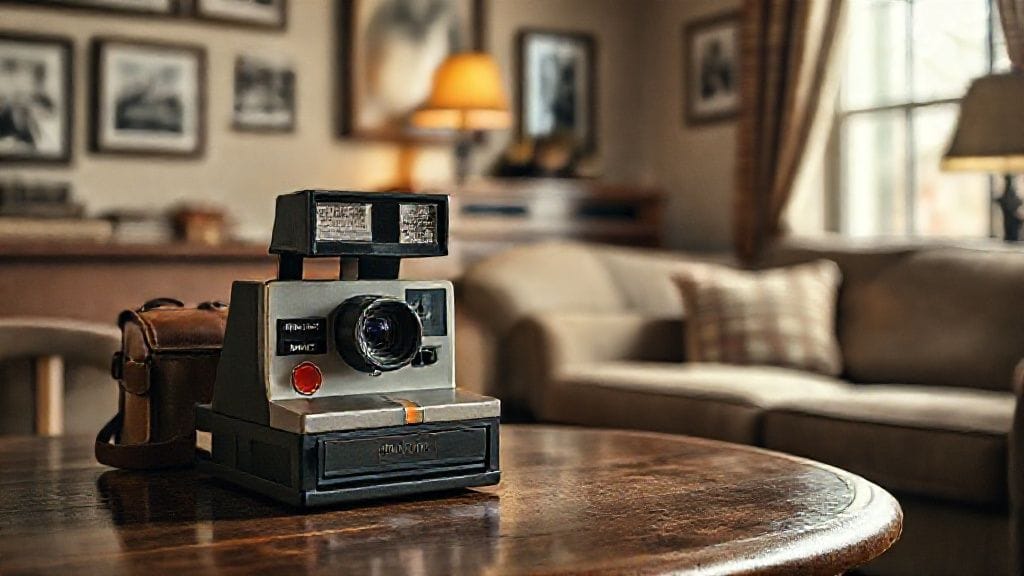
The launch that day was nothing short of historic. Held in New York City, Polaroid unveiled the Model 95—the world’s first instant camera. It completed a workflow faster than any previous camera: point, shoot, eject, watch. The process took just under a minute—astonishing in an era when photographing was otherwise a patient art.
The design of the Model 95 combined portability, simplicity, and elegance. Though bulky by today’s standards, it was a marvel of mid-century engineering—robust, manually operated, and user-friendly. The camera housed an integral film unit, each pack containing sheets preloaded with chemicals necessary to develop an image upon ejection. The resulting prints were monochrome, measuring about 3¼ by 4¼ inches, and tinged with the nostalgic texture that would come to define instant photography.
The public’s initial reactions were a mixture of awe and disbelief. Photographers and laypeople alike found it hard to believe that a photo could emerge fully formed in a matter of seconds. “It’s like magic,” journalists wrote, their words capturing the blend of technological wonder and human fascination. Early adopters praised the camera for its ease of use, while skeptics questioned its fidelity and eventual place among established photographic tools.
Polaroid swiftly harnessed marketing campaigns that emphasized immediacy and the camera’s ability to capture fleeting moments impossible to revisit otherwise. Advertisements portrayed joyful families, happy couples, and creative artists freezing their ephemeral lives in a tangible instant. The slogan was clear: photography had been transformed from a craft to an experience.
But this was just the beginning. The instant camera’s impact radiated far beyond flashes and family portraits. It opened new possibilities for artists like Andy Warhol and Ansel Adams, who experimented with its immediacy and aesthetic. Journalists gained a tool to document real-time events with hitherto unheard-of speed. Social dynamics shifted as candid, spontaneous photography replaced the stiff, posed images of the past.
Internationally, the Polaroid instant camera ignited a shift in photography markets worldwide. Its influence inspired local competitors and accelerated research into instant imaging technologies. At the same time, it nestled charmingly into the Cold War era’s broader technological race, where immediacy and communication speed were not just commercial but ideological battlegrounds.
Technological evolution propelled Polaroid further. Successor models introduced color instant film, reducing the wait for vivid memories and expanding the camera’s cultural footprint. But along with success came challenges: imitators flooded markets, creating legal battles and economic pressures. Polaroid’s story became one of innovation shadowed by competition.
Perhaps most fascinating are the countless human stories the instant camera enabled. From soldiers capturing glimpses of loved ones to families creating heirlooms on the spot, the Polaroid empowered everyday humans to witness and savor their lives in raw, unedited frames. For many, it was a tool for memory and emotion—more than just technology.
That legacy transcends the digital age. Even after the advent of smartphones and instant digital photography, Polaroid maintains a cult following. Enthusiasts continue to celebrate the tactile, unpredictable magic of an analog instant image appearing before their eyes—reminding us that sometimes, the future is best savored at the speed of emotion, not technology.
In the final analysis, the release of the Polaroid instant camera on November 26, 1948, reminds us of the power of curiosity, invention, and the human desire to connect. It proves that a single question from a child, coupled with relentless vision, can change the world—and the way we remember it—forever.
Conclusion
The Polaroid instant camera was not simply a new gadget; it was a gateway to immediacy that forever transformed how humans relate to time, memory, and art. Born from a spark of curiosity and made real by unwavering innovation, it shifted photography from a delayed luxury to a shared experience, accessible and immediate. Its echoes resonate still—in the film’s chemical layers, in cultural icons who wielded it, and in every candid moment frozen in an instant.
Innovation is never purely technical; it is profoundly human. Polaroid captured not just images but a new way of seeing life unfolding, layer by layer, until the light reveals itself. In a world impatient for the next advance, the instant camera reminds us of the enduring magic in pausing, clicking, and watching memories bloom right before our eyes.
FAQs
Q1: What inspired Edwin Land to invent the Polaroid instant camera?
A1: The invention was inspired by a simple question from Land’s young daughter in 1943, who asked why she couldn’t see a picture immediately after it was taken. This sparked Land’s determination to create a camera producing instant images.
Q2: How did the Polaroid instant camera work technically?
A2: It used a multilayer film containing chemicals that developed the photograph as it was ejected from the camera, bypassing the need for external developing processes.
Q3: What was the public’s initial reaction to the Polaroid camera in 1948?
A3: The public responded with awe and fascination, amazed by the instant development, although some skepticism about image quality persisted.
Q4: How did the Polaroid camera influence art and culture?
A4: The camera allowed artists to experiment with immediacy and spontaneity, influencing figures like Andy Warhol and expanding how candid moments were captured socially.
Q5: What challenges did Polaroid face after the camera’s release?
A5: Polaroid encountered competition from imitators producing cheap copies, leading to legal battles and economic struggles, especially with the rise of digital photography.
Q6: Does Polaroid still have relevance today?
A6: Yes, it enjoys a cult following among enthusiasts who value the tactile experience and aesthetic of instant analog photographs, even in the digital era.
Q7: How did the instant camera affect journalism?
A7: It revolutionized journalism by enabling the rapid capture and delivery of images, thus allowing real-time visual reporting and a new immediacy in news coverage.
Q8: Where can I learn more about the history of Polaroid?
A8: The Wikipedia page on the Polaroid instant camera offers a comprehensive overview and detailed references.