Table of Contents
- A Nation on the Brink: Poland in Early 1989
- The Storm Before the Calm: Solidarity and Decades of Resistance
- The Weight of Silence: Communist Poland’s Hidden Fractures
- The Winds of Change: International Pressures and Reformist Winds
- The Secret Conversations: Genesis of the Round Table Talks
- April 5th, 1989: Signing the Polish Round Table Agreement
- Personalities at the Table: Heroes, Pragmatists, and Skeptics
- The Complex Web of Negotiations: Compromises and Convictions
- The Role of the Catholic Church: A Moral Sanctuary and Political Actor
- The Legal and Political Innovations Introduced by the Agreement
- The Media’s Role: From Censorship to New Voices
- Solidarity’s Leap Forward: From Underground Movement to Legal Entity
- The Election of June 1989: The First Crack in the Iron Curtain
- The Fall of Communism in Poland: From Round Table to Roundabout
- Consequences for Eastern Europe: Inspiration and Imitation
- The Legacy of the Round Table: Democracy’s Uneasy Birth
- Human Stories: Courage, Doubt, and the Taste of Freedom
- Poland’s Transformation: Markets, Minds, and Memory
- The Round Table in Historical Perspective: A Model for Peaceful Transition?
- Reflections on Democracy’s Fragility and Resilience
A Nation on the Brink: Poland in Early 1989
Spring in Warsaw was a reluctant breath amidst decades of suffocating tension. The cold, gray skies mirrored the heavy silence enveloping the city’s streets, where invisible but palpable hopes and fears swirled like the first hesitant blossoms of April. For nearly half a century, Poland had been trapped under the iron grip of a communist regime, allied with the Soviet Union yet fiercely determined in its own paradoxes. By the dawn of 1989, the country was a powder keg of economic hardship, social unrest, and political yearning for change. And then, on April 5th, a signature quietly inked on a document in Warsaw would set in motion a sequence that would shatter the Cold War order and illuminate a path towards democracy.
Although it might seem like a simple act, the Polish Round Table Agreement was a masterstroke of political negotiation, courage, and trust forged amidst deep enmity. It was the culmination of months, even years, of daring dialogue between oppressors and the oppressed, between old systems and new dreams. This article unpacks that remarkable moment: the background, the strife, the personalities, and the enduring watershed that rebuilt a nation and inspired a continent.
The Storm Before the Calm: Solidarity and Decades of Resistance
To understand the significance of the Round Table Agreement, one must journey back to the roots of Polish resistance. After World War II, Poland, like many Eastern European nations, fell under Soviet influence. The Communist Party imposed a regime that stifled freedoms, repressed dissent, and attempted to subordinate Poland’s identity under Marxist-Leninist orthodoxy. Yet, Poland was never a compliant subject.
The 1970s and early 1980s were tumultuous decades. Economic mismanagement plunged the nation into waves of strikes and protests. Most notable was the rise of Solidarity (Solidarność), a trade union founded in 1980 at the Gdańsk Shipyard under the charismatic leadership of Lech Wałęsa. What started as a workers' movement swiftly grew into a mass social campaign challenging the very legitimacy of the communist regime. Solidarity’s demand was simple: freedom, human dignity, and political pluralism.
But the regime, shaken by Solidarity’s swelling support, struck back brutally. Martial law was declared in December 1981. Leaders were imprisoned, the union was outlawed, and fear was unleashed to silence opposition. Yet, the spirit of resistance survived underground, a delicate flame burning through years of repression.
The Weight of Silence: Communist Poland’s Hidden Fractures
By the late 1980s, the facade of omnipotence maintained by the Polish United Workers' Party was cracking. Economic crises worsened. Food shortages became routine. The black market thrived as the official economy faltered. Citizens’ discontent morphed from whispered rumors to open frustration.
Behind closed doors, even some Party leaders acknowledged the system's unsustainability. The Soviet Union under Mikhail Gorbachev was undergoing reforms (perestroika and glasnost), sending ripples across the Eastern Bloc. The winds of change were undeniable.
Internally, the Party was divided—between hardliners fearing any reform would unravel their power and reformists who saw negotiating with opposition as a necessary evil to preserve stability. This cleavage set the stage for extraordinary and courageous talks.
The Winds of Change: International Pressures and Reformist Winds
Poland’s strategic position made it a focal point of Cold War dynamics. The Reagan administration’s firm anti-communist stance and economic sanctions put pressure on Moscow’s satellites. Yet after decades of confrontation, a new approach was needed.
Gorbachev’s policies in Moscow signaled openness to “controlled” reform. Importantly, he made it clear the Kremlin would not militarily intervene to prop up failing regimes. This emboldened Polish reformers and opposition alike.
In parallel, the Catholic Church, a moral and spiritual pillar, offered both sanctuary and influence—Pope John Paul II, himself Polish, invigorated national pride and provided a beacon of hope.
The Secret Conversations: Genesis of the Round Table Talks
Beneath the surface, delicate negotiations began in late 1988. Representatives of the regime and Solidarity activists met covertly, testing the waters. Mutual distrust was palpable: how to trust those who had jailed and oppressed? Could compromise mean betrayal?
But pragmatic minds prevailed. The realization dawned that outright confrontation risked chaos or violent crackdown. Dialogue instead might deliver controlled transformation.
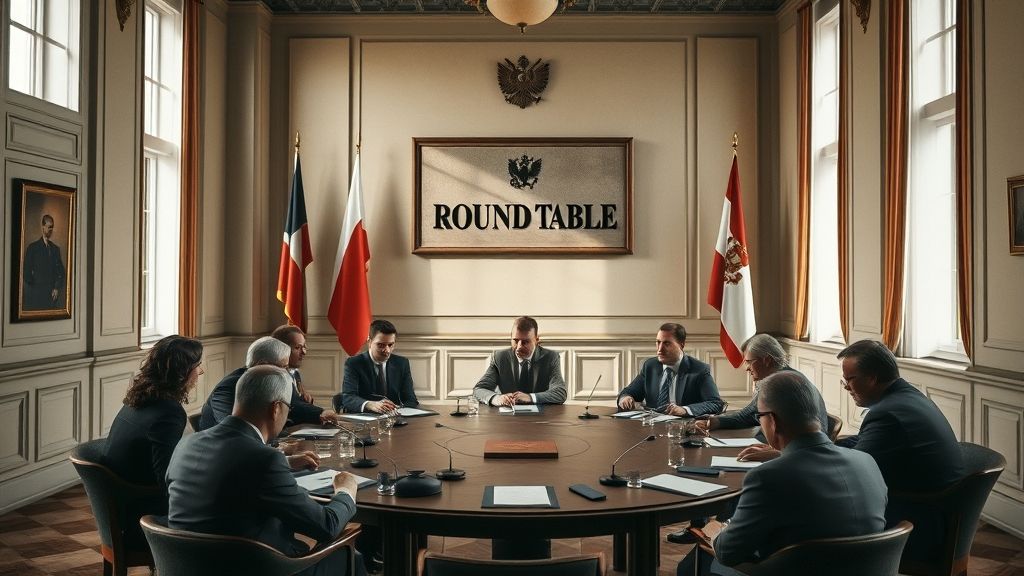
In February 1989, the Polish government officially invited Solidarity to formal “Round Table” talks. For months, these sessions would gather in Warsaw’s government buildings, a historic first, where former enemies spoke face to face.
April 5th, 1989: Signing the Polish Round Table Agreement
The day was unassuming but monumental. On this spring morning, leaders from competing worlds met to sign the document that would reshape Polish destiny.
The Round Table Agreement was not an all-out victory for either side; rather, it was a series of compromises: legalization of Solidarity, creation of a bicameral parliament, semi-free elections, allowance of independent media. The Party would retain a privileged position, but political pluralism was no longer taboo.
The symbolism of the round table itself—no head, no hierarchy—echoed the spirit of equal dialogue and shared responsibility.
Personalities at the Table: Heroes, Pragmatists, and Skeptics
Behind the signatures stood remarkable figures whose courage and pragmatism defined the process.
Lech Wałęsa, the electrician turned leader, embodied hope for millions. A man of humble origins, his humor and tenacity hid deep wisdom.
On the government side, General Czesław Kiszczak, a hardliner turned reformist, risked alienation within his own ranks to broker peace.
Others like Bronisław Geremek, a historian and Solidarity intellectual, exemplified the thoughtful navigation between idealism and realism.
Together, they danced a political ballet fraught with tension, mistrust, but a shared gaze toward Poland’s future.
The Complex Web of Negotiations: Compromises and Convictions
Each article of the agreement was fiercely debated. How much power to relinquish? How to guarantee freedoms without collapsing the state? How to manage the economy’s crisis while transitioning to capitalism?
The talks were marathon sessions of give-and-take, where sometimes personal grievances threatened to derail progress.
Yet, agreement prevailed. It was a victory not because all desires were met, but because peace was prioritized over vengeance.
The Role of the Catholic Church: A Moral Sanctuary and Political Actor
Invisible yet omnipresent, the Church played a silent but vital role.
It was a place of refuge where dissidents found protection. Its leaders mediated between extremes, nudging both sides toward reconciliation.
Pope John Paul II’s visits to Poland infused the public with spiritual courage, encouraging nonviolent resolution.
This sacred undercurrent lent legitimacy and hope to the talks.
The Legal and Political Innovations Introduced by the Agreement
The Round Table Agreement carved new legal paths.
It established the Senate, a new representative chamber, alongside the existing Sejm, a nod to pluralism.
Most importantly, it allowed for partially free elections—35% of seats elected freely, the rest reserved for the communist party and its affiliates, a political “controlled opening.”
Moreover, it decriminalized the opposition, lifted bans on union activities, and set frameworks for an independent press, setting precedents for post-communist governance.
The Media’s Role: From Censorship to New Voices
The agreement cracked the iron censorship that had silenced Poland for decades.
Newsrooms cautiously started publishing uncensored reports. New newspapers appeared; the public taste for independent information blossomed.
For the first time, narratives from Solidarity’s perspective reached millions, emboldening society’s thirst for truth.
Solidarity’s Leap Forward: From Underground Movement to Legal Entity
After eight years in the shadows, Solidarity reentered public life.
The union’s leaders regained their legal status and could openly organize.
New chapters began as Solidarity transformed from a protest movement into a political actor, a transition fraught with new challenges and responsibilities.
The Election of June 1989: The First Crack in the Iron Curtain
The real test came two months later. The partially free elections on June 4, 1989, were historic.
Solidarity won a stunning victory—winning all the freely contested seats in the Sejm and 99 of 100 in the Senate. The regime’s façade began to crumble.
This event rocked the Soviet bloc, demonstrating that peaceful political change was possible.
The Fall of Communism in Poland: From Round Table to Roundabout
The agreement sparked a domino effect.
Within months, the communist monopoly on power disintegrated. Poland established its first non-communist government since World War II, led by Tadeusz Mazowiecki.
This peaceful revolution sent shockwaves that rippled through Eastern Europe, hastening the Cold War’s demise.
Consequences for Eastern Europe: Inspiration and Imitation
Poland’s Round Table became a luminous model.
Czechoslovakia, Hungary, East Germany, Romania saw in this negotiation a roadmap.
While each nation followed its unique path, the principle of dialogue over violence gained new currency.
The Legacy of the Round Table: Democracy’s Uneasy Birth
The birth of democracy was imperfect.
The agreement preserved some privileges for the old elites, and economic hardships persisted.
Yet it laid the foundation for pluralism, respect for rights, and the rule of law.
It was a powerful lesson in transition’s complexity—hope tinged with struggle.
Human Stories: Courage, Doubt, and the Taste of Freedom
History often forgets the individual.
But behind every signature was sacrifice: jailed activists, fearful negotiators, families torn between optimism and caution.
Lech Wałęsa later reflected, “We owed our freedom to neither ideology nor armed struggle, but to dialogue—messy, difficult, but essential.”
Poland’s Transformation: Markets, Minds, and Memory
The years following the Round Table saw Poland’s painful but irreversible transformation.
Markets liberalized, freedoms expanded, new identities forged.
Today, Poland’s robust democracy traces its roots to that April day in 1989.
The Round Table in Historical Perspective: A Model for Peaceful Transition?
In a world often marred by violent revolutions, the Polish Round Table Agreement stands out as a beacon of peaceful change.
It demonstrated that enemies could become partners in nation-building, a lesson echoing well beyond Eastern Europe.
Reflections on Democracy’s Fragility and Resilience
The story reminds us that democracy is never guaranteed but must be continually nurtured.
It demands courage to talk, to listen, and to compromise.
Poland’s journey remains a testimony to hope’s endurance even in the darkest times.
Conclusion
The signing of the Polish Round Table Agreement on April 5th, 1989 was more than a political maneuver; it was a human triumph over fear, division, and dictatorship. It symbolized the possibility of peaceful change, of dialogue transcending distrust, and of hope piercing the iron curtain.
In embracing negotiation over conflict, Poland not only altered its own destiny but also reshaped global history, hastening the collapse of communist regimes in Eastern Europe. The Round Table reminds us that democracy, with all its imperfections, is a fragile but profound inheritance—one requiring dedication, courage, and an unwavering belief in the power of conversation.
For those who sat around that table—former enemies now allies—the future was uncertain but filled with promise. Their legacy endures, not only in Polish streets and institutions but in the quiet reaffirmation that freedom often begins with the courage to come together and speak.
FAQs
Q1: What led to the Polish Round Table Agreement?
Decades of communist repression, economic crisis, and civil resistance led by Solidarity created untenable pressure on Poland’s government. The reformist winds blowing from Moscow and international dynamics pushed parties to negotiate.
Q2: Who were the main participants at the Round Table?
Key players included Lech Wałęsa and Bronisław Geremek for Solidarity, General Czesław Kiszczak for the communist government, and influential actors from the Catholic Church and intellectual circles.
Q3: Why was the Round Table Agreement significant for the Cold War?
It was the first instance where a Soviet-backed regime negotiated a peaceful political transition, inspiring similar movements that contributed to the Cold War’s end.
Q4: How did the Agreement affect Polish elections?
It allowed partially free elections in June 1989, which resulted in overwhelming victories for Solidarity and triggered the decline of communist rule.
Q5: What role did the Catholic Church play?
The Church provided moral support, mediation, and sanctuary to dissidents, playing a subtle but pivotal role in facilitating dialogue.
Q6: Were there any immediate economic changes after the Agreement?
While political reforms began swiftly, economic transformations were gradual and often painful, involving austerity, market liberalization, and structural reforms.
Q7: Did the Round Table Agreement end communism overnight in Poland?
No, it was a negotiated, gradual transition. The communist party retained significant power initially but lost its monopoly over time.
Q8: How is the Round Table remembered today in Poland?
It is celebrated as a foundational moment of modern Polish democracy, symbolizing courage, dialogue, and hope amid oppression.