Table of Contents
- A Troubled Papacy on the Eve of Upheaval
- The Tusculan Dynasty and the Making of a Boy Pope
- Moral Scandals, Street Rumors, and a City on Edge
- The Roman Nobility Turns: Seeds of Rebellion in the Papal States
- Autumn 1044: Conspiracy in the Shadows of the Seven Hills
- The Uprising Erupts: How Pope Benedict IX Was Expelled from Rome
- Sylvester III: An Anti-Pope in a Divided City
- Exile and Countermoves: Benedict IX Strikes Back
- The German Connection: Emperor Henry III and the Crisis of the Papacy
- Simony, Sin, and the Sale of the Papal Throne
- The Roman People: Between Devotion and Desperation
- Historians, Chronicles, and the Making of a Villain
- Long Shadows: Reform, the Investiture Controversy, and Institutional Memory
- Legacy of Disorder: What Benedict IX’s Expulsions Reveal About Power
- Reconstructing 1044: How We Know What We Think We Know
- Conclusion
- FAQs
- External Resource
- Internal Link
Article Summary: This article traces the dramatic moment when pope benedict ix expelled from rome in 1044 became both a symptom and a catalyst of deep crisis in the medieval papacy. It begins with the rise of a boy pope molded by the ambitions of the Tusculan aristocracy, then follows the spiral of scandals, rumors, and political rivalries that set Rome ablaze. We explore how Benedict’s personal reputation, however exaggerated, fused with structural tensions in the Papal States to provoke revolt and his ouster from the city. The narrative shows that pope benedict ix expelled from rome was not a single episode, but part of a brutal cycle of expulsions, restorations, and rival claimants to the throne of St. Peter. By following nobles, emperors, reformers, and ordinary Romans, the article reveals how this turmoil prepared the ground for sweeping Church reforms later in the century. Throughout, we examine how 1044 looked to contemporaries and to later historians who shaped the legend of Benedict IX. Ultimately, the story of pope benedict ix expelled from rome uncovers a world where spiritual ideals and raw power clashed in the streets and squares of medieval Rome.
A Troubled Papacy on the Eve of Upheaval
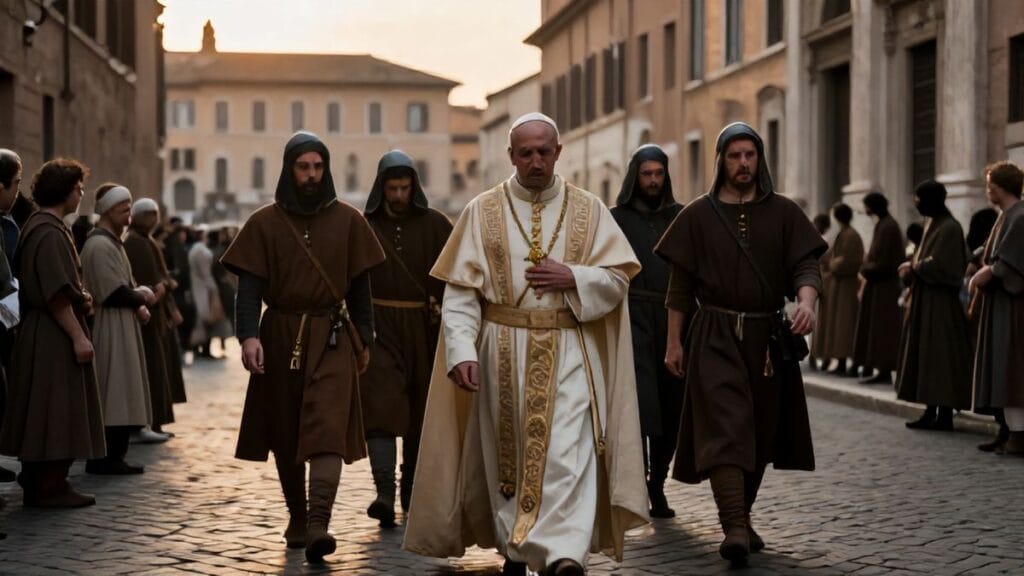
The year 1044 opened over Rome with an air of febrile tension. The stones of the ancient city, still bearing the scars of the Empire, now echoed to the rival chants of processions and armed men. At the center of this storm stood an unlikely figure: a young pope whose name would become synonymous with scandal, intrigue, and the very fragility of the medieval papacy. It was in this charged atmosphere that we find pope benedict ix expelled from rome, hounded from the city that had crowned him, and denounced by many who once knelt before his throne.
This was no simple change of ruler, no ordinary transfer of power cloaked in ritual. The expulsion of Benedict IX in 1044 was a rupture — a visible tearing of the veil between sacred ideal and political reality. For centuries, the bishop of Rome had grown in stature, from a local bishop overseeing the faithful of the Tiber to a figure claiming primacy over the Western Church. But the pope who now sat — and would soon be chased from — the Lateran Palace embodied the dangerous entanglement of spiritual authority with mercenary family ambition.
When we say that pope benedict ix expelled from rome in 1044, we are also saying that the Roman populace, weary of decades of noble rivalries and clerical corruption, rose up against the man who symbolized a broken system. It is astonishing, isn’t it, that in an age in which popes would later preside over vast Christendom, one of their number could be driven from his own city by the clamor of his supposed flock? Yet behind the noise of revolt stood years of preparation: whispered complaints in cloisters, bitter feuds among counts and barons, and murmurs in markets where pilgrims and citizens met to swap news.
The drama of Benedict IX’s fall cannot be understood as a mere moral tale, though medieval chroniclers would later relish describing his sins. It was also a social and political catastrophe, an eruption of pent-up anger in a city where secular lords had for generations treated the papacy as a family possession, a prize to be seized and traded in an endless game of dominance. Rome in the early eleventh century was a city of fortified towers, private militias, and tightly clustered wards where loyalty to a clan could mean more than fidelity to the Church.
Into this landscape came Benedict, of noble birth yet spiritually suspect in the eyes of his critics, an adolescent pope who grew into a byword for corruption. The moment when pope benedict ix expelled from rome was not only the punishment of an individual; it was the symptom of a wider disease infecting Christ’s Church and the civic body of Rome. This article follows that story in all its tangled detail: the patterns of patronage, the ambitions of German emperors, the rising calls for reform, and the very human desperation of a populace watching the sacred offices of their city become a stage for power struggles.
But this was only the beginning. To understand how the events of 1044 unfolded, we must first look backwards, into the families and factions that forged Benedict IX — and then turned against him.
The Tusculan Dynasty and the Making of a Boy Pope
The story of Benedict IX begins not in the cloisters of pious monasticism but in the stone halls and fortified towers of the Roman countryside. The Tusculan family, one of the mightiest aristocratic clans of the region, had long cast their shadow over the papacy. From their stronghold at Tusculum, southeast of Rome, they had learned that the key to dominance in central Italy lay not only in land and armies, but in the spiritual offices that commanded both fear and reverence.
By the time Benedetto, later Benedict IX, was born—likely in the early 1010s—his relatives already had a strong track record in papal politics. His uncle had reigned as Pope Benedict VIII; another relative had become Pope John XIX. With each election, the Tusculans tightened their grip on the machinery of the Church, seeing in it both prestige and profit. The Papal States were not merely a nebulous idea of spiritual territory; they generated real revenue, from tolls and rents to tributes and donations flowing to Rome from across Christendom.
Young Benedetto was a scion of this system. Sources describe him as the son of Alberic III, Count of Tusculum, a man steeped in the brutal horse-trading of Roman politics. For Alberic, placing his son on the papal throne was not an act of religious devotion but of dynastic ambition. When Pope John XIX died in 1032, the path was open. In a city where rival families like the Crescentii and various urban barons jostled for influence, speed and gold could decide who wore the Papal tiara.
And so it was. Contemporary accounts suggest that the Tusculans used their wealth and influence to secure Benedetto’s election, perhaps as young as twelve or fourteen years old. Whether he was an adolescent or slightly older, the idea that such a youth would become Bishop of Rome by the will of entrenched noble clans shocked even some of his contemporaries. Yet the machinery that made him pope would also one day conspire to see pope benedict ix expelled from rome.
With his election, the Papal States remained tethered to Tusculan interests. The noble houses, deeply enmeshed in the governance of Rome, expected favors: lucrative church offices, confirmation of lands, leniency in disputes. The papal court, such as it was, became the extension of a family enterprise. One must imagine a teenage Benedict learning quickly that survival meant aligning himself with the expectations of his kin, even as he held an office that in theory made him shepherd of all Christians.
Yet this arrangement contained seeds of instability. A papacy so openly bound to a single clan provoked resentment, especially among rival aristocrats who felt excluded from the feast. Spiritual reformers, scattered in monasteries from Cluny in Burgundy to smaller houses in Italy and Germany, saw in Benedict’s rise a scandalous symbol of simony and nepotism. And in the streets of Rome, where citizens bore the consequences of every feud and skirmish, the growing arrogance of the ruling families stirred quiet anger.
In that tension, Benedict IX grew to manhood. Whatever his personal character—historians debate how much to trust the lurid accusations—it is clear that he came to embody the worst fears of critics: a pope imposed by force, linked to violent nobles, and seemingly indifferent to calls for reform. When the moment came in 1044 for the city to rise, it would not simply be one man’s enemies who acted, but a broad coalition tired of Tusculan dominance.
Moral Scandals, Street Rumors, and a City on Edge
The legend of Benedict IX is steeped in accusations that would make even hardened medieval chroniclers pause. St. Peter Damian, the fiery reformer and later cardinal, would describe him in lurid terms, accusing him of “rapes… murders… and other unspeakable acts,” painting a portrait of a man who had turned the papal palace into, as he wrote, a “stable of vice.” Another prominent source, the Liber Pontificalis, hints at a reign marked by moral laxity and open corruption. These accusations shaped the memory of Benedict IX, but they also reveal the charged environment of his time.
In the cramped streets and crowded markets of Rome, rumors traveled quickly. Pilgrims arriving at St. Peter’s might hear traders mutter about the young pope’s indulgences, while clergy whispered in the sacristies about promotions purchased for gold. To a population used to severe public preaching on sin, the idea that the pope himself flouted the very laws he was meant to uphold was deeply unsettling. Yet behind the moral outrage lay something more: a sense that the office of the papacy itself had been degraded into a plaything of the mighty.
Was Benedict truly as monstrous as later accounts insist? Modern historians such as I. S. Robinson and others warn that much of the rhetoric surrounding him is colored by the triumph of the later reform movement. To the reformers of the later eleventh century, painting Benedict IX in the darkest possible colors helped justify their own dramatic break with the old order. Still, even if we strip away exaggeration, the pattern remains: a pope whose private life and public policies gave ammunition to his enemies and left the Roman Church vulnerable to attack.
Imagine how this must have felt on the ground. A priest in a small church near the Tiber hears that a local noble, notorious for extortion, has been granted a church benefice through Benedict’s favor. A widow, hoping for justice in a dispute with a landholder, finds that papal justice is for sale to the highest bidder. The city’s poor, who rely on alms and charity distributed in the name of the Church, see funds diverted to the entourages of powerful families. Each small injustice, each hint of scandal, chipped away at the sacred aura of Rome’s bishop.
In such an atmosphere, the phrase pope benedict ix expelled from rome would have seemed, to some, less an act of rebellion than of purification. Reform-minded clerics, though not yet organized as the mighty Gregorian movement they would later become, grumbled about the need to cleanse the Church of simony and incontinence. Secular nobles, envious of Tusculan privilege, found in Benedict’s reputation a potent weapon to mobilize support against him. And ordinary Romans, whose lives bore the impact of every political upheaval, began to see in their young pope not a spiritual father but yet another dissolute aristocrat.
Yet behind the celebrations that some would later stage for his downfall, there was another reality: Benedict IX’s household and supporters, many of them sincerely loyal or financially tied to his fortunes, viewed him not as a monster but as a rightful pope embattled by his enemies. Some would follow him even after his expulsion, clinging to the belief that the storm would pass and their patron would return. In this divided city, moral judgment and political allegiance had become almost impossible to separate.
The Roman Nobility Turns: Seeds of Rebellion in the Papal States
To understand why 1044 exploded into open revolt, one must look closely at the mosaic of power in Rome and the Papal States. The Tusculans did not rule alone. Across the hills and within the city walls, other families maintained their own fortresses, retainers, and ambitions. Each clan sought influence over the Curia, over lucrative ecclesiastical posts, and over the flow of pilgrims and revenues that made Rome a spiritual and economic hub.
Throughout the early eleventh century, rival families—particularly the Crescentii and others less well documented—had intermittently controlled the papacy or significant offices within the Church. Their exclusion during the ascendancy of the Tusculan popes had left them bitter. For them, pope benedict ix expelled from rome would be more than a political coup; it was a chance to reset the balance of power. Support for Benedict crumbled not simply because of his personal character, but because too many stakeholders had been shut out of the papal patronage system.
The Papal States themselves were a patchwork of territories, cities, and rural lands, nominally under papal suzerainty but in practice governed through local elites and bishops. In such a system, discontent could fester whenever Rome seemed distant, corrupt, or partial to a single faction. Violence was a routine instrument of negotiation. A disputed election in a town might lead to armed skirmishes; a contested bishopric could devolve into siege and counter-siege. Rome, as the capital of this volatile arrangement, was perpetually at risk.
Against this backdrop, Benedict IX faced growing resistance. Some cardinals and senior clergy began to hedge their bets, cautiously cultivating ties with rival nobles who hinted at supporting a different pope. These men, steeped in canon law and ecclesiastical precedent, knew that appealing to the moral unfitness of a pontiff could garner sympathy from reformers and from foreign powers, particularly the German court. By painting Benedict’s misrule as not just unfortunate but spiritually intolerable, they framed rebellion as a kind of defense of the Church.
Ordinary Romans, meanwhile, experienced the nobles’ competition as a series of small but brutal shocks: increased taxation to fund private militias, sudden violence in the streets when factions clashed, and the ever-present fear that disputes in the Curia would spill out into riots. When fragments of news reached them—that Benedict had favored one noble house over another, or that he had ignored calls for justice in a high-profile dispute—they filtered these facts through the lens of personal experience. For many, the equation was simple: the pope’s court had become a battleground, and the city paid the price.
This climate made the notion of action thinkable. In darkened chambers, away from the frescos and incense of liturgical life, men began to plan. The question was not whether the Tusculan pope should be challenged, but how and when. The year 1044 would provide the answer.
Autumn 1044: Conspiracy in the Shadows of the Seven Hills
The exact chronology of the plot against Benedict IX is fragmentary, made up of hints in later chronicles and scattered references in contemporary letters. Yet we can piece together a plausible sequence. By the autumn of 1044, opponents of the Tusculan regime had reached a critical mass. Their grievances ranged from Benedict’s reputed scandalous behavior to deep structural resentment at his family’s control of the papacy.
Meetings likely took place in the fortified houses of rival nobles within Rome’s walls. There, under dim torchlight and among racks of spears and swords, barons sworn to different banners found common cause. Some wanted to elevate one of their own as a rival pope; others simply wanted Benedict gone, imagining that his fall would open doors for negotiation with the Germans or with reform-minded clergy. What united them was the belief that Benedict could be overthrown and that the population of Rome—long restive—might be persuaded, or compelled, to support rebellion.
Churchmen were part of the conspiracy as well. A reform-minded faction within the clergy had grown increasingly alarmed at the state of the papacy. They saw in Benedict a living rebuke to their vision of a chaste, disciplined, and independent Church. For them, the narrative of pope benedict ix expelled from rome would serve as a cautionary tale, a turning point that proved God Himself had judged the corrupt. Whether they initiated the plot or merely blessed it after the fact, their support offered moral cover to a starkly political act.
And in the streets, something subtler was happening: the slow drift of public opinion. Rome’s people did not hold elections, but they could riot. They could refuse to support the pope’s men in a crisis, block access to key bridges and markets, and turn what might have been a small feud into a full-fledged uprising. The conspirators understood this, whispering their case against Benedict in taverns, patronizing certain neighborhoods, quietly arming loyalists.
By late 1044, the city was a tinderbox. Every procession, every public appearance of the pope, risked becoming a flashpoint. The Tusculans must have sensed this; their own retainers would have reported sullen faces and tight-lipped resistance among the people. Yet power has its own inertia. Once accustomed to winning every contest through force and wealth, the family and their pope may have believed they could simply weather the discontent—or crush it, as they had before.
They were wrong. The breaking point was near, and when it came, it would be sudden, violent, and decisive.
The Uprising Erupts: How Pope Benedict IX Was Expelled from Rome
In late 1044, the smoldering discontent within Rome burst into open flame. The chronicles are brief, but the outlines of the drama are clear enough. A coalition of nobles and their followers, supported by segments of the clergy, moved against Benedict IX. Whether it began with an armed assault on the Lateran Palace or with coordinated street fighting across multiple quarters, the end result was the same: the pope could no longer hold his city.
Picture the scene near the Lateran, the heart of papal authority. The basilica of St. John, site of papal enthronements, towered over the surrounding district. Around it clustered administrative buildings, residences of clergy, and the fortified dwellings of Tusculan allies. One morning—perhaps under a gray November sky—shouts rose, and the clatter of weapons echoed off the stone. Opponents of the Tusculans advanced, seizing intersections, blocking routes from the papal residence, and hemming in Benedict’s loyalists.
As fighting intensified, key allies of Benedict either fell back or defected. Nobles who had long coveted Tusculan lands and offices realized that history was moving against the young pope. They chose to save themselves, or to switch sides, rather than be dragged down with him. Servants and minor officials, sensing danger, abandoned their posts. The papal household, once so confident, now found itself isolated.
In this moment of crisis, Benedict IX faced a choice: resist to the end, turning the holy precincts into a battlefield, or flee and hope to regain power later. He chose flight. Under cover of chaos—perhaps through lesser-known passageways, perhaps in disguise—he escaped the city, heading into the countryside where Tusculan power remained stronger. Thus, in a swirl of smoke, dust, and shouted curses, pope benedict ix expelled from rome became a reality.
The symbolism was powerful. The Bishop of Rome, vicar of Christ, driven out of his own see by armed opposition and popular unrest—it was an image that would linger in the memory of friend and foe alike. For Benedict’s enemies, it was proof that God had not protected an unworthy shepherd. For his supporters, it was a bitter humiliation, a sign that spiritual authority, when stripped of worldly power, could suddenly seem fragile.
In the streets left behind, the balance of fear shifted. Men who had cowered under Tusculan dominance now shouted openly against Benedict, burning his effigy or defacing symbols of his authority. Clergy who had long muttered in private now spoke with startling boldness, condemning his sins from the pulpit. Even those who had been uncertain took the fact of his expulsion as a sign: the old order had cracked, and something else—though no one yet knew what—was taking shape.
But as so often in history, the fall of one figure did not instantly bring clarity. Benedict’s departure created a vacuum, and in Rome, vacuums are quickly filled. No sooner had pope benedict ix expelled from rome vanished into exile than his enemies prepared to install a rival on the throne of St. Peter.
Sylvester III: An Anti-Pope in a Divided City
With Benedict IX gone, the victors in Rome faced a delicate task. It was not enough to have expelled an unpopular pope; they needed to legitimize a new regime. The solution they chose was audacious: they would elect another man as pope, despite Benedict’s continued claim to the office. Thus emerged Sylvester III, a figure whose short reign symbolizes the constitutional chaos of the time.
John, bishop of Sabina—one of the hill towns near Rome—was their candidate. He represented a different faction of the Roman aristocracy, likely tied to the Crescenzi or similar families. His supporters convened a gathering, presented him as a moral and political alternative to Benedict, and had him acclaimed as pope, taking the name Sylvester III. In the minds of the rebels, this was no mere anti-pope but the rightful successor, chosen after God had manifestly abandoned the corrupt Benedict.
The ceremony of enthronement, likely held at the Lateran, must have been charged with both triumph and unease. As Sylvester donned the papal vestments, everyone present would have known that Benedict still lived, still claimed the office, and still had powerful relatives. The city, though nominally under the control of the anti-Benedict faction, remained divided. Some neighborhoods and churches accepted Sylvester’s authority; others stayed sullenly loyal to the exiled pope or simply tried to keep their heads down.
From a canonical perspective, the situation was murky. Traditional law emphasized the permanence of papal office until death or legitimate resignation. Could a pope be deposed and replaced simply because his city had rejected him? The answer, in 1044, was not yet clearly codified. Reformers would later argue that a manifestly unworthy pontiff could and should be removed; Benedict’s supporters would insist that any rival was, by definition, an intruder and a usurper.
As Sylvester III attempted to govern, issuing decisions and asserting control over the Papal States, events outside the city fermented. Benedict, in exile, was far from finished. In the countryside and in allied strongholds, support for him remained strong. For loyalists, the phrase pope benedict ix expelled from rome was a temporary embarrassment, a setback that could be reversed with the right combination of force, alliances, and perhaps imperial intervention.
Sylvester’s position, therefore, was precarious from the start. His name would later be recorded as that of an anti-pope rather than a legitimate successor, a sign of the eventual triumph of Benedict’s partisans in the memory wars that followed. But in the days immediately following 1044, nothing was settled. Rome was still, in effect, two cities: one in which Sylvester reigned from the Lateran, and another that looked anxiously beyond the walls, wondering when the exiled Tusculan pope would try to return.
Exile and Countermoves: Benedict IX Strikes Back
Benedict IX’s flight from Rome did not mark the end of his political life; in many ways, it marked the beginning of its most desperate and audacious phase. Safely outside the city, in territories where Tusculan and allied noble forces still held sway, the exiled pope began to plan his comeback. The pattern is familiar from other medieval power struggles: the defeated ruler seeks allies, consolidates remaining resources, and waits for the opportune moment to reassert his claim.
Accounts suggest that Benedict sought aid among his kin and in the broader aristocracy of central Italy. Even those who may have disapproved of his private conduct had a vested interest in resisting the idea that nobles could simply depose a pope. Today we might say they worried about “precedent”: if Benedict’s expulsion was allowed to stand, what would stop future coalitions from doing the same to any pope who displeased them? Aristocratic logic, as much as loyalty, pushed some to back the exiled pontiff.
Meanwhile, Benedict’s envoys likely crisscrossed the region, carrying messages to bishops, abbots, and lay rulers. Some were warned of the dangers of recognizing Sylvester III, reminded that such support might one day be judged schismatic or heretical if Benedict prevailed. Others were promised favors and benefices should they help restore him. In an era when the lines between spiritual and secular authority were porous, these negotiations were both diplomatic and mercantile.
Rome, meanwhile, could not seal itself off from these maneuvers. News of Benedict’s efforts filtered back into the city in fragments: a noble had pledged support here, a rumor spread that German envoys were watching the situation, a report reached a monastery that Benedict was gathering troops. For those who had helped drive pope benedict ix expelled from rome, these whispers were alarming. For his remaining sympathizers in the city, they were a source of hope.
At some point—within a year or so of his expulsion—Benedict did in fact retake control of Rome, at least temporarily. Sylvester III, the anti-pope, was driven out or reduced to a marginal figure. Benedict’s return, accomplished by a blend of force and negotiation, underscores how fragile the victory of 1044 had been. The exiled pope rode back into the city he had fled, a deeply compromised yet still potent symbol of Tusculan resilience.
Yet the triumph was hollow. The act of having expelled him could not be undone; memory of that public humiliation lingered. His enemies had tasted the possibility of a different pope, and the wider Church had been forced to reckon with the idea that the Roman See could be contested. Even as Benedict resumed office, the seeds of further conflict were sprouting—seeds that would soon entangle him in an even stranger transaction: the sale of the papacy itself.
The German Connection: Emperor Henry III and the Crisis of the Papacy
While Rome tore itself apart, another power watched from the north: the German monarchy, soon to be embodied in Emperor Henry III. For decades, German rulers had seen themselves as protectors of the Church and, in practical terms, as kingmakers in papal politics. When Italian factions plunged the papacy into chaos, German intervention often followed, framed as a rescue mission for Christendom but also an assertion of imperial authority.
Henry III came to the throne at a moment when the disorder in Rome resonated with his own concerns about reform and consolidation. The spectacle of pope benedict ix expelled from rome, replaced by Sylvester III, then restored, only to be drawn into further scandals, offered Henry and his advisors a powerful argument: the Roman aristocracy, left to its own devices, could not be trusted with the selection of popes. Their feuds, greed, and violence were corrupting the very institution that should guide Christendom.
German bishops, many of them shaped by the monastic reform currents that flowed from places like Gorze and Cluny, reinforced this view. They saw in Benedict’s reign a culminating example of everything they opposed: simony, lay control over ecclesiastical offices, and the degradation of celibate ideals. To them, centralizing papal elections under stronger imperial influence seemed not a power-grab but a necessary step to restore holiness.
Henry’s subsequent involvement in papal politics—most famously at the Synod of Sutri in 1046, where multiple claimants were deposed and a new pope, Clement II, was installed—cannot be separated from the earlier crisis. The fact that Rome had seen pope benedict ix expelled from rome, a rival elected, and then Benedict restored, demonstrated conclusively that the papacy was in thrall to local noble interests. German intervention would be justified as the only way to break this vicious cycle.
Of course, from another perspective, imperial involvement posed its own dangers. Later reformers, notably those of the Gregorian era, would struggle to disentangle the Church from lay control, including that of the very emperors who had once been hailed as saviors. Yet in the mid-eleventh century, in the immediate aftermath of Benedict IX’s tumultuous reign, many reform-minded clerics were willing to accept imperial help as the lesser of two evils.
In a sense, then, the events of 1044 did not only reorder the political relationships within Rome; they also recalibrated the axis between Rome and the Empire. The image of a disgraced pope fleeing his own city, of nobles enthroning alternatives on the Lateran, and of papal authority reduced to a chip in local bargaining strengthened the case for an emperor who would claim the right, even the duty, to intervene. History would show how fraught that bargain would become.
Simony, Sin, and the Sale of the Papal Throne
Among all the shocking episodes associated with Benedict IX, none has captured the imagination of historians and moralists more than the alleged sale of the papacy. After regaining control of Rome, Benedict found himself again embattled, disliked by reformers and entangled in Tusculan and anti-Tusculan rivalries. According to several chroniclers, he reached a decision almost unimaginable in later centuries: he would resign and transfer the papacy to another man in exchange for money.
The buyer, so to speak, was his godfather, the respected priest John Gratian. Deeply troubled by the chaos surrounding Benedict’s pontificate, John Gratian may have believed that purchasing the papacy was, paradoxically, an act of piety—buying out a scandalous reign to replace it with a more devout one. Taking the name Gregory VI, he stepped into an office indelibly tainted by the transaction that had brought him there.
From a doctrinal standpoint, this was simony in the starkest sense: the buying and selling of spiritual office, condemned by Scripture and Church councils alike. Contemporaries reacted with outrage and confusion. Could a pope sell his office like a piece of property? Could a buyer, however well-intentioned, claim legitimacy over a see obtained by such means? Reformers, even those sympathetic to John Gratian’s personal virtue, struggled with the implications.
In this bizarre twist, the earlier memory of pope benedict ix expelled from rome took on new meaning. Some began to argue that his deposition had been a providential warning ignored, an opportunity to cleanse the papacy that had been squandered when he was allowed to return and then profit from his resignation. To their eyes, the sale of the papacy was the natural culmination of a system corrupted from top to bottom by aristocratic greed.
The scandal would fuel later reform rhetoric for decades. It became a stock example of why the Church needed to free itself from lay interference and from the commodification of spiritual goods. Yet we should not overlook the tragic dimension: individuals like John Gratian may have entered into this arrangement believing they were rescuing the Church, not further damning it in the eyes of posterity. In their constrained world of options, buying the papacy from Benedict might have seemed like the only way to oust him without more bloodshed.
Ultimately, however, the sale only deepened the crisis. At the Synod of Sutri in 1046, Henry III would preside over the deposition of Benedict IX, Sylvester III, and Gregory VI, sweeping all rival claims from the board in order to install Clement II. The papacy had reached such a state of disrepute that an emperor could justify stripping it bare and starting again. The extraordinary sight of multiple popes and anti-popes being judged and removed in one synod traced its origins back to the first break in Benedict’s reign: the day when Rome drove him from its streets.
The Roman People: Between Devotion and Desperation
Amid the high drama of popes, emperors, and mighty families, it is easy to overlook the people whose lives formed the backdrop of every event: the citizens of Rome. They were butchers and bakers, craftsmen and laborers, widows and pilgrims, clerks and minor clerics. Their names rarely appear in the chronicles, yet their actions—riots, shouts of acclamation, sullen refusals to obey—shaped the course of history as surely as any edict.
For the ordinary Roman, the papacy was not an abstract theological concept but a tangible presence. The pope’s processions passed through their streets; his officials collected rents; his decisions touched disputes over land, marriage, and inheritance. When the Church offered charity, it was a lifeline. When ecclesiastical offices were sold to the highest bidder, the poor suffered the most. They saw directly how noble manipulation of the papacy translated into higher exactions, more frequent street violence, and fewer resources for the needy.
It was in this context that the narrative of pope benedict ix expelled from rome resonated on a human level. Some rejoiced openly at his fall, convinced that God had judged a corrupt shepherd. Others, wary of any change that might unleash new violence, viewed events with fear. For many, allegiance shifted less on theological grounds than on immediate concerns: Which faction would keep the peace? Which would protect their neighborhood from looting? Which would allow tradespeople to continue their work without extortion?
The people of Rome were not passive pawns, however. Their presence in public ceremonies could legitimize or undermine a ruler. When a pope was enthroned, the response of the crowd mattered. Acclamation was a vital part of medieval political theater; a silent or hostile crowd sent a powerful message. Likewise, uprisings—whether carefully planned or spontaneously triggered—were impossible without some degree of popular participation or at least acquiescence.
We must imagine the faces in that 1044 crowd: a woman clutching her child as men shout against the pope; a young apprentice, exhilarated by the sense of overturning a hated order; a cleric caught between obedience to his superiors and sympathy for the rebels; an old man remembering earlier uprisings against other popes. For them, the expulsion of Benedict IX was not a line in a chronicle but a day of smoke, dust, and fear, whose aftermath would determine whether they had bread tomorrow and whether their parish priest would remain or be replaced.
Their emotions were mixed: devotion to the Church, though often sincere and deep, coexisted with exasperation at its leaders. This dissonance—loving the institution, fearing or despising its rulers—would become a familiar theme in later centuries, from the Reformation to modern controversies. In 1044, it was already present in every whispered prayer and every shout in the streets, as the people watched the man who claimed to be their spiritual father run for his life.
Historians, Chronicles, and the Making of a Villain
Our knowledge of Benedict IX is filtered through the pens of those who, in many cases, loathed him or the system that produced him. Chief among these voices is Peter Damian, whose fiery rhetoric turned Benedict’s life into a dark parable of corruption. In his Book of Gomorrah, Peter condemned clerical immorality and, in that broader context, painted Benedict as almost a caricature of vice: a man so depraved that his very continued presence in the papal office seemed an affront to heaven.
Other sources include the Liber Pontificalis, extended by anonymous compilers, and later chroniclers from Germany and Italy who, writing under the shadow of the reform papacy, embraced a narrative in which Benedict IX represented the nadir of the “old” corrupt order. They were not unbiased observers. To justify sweeping reforms, including greater papal independence and the curbing of lay influence, reformers needed examples of how bad things had once been. Benedict’s expulsions, scandals, and the sale of the papacy offered ready material.
Modern historians, sifting through these sources, face a dilemma. On one hand, the sheer volume and intensity of negative testimony suggest that there was indeed something deeply wrong with Benedict’s pontificate. On the other, the rhetorical demands of reform propaganda likely exaggerated and simplified. As historian H. E. J. Cowdrey and others have argued, we must distinguish between the real abuses of the eleventh-century Church and the polemical constructions built around them. The image of pope benedict ix expelled from rome as divine justice enacted in history belongs more to theology than to cold analysis.
Yet even if we strip away the hyperbole, important truths remain. Benedict’s election as a very young man through noble influence, the evident pattern of simony in his reign, the armed factionalism surrounding his papacy, and the undeniable fact of his periodic expulsions and restorations—these are well attested. Behind the villain of legend stands a historical pope whose tenure encapsulated the dangerous fusion of family ambition and spiritual office.
Historiography, in this case, is not merely about apportioning blame. It raises broader questions: How does an institution remember its own failures? How are certain figures turned into symbols of an era’s sins, while others, perhaps equally culpable, are allowed to fade into obscurity? The story of Benedict IX demonstrates how a church struggling to reform itself can project its anxieties and hopes onto the past, casting some as demons and others as saints in a drama that is as much about the present as about history.
Thus, when we read of pope benedict ix expelled from rome in searing detail, we should hear two voices at once: the cry of contemporaries who genuinely suffered under a broken system, and the editorial pen of later reformers choosing, shaping, and amplifying certain episodes for their own age’s purposes.
Long Shadows: Reform, the Investiture Controversy, and Institutional Memory
The tumult surrounding Benedict IX did not end with his final removal from office. Its echoes reverberated through the remainder of the eleventh century, influencing both the development of Church reform and the shape of the great conflict known as the Investiture Controversy. The memory of a pope who could be expelled from his city, restored, sell his office, and still command some allegiance haunted reformers seeking to build a more stable ecclesiastical order.
As the so-called Gregorian Reform gathered pace under Pope Gregory VII and his successors, several core principles emerged: the insistence on clerical celibacy, the fierce condemnation of simony, and the determination to free the Church from the control of lay rulers. All of these priorities were, in some way, responses to the world that had produced Benedict IX. The narrative of pope benedict ix expelled from rome, sold his office, and was entangled in noble feuds became a cautionary tale used to justify radical restructuring of Church governance.
When Gregory VII clashed with Emperor Henry IV over who held the right to invest bishops with ring and staff, the stakes were framed in part by the chaos of the preceding decades. Reformers argued that lay control over ecclesiastical offices—exactly the system that had allowed Roman nobles to install a boy pope like Benedict—inevitably led to corruption and scandal. Only by ensuring that the Church chose its own leaders, free from secular interference, could future Benedicts be avoided.
Institutional memory is selective, of course. The Church did not dwell on the sincere piety that may have existed even within Benedict’s circle, nor on the complexities of figures like John Gratian, who purchased the papacy with reformist intentions. Instead, it remembered—and taught—the stark contrast between the “bad old days” of Tusculan domination and the new era of disciplined, morally rigorous popes who stood up even to emperors.
Yet the paradox is striking: the very crisis that allowed emperors like Henry III to step in and “save” the papacy also galvanized a movement determined to cast off imperial influence. The long shadow of 1044 thus fell on both sides of the investiture dispute. Imperial advisors could point to Benedict IX as proof that Rome needed imperial oversight; papal reformers could point to the same example as proof that the Church must be independent of all lay powers, including kings and emperors.
In this way, a specific moment—pope benedict ix expelled from rome amid clashing nobles—became part of a shared repertoire of examples, invoked by rival parties to argue for opposing solutions. History, once again, offered not a single lesson but a contested field of interpretations.
Legacy of Disorder: What Benedict IX’s Expulsions Reveal About Power
When we step back from the details of Benedict IX’s life, what emerges is not simply the portrait of a scandalous individual, but a broader picture of how power functioned in the early eleventh century. The repeated expulsions and restorations of a pope, the sale of the papal office, and the open interference of nobles and emperors all indicate a Church whose institutional frameworks lagged behind the realities of its influence.
The papacy had grown, over centuries, from a largely local office into one with continental reach. Pilgrimages, missionary activity, and the expanding network of monasteries and dioceses made the pope a central figure in Western Christianity. Yet internally, the mechanisms for choosing and disciplining popes remained rooted in local Roman politics and aristocratic rivalry. The city that held the tombs of Peter and Paul also held families who saw the papacy as their patrimony.
The events of 1044—pope benedict ix expelled from rome, replaced by Sylvester III, then returning and ultimately selling his office—exposed a dangerous mismatch between the universal claims of the papacy and the parochial, personalistic way it was often governed. They showed that as long as the selection of popes depended on armed factions within a single city, the Church remained vulnerable to the worst excesses of feudal politics.
They also revealed something about popular agency. The people of Rome, though constrained by fear and custom, were not without power. Their willingness to support or tolerate uprisings mattered. Their response to papal behavior—whether loyalty, indifference, or outright anger—helped shape the actions of nobles and clergy. Benedict’s story is, in part, about a ruler whose conduct crossed a threshold beyond which even a politically resigned populace would no longer remain quiet.
Finally, the Benedict episode forced the Church to confront questions of legitimacy. If a pope could be expelled, restored, deposed by a synod, or replaced by another claimant, on what foundation did papal authority ultimately rest? Was it the will of the Roman people, the backing of aristocratic clans, the judgment of councils, or the favor of emperors? In seeking answers to these questions, reformers laid the groundwork for more formalized procedures of papal election, culminating in the creation of the College of Cardinals as the sole electors of popes later in the century.
In that sense, the chaos of Benedict IX’s pontificate was not merely destructive. It was also catalytic, forcing an institution to reckon with its weaknesses and prompting changes that would shape the Church for centuries. The ruins of one man’s reign became, paradoxically, the foundations of a stronger papacy.
Reconstructing 1044: How We Know What We Think We Know
Every narrative about Benedict IX’s expulsion in 1044 is, at its core, an act of reconstruction. The surviving sources are partial, biased, and often written decades after the events they describe. To tell the story of pope benedict ix expelled from rome is to weave together chronicle entries, letters, legal documents, and later commentaries, always aware that gaps remain and that our own perspectives color the choices we make.
The main contemporary or near-contemporary sources include the extended Liber Pontificalis, German chronicles such as those of Hermann of Reichenau, and the polemical writings of reformers like Peter Damian. Each brings a distinct vantage point: Roman compilers obsessed with local politics and clerical reputations; German writers concerned with imperial involvement and Church unity; reformers burning with zeal to expose and condemn corruption. By comparing and contrasting these accounts, historians attempt to triangulate a more balanced picture.
Archaeological evidence and charter collections provide supplementary hints. References in legal documents to contested appointments, disputes over church property, or sudden changes in episcopal leadership can be correlated with political upheavals in Rome. While they rarely mention Benedict IX by name, they show the ripple effects of papal instability across the Papal States and beyond.
Modern scholarship adds another layer. Historians debate, for example, the exact age of Benedict at his election, the precise sequence of his expulsions and returns, and the degree to which later reformers distorted the record. Some argue that while Benedict was undoubtedly a problematic figure, his vilification has been exaggerated to serve reformist narratives. Others maintain that, even allowing for rhetorical excess, the basic picture of a deeply compromised pontificate remains accurate.
Amid these debates, one central fact is not contested: in 1044, Benedict was forcibly driven from Rome by a coalition of nobles and clergy, replaced by a rival, and later returned. The phrase pope benedict ix expelled from rome captures a turning point whose reality is secure even if many details elude us. It marks the moment when the tensions of Roman aristocratic politics, moral scandal, and wider Church dissatisfaction exploded into open revolt.
Reconstructing that moment requires humility. We must resist the temptation to imagine we can hear every voice or know every motive. But by carefully reading the surviving testimony and placing it in its social and political context, we can at least glimpse the contours of that turbulent year: the fear in Benedict’s camp, the defiant joy of his enemies, the fretful prayers of the faithful, and the calculating gaze of distant emperors who watched, and waited, and finally intervened.
Conclusion
The expulsion of Benedict IX from Rome in 1044 was not an isolated scandal but a crystallization of deeper crises within the medieval Church and the city that housed its most sacred office. It revealed a papacy enmeshed in family ambitions, a city ruled as much by swords as by sacraments, and a laity caught between devotion to the Church and anger at its leaders. In the streets and palaces of Rome, the abstract problem of simony and corruption took on flesh and blood as pope benedict ix expelled from rome became both symbol and symptom of an institution under strain.
Across his tumultuous career—his youthful election, notorious reputation, expulsion, return, and the astonishing sale of his office—Benedict IX forced contemporaries to ask what it meant for the pope to be both a spiritual father and a political actor. His story provoked responses from all quarters: uprisings among the Roman people, machinations among nobles, reformist manifestos from theologians, and decisive interventions from the German emperors. Each reaction exposed the fault lines running through eleventh-century Christendom.
In the long run, the trauma of Benedict’s pontificate contributed to profound change. The reform movements that emerged in his wake, culminating in the Gregorian Reforms, sought to sever the chains that bound the Church to local aristocratic interests, to root out simony, and to clarify the processes by which popes were chosen and, if necessary, judged. Later conflicts, including the Investiture Controversy, would unfold in a landscape already shaped by the memory of Benedict’s expulsions and the weakness they revealed.
Yet the story is more than institutional history. It is also human drama: a boy thrust into an office for which he was unprepared, a city seething under misrule, reformers torn between compromise and purity, emperors weighing faith against strategy, and countless ordinary believers trying to live devout lives amid turmoil. To follow the path from 1044 is to see how deeply entwined spiritual ideals and political realities were—and remain.
In the end, Benedict IX’s fate serves as a reminder that no institution, however sacred its claims, is immune to the pressures of power, character, and circumstance. The image of a pope fleeing his own city underlines a truth that reformers of every age must face: renewal often begins in the rubble left behind by failure. Rome learned that lesson the hard way in 1044; the Church would spend the next century trying, with mixed success, to ensure that such a spectacle would never be repeated.
FAQs
- Who was Pope Benedict IX?
Pope Benedict IX was a member of the powerful Tusculan family who became pope at a very young age, likely in his early teens, around 1032. His pontificate was marked by accusations of moral corruption, political factionalism, and repeated depositions and restorations, making him one of the most controversial popes in medieval history. - Why was Pope Benedict IX expelled from Rome in 1044?
Benedict IX was expelled from Rome in 1044 because a coalition of rival Roman nobles and reform-minded clergy turned against him, exploiting his scandalous reputation and the widespread resentment of Tusculan dominance. They led an uprising that made it impossible for him to maintain control of the city, forcing him to flee while they installed a rival claimant, Sylvester III. - Who was Sylvester III and why is he considered an anti-pope?
Sylvester III was John, bishop of Sabina, elected by Benedict’s opponents after the latter’s expulsion from Rome. Because Benedict IX was still alive and claiming the papacy, and because Sylvester’s election rested on a local rebellion rather than broad ecclesiastical consensus, later Church authorities judged him an anti-pope rather than a legitimate pontiff. - Did Pope Benedict IX really sell the papacy?
Several medieval sources, including reforming writers, report that Benedict IX sold the papacy to his godfather, the priest John Gratian, who became Pope Gregory VI. While some details are debated, most historians accept that a financial transaction occurred, making this one of the clearest and most scandalous examples of simony at the highest level of the Church. - How did the German Emperor Henry III become involved in this crisis?
Emperor Henry III intervened because the chaos of multiple rival popes and the evident corruption in Roman elections undermined the stability and moral authority of the Church. At the Synod of Sutri in 1046, he presided over the deposition of Benedict IX, Sylvester III, and Gregory VI, clearing the way for the election of Pope Clement II under strong imperial influence. - What role did the Roman people play in Benedict IX’s expulsion?
The Roman populace played a crucial supporting role, as their discontent and willingness to back noble-led uprisings gave Benedict’s enemies the strength they needed. While the rebellion was orchestrated by aristocratic and clerical factions, it relied on popular participation—riots, street fighting, and public acclamations—to legitimize the expulsion. - How reliable are the sources that describe Benedict IX’s scandals?
Many key sources, such as the writings of Peter Damian, are strongly colored by reformist polemic and may exaggerate Benedict’s personal vices. However, even cautious historians agree that his pontificate was deeply compromised by simony, factional politics, and at least some serious moral failings. The challenge is to separate genuine misconduct from rhetorical amplification. - What long-term impact did Benedict IX’s troubled reign have on the Church?
Benedict IX’s reign helped galvanize the Church reform movement, which sought to end simony, enforce clerical celibacy, and free the Church from lay control. The chaos surrounding his repeated expulsions and restorations underscored the need for clearer procedures in papal elections and contributed to the later dominance of the College of Cardinals and the assertive, reforming papacy of the Gregorian era.
External Resource
Internal Link
Other Resources
- Encyclopaedia Britannica – general search for the exact subject
- Google Scholar – academic search for the exact subject
- Internet Archive – digital library search for the exact subject

