Table of Contents
- A Dawn in Rome: The Momentous Year of 880
- The Papal Seat and the Moravian Mission: An Uneasy Alliance
- Who Were the Moravians? A People Poised at Cultural Crossroads
- The Legacy of Cyril and Methodius: Apostles of Slavic Christianity
- Pope John VIII: The Shepherd of a Fragmented Christendom
- The Geographic and Political Chessboard of 9th-Century Europe
- The Slavic Alphabet and the Liturgical Language Debate
- Negotiations Behind Closed Doors: The Papal Approval Process
- The Day of Decree: Pope John VIII’s Letter of Authorization
- Reactions from Rome: Clerical Enthusiasm and Skepticism
- The Frankish Empire’s Pushback: Political and Religious Rivalries
- The Spread of the Moravian Liturgy: A Cultural Revolution
- The Impact on Slavic Identity and the Birth of National Churches
- Resistance, Suppression, and the Shadows of Conflict
- The Enduring Legacy of the Moravian Liturgy in European Christianity
- Reflections on Tradition, Language, and Faith: Lessons from 880
- The Long Road to Modern Slavic Orthodoxy and Catholicism
- How Pope John VIII’s Decision Resonates Today
- The Interplay of Politics and Religion: Power Behind the Scenes
- Final Chronicles: The Moravian Church After Pope John VIII
- The Human Face of Faith: Stories from Moravian Converts
- Archaeological and Manuscript Evidence: What We Can Still Learn
- The Liturgy Authorized: The Texts and Music of Early Slavic Worship
- Conclusion: A Bold Step that Shaped Europe’s Spiritual Landscape
- FAQs: Understanding Pope John VIII and the Moravian Liturgy
- External Resource
- Internal Link
1. A Dawn in Rome: The Momentous Year of 880
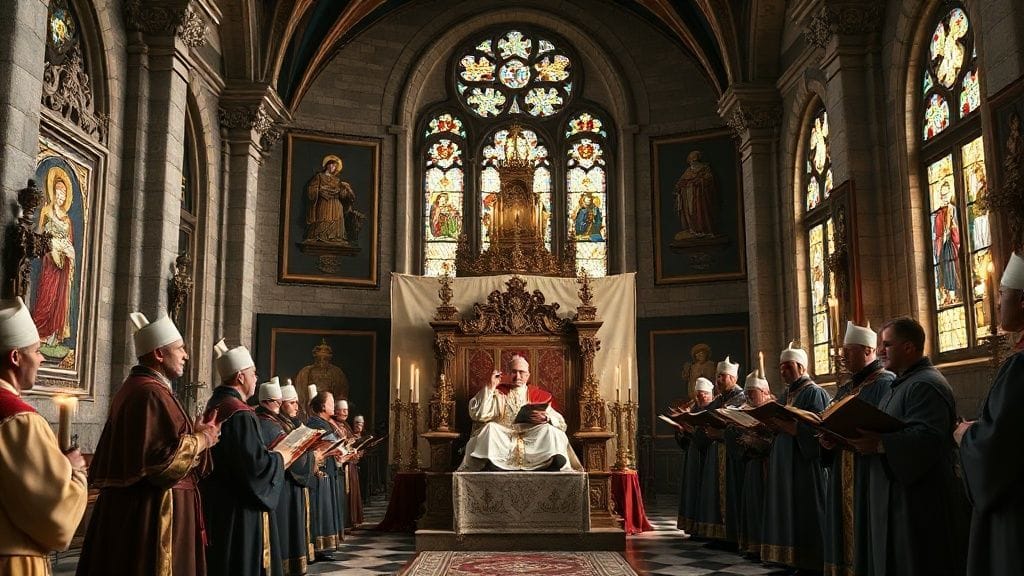
The air in Rome was thick with incense and anticipation in the year 880. Within the hallowed halls of the Vatican, Pope John VIII put quill to parchment, authorizing what would become one of the most culturally transformative decisions of the early medieval era: the official allowance of the Moravian liturgy in the Slavic vernacular. For centuries, the Christian Church had wielded Latin as the sacred tongue—a language inaccessible to the masses in Central and Eastern Europe. But now, a new chapter was about to be written, one that would echo through time and reshape faith, identity, and power in an ever-changing continent.
This wasn’t a mere bureaucratic gesture; it was a revolutionary affirmation that faith could flourish beyond the Latin tongue, that diverse peoples might worship in their own voice. The choice crowned a slow, intricate struggle for recognition and respect that tied together diplomacies, religious zeal, and the fervor of a people seeking both spiritual and political affirmation.
2. The Papal Seat and the Moravian Mission: An Uneasy Alliance
By 880, the papacy had accumulated vast religious authority but faced severe internal and external pressures. The papal throne, while spiritually prominent, navigated a complex web of local political forces, threats from Byzantine rivals, and the expanding influence of the Frankish Empire. Pope John VIII himself was noted for both his erudition and his precarious position, buffeted by political intrigues within Rome and looming dangers from Saracen raids.
Into this fragile yet momentous stage stepped the Moravians—a Slavic polity situated strategically between two great powers. Their rulers saw the Church’s blessing not merely as a path to salvation but as a means to bolster their political legitimacy and cultural endurance. For the pope, supporting the Moravian liturgy was a delicate balancing act between welcoming diverse worship and appeasing powerful allies who regarded the Slavic rite with suspicion.
3. Who Were the Moravians? A People Poised at Cultural Crossroads
Moravia in the late ninth century was a patchwork of Slavic tribes coalescing into a formidable principality that stretched across present-day Czech and Slovak lands and parts of Poland and Austria. The Moravians were warrior people and farmers, navigating the rugged borders between emerging European states. Their leaders, particularly Prince Svatopluk, were astute operators, eager to position Moravia as a sovereign entity aligned with Western Christendom.
But their cultural identity was distinct, anchored in a Slavic language that resisted Latin’s dominance. The Christianization of Moravia had been underway for decades, but worship remained mostly conducted in Latin or Greek—languages foreign to many Moravians. This alienation bred both confusion and a yearning for familiarity.
4. The Legacy of Cyril and Methodius: Apostles of Slavic Christianity
Central to the Moravian quest for a native liturgy were two brothers, Cyril and Methodius, missionaries dispatched from Constantinople to spread Christianity among the Slavs decades earlier. Their revolutionary idea was to translate scripture and liturgical texts into Old Church Slavonic, using a script they developed—the Glagolitic alphabet—which predated the Cyrillic script that would later bear their name.
Cyril and Methodius faced suspicion and outright hostility from Latin clergy who feared the threat of unauthorized rites weakening the Roman Church’s authority. Yet their intellectual and spiritual legacy endured. By 880, their vision was embraced by Moravian rulers and presented to the papacy as proof of a Slavic Christian culture deserving formal recognition.
5. Pope John VIII: The Shepherd of a Fragmented Christendom
John VIII's papacy (872-882) was marked by turbulence and bold decisions. His pontificate coincided with the decline of Carolingian power, ongoing Muslim raids, and a fractious political landscape. Despite these pressures, he championed ecclesiastical reform and sought to maintain Rome’s spiritual supremacy over Europe’s fracturing states.
His authorization of the Moravian liturgy can be seen as an act of visionary pragmatism—both spiritual and political. John VIII understood that to counterbalance the rising influence of Constantinople and appease new converts, the Church needed to embrace diversity within orthodoxy. This wasn’t a mere accommodation; it was a radical endorsement of vernacular worship, reinforcing Rome’s universal reach.
6. The Geographic and Political Chessboard of 9th-Century Europe
Europe in 880 was a tapestry of emerging nations, disputing borders, and contested loyalties. The Moravians sat at a crossroads—between the East and West, between the Franks and Byzantines. The Frankish Empire, under leaders like Charles the Fat, viewed the Slavs with suspicion and ambition, wary of Moravia’s alliances.
Meanwhile, Constantinople and the Byzantine Church competed for influence among Slavic peoples through Orthodox missions. The papal sanction of a Slavic liturgy tilted this delicate balance, providing Moravia and its Slavic neighbors a spiritual anchor tied to Rome rather than Constantinople.
7. The Slavic Alphabet and the Liturgical Language Debate
Language was the battleground where culture and faith collided. Latin was the lingua sacra of Western Christianity, perceived as immutable and sacred. The endeavor to allow Old Church Slavonic liturgy was revolutionary—it challenged centuries of ecclesiastical uniformity.
The Glagolitic script, with its unique characters, seemed as foreign and vibrant as the peoples who began embracing it. For many churchmen steeped in Roman tradition, vernacular liturgies were threats to spiritual discipline. For Moravians and their believers, it was liberation—understanding scripture without an interpreter’s filter.
8. Negotiations Behind Closed Doors: The Papal Approval Process
Behind the majestic images of papal authority lay intense negotiations and political maneuvering. Representatives of Moravia, including Methodius himself, journeyed to Rome multiple times before 880. They presented theological arguments, demonstrated liturgical texts, and appealed to the pope’s spiritual and political sensibilities.
Letters and papal bulls contained precise clauses, stipulating the conditions under which the Moravian liturgy was to be conducted—always within the unity of the Roman Church. This cautious path reflected Rome’s desire to integrate, not alienate, the Slavic converts.
9. The Day of Decree: Pope John VIII’s Letter of Authorization
The definitive moment arrived with Pope John VIII’s letter, dated around 880, addressed warmly to Svatopluk and the Moravian Church. The pope declared that Mass and other sacraments could be celebrated in the Slavonic language, affirming the apostolic work of Cyril and Methodius and officially recognizing the rights of Moravian clergy to utilize the vernacular.
This letter was revolutionary: it broke centuries of Latin exclusivity and anticipated centuries of liturgical debates that would echo even to the Second Vatican Council. The authorization granted a legal and spiritual foundation that would shape Central European Christianity.
10. Reactions from Rome: Clerical Enthusiasm and Skepticism
While many in Moravia celebrated, reactions in Rome were mixed. Some clergy hailed the pope’s approval as an enlightened embrace of missionary necessity; others resisted, fearing fragmentation and loss of authority. Suspicion toward Slavic rites also stemmed from concerns about doctrinal uniformity—would translations preserve orthodoxy? Could Rome control these new liturgies?
These tensions foretold prolonged disputes, political machinations, and occasional crackdowns on Slavic clergy who refused to conform strictly to Latin customs.
11. The Frankish Empire’s Pushback: Political and Religious Rivalries
For the Frankish rulers and their bishops, the pope’s sanction was a diplomatic affront. The Franks had long considered the Slavs within their sphere and imposed Latin rites with iron discipline. The Moravian liturgy represented both a loss of influence and a challenge to Frankish ecclesiastical jurisdiction.
Political intrigue ensued, with Frankish clerics lobbying Rome to retract support or limit autonomy. This clash underscored that the battle for liturgical language was inseparable from power dynamics in medieval Europe.
12. The Spread of the Moravian Liturgy: A Cultural Revolution
With papal approval secured, the Moravian liturgy flourished. Churches across Moravia and neighboring Slavic lands began to celebrate Mass, baptism, and other rites in their own tongue. This was not merely religious empowerment—it was cultural affirmation.
Slavic literature blossomed, inspired by the translations of biblical texts, hymns, and sermons. Schools trained native clergy, and the sense of a distinct Slavic Christianity took root, setting the stage for the later development of national churches and identities.
13. The Impact on Slavic Identity and the Birth of National Churches
The authorization ignited a movement that transcended theology: it gave the Slavic peoples a spiritual umbrella suited to their culture and language. The Moravian example inspired other Slavic regions, including Bulgaria and later Russia, to assert their ecclesiastical traditions.
By elevating Old Church Slavonic, the Church inadvertently sowed seeds of national consciousness. Religious rites became intertwined with cultural pride; language became a vehicle of sovereignty as much as salvation.
14. Resistance, Suppression, and the Shadows of Conflict
But this empowerment was not uncontested. Within decades, rising opposition culminated in the expulsion of Methodius’ disciples and efforts to impose Latin rites once more. Some Moravian churches returned to Latin, and the political tides shifted.
This period of suppression illuminates the fragile nature of religious compromise in medieval Europe, where political interests, theological rigidity, and cultural aspirations collided violently.
15. The Enduring Legacy of the Moravian Liturgy in European Christianity
Despite setbacks, the imprint of Pope John VIII’s decision endured. The Cyrillic script, borne of the same cultural enterprise, became the liturgical backbone of Orthodox Slavic churches. The idea of vernacular worship survived intermittently in Catholic regions too, culminating centuries later in broader acceptance.
The Moravian liturgy established a paradigm: Christianity could be universal yet culturally diverse—a lesson as relevant today as it was in 880.
16. Reflections on Tradition, Language, and Faith: Lessons from 880
Pope John VIII’s authorization invites reflection on the tensions between tradition and adaptation. It reflects the Church’s pivotal role as both a conservative force preserving dogma, and a dynamic institution responding to the spiritual needs of diverse peoples.
Language was not merely practical here; it was identity, power, and salvation entwined. The Moravian case highlights the delicate dance of inclusivity in faith’s history.
17. The Long Road to Modern Slavic Orthodoxy and Catholicism
The authorization set in motion trajectories that shaped Eastern Europe’s religious landscape. The later Great Schism between Eastern Orthodoxy and Roman Catholicism, the rise of national churches, and the role of language in religious practice can all trace roots to this moment.
Today, Slavic Christianity’s diversity—between Roman Catholic and Orthodox branches—reflects centuries of complex inheritance beginning with this papal decree.
18. How Pope John VIII’s Decision Resonates Today
In a globalized world confronting questions of cultural rights and religious expression, the decision of Pope John VIII remains a historical touchstone. It speaks to the potential harmony between universal faith and cultural particularity.
Modern Catholic liturgical reforms, regional churches, and ecumenical dialogues echo that same spirit of adaptation and dialogue embodied in 880.
19. The Interplay of Politics and Religion: Power Behind the Scenes
No medieval papal decision was purely spiritual. Behind the official letter lay political calculations: gaining allies, countering rivals, and expanding influence. Rome’s embrace of the Moravian liturgy was as much a chess move against Byzantium and the Franks as a gesture of pastoral care.
Understanding this context reminds us that religious history is inseparable from the political intrigues that shape it.
20. Final Chronicles: The Moravian Church After Pope John VIII
After Pope John VIII’s death, the Moravian Church faced renewed challenges—persecution, Latinization attempts, and eventual dissolution of the Great Moravian state. However, the seeds sown by the Slavic liturgy influenced successor nations.
The story of the Moravian Church after 880 is a poignant saga of cultural resilience amid political upheaval and ecclesiastical contestation.
21. The Human Face of Faith: Stories from Moravian Converts
Behind the grand narratives were human souls—farmers, nobles, children—experiencing faith anew in their mother tongue. Tales of baptism, communal worship, and learning to read scriptures in one’s native speech capture the profound human transformation wrought by this authorization.
Oral traditions and scattered chronicles preserve echoes of these lives changed forever.
22. Archaeological and Manuscript Evidence: What We Can Still Learn
Today, manuscripts in Old Church Slavonic, remnants of early Moravian churches, and archaeological finds illuminate the material culture of this spiritual revolution. Codices, liturgical texts, and inscriptions offer scholars windows into an era that balanced precariously between tradition and innovation.
Each artifact enriches our understanding of how faith was lived and expressed.
23. The Liturgy Authorized: The Texts and Music of Early Slavic Worship
The liturgy itself, with its chants, prayers, and ritual actions, was a work of artistic and theological synthesis. The Slavic rite was not a crude translation but an elegant, poetic form deeply rooted in Christian theology.
Musicologists and historians study these compositions to trace the evolution of sacred music—an auditory heritage stemming from John VIII’s decision.
24. Conclusion: A Bold Step that Shaped Europe’s Spiritual Landscape
Pope John VIII’s authorization of the Moravian liturgy in 880 was more than a papal decree; it was a beacon that illuminated the possibilities of faith beyond linguistic and cultural constraints. It symbolized a Church daring to evolve, a people finding their voice, and a continent edging toward a more pluralistic spiritual identity.
This historic moment remains a testament to the power of inclusion and the enduring spirit of faith.
Conclusion
Looking back through the corridors of time to 880, the decision of Pope John VIII emerges not simply as a footnote in ecclesiastical history, but as a beacon of cultural and spiritual courage. It was a moment when a fragile papacy, beset by challenges, chose to embrace diversity in the name of Christian unity rather than insist on uniformity. The authorization of the Moravian liturgy was an act that transcended politics and theology; it recognized the humanity embedded in language and marked a significant step toward the Church’s eventual recognition that universality need not mean sameness.
What happened in Rome under John VIII’s watch teaches us about power, faith, and identity. It underscores the transformative potential embedded in listening—to peoples, to cultures, to God’s call echoing in every tongue. More than a millennium ago, that choice opened a door that shaped Europe’s spiritual landscape, nurturing the rich mosaic of Slavic Christianity known today. It calls modern readers to appreciate that faith must speak the languages of the people it serves—both literally and figuratively.
FAQs
1. Why did Pope John VIII authorize the Moravian liturgy?
He recognized the need to adapt Christian worship to the linguistic and cultural realities of the Slavic peoples, strengthening their faith and aligning Moravia more closely with Rome rather than Constantinople or the Franks.
2. Who were Cyril and Methodius, and what was their role?
They were Byzantine brothers who created the Glagolitic script and translated Christian texts into Old Church Slavonic, pioneering Slavic liturgical language decades before 880 and inspiring the Moravian mission.
3. How did the Frankish Empire react to this authorization?
Frankish rulers saw it as a threat to their influence and favored Latin rites. They often opposed Slavic liturgy as undermining ecclesiastical uniformity and political dominance in the region.
4. What was the significance of allowing vernacular languages in worship?
It democratized faith, making scripture and rites understandable to common people, fostering deeper spiritual engagement and cultural identity.
5. Did the Moravian liturgy survive unchallenged after 880?
No, it faced resistance, suppression, and eventual decline in Moravia itself, but its legacy influenced broader Slavic Christianity and vernacular worship traditions.
6. How does this event connect to today’s religious practices?
It prefigured modern liturgical reforms allowing vernacular languages in worship and highlights early Church recognition of cultural diversity within a universal faith.
7. Was Pope John VIII’s decision unique for its time?
Yes, very few medieval popes authorized vernacular liturgies; this was a rare and transformative act signaling a shift in ecclesiastical inclusivity.
8. Where can I find more detailed historical sources about this event?
The Vatican archives, early Slavic manuscripts, and contemporary chroniclers provide primary documentation, while modern historians analyze the political and cultural contexts extensively.

